TOTAL PAGEVIEWS

TRANSLATE

Monday, 21 April 2025

25-3-2025 GAL OYA LODGE, SRI LANKA - WHITE RUMPED MUNIA (Lonchura striata)


The White-rumped Munia, known scientifically as Lonchura striata, is a diminutive passerine bird belonging to the waxbill "finches" family, Estrildidae. This species is not closely related to the true finches or sparrows. It is characterized by its small size, approximately 10 to 11 cm in length, with a stout grey bill and a sharply pointed black tail. The plumage is generally brown above and on the breast, with a paler underside and a distinctive white rump.

Adult White-rumped Munias exhibit brown upperparts and breast, with lighter underparts. The white rump is a key distinguishing feature. While there is some variation among subspecies, males and females are nearly indistinguishable, though males may possess a slightly more robust head and bill.

This species thrives in open woodlands, grasslands, and scrub areas. It is also quite adept at adapting to agricultural landscapes. The White-rumped Munia is often found near water and is known to feed on algae, particularly in paddy fields.

The White-rumped Munia is a common resident breeder across the Indian subcontinent, extending to southern China, Taiwan, and Southeast Asia down to Sumatra.

24-3-2025 GAL OYA LODGE, SRI LANKA - LOTEN'S SUNBIRD (FEMALE) (Cinnyris lotenius)

The Loten's sunbird, also known as the long-billed sunbird or maroon-breasted sunbird, is a diminutive yet vibrant avian species endemic to the Indian subcontinent. Males are particularly striking with their glossy purple plumage and a distinctive maroon band across the breast, while females are more subdued with yellow-grey upperparts and yellowish underparts.

To identify the Loten's sunbird, look for the male's long bill and maroon breast band, which can be seen under good lighting. The wings are a telltale brownish hue. Females lack the supercilium found in similar species and are generally less colorful. The male's pectoral tufts, a blend of yellow and crimson, are a spectacle during displays.

These sunbirds favor the lush forests and cultivated areas of peninsular India and Sri Lanka. They are also quite at home in urban gardens, where they are a common sight, flitting from flower to flower.

The Loten's sunbird is found exclusively in peninsular India and Sri Lanka, with a particular prevalence along the Western Ghats and into the southern peninsula. Their presence extends to central India and the northern Eastern Ghats up to Orissa.

The Loten's sunbird is a resident species, showing no known seasonal migration. It exhibits a preference for hovering at flowers when foraging for nectar, a behavior that sets it apart from the purple sunbird. They also consume insects and spiders, supplementing their nectar diet.


The male Loten's sunbird serenades with a long, repetitive "wue-wue-wue…" that accelerates towards the end, reminiscent of the call of the cinereous tit. Their call is a distinctive buzzy "zwick zwick."

Breeding season spans from November to March in India and February to May in Sri Lanka. The female is solely responsible for incubating the eggs, which she does for about 15 days. The nest, a remarkable bag-like structure woven from webs and bark, is often situated within the nests of social spiders.

The Loten's sunbird can be confused with the purple sunbird, but the former can be distinguished by its longer bill and the maroon breast band in males.

These birds have a penchant for nectar, which they extract from a variety of flowers using their specialized down-curved bills and brush-tipped tongues. They also partake in small insects and spiders for sustenance.

The IUCN Red List categorizes the Loten's sunbird as Least Concern, indicating a stable population without significant threats to its survival at present.

24-3-2025 GAL OYA LODGE, SRI LANKA - STICK INSECT (order phasmida)


The Phasmatodea (also known as Phasmida or Phasmatoptera) are an order of insects whose members are variously known as stick insects, stick bugs, walkingsticks, stick animals, or bug sticks. They are also occasionally referred to as Devil's darning needles, although this name is shared by both dragonflies and crane flies. They can be generally referred to as phasmatodeans, phasmids, or ghost insects, with phasmids in the family Phylliidae called leaf insects, leaf-bugs, walking leaves, or bug leaves. The group's name is derived from the Ancient Greek φάσμα phasma, meaning an apparition or phantom, referring to their resemblance to vegetation while in fact being animals. Their natural camouflage makes them difficult for predators to detect; still, many species have one of several secondary lines of defense in the form of startle displays, spines or toxic secretions. Stick insects from the genera Phryganistria, Ctenomorpha, and Phobaeticus include the world's longest insects.

Members of the order are found on all continents except Antarctica, but they are most abundant in the tropics and subtropics. They are herbivorous, with many species living unobtrusively in the tree canopy. They have an incomplete metamorphosis life cycle with three stages: egg, nymph and adult. Many phasmids are parthenogenic or androgenetic, and do not require fertilized eggs for female offspring to be produced. In hotter climates, they may breed all year round; in more temperate regions, the females lay eggs in the autumn before dying, and the new generation hatches in the spring. Some species have wings and can disperse by flying, while others are more restricted.

21-4-2025 POTRIES, VALENCIA - WOODCHAT SHRIKE (Lanius senator)

The Woodchat Shrike, Lanius senator, is a captivating bird, slightly larger than its cousin, the Red-backed Shrike. The male boasts a distinctive appearance with black and white upper parts and a rich chestnut crown, while the female and juveniles display a more subdued brown and white vermiculated plumage with buff underparts.

To identify the Woodchat Shrike, look for the male's striking black and white upper parts and chestnut crown. The female and young birds are less conspicuous with their vermiculated brown and white upper parts and buff underparts. The western Mediterranean race, L. s. badius, lacks the prominent white wing patches seen in other subspecies.

This species has a preference for open wooded areas with scattered trees, such as orchards, especially where the ground is bare or sandy. 

The Woodchat Shrike breeds across southern Europe, the Middle East, and northwest Africa, and migrates to winter in tropical Africa. Its range spans from Portugal to Greece and from Mauritania to Libya, with occasional sightings as far north as Great Britain.

The Woodchat Shrike is known for its perching behaviour, often seen on exposed lookouts from where it swoops down or glides to capture its prey. It is also known to occasionally impale its prey on thorns, a behaviour typical of shrikes.

Breeding occurs from early May to mid-July. Both sexes contribute to nest building, which is typically situated in a tree. The clutch consists of 5-6 eggs, incubated mainly by the female, with fledglings cared for by both parents.

The diet of the Woodchat Shrike is primarily insectivorous, with beetles being a favoured choice. It employs a sit-and-wait hunting strategy from elevated perches and is known to dismember larger insects.

The Woodchat Shrike is currently classified as Near Threatened due to long-term population declines attributed to habitat loss, pesticide use, climate change, hunting during migration, and other factors. Despite this, it has a large estimated population of 5.9-10 million individuals.

Sunday, 20 April 2025

24-3-2025 GAL OYA LAKE, SRI LANKA - PAINTED STORK (Mycteria leucocephala)

The Painted Stork (Mycteria leucocephala) is a large wader belonging to the stork family. It is easily recognized by its heavy yellow beak with a down-curved tip, reminiscent of an ibis. The adult's head is bare and exhibits a vibrant orange or reddish hue. Notably, the long tertials are tipped in bright pink, which gracefully extend over the back and rump when the bird is at rest. A distinctive black breast band adorned with white scaly markings is present, continuing into the under-wing coverts. The white tips of the black coverts create the illusion of white stripes running across the under-wing lining. The rest of the body is predominantly whitish in adults, with black primaries and secondaries that have a greenish gloss. The legs range from yellowish to red, often appearing white due to the habit of urohidrosis. The short tail is black with a green gloss. This medium-sized stork stands about 93–102 cm tall, spans 150–160 cm across the wings, and weighs 2–3.5 kg. Males and females are similar in appearance, though males are typically larger.

When identifying the Painted Stork, look for the pink tertial feathers, the black breast band with white scaly markings, and the heavy yellow beak with a down-curved tip. In flight, they are distinguished by their outstretched neck and the white stripes across the under-wing. Juveniles are brownish with grey bills and lack the vibrant adult coloration.


Painted Storks favor freshwater wetlands, but they also frequent irrigation canals and agricultural fields, particularly during the monsoon when rice fields are flooded.

These birds are found across the plains of tropical Asia, from the Indian Subcontinent extending into Southeast Asia, south of the Himalayas. They are absent from arid regions, dense forests, and higher hill areas.

Painted Storks are sociable birds, often seen foraging in flocks in shallow waters. They employ a tactile method of feeding, sweeping their half-open beaks side to side in the water to catch small fish. They are known to stir the water with their feet to flush out hiding fish. These storks are not migratory but may move short distances in response to weather or food availability, or for breeding purposes. At the nest, they communicate with weak moans or bill clattering.

The Painted Stork is mostly silent, but at the nest, it may produce weak moans or engage in bill clattering.

They nest colonially in trees, often alongside other waterbirds. The breeding season varies by region, with nest initiation ranging from mid-August in northern India to October in southern India. Clutch size can vary from one to five eggs, with incubation lasting about a month and fledging taking nearly two months.

The Painted Stork can be confused with other storks, but its distinctive pink tertials and black breast band with white scaly markings help differentiate it.

Their diet consists mainly of small fish, which they sense by touch. They may also consume frogs and occasionally snakes. They forage primarily during the day but can also feed at night under certain conditions.

24-3-2025 GAL OYA LAKE, SRI LANKA - WHITE BELLIED SEA EAGLE (Haliaeetus leucogaster)

The White-bellied Sea Eagle (Icthyophaga leucogaster), also known as the White-breasted Sea Eagle, is a majestic and large diurnal bird of prey belonging to the family Accipitridae. It is characterized by its striking white head, breast, under-wing coverts, and tail, contrasting with its grey upper parts and black under-wing flight feathers. The tail is notably short and wedge-shaped, a common feature among Haliaeetinae species. Females are typically larger than males, reaching up to 90 cm in length, with a wingspan of up to 2.2 meters, and can weigh as much as 4.5 kg. Immature birds are cloaked in brown plumage, which gradually transitions to white over several years.

Adult White-bellied Sea Eagles are unmistakable with their white and grey plumage. The black flight feathers are prominent when viewed from below. The bill is a leaden blue-grey with a darker tip, and the eyes are dark brown. The legs and feet are yellow or grey with long black talons. Juveniles are predominantly brown with pale cream streaks on their head and neck, and their plumage slowly whitens with age.

This sea eagle is often found in coastal regions but can also be seen inland near large bodies of water. It prefers areas with tall trees or pylons for nesting, with a clear view of the surrounding landscape.

The species is widespread, ranging from India and Sri Lanka through Southeast Asia to Australia. It is a common sight along coastlines and major waterways, and although generally sedentary, it can travel considerable distances.


The White-bellied Sea Eagle is territorial and monogamous, with pairs often remaining together for life. They are known for their impressive aerial displays during courtship. These birds are most often seen perched high or soaring over waterways, and they are generally encountered singly or in pairs.

The call of the White-bellied Sea Eagle is a loud, goose-like honking, which is particularly prominent during the breeding season. Pairs may call in unison, with the male's call being higher-pitched and more rapid than the female's.

Breeding season varies by location, with courtship involving intricate aerial displays. Nests are large structures made of sticks and branches, often located in tall trees overlooking water. Typically, two eggs are laid, but it is common for only one chick to fledge successfully.

An opportunistic carnivore, the White-bellied Sea Eagle has a diverse diet that includes fish, turtles, snakes, birds, and mammals. It is a skilled hunter, often catching fish by flying low over the water and grasping them with its talons.

24-3-2025 GAL OYA LAKE, SRI LANKA - WHITE THROATED KINGFISHER (Halcyon smyrnensis)

The White-throated Kingfisher, Halcyon smyrnensis, also known as the White-breasted Kingfisher, is a vibrant tree kingfisher. It boasts a striking blue back, wings, and tail, while its head, shoulders, flanks, and lower belly are a rich chestnut. The throat and breast are a contrasting white, and the large bill and legs are a vivid red. This robust bird measures 27–28 cm in length and exhibits a rapid and direct flight, revealing large white patches on its blue and black wings during flight. Both sexes appear similar, though juveniles present a more subdued version of the adult's plumage.


When identifying the White-throated Kingfisher, look for its bright blue upperparts and chestnut head and body. The white throat and breast are distinctive, as is the red bill and legs. In flight, the white wing patches are a key identification feature. Juveniles may be less colorful but retain the same general pattern.

This kingfisher is adaptable and can be found in a variety of open habitats, from plains with trees and wires to urban areas. It is also seen at elevations up to 7500 feet in the Himalayas.


The White-throated Kingfisher has a wide distribution across Asia, from the Sinai in the west, through the Indian subcontinent, to China and Indonesia. It is a resident species over much of its range, with some populations making short-distance movements.

This kingfisher is known for its conspicuous perching on wires or other exposed perches within its territory. It is a common sight in South Asia and is known to be attracted to lights at night during the monsoon season, suggesting partial migratory behavior.

During the breeding season, the White-throated Kingfisher is vocal, with loud calls in the mornings from prominent perches. The male's courtship display includes stiffly flicking open wings to expose the white wing mirrors, while the female invites with a rapid kit-kit-kit call.

Breeding coincides with the onset of the Monsoons. The nest is a tunnel in an earth bank, and a clutch typically consists of 4-7 round white eggs. Incubation takes 20-22 days, and fledging occurs in 19 days.

The diet is varied, including large crustaceans, insects, earthworms, rodents, lizards, snakes, fish, frogs, and occasionally small birds. It is noted for rarely drinking water but regularly bathing.

24-3-2025 GAL OYA NAT PARK, SRI LANKA - RED BACKED FLAMEBACK WOODPECKER


The Red-backed flameback, also known as the Lesser Sri Lanka flameback or Ceylon red-backed woodpecker, is a striking bird endemic to the island of Sri Lanka. It is a medium-sized woodpecker, approximately 28 centimeters in length, with a predominantly crimson plumage and black trailing edges on its wings. The underparts are white, adorned with untidy black markings.

Males boast a resplendent red crown, while females display a black-speckled forecrown and forehead with white spots. Both sexes have a black eyestripe that extends to the back of the neck, merging into the nape and upper back with white streaks. Their grey bill is of moderate size, ending in a blunt point. Juveniles appear duller with less pronounced markings. Hybrids with the Black-rumped flameback may exhibit a blend of red, orange, or yellow plumage.

The Red-backed flameback thrives in a variety of habitats, including subtropical or tropical dry forests, moist lowland forests, and mangrove forests. It is also a common sight in manmade environments such as home gardens and can be observed up to elevations of 1,500 meters.

This woodpecker species is found throughout Sri Lanka, with the exception of the far-north regions. It is most prevalent in the dry zone but has a preference for humid environments.

The Red-backed flameback is known to forage alone, in pairs, or as family groups. It often joins multi-species foraging flocks and exhibits a flap-and-glide bounding flight pattern. When climbing trees, it uses its tail as a prop for support.

24-3-2025 GAL OYA LAKE, SRI LANKA - CRESTED SERPENT EAGLE SRI LANKAN (Spilornis cheela ssp. spilogaster)


The crested serpent eagle, Spilornis cheela, is a medium-sized raptor with a robust build, characterized by its dark brown plumage, rounded wings, and short tail. Its most distinctive feature is the short black and white fan-shaped nuchal crest, which imparts a thick-necked appearance. The face is bare, with striking yellow skin that extends to the ceres, and the powerful feet are unfeathered, displaying heavy scaling. The underside is adorned with white and yellowish-brown spots, and when perched, the wingtips fall short of the tail tip. In flight, the broad wings form a shallow 'V', and the tail and underside of the flight feathers exhibit bold black and white bars.

The crested serpent eagle is a reptile specialist, hunting snakes and lizards over forested habitats and wet grasslands. It also preys on various other animals, including birds and mammals. This species is mostly sedentary, with some populations being migratory. They spend much of their time perched, calling frequently with a loud, piercing three or two-note call. Males in Taiwan have been observed to have larger home ranges than females. The species uses a sit-and-wait hunting strategy and is known to roost in densely foliaged trees.

The call of the crested serpent eagle is a distinctive and rising "Kluee-wip-wip," often heard in the late mornings.

23-3-2025 GAL OYA, SRI LANKA - LOTEN'S SUNBIRD (FEMALE) (Cinnyris lotenius)

The Loten's sunbird, also known as the long-billed sunbird or maroon-breasted sunbird, is a diminutive yet vibrant avian species endemic to the Indian subcontinent. Males are particularly striking with their glossy purple plumage and a distinctive maroon band across the breast, while females are more subdued with yellow-grey upperparts and yellowish underparts.

To identify the Loten's sunbird, look for the male's long bill and maroon breast band, which can be seen under good lighting. The wings are a telltale brownish hue. Females lack the supercilium found in similar species and are generally less colorful. The male's pectoral tufts, a blend of yellow and crimson, are a spectacle during displays.


These sunbirds favor the lush forests and cultivated areas of peninsular India and Sri Lanka. They are also quite at home in urban gardens, where they are a common sight, flitting from flower to flower.

The Loten's sunbird is found exclusively in peninsular India and Sri Lanka, with a particular prevalence along the Western Ghats and into the southern peninsula. Their presence extends to central India and the northern Eastern Ghats up to Orissa.

The Loten's sunbird is a resident species, showing no known seasonal migration. It exhibits a preference for hovering at flowers when foraging for nectar, a behavior that sets it apart from the purple sunbird. They also consume insects and spiders, supplementing their nectar diet.

The male Loten's sunbird serenades with a long, repetitive "wue-wue-wue…" that accelerates towards the end, reminiscent of the call of the cinereous tit. Their call is a distinctive buzzy "zwick zwick."

Breeding season spans from November to March in India and February to May in Sri Lanka. The female is solely responsible for incubating the eggs, which she does for about 15 days. The nest, a remarkable bag-like structure woven from webs and bark, is often situated within the nests of social spiders.

The Loten's sunbird can be confused with the purple sunbird, but the former can be distinguished by its longer bill and the maroon breast band in males.

These birds have a penchant for nectar, which they extract from a variety of flowers using their specialized down-curved bills and brush-tipped tongues. They also partake in small insects and spiders for sustenance.

The IUCN Red List categorizes the Loten's sunbird as Least Concern, indicating a stable population without significant threats to its survival at present.

20-4-2025 MONTE CORONA, VALENCIA - LAVENDER SCALLOPS (Kalanchoe fedtschenkoi)

Kalanchoe fedtschenkoi, formerly known as Bryophyllum fedtschenkoi, is a species of flowering plant in the family Crassulaceae. It is native to Madagascar. It is widely sold as a house or garden plant that has established itself in the wild in some southern parts of the United States of America. The specific epithet fedtschenkoi honors botanist Boris Fedtschenko (1873-1947). Its genome has been sequenced as a model to study CAM metabolism.

Kalanchoe fedtschenkoi is a low-growing, frost-tender perennial succulent which prefers dry, open ground. It grows to 10–12 inches (25–30 cm) tall as an untidy, low, rounded herb. The stems are round, smooth and lax with visible leaf scars, often bending and touching the ground where they produce roots and new plants.


Leaves are fleshy, alternate, blue-green and oval or obovate with fine scalloped edges, the edges may turn pink or red under strong sunlight or drought conditions. Commonly called ‘Lavender Scallops’ from the shape and color of its leaves. It has few pests but may harbor mealy bugs or occasionally scale insects.

The tubular flowers are in corymbs, often multi-layered in good conditions. Each flower has a short calyx edged with delta-shaped segments, which is shorter than its tubular corolla. The corolla is an orange/coral/apricot color. The flowers are pendant.

20-4-2025 MONTE CORONA, VALENCIA - WAVE MOTH (Idaea cervantaria)


Idaea, sometimes called Hyriogona (among other synonyms), is a large genus of geometer moths. It was erected by Georg Friedrich Treitschke in 1825. They are found nearly worldwide, with many native to the Mediterranean, the African savannas, and the deserts of western Asia.

As of 2013, there were about 680 species in the genus.

19-4-2025 MONTE CORONA, VALENCIA - COMMON GREEN LACEWING (Genus Chrysoperla)


Chrysoperla carnea, one of the species of common green lacewing,[1][2] is an insect in the Chrysopidae family. Although the adults feed on nectar, pollen and aphid honeydew, the larvae are active predators and feed on aphids and other small insects. It has been used in the biological control of insect pests on crops.

Chrysoperla carnea was originally considered to be a single species with a holarctic distribution but it has now been shown to be a complex of many cryptic, sibling subspecies. These are indistinguishable from each other morphologically but can be recognised by variations in the vibrational songs the insects use to communicate with each other, which they especially do during courtship.

The green lacewing eggs are oval and secured to the plant by long slender stalks. They are pale green when first laid but become gray later. The larvae are about one millimetre long when they first hatch. They are brown and resemble small alligators, crawling actively around in search of prey. They have a pair of pincer-like mandibles on their head with which they grasp their prey, sometimes lifting the victim off the leaf surface to prevent its escape. The larvae inject enzymes into the bodies of their victims which digest the internal organs, after which they suck out the liquidated body fluids.[citation needed] The larvae grow to about eight millimetres long before they spin circular cocoons and pupate.

Adult green lacewings are a pale green colour with long, threadlike antennae and glossy, golden, compound eyes. They have a delicate appearance and are from twelve to twenty millimetres long with large, membranous, pale green wings which they fold tent-wise above their abdomens. They are weak fliers and have a fluttery form of flight. They are often seen during the evenings and at night when they are attracted by lights. The high green sensitivity of the superposition eyes allows the green lacewings to recognize fresh green leaves that they use to find honey dew produced by aphids, a site for egglaying and a resting place.

17-4-2025 MONTE CORONA, VALENCIA - CURVED HORN MOTH (Symmoca signatella)


Symmoca signatella is a moth of the family Autostichidae. It is known from most of western Europe, but also Lithuania, Croatia, Greece and southern Russia. It has also been recorded from California in North America.

The wingspan is 12–15 mm. Adults are on wing in late summer and autumn.

The larvae feed on dried vegetable matter. They have been recorded feeding on dry leaves and plant debris on the stem and branches of Rosmarinus officinalis. The accumulation of debris was connected by light webbing.

23-3-2025 GAL OYA, SRI LANKA - PADDYFIELD PIPIT (Anthus rufulus)

The Paddyfield Pipit, or Oriental Pipit, is a rather large member of the pipit family, measuring around 15 cm in length. It is predominantly streaked grey-brown on its upper parts and pale on its underparts, with some breast streaking. Both sexes appear similar, with long legs, a lengthy tail, and a dark bill. The plumage does not vary significantly between seasons, but juveniles can be distinguished by their richer coloration below and more pronounced spotting on the breast.

Distinguishing the Paddyfield Pipit in winter can be challenging due to the presence of migratory pipit species. However, it is generally smaller and more compact than its relatives, with a shorter tail and a less powerful flight. Its call, a repetitive "chip-chip-chip," is distinct from the explosive "shreep" of Richard's Pipit and the nasal "pschreen" of Blyth's Pipit. The Paddyfield Pipit can be confused with the Tawny Pipit but has more streaking on the mantle and lacks the Tawny's black loreal stripe.

This species thrives in open environments, particularly in short grasslands and cultivated areas that offer patches of bare ground.

The Paddyfield Pipit is a resident breeder across the Indian Subcontinent, extending east to southern China, southern Thailand, and Indochina. Its range also includes the Philippines and parts of Indonesia.

The Paddyfield Pipit is known for its rapid movements on the ground. When disturbed, it takes flight briefly before settling back down. It breeds mainly during the dry season, possibly raising multiple broods. Its breeding behavior includes a fluttery flight display accompanied by a repeated note.

The bird's vocalizations are characterized by a "chip-chip-chip" call, which is notably different from the calls of similar pipit species in the region.

Nesting occurs on the ground, often under grass tufts or bushes. The nest is typically cup-shaped, though exposed nests may be domed. Clutches usually consist of three to four eggs with a greenish hue and brown specks.

The Paddyfield Pipit primarily feeds on small insects, but it will also consume larger beetles, tiny snails, and worms. It forages on the ground and may also catch insects in flight.

The Paddyfield Pipit is classified as Least Concern by the IUCN, indicating that it is not currently at significant risk of extinction.

23-3-2025 GAL OYA, SRI LANKA - ORIENTAL GARDEN LIZARD (Calotes versicolor)

The oriental garden lizard (Calotes versicolor), also called the eastern garden lizard, Indian garden lizard, common garden lizard, bloodsucker or changeable lizard, is an agamid lizard found widely distributed in Indo-Malaya. It has also been introduced in many other parts of the world.

Calotes versicolor is an insectivore, and the male gets a bright red throat in the breeding season. It measures over 10 cm (3.9 in) in length snout-to-vent. Total length including the tail is up to 37 cm (14.5 in). Two small groups of spines, perfectly separated from each other, above each tympanum. Dorsal crest moderately elevated on the neck and anterior part of the trunk, extending on to the root of the tail in large individuals, and gradually disappearing on the middle of the trunk in younger ones. No fold in front of the shoulder, but the scales behind the lower jaw are much smaller than the others; gular sac not developed. From thirty-nine to forty-three series of scales round the middle of the trunk. The hind foot (measured from the heel to the extremity of the fourth toe) is not much longer than the head in the adult, whilst it is considerably longer in the young. The coloration is very variable, sometimes uniform brownish or greyish-olive or yellowish. Generally broad brown bands across the back, interrupted by a yellowish lateral band. Black streaks radiate from the eye, and some of them are continued over the throat, running obliquely backwards, belly frequently with greyish longitudinal stripes, one along the median line being the most distinct; young and half-grown specimens have a dark, black-edged band across the inter-orbital region.


The ground-colour is generally a light brownish olive, but the lizard can change it to bright red, to black, and to a mixture of both. This change is sometimes confined to the head, at other times diffused over the whole body and tail. A common state in which it may be seen (as stated by T. C. Jerdon) is, seated on a hedge or bush, with the tail and limbs black, head and neck yellow picked out with red, and the rest of the body red. Jerdon and Blyth agree that these bright, changeable colours are peculiar to the male during the breeding-season, which falls in the months of May to early October.

Albert Guenther mentioned that Alexandre Henri Mouhot had collected in Siam one of those fine variations of colours, which, however, appear to be infinite. It has the usual cross streaks between the eyes and the radiating lines continent of India to China; it is very common in Ceylon, not extending into the temperate zone of the Himalayas. Ceylonese specimens are generally somewhat larger; one of them measured 16 inches, the tail taking 11 inches. It is found in hedges and trees; it is known in Ceylon under the name of "Bloodsucker", a designation the origin of which cannot be satisfactorily traced; in the opinion of Kelaart, the name was given to it from the occasional reddish hue of the throat and neck. "Roktochosha (রক্তচোষা)" is also a local name in the Bengali language, which also translates to "bloodsucker".

The female lays from five to sixteen soft oval eggs, about 5/8 of an inch long, in hollows of trees, or in holes in the soil which they have burrowed, afterward covering them up. The young appear in about eight or nine weeks. In a hot sunny day a solitary bloodsucker may be seen on a twig or on a wall, basking in the sun, with mouth wide open. After a shower of rain numbers of them are seen to come down on the ground and pick up the larva and small insects which fall from the trees during the showers. Changeable lizards escape danger by darting to the nearest tree. If the predator comes even closer, they will scale to the side of the tree facing away from the predator and very swiftly dart up the tree. The predator looks behind the tree only to see that the lizard is up in the branches.

23-3-2025 GAL OYA, SRI LANKA - ORANGE MIGRANT BUTTERFLY (Catopsilia scylla)


Catopsilia scylla, the orange migrant or orange emigrant, is a species of butterfly that lives in South East Asia and Australasia. Its larvae feed predominantly on plants of the genera Cassia and Senna.

Adults are approximately 60–65 millimetres (2.4–2.6 in) long. The males have white forewings edged in black, and cadmium-yellow hindwings, usually with black spots on the margins. Females are similar, but have an additional group of black spots on the forewing, which often merge to form a dark ring.

Catopsilia scylla has a wide distribution in South East Asia and Australasia. Its range stretches from Myanmar, Cambodia, Philippines, Thailand, and Vietnam, along the Malay Peninsula, across Java and Sumatra, and over northern Australia. It was recently discovered in Sri Lanka.

In Australia, C. scylla has been recorded on various species of Senna, including S. didymobotrya, S. leptoclada and S. surattensis. In Singapore, host plants include Senna obtusifolia, Cassia fistula, and especially Senna pallida.

The eggs are milky white and spindle shaped, and are usually laid singly on a leaf of the host plant. The eggs hatch after 1.5–2 days, and the caterpillars grow through five instars over 11–13 days, to reach a final length of 40 millimetres (1.6 in). The caterpillars are green and smooth, with a rounded head, and develops a series of black dots and a white lateral line on top of the plain green ground colour. Pupae are 26 mm (1.0 in) long, and are attached to the host plant in an upright position. After seven days, the adult emerges.

Saturday, 19 April 2025

23-3-2025 GAL OYA, SRI LANKA - COMMON JEZEBEL BUTTERFLY (Delias eucharis)

Delias eucharis, the common Jezebel, is a medium-sized pierid butterfly found in many areas of south and southeast Asia, especially in the non-arid regions of India, Bangladesh, Sri Lanka, Indonesia, Myanmar and Thailand. The common Jezebel is one of the most common of the approximately 225 described species in the genus Delias.

The wingspan of both males and females ranges from 6.5 to 8.5 cm.

The common Jezebel are nomadic in behaviour and are found in a variety of environment including, but not limited to, temperate hill forests, tropical rainforests, dry open woodlands, and beach hinterlands. They are generally found all over India, except in the desert tracts, and up to an altitude of 7,000 feet (2,100 m) in the hills. The butterfly may be found wherever there are trees, even in towns and cities, flying high among the trees and visiting flowers.

It is also commonly seen in gardens. The females can be seen flying amongst the trees in search of its food plants, while the males are more frequently observed visiting flowers for nectar. It rests with its wings closed exhibiting the brilliantly coloured underside.

The Jezebel often flies high up in the canopy and usually comes lower down only to feed on nectar in flowers. Due to this habit apparently, it has evolved a dull upperside and a brilliant underside so that birds below it recognise it immediately while in flight and at rest.

It has bright colouration to indicate the fact that it is unpalatable due to toxins accumulated by the larvae from the host plants.

Like other unpalatable butterflies the common Jezebel is mimicked by Prioneris sita, the painted sawtooth. The common Jezebel can be distinguished by the shape of the orange red spots on the hindwing. In the painted sawtooth these spots are very squarish whereas in the common Jezebel they are more arrow head shaped. The painted sawtooth also flies faster and will also mudpuddle.

The Jezebel breeds all year round.

23-3-2025 GAL OYA, SRI LANKA - INDIAN CORMORANT (Phalacrocorax fuscicollis)

The Indian cormorant or Indian shag (Phalacrocorax fuscicollis) is a member of the cormorant family. It is found mainly along the inland waters of the Indian Subcontinent but extending west to Sind and east to Thailand and Cambodia. It is a gregarious species that can be easily distinguished from the similar sized little cormorant by its blue eye, small head with a sloping forehead and a long narrow bill ending in a hooked tip.

This medium-sized bronze brown cormorant is scalloped in black on the upper plumage, lacks a crest and has a small and slightly peaked head with a long narrow bill that ends in a hooked tip. The eye is blue and bare yellow facial skin during the non-breeding season. Breeding birds have a short white ear tuft. In some plumages it has a white throat but the white is restricted below the gape unlike in the much larger great cormorant. Sexes are similar, but non-breeding adults and juveniles are browner.

This cormorant fishes gregariously in inland rivers or large wetlands of peninsular India and the northern part of Sri Lanka. It also occurs in estuaries and mangroves but not on the open coast. They breed very locally in mixed species breeding colonies. They extend north-east to Assam and eastward into Thailand, Burma and Cambodia.

The breeding season is July to February but depends on rainfall and water conditions. In northern India, they breed from July to February and in Sri Lanka, between November and February. The nest is a platform of twigs placed in the forks of partially submerged trees or of those growing on the islands. The nests are similar to those of other Indian cormorants, storks or waterbirds in dense colonies, often with several tiers of nests. The usual clutch is three to five eggs which are bluish green and with a chalky surface.

The Indian cormorant makes short dives to capture the fish and a group will often fish communally, forming a broad front to drive fish into a corner.

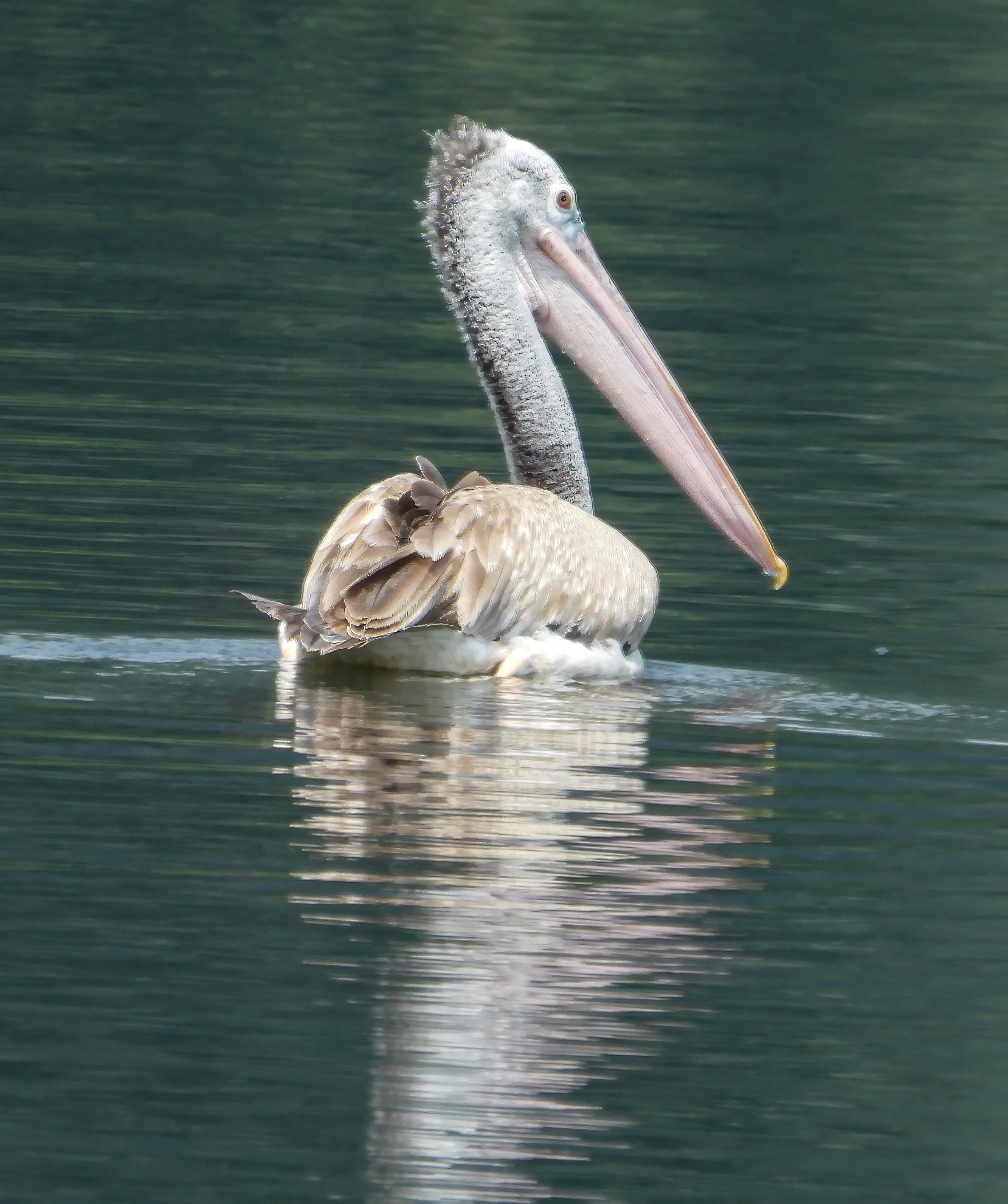
23-3-2025 GAL OYA, SRI LANKA - SPOT BILLED PELICAN (Pelecanus philippensis)

The Spot-billed Pelican, or Gray Pelican, is a member of the pelican family, distinguished by its size, which is smaller than other regional pelicans, and its distinctive plumage. It has a white body with a grey crest and a brownish tail. The feathers on the hind neck are curly, forming a greyish nape crest. The pouch is pink to purplish with large pale spots, and the upper mandible is similarly spotted. The bill's tip is yellow to orange, and the bird's overall length ranges from 125 to 152 cm, with a wingspan of 213 to 250 cm.

At a distance, the Spot-billed Pelican may be confused with other pelicans, but upon closer inspection, the spots on the upper mandible and the lack of bright colors set it apart. The greyer plumage and the rounder tail are also key identification features. The breeding plumage includes a dark base of the beak and a pink orbital patch.

This species favors large inland and coastal waters, particularly large lakes, where it can be found in shallow lowland freshwaters.

The Spot-billed Pelican breeds in southern Asia, from southern Iran across India to Indonesia. It is not migratory but may make local movements, with a wider distribution in the non-breeding season.

Spot-billed Pelicans are generally silent, but they can produce hisses, grunts, or bill snaps at their nests. They fish singly or in small flocks, often soaring on thermals during the day. They may forage at night and nest in colonies, often alongside other waterbirds.

The Spot-billed Pelican is typically silent, with vocalizations limited to the nesting period.

Breeding occurs in colonies, with nests made of twigs on low trees near wetlands. The breeding season varies, with courtship involving head movements and bill claps. Clutches usually consist of three to four chalky white eggs.

The Dalmatian Pelican is similar in flight but has darker tertials and inner secondaries, and a pale band along the greater coverts.

The Spot-billed Pelican catches fish in its bill pouch while swimming. It does not form large feeding flocks and may fish at night.

The Spot-billed Pelican is classified as Near Threatened due to habitat loss and human disturbance. However, populations in southern India are thought to be on the rise, and increased protection has led to a recovery in numbers.

23-3-2025 GAL OYA, SRI LANKA - COMMON EVENING BROWN BUTTERFLY (Melanitis leda)


Melanitis leda, the common evening brown, is a common species of butterfly found flying at dusk. The flight of this species is erratic. They are found in Africa, South Asia and South-east Asia extending to parts of Australia.

Underside varies in colour greatly. Antennae, head, thorax and abdomen in both seasonal forms brown or greyish brown: the antennae annulated with white, ochraceous at apex.

Resident butterflies are known to fight off visitors to the area during dusk hours. This chase behaviour is elicited even by pebbles thrown nearby.

The caterpillars feed on a wide variety of grasses including rice (Oryza sativa), bamboos, Andropogon, Rotboellia cochinchinensis, Brachiaria mutica, Cynodon, Imperata, and millets such as Oplismenus compositus, Panicum and Eleusine indica.

Adults feed mainly on nectar, and in rare cases visit rotting fruits.

23-3-2025 GAL OYA, SRI LANKA - SRI LANKA BRONZE SKINK (Eutropis madaraszi)

Eutropis madaraszi, also known commonly as the Sri Lanka bronze mabuya, the Sri Lanka bronze skink, or (ambiguously) the spotted skink, is a species of lizard in the family Scincidae. The species is endemic to the island of Sri Lanka.

The specific name, madaraszi, is in honor of Hungarian ornithologist Gyula Madarász of the Hungarian National Museum.


A widespread terrestrial skink, E. madaraszi has been reported from both wet and dry zones. Known localities include Colombo, as well as around Kala Wewa, and Madatugama.

The body of E. madaraszi is slender, with 32 midbody scale rows. The dorsum is brown, with a dark line along the flank. The venter is creamy and unpatterned.

E. madaraszi is found at elevations up to 800 m (2,600 ft), in rock crevices, under leaf litter or under logs, and seen basking at midday.

22-3-2025 WATER GARDENS LODGE, SIGIRIYA - WHITE THROATED KINGFISHER (Halcyon smyrnensis)


The White-throated Kingfisher, Halcyon smyrnensis, also known as the White-breasted Kingfisher, is a vibrant tree kingfisher. It boasts a striking blue back, wings, and tail, while its head, shoulders, flanks, and lower belly are a rich chestnut. The throat and breast are a contrasting white, and the large bill and legs are a vivid red. This robust bird measures 27–28 cm in length and exhibits a rapid and direct flight, revealing large white patches on its blue and black wings during flight. Both sexes appear similar, though juveniles present a more subdued version of the adult's plumage.

When identifying the White-throated Kingfisher, look for its bright blue upperparts and chestnut head and body. The white throat and breast are distinctive, as is the red bill and legs. In flight, the white wing patches are a key identification feature. Juveniles may be less colorful but retain the same general pattern.

This kingfisher is adaptable and can be found in a variety of open habitats, from plains with trees and wires to urban areas. It is also seen at elevations up to 7500 feet in the Himalayas.

The White-throated Kingfisher has a wide distribution across Asia, from the Sinai in the west, through the Indian subcontinent, to China and Indonesia. It is a resident species over much of its range, with some populations making short-distance movements.

22-3-2025 WATER GARDENS LODGE, SIGIRIYA - LITTLE EGRET (Egretta garzetta)

The Little Egret, Egretta garzetta, is a dainty heron adorned in pure white plumage. It is characterized by a slender black beak, long black legs, and, notably in the western race, yellow feet. This elegant bird is a sight to behold with its graceful neck and poised stance.

Adult Little Egrets measure between 55–65 cm in length with a wingspan of 88–106 cm, and weigh 350–550 g. Their plumage is predominantly white, though some may exhibit bluish-grey coloration. Breeding adults boast ornate nape plumes reaching about 150 mm, along with distinctive feathers on the breast and elongated scapulars. The bill and lores are black, with greenish-grey skin at the base of the lower mandible and around the eye, which houses a yellow iris. Legs are black with contrasting yellow feet, though juveniles may have greenish-black legs and duller feet. The subspecies E. g. nigripes is distinguished by yellow skin between the bill and eye, and blackish feet.

The Little Egret frequents a variety of wetland habitats, from the shores of lakes and rivers to marshes and coastal regions. It is often found in open environments, such as mangroves, swamps, mudflats, and sandy beaches, as well as human-altered landscapes like rice fields.

The species has a broad breeding distribution across warm temperate to tropical regions of Asia, Africa, Australia, and Europe. Northern populations are migratory, wintering in Africa and southern Asia, while others remain as permanent residents in warmer areas.

22-3-2025 WATER GARDENS LODGE, SIGIRIYA - GREY HERON (Ardea cinerea)


The Grey Heron (Ardea cinerea) is a statuesque wading bird belonging to the family Ardeidae. It is a familiar sight in both rural and urban settings, often seen standing stoically along the water's edge. An adult Grey Heron is a large bird, reaching up to 100 cm in height, with a wingspan between 155 to 195 cm. It weighs between 1 to 2 kg. The plumage is predominantly ashy-grey above, with a greyish-white underbelly and some black on the flanks. A striking feature is the white head and neck adorned with a broad black stripe that extends from the eye to the black crest. The beak is pinkish-yellow, long, and sharply pointed, while the legs are a brown hue.

When identifying the Grey Heron, look for the white head with the black supercilium and crest, the long grey neck, and the ashy-grey wings and back. The underparts are lighter, and the legs are long and brown. Juveniles can be distinguished by their duller grey neck and smaller crest. The beak is a useful indicator of age, being brighter in breeding adults.

Grey Herons are highly adaptable and can be found in a variety of watery habitats including lakes, rivers, ponds, marshes, and coastal environments. They require shallow waters for foraging or areas with shelving margins where they can wade.

Native to temperate Europe and Asia, as well as parts of Africa, the Grey Heron has a broad range. Northern populations may migrate southwards in autumn, while others remain resident year-round. Vagrant sightings have occurred in the Caribbean, Bermuda, and parts of North America.