TOTAL PAGEVIEWS

TRANSLATE

Thursday, 7 January 2016

7-1-2016 HONG KONG - WHITE EARED CATBIRD (Ailuroedus buccoides)


The white-eared catbird (Ailuroedus buccoides ) is a species of bird in the family Ptilonorhynchidae found on New Guinea and the West Papuan Islands. Its natural habitats are subtropical or tropical dry forest and subtropical or tropical moist lowland forest.


Martin Irestedt and colleagues examined the white-eared catbird species complex genetically and found there were three distinct lineages: the white-eared catbird (Ailuroedus buccoides ) proper of the Bird's Head (Vogelkop) Peninsula, the ochre-breasted catbird (Ailuroedus stonii ) of the southern lowlands of New Guinea, and tan-capped catbird (Ailuroedus geislerorum ) of the northern lowlands of New Guinea. In 2016, the ochre-breasted catbird and the tan-capped catbird were split from the white-eared catbird as separate species.


A large, shy, stocky bird of lowland and foothill forest interior of western New Guinea. A dark brown crown edged with black, contrasting with white cheek and throat, containing small black dots forming an uneven moustache. A messy, black collar joins the crown on the back of the neck and gets narrower to the throat. Chest and belly are buffy with large black spots. May overlap with Arfak Catbird, but White-eared is usually found at lower elevation, is smaller and has a white cheek. Call, a harsh rasping note.


The white-eared catbird (Ailuroedus buccoides) is a medium-sized passerine found in the tropical and sub-tropical dry forests of Papua (Indonesia), Papua New Guinea and some nearby islands.

The 25 cm long bird is on top green colored, and the chest and abdomen are pale yellow-brown with black spots. The cheeks are white and the cap is black or dark brown.

Adult catbirds subsist primarily on fruit, but will take the nestlings of other species on rare occasions; chicks are mostly fed insects.

The white-eared catbird is a very vocal bird, with a loud, hissing call.

Wednesday, 6 January 2016

7-1-2016 HONG KONG - PURPLE SAPPHIRE BUTTERFLY (Heliophorus epicles)


Heliophorus epicles, commonly known as the purple sapphire, is a species of lycaenid or blue butterfly found in Asia. The species was first described by Jean Baptiste Godart in 1823.

In India, this butterfly can only be traced in the Himalayas at 2000–7000 ft (600–2100 m). Apart from that they can be found from Kumaon in the Himalayas to southern Myanmar. They mainly inhabit in dense forest region.

Purple Sapphire is a colourful and common butterfly species which has a bright yellow wing colour on the ventral side with a red band at the edge. This species shows sexual dimorphism which the males have a purplish blue patch on the dorsal side of the forewing while the females do not.

Typically found at elevations between 600 and 2100 meters above sea level, they have also been spotted as low as 200 meters. As a common butterfly, it can be found in various environments such as forests, woodlands, and gardens – often inhabiting roadside verges, expansive grassy forest paths, or old quarries converting back to grassland and scrub. These butterflies tend to remain close to the ground and can be observed along forest trails and clearings.


The upper sides of the wings boast deep purple and metallic blue hues, evoking the precious gemstone they are named after. These colors transition and glimmer in the light, granting the butterfly a spellbinding and otherworldly presence. Beneath the wings lies a stunning blend of yellow, red, black, and white. Both genders share a similar appearance, although the female displays larger orange markings on her forewing.

On the other hand, the wing's underside exhibits distinct coloration. Encompassing a mix of white, gray, and black, the hinder wings are embellished with elaborate designs and markings. These patterns heighten the butterfly's allure while also functioning as camouflage, allowing it to seamlessly blend into its environment and escape potential predators.

20-12-2015 JURONG, SINGAPORE - VIOLET BACKED STARLING (MALE) (Cinnyricinclus leucogaster)


20-12-2015 JURONG, SINGAPORE - ORIENTAL WHITE EYE (Zosterops palpebrosus)


20-12-2015 JURONG, SINGAPORE - NICOBAR PIGEON (Caloenas nicobarica)


4-12-2015 JURONG, SINGAPORE - MANDARIN DUCK (FEMALE) (Aix galericulata)


The Mandarin duck (Aix galericulata) is a perching duck species native to the East Palearctic. It is closely related to the North American Wood duck, the only other member of the genus Aix. 'Aix' is an Ancient Greek word that was used by Aristotle to refer to an unknown diving bird, and 'galericulata' is the Latin for a wig, derived from galerum, a cap, or bonnet. Mandarin ducks, called yuan-yang by the Chinese, are featured often in Oriental art and regarded as symbols of conjugal fidelity and affection.

Adult males are striking and unmistakable, with a red bill, a large white crescent above their eyes, and a reddish face with "whiskers". Their breasts are purple with double vertical white bars and their flanks are red and have two orange "sails" in the rear. During molting, the males resemble the females but their red bill is their point of difference. The females' bills are pinkish and they are much less colorful than males. They are pale beige with a thin white flank stripe and a white underbody and have a white eye-ring from where a stripe runs to the back of their heads.

20-12-2015 JURONG, SINGAPORE - GREY HERON (Ardea cinerea)


20-12-2015 JURONG, SINGAPORE - PINK NECKED GREEN PIGEON (Treron vernans)


The pink-necked green pigeon (Treron vernans ) is a species of bird of the pigeon and dove family, Columbidae. It is a common species of Southeast Asia, found from Myanmar and Vietnam south through to the major islands of Indonesia and the Philippines (where it is called "punay"). It is a medium-sized pigeon with predominantly green plumage; only the male has the pink neck that gives the species its name. The species lives in a wide range of forested and human-modified habitats and is particularly found in open habitats. Its diet is dominated by fruit, in particular figs. Pairs lay two eggs in a flimsy twig nest in a tree, shrub, or hedge, and work together to incubate the eggs and raise the chicks. The species is thought to be an important disperser of fruit seeds. The species has adapted well to human changes to the environment, and can be found in crowded cities as long as fruiting trees are present. It is not considered to be at risk of extinction.


The pink-necked green pigeon is a medium-sized pigeon, measuring 25 to 30 cm (9.8–11.8 in) in length and weighing around 105–160 g (3.7–5.6 oz). The species has sexually dimorphic plumage. The male has a grey head, pinkish neck and upper breast, and the rest of the breast is orange. The back is olive green and the wings are green with black primaries and yellow edging on the tertiaries which create a yellow bar across the wing in flight. The belly is yellowish with grey flanks, and the tail is grey with a black band at the end, and a chestnut uppertail coverts. The female is smaller overall, has a yellowish belly, throat and face, and greenish crown and back of the neck, although is otherwise similar to the male. The legs are pink or reddish, and the bill is white, pale blue green or grey. Juvenile birds look similar to females but are greyer above.

Pigeons in the genus Treron are unusual in the family for not having cooing calls, instead making whistling and quacking noises, but some cooing notes have been recorded for the pink-necked green pigeon, as the male makes a tri-syballic whistling call ending in a coo. It is also reported to make a rasping krrak krrak... call, but the species is generally held to not be particularly vocal, usually only calling in communal roosts and when it finds food.

The range of the pink-necked green pigeon extends from southern Myanmar, Thailand, Cambodia, and Vietnam south through the Malay Peninsula and across the Greater Sundas (and their surrounding islands), Bali, Lombok, Sumbawa, and as far east as the Moluccas as well as the Philippines. It occupies a variety of habitats, including primary forest, forest edge, secondary forest, and coastal mangroves. It favours more open environments and where it is found in association with denser forest it is typically on the edges. It is also readily found in human dominated environments such as gardens, plantations and farmland. It is more common in lowlands and close to the coast, but can be found up to 300 m (980 ft) in the Philippines, 750 m (2,460 ft) in Borneo and 1,200 m (3,900 ft) in Sulawesi. The species is recorded as non-migratory by the Handbook of the Birds of the World, but other sources have described it as making local movements. A related species, the thick-billed green pigeon, covers vast distances in search of fruit, and it is likely that the pink-necked green pigeon has a similar behaviour.

20-12-2015 SINGAPORE - BLACK NAPED ORIOLE (Oriolus chinensis)


The black-naped oriole (Oriolus chinensis ) is a passerine bird in the oriole family that is found in many parts of Asia. There are several distinctive populations within the wide distribution range of this species and in the past the slender-billed oriole (Oriolus tenuirostris ) was included as a subspecies. Unlike the Indian golden oriole which only has a short and narrow eye-stripe, the black-naped oriole has the stripe broadening and joining at the back of the neck. Males and females are very similar although the wing lining of the female is more greenish. The bill is pink and is stouter than in the golden oriole.

The black-naped oriole is medium-sized and overall golden with a strong pinkish bill and a broad black mask and nape. The adult male has the central tail feathers tipped yellow and the lateral ones are more broadly yellow. The female has the mantle colour more greenish or olive. The juvenile has a streaked underside. The nestling has dull greenish with brown streaks. The head and nape are more yellowish and the undertail coverts are yellow. Several variations exist in the populations that have been separated as subspecies.


Subspecies diffusus breeds in eastern Siberia, Ussuriland, northeastern China, Korea, Japan and northern Vietnam and is widespread across India during winter, mainly in the northeastern parts and in the peninsular region and also found in Bangladesh. The population in the Andaman and Nicobar Islands are resident. In winter, populations breeding in eastern Asia spend the winter in the tropical areas of Southeast Asia such as Thailand and Myanmar. Subspecies diffusus is an uncommon migrant in many parts of South India and very rare migrant to Sri Lanka and are most regularly seen in the Western Ghats. In Singapore they are believed to have established as breeders only in the 1920s and are today common even within gardens in the city. In the 1880s they were considered rare. At the present time, orioles are fairly common in Singapore.

The black-naped oriole is found in forests, gardens and plantations. It feeds on berries and insects in the canopy.

20-12-2015 JURONG, SINGAPORE - AMERICAN FLAMINGO (Phoenicopterus ruber)


The American flamingo (Phoenicopterus ruber) is a large species of flamingo native to the Neotropics. It is the only flamingo that naturally inhabits North America.

The American flamingo is a large wading bird. Most of its plumage is pink, giving rise to its earlier name of Rosy flamingo and differentiating adults from the much paler Greater flamingo. The wing coverts are red, and the primary and secondary flight feathers are black. The bill is pink and white with an extensive black tip. The legs are entirely pink. Adult American flamingos are smaller on average than Greater flamingos but are the largest flamingos in the Americas.


The American flamingo inhabits South America’s north coast, the Yucatan Peninsula in Mexico, and some of the Caribbean islands. There is also a small isolated population that inhabits the Galapagos Islands. It is the only flamingo that is native to North America. It lives in a wide variety of freshwater and saline habitats such as lagoons, estuaries, coastal and inland lakes, and mudflats.

American flamingos are threatened by human disturbance and habitat loss along the Caribbean’s coastal wetlands.

IUCN Red List estimates the number of mature individuals to be around 260,000-330,000 birds. Overall, the numbers of this species are increasing today, and it is classified as least concern (LC).

American flamingos eat large amounts of crustaceans, aquatic invertebrates, and algae, and so have a big impact on these populations.


Flamingos live, feed, and breed in large flocks, which may number thousands of individuals. When mating and interacting with others in the colony, they use highly ritualized displays. Most of the day American flamingos spend feeding. They are shy and fly away if disturbed. Both adults and juveniles spend most of their time feeding, preening, and resting. Each individual becomes aggressively territorial when foraging for food. A bird claims a "territory" and doesn’t allow others to come nearby. If one does come too close, the bird that has been offended will exhibit threatening displays in warning, so that the intruder will leave. A colony establishes distinct areas where the birds can freely interact, the drinking area being one such place. Like other flamingo species, American flamingos will migrate short distances to ensure that they get enough food or because their current habitat has been disturbed in some way. While their flights are not as long as other migratory birds, flamingos still fly for periods without eating.


American flamingos are monogamous, with strong, long-term pair bonds. They engage in group courtship displays, thousands of birds turning their heads, bowing their necks, or raising their wings in spectacular synchrony. These displays make sure that the colony members are all ready for mating at the same time. These birds mate after the rainy season, typically in spring or summer. The parents both build the nest. Usually, just one egg is laid and is incubated by the male and the female for 27 to 31 days. Both parents feed the chick, with the typical “crop milk” that is secreted in the adults’ upper digestive tract. The chick is brooded for about 5-15 days, and then it gathers with other chicks in large crèches which several adults look after. It fledges at about 70-75 days old and becomes reproductively mature when it is 3-5 years old.

20-12-2015 JURONG, SINGAPORE - EURASIAN GREAT CORMORANT (Phalacrocorax carbo)


The Great cormorant (Phalacrocorax carbo) is a widespread member of the cormorant family of seabirds. Many fishermen see in the Great cormorant a competitor for fish. Because of this, it was hunted nearly to extinction in the past but luckily due to conservation efforts, its numbers increased.

The Great cormorant is a large black bird, but there is a wide variation in size in the species' wide range. Males are typically larger and heavier than females. It has a longish tail and yellow throat patch. Adults have white patches on the thighs and on the throat in the breeding season. In European waters, the Great cormorant can be distinguished from the Common shag by its larger size, heavier build, thicker bill, lack of a crest, and plumage without any green tinge. In eastern North America, it is similarly larger and bulkier than the Double-crested cormorant, and the latter species has more yellow on the throat and bill and lack the white thigh patches frequently seen on great cormorants.


Great cormorants occur throughout Europe, Asia, Australia, Africa, and northeastern coastal North America. They may be both resident and migratory. Throughout the year in some areas, large groups remain within the breeding range. Greta cormorants frequent open marine environments and inland waters. They inhabit sandy or rocky sheltered coasts and estuaries and are rarely seen any distance from the coast. This species breeds on cliffs and inshore islands, among boulders and man-made structures. Birds that nest inland will breed on trees, bushes, and reedbeds, and even on bare ground.

Great cormorants are active during the day and are social birds, usually leaving roosts to forage early in the morning and returning within an hour. Little time each day is spent foraging, although parents with young tend to forage for longer. Much of the day is spent resting and preening near foraging areas or at roosts. Great cormorants generally are not aggressive towards one another, apart from at nest sites, where they exhibit territorial behavior. There may be dominance hierarchies. Outside of the breeding season, they usually gather in mixed-age, mixed-sex groups.


Great cormorants are monogamous, with pairs sometimes reuniting in subsequent years. The male chooses the nest site, displaying to attract the female by waving his wings up and down and flashing his white rump patch. He will also swing his head from side to side while holding his tail erect and calling loudly. The female responds by swinging her head slightly and “purring”. This species breeds at any time, depending on food resources. Breeding takes place in colonies of as many as 2,000 pairs, although colonies of a smaller size are typical. Colonies are often located close to other species, like darters, herons, and spoonbills. The parents build their nest with reeds, sticks, and seaweeds on a cliff, in a tree, or in a bush, according to the region. Often a nest is reused. 2 to 6 eggs are laid, with an average of 3-4. The parents share the incubation for 27 to 31 days. The altricial chicks hatch at intervals and fledge at about 50 days old. They remain with their parents for 50 or more days, relying on them for food. The young start to breed between 2 and 4 years old, typically when 3 years old.

20-12-2015 JURONG, SINGAPORE - GOLDEN PHEASANT (FEMALE) (Chrysolophus pictus)


The Golden pheasant (Chrysolophus pictus) is a colorful bird native to forests in mountainous areas of China. The genus name of this bird comes from Ancient Greek khrusolophos which means "with golden crest", and pictus - Latin for "painted" from pingere, "to paint".

The adult male of this species is unmistakable with its golden crest and rump and bright red body. The deep orange "cape" can be spread in display, appearing as an alternating black and orange fan that covers all of the face except its bright yellow eye with a pinpoint black pupil. The female is much less showy, with a duller mottled brown plumage. The female's breast and sides are barred buff and blackish brown, and the abdomen is plain buff. She has a buff face and throat. Some abnormal females may later in their lifetime get some male plumage. Both males and females have yellow legs and yellow bills.


Golden pheasants are found in western China. They prefer dense conifer forests in mountainous regions but can also be found in mixed forests with thick shrubs.

Golden pheasants are sedentary and generally solitary birds; outside of the breeding season, they prefer to stay singly. These are mainly terrestrial birds. While they can fly clumsily in short bursts, they prefer to run and spend most of their time on the ground. They feed on the ground but roost in trees at night. During winter, flocks often forage close to human settlements at the edge of the forest, taking primarily wheat leaves and seeds. If startled, they can suddenly burst upwards at great speed and with a distinctive wing sound. Golden pheasants communicate with a wide range of calls that are used in different situations. Their main call sounds as 'chack chack' and in the breeding season males produce a metallic call.

20-12-2015 JURONG, SINGAPORE - JAVAN MYNA (Acridotheres javanicus)


The Javan myna (Acridotheres javanicus ), also known as the white-vented myna, is a species of myna. It is a member of the starling family. It is native to Bali and Java. It has been introduced to other Asian countries, and as far away as Puerto Rico.

The Javan myna is mainly black. The wings are brownish-black, and the primaries have white bases. The undertail-coverts are white. There is a short crest on the forehead.Its beak, legs and feet are yellow. The eyes are lemon-yellow. The immature is browner. Its length is 21–23 cm (8.3–9.1 in). Its weight is about 100 g (3.5 oz).


The Javan myna is omnivorous and eats seeds, fruit, nectar, insects and human waste. It is often found in large groups. Its voice is similar to that of the common myna. It builds its nest in holes. The eggs are bluish-glaucous. Javan mynas are bold and not very afraid of humans. Javan mynas are kept in cages in Malaysia and Indonesia. The birds scavenge in groups, minimum two but usually three or more, with all except one feeding and one usually at a vantage point keeping a look out. If the bird that is keeping watch sees anything that might pose a threat, it alarms the group members with a high pitch tweet and they all flee the area swiftly.

20-12-2015 JURONG, SINGAPORE - WHITE NAPED CRANE (Antigone vipio)


These cranes breed in northeastern China, northeastern Mongolia, and adjacent parts of southeastern Russia. Individuals in the western part of the breeding range will migrate south through China, stopping to rest at the Yellow River delta, then wintering in wetlands of the middle Yangtze River valley. Overwintering areas include the Demilitarized Zone that separates North and South Korea, as well as the Japanese island Kyushu, where there is an artificial feeding station outside the city of Izumi which they heavily rely upon. These birds prefer shallow wetlands or wet meadows within broad river valleys, near lake edges, and within lowland steppes or areas that are mixed forest-steppe. They feed nest, and roost in shallow wetlands and along the edges of wetlands, foraging in the adjacent grasslands or farmlands. While migrating and at their wintering grounds, they will use rice paddies, agricultural fields, mudflats, and other wetlands.


The White-naped crane is a social bird and is often found alongside other crane species within their range, such as Red-crowned, Hooded, Eurasian and Demoiselle cranes. A White-naped crane is diurnal and when foraging it digs into the soil with its long bill, to reach tubers and roots. This species is fairly territorial when digging and feeding. As with all cranes species, these cranes are often observed ‘dancing’: flapping their wings, tossing sticks and grass, jumping, running and bowing. These actions are part of courtship, but are also thought to relieve tension and reduce aggression. White-naped cranes start a flight by running along the ground, and taking off into the wind, quickly gaining speed, and lifting into the air, to fly with outstretched necks, while the legs trail behind. They use thermal currents whenever possible. They fly in a V formation during migration. They make high-pitched, penetrating calls.

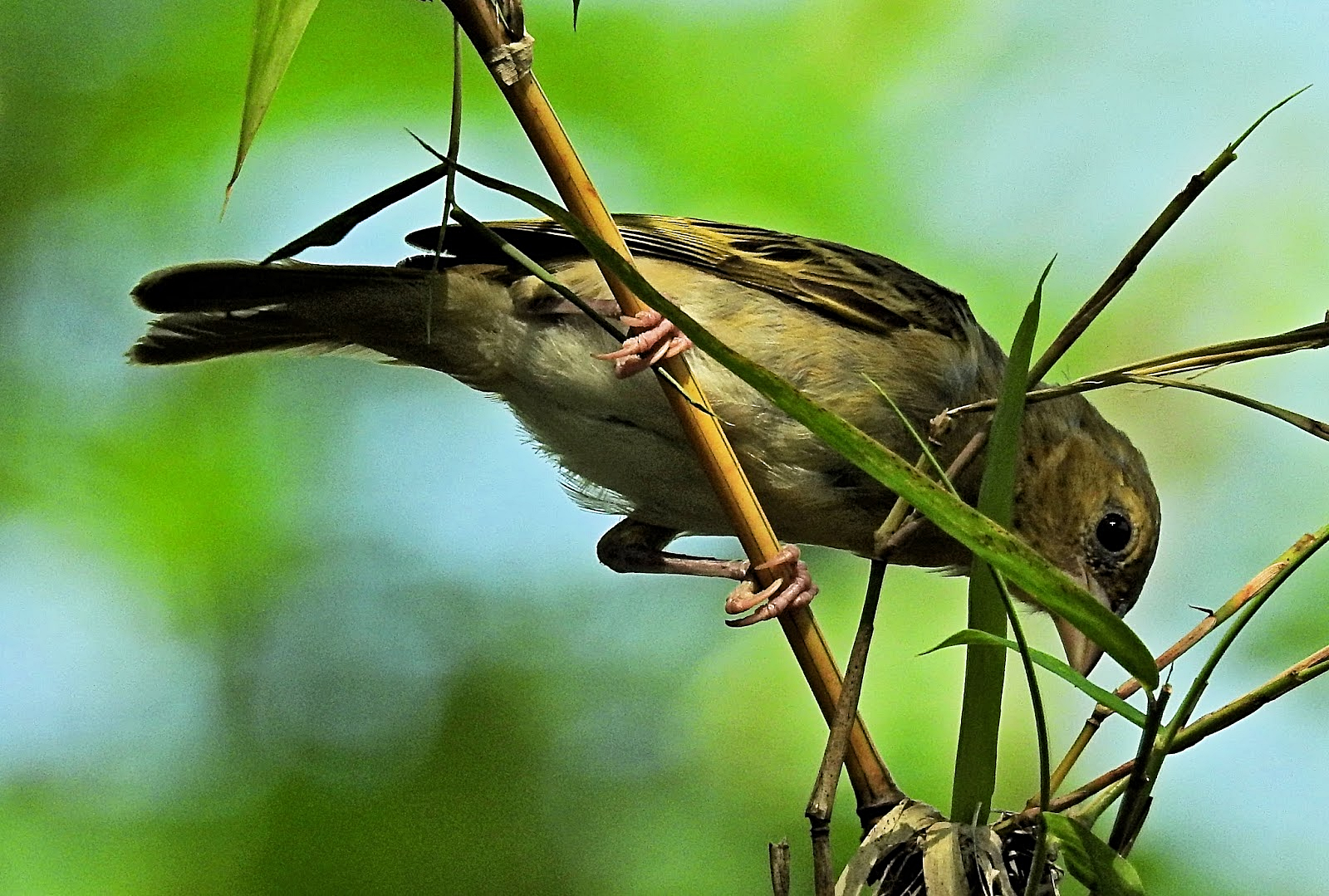
20-12-2015 JURONG, SINGAPORE - GOLDEN BACKED WEAVER (Ploceus jacksoni)

27-12-2015 SAIGON, VIETNAM - GREY HEADED SWAMPHEN (Porphyrio poliocephalus)


The grey-headed swamphen (Porphyrio poliocephalus ) is a species of swamphen occurring from the Middle East and the Indian subcontinent to southern China and northern Thailand. It used to be considered a subspecies of the purple swamphen, but was elevated to full species status in 2015; today the purple swamphen is considered a superspecies and each of its six subspecies groups are designated full species.

The male has an elaborate courtship display, holding water weeds in his bill and bowing to the female with loud chuckles.

The grey-headed swamphen was introduced to North America in the late 1990s due to avicultural escapes in the Pembroke Pines, Florida area. State wildlife biologists attempted to eradicate the birds, but they have multiplied and can now be found in many areas of southern Florida. Ornithological authorities consider it likely that the swamphen will become an established part of Florida's avifauna. It was added to the American Birding Association checklist in February 2013.


Looking like an oversized version of a Purple Gallinule with a massive red bill, the Gray-headed Swamphen is an impressive bird and the largest rail in North America. Originally from southern Asia, it became established in southern Florida in the mid-1990s when birds escaped from captivity and began breeding. Like gallinules, this species forages in marshes by wading, swimming, and even climbing to reach aquatic vegetation, insects, and animal prey. Swamphens are aggressive competitors and may dominate or displace our native North American rails.

27-12-2015 SAIGON, VIETNAM - PAINTED STORK (Mycteria leucocephala)


27-12-2015 SAIGON, VIETNAM - MARABOU STORK (Leptoptilos crumenifer)


The Marabou stork (Leptoptilos crumenifer) is a large wading bird that breeds in Africa often near human habitation, especially landfill sites. It is sometimes called the "undertaker bird" due to its shape from behind: cloak-like wings and back, skinny white legs, and sometimes a large white mass of "hair".

Marabou storks are scavengers and feed mainly on carrion. However, they occasionally eat other birds including pigeons, doves, pelican and cormorant chicks, and even flamingos. During the breeding season, adult marabous take mostly small, live prey since nestlings need this kind of food to survive. Common prey at this time may consist of fish, frogs, insects, eggs, small mammals, and reptiles such as crocodile hatchlings and eggs, and lizards and snakes.

The Marabou stork is a massive bird. This bird is unmistakable due to its size, bare head, and neck, huge bill, pink gular sac at its throat (crumenifer(us) - means "carrier of a pouch for money"), and neck ruff. The male and the female are alike, but the young bird is browner and has a smaller bill.


Marabou storks breed in Africa south of the Sahara. They live in both wet and arid habitats and can be found in open dry savannas, grasslands, riverbanks, lakeshores, and swamps. These birds are also frequent visitors to landfills and fishing villages.

Marabou storks are monogamous and form strong pair bonds that last for life. They breed in colonies, starting during the dry season when food is more readily available as the pools shrink. Males attract a female with bill-rattling courtship displays and their throat sac is also used to make various noises at that time. Marabous build a small nest in a tree made of sticks and line it with twigs and green leaves. The female lays 2-3 eggs which hatch after an incubation period of 30 days. At hatching, the chicks are fed by both parents and fledge between 13 and 15 weeks of age. They remain with their parents for about another 4 months and reach reproductive maturity at 4 years of age.


Marabou storks are social birds and often gather in groups near lakes or rivers. They are generally silent but may sometimes make grunts, croak with their throat sac, or rattle their bills. These large and powerful birds eat mainly carrion, scraps, and feces but will opportunistically eat almost any animal matter they can swallow. Marabou storks feed by day soaring high over the open country looking for food or frequently following vultures which lead them to carrion. When feeding on carrion, marabous may wait for the vultures to cast aside a piece, steal a piece of meat directly from the vulture or wait until the vultures are done.


Marabous will also forage by wading in shallow water using their sensitive bills. When prey touches the bill it snaps shut and the bird swallows its catch. Increasingly, marabous have become dependent on human garbage and hundreds of these huge birds are seen around African dumps or waiting for a handout in urban areas. Marabous eating human garbage have been seen to devour virtually anything that they can swallow, including even shoes and pieces of metal.

27-12-2015 SAIGON, VIETNAM - EURASIAN TREE SPARROW (MALE) (Passer montanus)


The Eurasian tree sparrow (Passer montanus) is asmall passerine bird that breeds over most of temperate Eurasia and Southeast Asia, where it is known as the Tree sparrow. It has been introduced elsewhere including the United States, where it is known as the Eurasian tree sparrow or German sparrow to differentiate it from the native unrelated American tree sparrow.

The adult's crown and nape are rich chestnut, and there is a kidney-shaped black ear patch on each pure white cheek; the chin, throat, and the area between the bill and throat are black. The upperparts are light brown, streaked with black, and the brown wings have two distinct narrow white bars. The legs are pale brown, and the bill is lead-blue in summer, becoming almost black in winter. This sparrow is distinctive even within its genus in that it has no plumage differences between the sexes; the juvenile also resembles the adult, although the colors tend to be duller. Its contrasting face pattern makes this species easily identifiable in all plumages; the smaller size and brown, not grey, crown are additional differences from the male house sparrow. Adult and juvenile Eurasian tree sparrows undergo a slow complete molt in the autumn and show an increase in body mass despite a reduction in stored fat. The change in mass is due to an increase in blood volume to support active feather growth and generally higher water content in the body.