TOTAL PAGEVIEWS

TRANSLATE

Showing posts with label CHACMA BABOON (Papio ursinus). Show all posts

Sunday, 5 December 2021

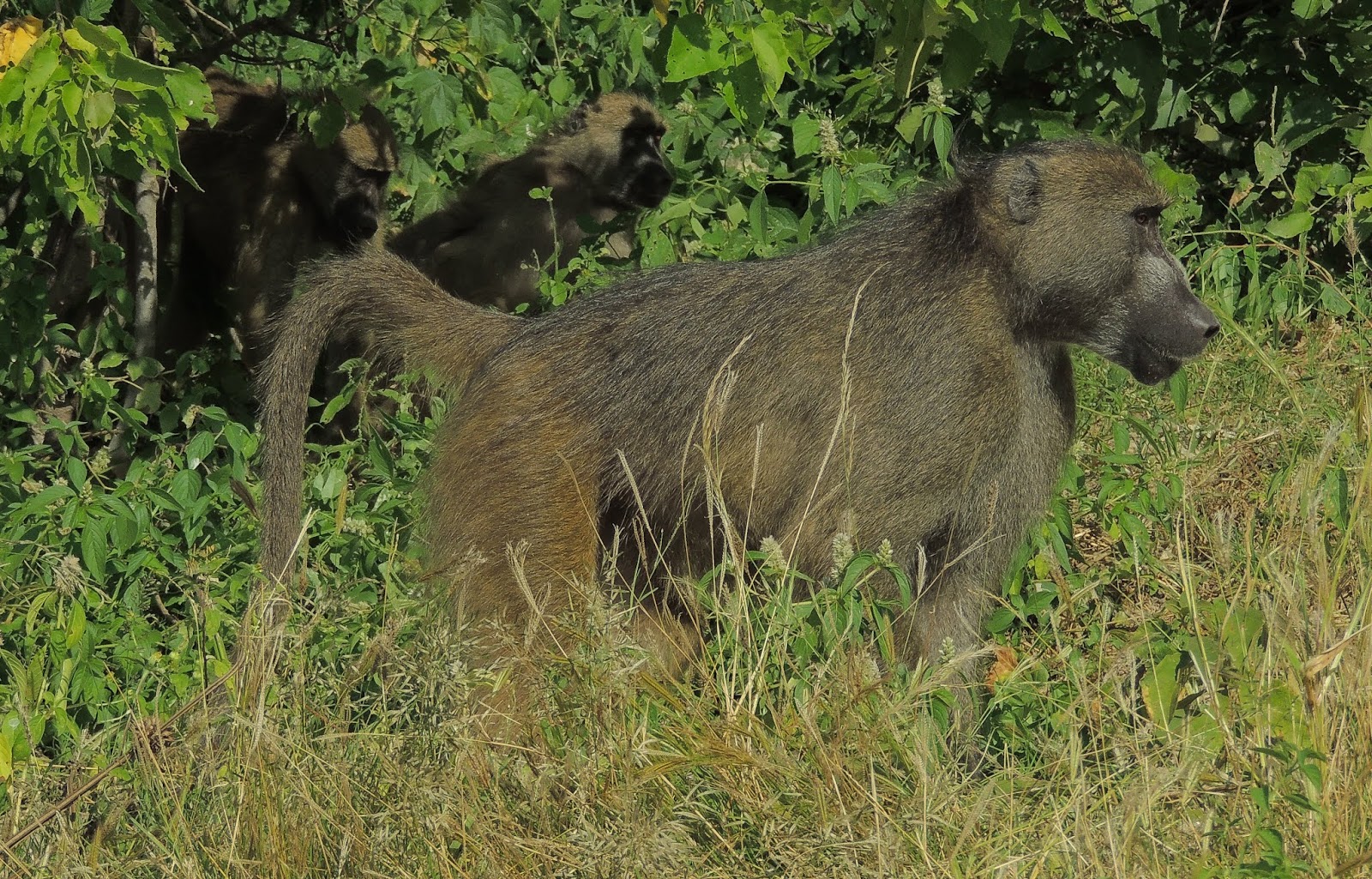
1-6-2019 LINYANTI CAMP, BOTSWANA - CHACMA BABOON (Papio ursinus)


Chacma baboons are found throughout southern Africa, ranging from South Africa north to Angola, Zambia, and Mozambique. They live in diverse habitats from woodlands to savannas, steppes, and sub-deserts. Chacma baboons are found in the Kalahari Desert as well as on the alpine slopes of the Drakensberg. They usually sleep on hills, cliffs, or large trees and during the day, avoid arid areas with a lack of water.

The Chacma baboon (Papio ursinus) is a member of the Old World monkey family. It is one of the largest of all monkeys. Located primarily in southern Africa, the chacma baboon has a wide variety of social behaviors, including a dominance hierarchy, collective foraging, adoption of young by females, and friendship pairings. In general, the species is not threatened, but hunting, trapping, and accidents kill or remove many baboons from the wild, thereby reducing their numbers and disrupting their social structure.

Saturday, 20 July 2019

25-5-2019 MANA POOLS , ZIMBABWE - CHACMA BABOON (Papio ursinus)


Chacma baboons are found throughout southern Africa, ranging from South Africa north to Angola, Zambia, and Mozambique. They live in diverse habitats from woodlands to savannas, steppes, and sub-deserts. Chacma baboons are found in the Kalahari Desert as well as on the alpine slopes of the Drakensberg. They usually sleep on hills, cliffs, or large trees and during the day, avoid arid areas with a lack of water.

The Chacma baboon (Papio ursinus) is a member of the Old World monkey family. It is one of the largest of all monkeys. Located primarily in southern Africa, the chacma baboon has a wide variety of social behaviors, including a dominance hierarchy, collective foraging, adoption of young by females, and friendship pairings. In general, the species is not threatened, but hunting, trapping, and accidents kill or remove many baboons from the wild, thereby reducing their numbers and disrupting their social structure.

Sunday, 14 July 2019

22-5-2019 MANA POOLS, ZIMBABWE - CHACMA BABOON (Papio ursinus)


Chacma baboons are the largest monkey species, living in large, male-dominated troops across Southern Africa, known for their dog-like faces, omnivorous diet (plants, insects, small animals), and complex social hierarchy where males fight for dominance, sometimes leading to infanticide. They're terrestrial, sleeping in trees or cliffs, and communicate with gestures and sounds, adapting well to diverse habitats from grasslands to mountains. 

Key Facts:

Size: Males are significantly larger, weighing up to 45 kg (99 lbs) and measuring over a meter long, while females are about half the size.

Appearance: Dark brown to gray fur, long faces with prominent muzzles, and long limbs; males have rough hair on their neck but not a full mane like some other baboons.

Habitat: Found across Southern Africa (south of the Zambezi River), thriving in grasslands, woodlands, semi-deserts, and mountainous areas.

Diet: Omnivores, eating fruits, seeds, grasses, insects, scorpions, and occasionally meat from small animals.


Social Structure: Live in large troops (20-200+), with complex, unstable male hierarchies and strong female family bonds.

Behavior: Highly social, using body language and vocalizations; males can be aggressive; females stay in their birth groups.

Reproduction: Six-month gestation, typically one infant; fathers are protective, but infanticide by new alpha males occurs to bring females into estrus.

Conservation: Generally "Least Concern," but conflicts arise with farmers due to crop raiding.

Predators: Leopards, crocodiles, eagles, lions, and hyenas. 

Sunday, 30 June 2019

21-5-2019 BUMI HILLS, ZIMBABWE - CHACMA BABOON (Papio ursinus)


Chacma baboons are found throughout southern Africa, ranging from South Africa north to Angola, Zambia, and Mozambique. They live in diverse habitats from woodlands to savannas, steppes, and sub-deserts. Chacma baboons are found in the Kalahari Desert as well as on the alpine slopes of the Drakensberg. They usually sleep on hills, cliffs, or large trees and during the day, avoid arid areas with a lack of water.

The Chacma baboon (Papio ursinus) is a member of the Old World monkey family. It is one of the largest of all monkeys. Located primarily in southern Africa, the chacma baboon has a wide variety of social behaviors, including a dominance hierarchy, collective foraging, adoption of young by females, and friendship pairings. In general, the species is not threatened, but hunting, trapping, and accidents kill or remove many baboons from the wild, thereby reducing their numbers and disrupting their social structure.


The Chacma baboon is perhaps the longest species of monkey and it is also one of the heaviest. Adult males can in some instances be about twice as long and three times as heavy as adult females. Perhaps the most distinctive feature of this baboon is its long, downward-sloping face. The Chacma baboon is generally dark brown to gray in color, with a patch of rough hair on the nape of its neck. Unlike the males of northern baboon species (Guinea, hamadryas, and Olive baboons), Chacma males do not have a mane. The three subspecies are differentiated by size and color. The Cape chacma is a large, heavy, dark-brown, and has black feet. The Gray-footed chacma is slightly smaller than the Cape chacma, lighter in color and build, and has gray feet. The Ruacana chacma generally appears to be a smaller, less darkly colored version of the Cape chacma.

Sunday, 16 June 2019

5-6-2019 LINYANTI CAMP, BOTSWANA - CHACMA BABOON (Papio ursinus)


Chacma baboons are found throughout southern Africa, ranging from South Africa north to Angola, Zambia, and Mozambique. They live in diverse habitats from woodlands to savannas, steppes, and sub-deserts. Chacma baboons are found in the Kalahari Desert as well as on the alpine slopes of the Drakensberg. They usually sleep on hills, cliffs, or large trees and during the day, avoid arid areas with a lack of water.

The Chacma baboon (Papio ursinus) is a member of the Old World monkey family. It is one of the largest of all monkeys. Located primarily in southern Africa, the chacma baboon has a wide variety of social behaviors, including a dominance hierarchy, collective foraging, adoption of young by females, and friendship pairings. In general, the species is not threatened, but hunting, trapping, and accidents kill or remove many baboons from the wild, thereby reducing their numbers and disrupting their social structure.

Saturday, 24 November 2018

21-4-2018 OKAVANGO DELTA, BOTSWANA - CHACMA BABOON (Papio ursinus)


The Chacma baboon (Papio ursinus) is a member of the Old World monkey family. It is one of the largest of all monkeys. Located primarily in southern Africa, the chacma baboon has a wide variety of social behaviors, including a dominance hierarchy, collective foraging, adoption of young by females, and friendship pairings. In general, the species is not threatened, but hunting, trapping, and accidents kill or remove many baboons from the wild, thereby reducing their numbers and disrupting their social structure.

Friday, 17 August 2018

16-4-2018 CHOBE NATIONAL PARK, BOTSWANA - CHACMA BABOON (Papio ursinus)


Chacma baboons are found throughout southern Africa, ranging from South Africa north to Angola, Zambia, and Mozambique. They live in diverse habitats from woodlands to savannas, steppes, and sub-deserts. Chacma baboons are found in the Kalahari Desert as well as on the alpine slopes of the Drakensberg. They usually sleep on hills, cliffs, or large trees and during the day, avoid arid areas with a lack of water.

The Chacma baboon (Papio ursinus) is a member of the Old World monkey family. It is one of the largest of all monkeys. Located primarily in southern Africa, the chacma baboon has a wide variety of social behaviors, including a dominance hierarchy, collective foraging, adoption of young by females, and friendship pairings. In general, the species is not threatened, but hunting, trapping, and accidents kill or remove many baboons from the wild, thereby reducing their numbers and disrupting their social structure.


The Chacma baboon is perhaps the longest species of monkey and it is also one of the heaviest. Adult males can in some instances be about twice as long and three times as heavy as adult females. Perhaps the most distinctive feature of this baboon is its long, downward-sloping face. The Chacma baboon is generally dark brown to gray in color, with a patch of rough hair on the nape of its neck. Unlike the males of northern baboon species (Guinea, hamadryas, and Olive baboons), Chacma males do not have a mane. The three subspecies are differentiated by size and color. The Cape chacma is a large, heavy, dark-brown, and has black feet. The Gray-footed chacma is slightly smaller than the Cape chacma, lighter in color and build, and has gray feet. The Ruacana chacma generally appears to be a smaller, less darkly colored version of the Cape chacma.

Friday, 10 August 2018

15-4-2018 CHOBE RIVER, NAMIBIA - CHACMA BABOON (Papio ursinus)


Chacma baboons are found throughout southern Africa, ranging from South Africa north to Angola, Zambia, and Mozambique. They live in diverse habitats from woodlands to savannas, steppes, and sub-deserts. Chacma baboons are found in the Kalahari Desert as well as on the alpine slopes of the Drakensberg. They usually sleep on hills, cliffs, or large trees and during the day, avoid arid areas with a lack of water.

The Chacma baboon (Papio ursinus) is a member of the Old World monkey family. It is one of the largest of all monkeys. Located primarily in southern Africa, the chacma baboon has a wide variety of social behaviors, including a dominance hierarchy, collective foraging, adoption of young by females, and friendship pairings. In general, the species is not threatened, but hunting, trapping, and accidents kill or remove many baboons from the wild, thereby reducing their numbers and disrupting their social structure.


The Chacma baboon is perhaps the longest species of monkey and it is also one of the heaviest. Adult males can in some instances be about twice as long and three times as heavy as adult females. Perhaps the most distinctive feature of this baboon is its long, downward-sloping face. The Chacma baboon is generally dark brown to gray in color, with a patch of rough hair on the nape of its neck. Unlike the males of northern baboon species (Guinea, hamadryas, and Olive baboons), Chacma males do not have a mane. The three subspecies are differentiated by size and color. The Cape chacma is a large, heavy, dark-brown, and has black feet. The Gray-footed chacma is slightly smaller than the Cape chacma, lighter in color and build, and has gray feet. The Ruacana chacma generally appears to be a smaller, less darkly colored version of the Cape chacma.

Tuesday, 3 July 2018

8-4-2018 THORNYBUSH LODGE, SOUTH AFRICA - CHACMA BABOON (Papio ursinus)


Chacma baboons are found throughout southern Africa, ranging from South Africa north to Angola, Zambia, and Mozambique. They live in diverse habitats from woodlands to savannas, steppes, and sub-deserts. Chacma baboons are found in the Kalahari Desert as well as on the alpine slopes of the Drakensberg. They usually sleep on hills, cliffs, or large trees and during the day, avoid arid areas with a lack of water.

The Chacma baboon (Papio ursinus) is a member of the Old World monkey family. It is one of the largest of all monkeys. Located primarily in southern Africa, the chacma baboon has a wide variety of social behaviors, including a dominance hierarchy, collective foraging, adoption of young by females, and friendship pairings. In general, the species is not threatened, but hunting, trapping, and accidents kill or remove many baboons from the wild, thereby reducing their numbers and disrupting their social structure.


The Chacma baboon is perhaps the longest species of monkey and it is also one of the heaviest. Adult males can in some instances be about twice as long and three times as heavy as adult females. Perhaps the most distinctive feature of this baboon is its long, downward-sloping face. The Chacma baboon is generally dark brown to gray in color, with a patch of rough hair on the nape of its neck. Unlike the males of northern baboon species (Guinea, hamadryas, and Olive baboons), Chacma males do not have a mane. The three subspecies are differentiated by size and color. The Cape chacma is a large, heavy, dark-brown, and has black feet. The Gray-footed chacma is slightly smaller than the Cape chacma, lighter in color and build, and has gray feet. The Ruacana chacma generally appears to be a smaller, less darkly colored version of the Cape chacma.

Saturday, 16 June 2018

23-3-2018 CAPE POINT, CAPE TOWN - CHACMA BABOON (Papio ursinus)


Chacma baboons are found throughout southern Africa, ranging from South Africa north to Angola, Zambia, and Mozambique. They live in diverse habitats from woodlands to savannas, steppes, and sub-deserts. Chacma baboons are found in the Kalahari Desert as well as on the alpine slopes of the Drakensberg. They usually sleep on hills, cliffs, or large trees and during the day, avoid arid areas with a lack of water.

The Chacma baboon (Papio ursinus) is a member of the Old World monkey family. It is one of the largest of all monkeys. Located primarily in southern Africa, the chacma baboon has a wide variety of social behaviors, including a dominance hierarchy, collective foraging, adoption of young by females, and friendship pairings. In general, the species is not threatened, but hunting, trapping, and accidents kill or remove many baboons from the wild, thereby reducing their numbers and disrupting their social structure.


The Chacma baboon is perhaps the longest species of monkey and it is also one of the heaviest. Adult males can in some instances be about twice as long and three times as heavy as adult females. Perhaps the most distinctive feature of this baboon is its long, downward-sloping face. The Chacma baboon is generally dark brown to gray in color, with a patch of rough hair on the nape of its neck. Unlike the males of northern baboon species (Guinea, hamadryas, and Olive baboons), Chacma males do not have a mane. The three subspecies are differentiated by size and color. The Cape chacma is a large, heavy, dark-brown, and has black feet. The Gray-footed chacma is slightly smaller than the Cape chacma, lighter in color and build, and has gray feet. The Ruacana chacma generally appears to be a smaller, less darkly colored version of the Cape chacma.

Sunday, 3 June 2018

15-4-2018 CHOBE RIVER, NAMIBIA - CHACMA BABOON (Papio ursinus) COURTESY OF MRS VALERIE FISHER


The Chacma baboon (Papio ursinus) is a member of the Old World monkey family. It is one of the largest of all monkeys. Located primarily in southern Africa, the chacma baboon has a wide variety of social behaviors, including a dominance hierarchy, collective foraging, adoption of young by females, and friendship pairings. In general, the species is not threatened, but hunting, trapping, and accidents kill or remove many baboons from the wild, thereby reducing their numbers and disrupting their social structure.

The Chacma baboon is perhaps the longest species of monkey and it is also one of the heaviest. Adult males can in some instances be about twice as long and three times as heavy as adult females. Perhaps the most distinctive feature of this baboon is its long, downward-sloping face. The Chacma baboon is generally dark brown to gray in color, with a patch of rough hair on the nape of its neck. Unlike the males of northern baboon species (Guinea, hamadryas, and Olive baboons), Chacma males do not have a mane. The three subspecies are differentiated by size and color. The Cape chacma is a large, heavy, dark-brown, and has black feet. The Gray-footed chacma is slightly smaller than the Cape chacma, lighter in color and build, and has gray feet. The Ruacana chacma generally appears to be a smaller, less darkly colored version of the Cape chacma.


Chacma baboons are found throughout southern Africa, ranging from South Africa north to Angola, Zambia, and Mozambique. They live in diverse habitats from woodlands to savannas, steppes, and sub-deserts. Chacma baboons are found in the Kalahari Desert as well as on the alpine slopes of the Drakensberg. They usually sleep on hills, cliffs, or large trees and during the day, avoid arid areas with a lack of water.

Chacma baboons are diurnal, spending most of the day on the ground. They are highly sociable animals, living in troops, which consist of 20-80 individuals. The troops include males as well as females with their young. Members of a troop are in close ties with each other, sleeping, feeding, and grooming together. During the day the groups split into smaller subgroups, consisting of 4-5 females with their young and a dominant male, who leads the group and defends it from other males. They are always on the alert, living in troops for protection and watching for predators. When threatened, the baboons give out loud barks. Then the males run to attack while the females and young hide in a safe place among the trees. Chacma baboons communicate by vocalizations, using about 30 different sounds such as grunting, barking, or screaming. They also use gestures such as shoulder shrugs, yawns, or lip-smacking.

Monday, 28 May 2018

18-4-2018 CHOBE NAT PARK, BOTSWANA - CHACMA BABOON (Papio ursinus)


The Chacma baboon (Papio ursinus) is a member of the Old World monkey family. It is one of the largest of all monkeys. Located primarily in southern Africa, the chacma baboon has a wide variety of social behaviors, including a dominance hierarchy, collective foraging, adoption of young by females, and friendship pairings. In general, the species is not threatened, but hunting, trapping, and accidents kill or remove many baboons from the wild, thereby reducing their numbers and disrupting their social structure.

The Chacma baboon is perhaps the longest species of monkey and it is also one of the heaviest. Adult males can in some instances be about twice as long and three times as heavy as adult females. Perhaps the most distinctive feature of this baboon is its long, downward-sloping face. The Chacma baboon is generally dark brown to gray in color, with a patch of rough hair on the nape of its neck. Unlike the males of northern baboon species (Guinea, hamadryas, and Olive baboons), Chacma males do not have a mane. The three subspecies are differentiated by size and color. The Cape chacma is a large, heavy, dark-brown, and has black feet. The Gray-footed chacma is slightly smaller than the Cape chacma, lighter in color and build, and has gray feet. The Ruacana chacma generally appears to be a smaller, less darkly colored version of the Cape chacma.


Chacma baboons are found throughout southern Africa, ranging from South Africa north to Angola, Zambia, and Mozambique. They live in diverse habitats from woodlands to savannas, steppes, and sub-deserts. Chacma baboons are found in the Kalahari Desert as well as on the alpine slopes of the Drakensberg. They usually sleep on hills, cliffs, or large trees and during the day, avoid arid areas with a lack of water.

Chacma baboons are diurnal, spending most of the day on the ground. They are highly sociable animals, living in troops, which consist of 20-80 individuals. The troops include males as well as females with their young. Members of a troop are in close ties with each other, sleeping, feeding, and grooming together. During the day the groups split into smaller subgroups, consisting of 4-5 females with their young and a dominant male, who leads the group and defends it from other males. They are always on the alert, living in troops for protection and watching for predators. When threatened, the baboons give out loud barks. Then the males run to attack while the females and young hide in a safe place among the trees. Chacma baboons communicate by vocalizations, using about 30 different sounds such as grunting, barking, or screaming. They also use gestures such as shoulder shrugs, yawns, or lip-smacking.


Chacma baboons have polygynandrous (promiscuous) mating system. The dominant male of a subgroup competes with other males for mating rights, though females of baboons mate with a number of males during their lives. They breed at any time of the year. The gestation period lasts about six months, yielding a single baby. The newborn infant clings onto its mother’s breast, grabs onto her fur and later rides on her back. The baby is weaned at the age of 8-12 months. By this time, females keep on living within the troop while males usually join another troop. Males become reproductively mature at 5 years old whereas females are mature at 3 years old.

Sunday, 27 May 2018

18-4-2018 CHOBE NAT PARK, BOTSWANA - CHACMA BABOON (Papio ursinus)


The Chacma baboon (Papio ursinus) is a member of the Old World monkey family. It is one of the largest of all monkeys. Located primarily in southern Africa, the chacma baboon has a wide variety of social behaviors, including a dominance hierarchy, collective foraging, adoption of young by females, and friendship pairings. In general, the species is not threatened, but hunting, trapping, and accidents kill or remove many baboons from the wild, thereby reducing their numbers and disrupting their social structure.


The Chacma baboon is perhaps the longest species of monkey and it is also one of the heaviest. Adult males can in some instances be about twice as long and three times as heavy as adult females. Perhaps the most distinctive feature of this baboon is its long, downward-sloping face. The Chacma baboon is generally dark brown to gray in color, with a patch of rough hair on the nape of its neck. Unlike the males of northern baboon species (Guinea, hamadryas, and Olive baboons), Chacma males do not have a mane. The three subspecies are differentiated by size and color. The Cape chacma is a large, heavy, dark-brown, and has black feet. The Gray-footed chacma is slightly smaller than the Cape chacma, lighter in color and build, and has gray feet. The Ruacana chacma generally appears to be a smaller, less darkly colored version of the Cape chacma.

Thursday, 24 May 2018

15-4-2018 CHOBE RIVER, NAMIBIA - CHACMA BABOON (Papio ursinus) COURTESY OF MRS VALERIE FISHER


The Chacma baboon (Papio ursinus) is a member of the Old World monkey family. It is one of the largest of all monkeys. Located primarily in southern Africa, the chacma baboon has a wide variety of social behaviors, including a dominance hierarchy, collective foraging, adoption of young by females, and friendship pairings. In general, the species is not threatened, but hunting, trapping, and accidents kill or remove many baboons from the wild, thereby reducing their numbers and disrupting their social structure.

The Chacma baboon is perhaps the longest species of monkey and it is also one of the heaviest. Adult males can in some instances be about twice as long and three times as heavy as adult females. Perhaps the most distinctive feature of this baboon is its long, downward-sloping face. The Chacma baboon is generally dark brown to gray in color, with a patch of rough hair on the nape of its neck. Unlike the males of northern baboon species (Guinea, hamadryas, and Olive baboons), Chacma males do not have a mane. The three subspecies are differentiated by size and color. The Cape chacma is a large, heavy, dark-brown, and has black feet. The Gray-footed chacma is slightly smaller than the Cape chacma, lighter in color and build, and has gray feet. The Ruacana chacma generally appears to be a smaller, less darkly colored version of the Cape chacma.


Chacma baboons are found throughout southern Africa, ranging from South Africa north to Angola, Zambia, and Mozambique. They live in diverse habitats from woodlands to savannas, steppes, and sub-deserts. Chacma baboons are found in the Kalahari Desert as well as on the alpine slopes of the Drakensberg. They usually sleep on hills, cliffs, or large trees and during the day, avoid arid areas with a lack of water.

Chacma baboons are diurnal, spending most of the day on the ground. They are highly sociable animals, living in troops, which consist of 20-80 individuals. The troops include males as well as females with their young. Members of a troop are in close ties with each other, sleeping, feeding, and grooming together. During the day the groups split into smaller subgroups, consisting of 4-5 females with their young and a dominant male, who leads the group and defends it from other males. They are always on the alert, living in troops for protection and watching for predators. When threatened, the baboons give out loud barks. Then the males run to attack while the females and young hide in a safe place among the trees. Chacma baboons communicate by vocalizations, using about 30 different sounds such as grunting, barking, or screaming. They also use gestures such as shoulder shrugs, yawns, or lip-smacking.


Chacma baboons have polygynandrous (promiscuous) mating system. The dominant male of a subgroup competes with other males for mating rights, though females of baboons mate with a number of males during their lives. They breed at any time of the year. The gestation period lasts about six months, yielding a single baby. The newborn infant clings onto its mother’s breast, grabs onto her fur and later rides on her back. The baby is weaned at the age of 8-12 months. By this time, females keep on living within the troop while males usually join another troop. Males become reproductively mature at 5 years old whereas females are mature at 3 years old.

Wednesday, 9 May 2018

15-4-2018 CHOBE RIVER, NAMIBIA - CHACMA BABOON (Papio ursinus) COURTESY OF MRS VALERIE FISHER


The Chacma baboon (Papio ursinus) is a member of the Old World monkey family. It is one of the largest of all monkeys. Located primarily in southern Africa, the chacma baboon has a wide variety of social behaviors, including a dominance hierarchy, collective foraging, adoption of young by females, and friendship pairings. In general, the species is not threatened, but hunting, trapping, and accidents kill or remove many baboons from the wild, thereby reducing their numbers and disrupting their social structure.

The Chacma baboon is perhaps the longest species of monkey and it is also one of the heaviest. Adult males can in some instances be about twice as long and three times as heavy as adult females. Perhaps the most distinctive feature of this baboon is its long, downward-sloping face. The Chacma baboon is generally dark brown to gray in color, with a patch of rough hair on the nape of its neck. Unlike the males of northern baboon species (Guinea, hamadryas, and Olive baboons), Chacma males do not have a mane. The three subspecies are differentiated by size and color. The Cape chacma is a large, heavy, dark-brown, and has black feet. The Gray-footed chacma is slightly smaller than the Cape chacma, lighter in color and build, and has gray feet. The Ruacana chacma generally appears to be a smaller, less darkly colored version of the Cape chacma.

Friday, 4 May 2018

21-4-2018 OKAVANGO DELTA, BOTSWANA - CHACMA BABOON (Papio ursinus)


Chacma baboons are found throughout southern Africa, ranging from South Africa north to Angola, Zambia, and Mozambique. They live in diverse habitats from woodlands to savannas, steppes, and sub-deserts. Chacma baboons are found in the Kalahari Desert as well as on the alpine slopes of the Drakensberg. They usually sleep on hills, cliffs, or large trees and during the day, avoid arid areas with a lack of water.


The Chacma baboon (Papio ursinus) is a member of the Old World monkey family. It is one of the largest of all monkeys. Located primarily in southern Africa, the chacma baboon has a wide variety of social behaviors, including a dominance hierarchy, collective foraging, adoption of young by females, and friendship pairings. In general, the species is not threatened, but hunting, trapping, and accidents kill or remove many baboons from the wild, thereby reducing their numbers and disrupting their social structure.


The Chacma baboon is perhaps the longest species of monkey and it is also one of the heaviest. Adult males can in some instances be about twice as long and three times as heavy as adult females. Perhaps the most distinctive feature of this baboon is its long, downward-sloping face. The Chacma baboon is generally dark brown to gray in color, with a patch of rough hair on the nape of its neck. Unlike the males of northern baboon species (Guinea, hamadryas, and Olive baboons), Chacma males do not have a mane. The three subspecies are differentiated by size and color. The Cape chacma is a large, heavy, dark-brown, and has black feet. The Gray-footed chacma is slightly smaller than the Cape chacma, lighter in color and build, and has gray feet. The Ruacana chacma generally appears to be a smaller, less darkly colored version of the Cape chacma.

Saturday, 31 March 2018

23-3-2018 CAPE POINT, CAPE TOWN - CHACMA BABOON (Papio ursinus)


Chacma baboons are found throughout southern Africa, ranging from South Africa north to Angola, Zambia, and Mozambique. They live in diverse habitats from woodlands to savannas, steppes, and sub-deserts. Chacma baboons are found in the Kalahari Desert as well as on the alpine slopes of the Drakensberg. They usually sleep on hills, cliffs, or large trees and during the day, avoid arid areas with a lack of water.

The Chacma baboon (Papio ursinus) is a member of the Old World monkey family. It is one of the largest of all monkeys. Located primarily in southern Africa, the chacma baboon has a wide variety of social behaviors, including a dominance hierarchy, collective foraging, adoption of young by females, and friendship pairings. In general, the species is not threatened, but hunting, trapping, and accidents kill or remove many baboons from the wild, thereby reducing their numbers and disrupting their social structure.


The Chacma baboon is perhaps the longest species of monkey and it is also one of the heaviest. Adult males can in some instances be about twice as long and three times as heavy as adult females. Perhaps the most distinctive feature of this baboon is its long, downward-sloping face. The Chacma baboon is generally dark brown to gray in color, with a patch of rough hair on the nape of its neck. Unlike the males of northern baboon species (Guinea, hamadryas, and Olive baboons), Chacma males do not have a mane. The three subspecies are differentiated by size and color. The Cape chacma is a large, heavy, dark-brown, and has black feet. The Gray-footed chacma is slightly smaller than the Cape chacma, lighter in color and build, and has gray feet. The Ruacana chacma generally appears to be a smaller, less darkly colored version of the Cape chacma.


Chacma baboons are diurnal, spending most of the day on the ground. They are highly sociable animals, living in troops, which consist of 20-80 individuals. The troops include males as well as females with their young. Members of a troop are in close ties with each other, sleeping, feeding, and grooming together. During the day the groups split into smaller subgroups, consisting of 4-5 females with their young and a dominant male, who leads the group and defends it from other males. They are always on the alert, living in troops for protection and watching for predators. When threatened, the baboons give out loud barks. Then the males run to attack while the females and young hide in a safe place among the trees. Chacma baboons communicate by vocalizations, using about 30 different sounds such as grunting, barking, or screaming. They also use gestures such as shoulder shrugs, yawns, or lip-smacking.