TOTAL PAGEVIEWS

TRANSLATE

Showing posts with label EASTERN FORK TAILED DRONGO (Dicrurus adsimilis ssp. fugax). Show all posts

Saturday, 15 January 2022

28-5-2019 SOMALISA CAMP, ZIMBABWE - EASTERN FORK TAILED DRONGO (Dicrurus adsimilis ssp. fugax)


The East African Fork-Tailed Drongo (Dicrurus adsimilis fugax) is a medium-sized passerine songbird. It is also known as the Common Drongo, the African Drongo, or the Savannah Drongo.

The East African Fork-Tailed Drongo is glossy black, with duller black wings. It has patches of brown feathers. It has a large head, and a light-grey thick, hooked beak, with nasal bristles (hairs). It has orange-brown eyes. It has short legs. The feathers on its tail curve outwards, forming a fork tail.


The term "eastern fork-tailed drongo" refers to Sharpe's Drongo (\(<<!nav>>Dicrurussharpeisharpei<<!/nav>>\)) or can be a less common way to refer to the Fork-tailed Drongo (\(<<!nav>>Dicrurusadsimilis<<!/nav>>\)), which has populations in eastern Africa. Both are black, fork-tailed birds, with the fork-tailed drongo being more widespread in sub-Saharan Africa and Sharpe's drongo primarily found in eastern and central Africa's forests. They are known for their bright red eyes and ability to mimic other birds to steal food. Sharpe's Drongo (\(Dicrurussharpei\)) Identification: An all-black bird with a deep fork in its tail and a glossy, blue-green sheen on its head and upperparts.
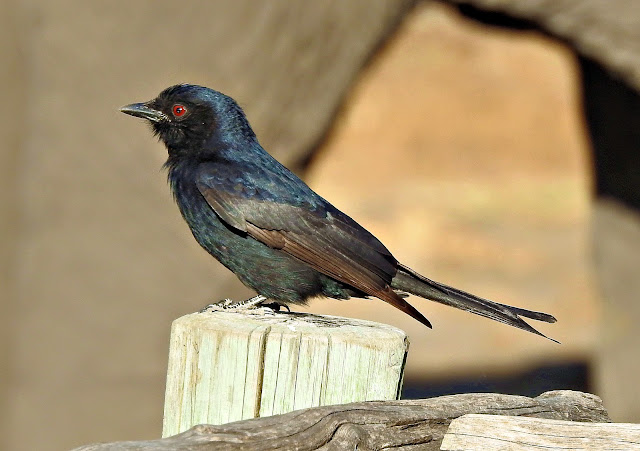

Habitat: Found primarily in forest habitats, particularly in eastern Africa.Behavior: Mimics other birds, including warning calls, to steal food. Fork-tailed Drongo (\(Dicrurusadsimilis\)) Identification: A black bird with a deeply forked tail, red eyes, and a slight blue-green gloss on its upperparts.Habitat: Inhabits more open country across sub-Saharan Africa and is absent from dense forests and high-altitude areas.Behavior: Known for mimicking the alarm calls of other birds to steal food. 

Sunday, 14 July 2019

18-5-2019 BUMI HILLS, ZIMBABWE - EASTERN FORK TAILED DRONGO (Dicrurus adsimilis ssp. fugax)


The fork-tailed drongo (Dicrurus adsimilis), also called the common drongo or African drongo, is a small bird found from the Sahel to South Africa that lives in wooded habitats, particularly woodlands and savannas. It is part of the family Dicruridae and has four recognized subspecies, D. a adsimilis, D. a. apivorus, D. a. fugax and D. a. jubaensis. Like other drongos, the fork-tailed is mostly insectivorous; its diet mainly consists of butterflies, termites, and grasshoppers.

Physically, this species is characterized with a narrow fork-shaped tail, red-brownish eyes, and black plumage throughout all of its body. These birds nest close to wetlands, forests, and farms and the breeding season varies depending the region. The female usually lays one to four eggs, which hatch in 15 to 18 days.


The fork-tailed drongo is known for its ability to deceptively mimic other bird alarm calls in order for a certain animal to flee the scene so it can steal their food (kleptoparasitism). They are also known for their aggressive and fearless behavior, often attacking and driving away much larger animals, including birds of prey, when their nest is in danger. Due to its extensive range and stable population, the fork-tailed drongo is classified by the IUCN Red List as a least-concern species.The fork-tailed drongo is a common and widespread resident breeder in Africa south of the Sahara. This insect-eating bird is usually found in open woodland, savanna and forest edge and is tolerant of arid climates. Its range was formerly considered to include Asia, but the Asian species is now called the black drongo (D. macrocercus). The bird can be found at heights as high as 2200 meters.


The bird possesses a robust black beak and red eyes. When born, they lack feathers, exhibiting reddish skin, an orange beak, yellow gape flange, brown eyes, and a black beak. Juvenile fork-tailed drongos are dark brown tone with some buff-colored feather tips, a less pronounced tail fork, brown or grey eyes, and a pale mouth. While resembling adults, they lack the glossy shine on the lower body and display pale feathers on certain areas. Both sexes share a black body with a blue-green iridescence in specific regions. The underside, including the belly, is uniformly black, contrasting with the glossy black-blue upper body. Their lengthy tail is deeply forked and black, measuring approximately 115–126 mm in length and 19–23 mm in depth. They feature short legs and a wingspan of 134 mm. Their bill is characterized by a depth of 0.4 mm and a length of 2.8 mm.

Following breeding, adult birds experience a complete molt, usually taking place between December and March in Southern Africa, with varying months in other areas. Young birds maintain their immature plumage until the next breeding season. The partial post-juvenile molt initiates prior to the growth of new wing and tail feathers following the nesting period. Instances of leucism have been observed in the fork-tailed drongo.