TOTAL PAGEVIEWS

TRANSLATE

Showing posts with label IBERIAN GREEN FROG (Pelophylax perezi). Show all posts

Saturday, 27 September 2025

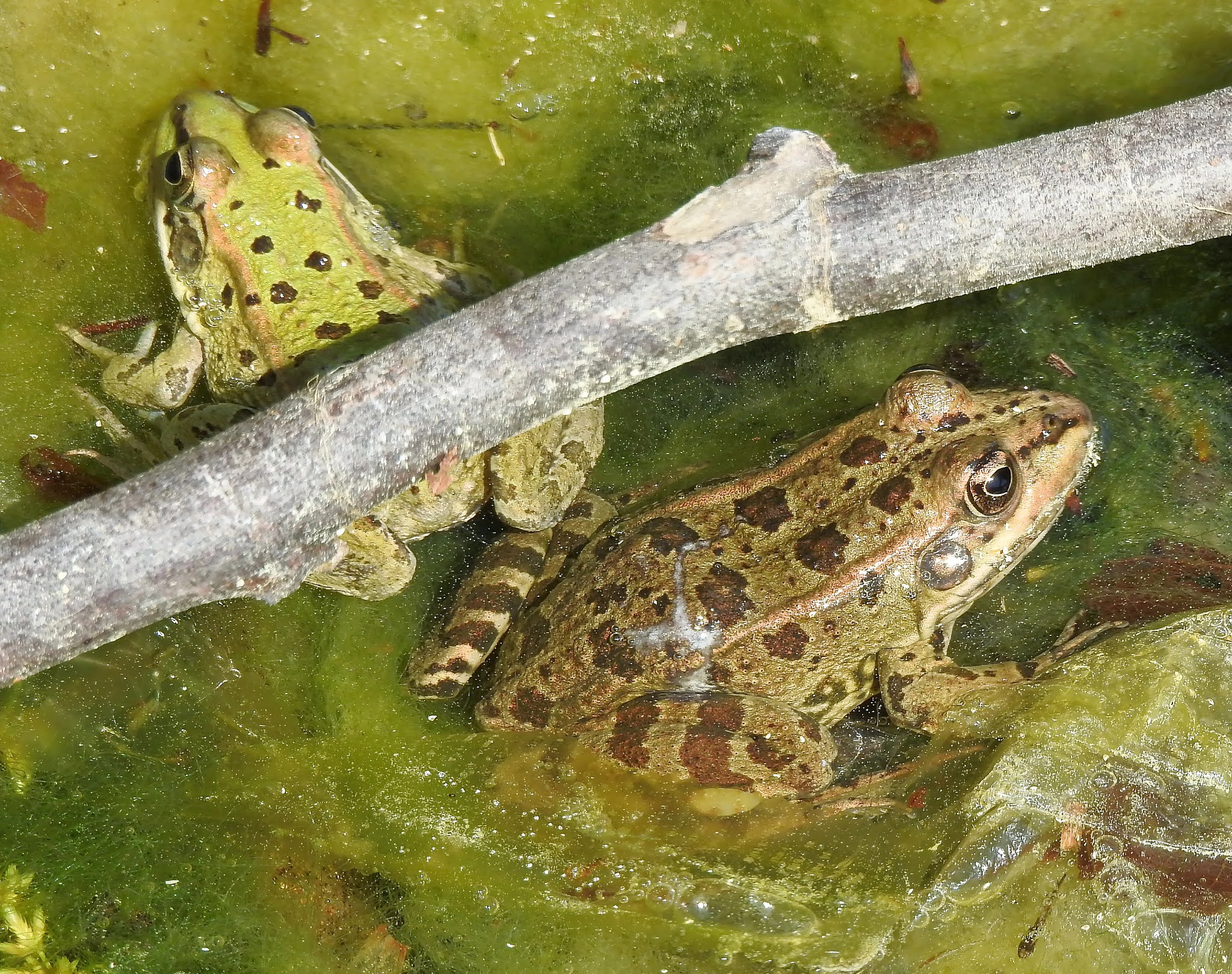
27-9-2025 RIO SERPIS GANDIA, VALENCIA - IBERIAN GREEN FROG (Pelophylax perezi)

The Perez's frog (Pelophylax perezi), also known as Iberian waterfrog, Iberian green frog or Coruna frog, is a species of frog in the family Ranidae. It is native to southern France, Portugal, Spain, and has been introduced to the Canary and Balearic Islands, Madeira, the United Kingdom, and the Azores. In the Iberian Peninsula it is widespread and common.

Its natural habitats are temperate forests, temperate shrubland, Mediterranean-type shrubby vegetation, rivers, intermittent rivers, swamps, freshwater lakes, intermittent freshwater lakes, freshwater marshes, intermittent freshwater marshes, sandy shores, arable land, and urban areas. It is not considered threatened by the IUCN. A medium-sized, stout frog; snout-vent length is usually from 40 to 70 mm, but sometimes is longer than 10 cm (Docampo and Milagrosa-Vega 1988; González de la Vega 1988). The head is as long as wide, with prominent eyes located in dorsal position very close to each other. The tympanum is well marked, about 1/2 to 3/4 the eye diameter (Salvador and García-París 2001). Toes have well developed webbing. Skin is either smooth or slightly rough, with well-formed dorsolateral folds.

The dorsal coloration is very variable, usually green but also brown or grayish to dark gray. They usually show a vertebral stripe, mostly yellow or green. Two irregular rows of dark, rectangular spots are present on both sides of the vertebral stripe. These spots are also present on the rear limbs, sometimes forming a banded pattern. Some individuals lack both the spots and the vertebral stripe. Ventrally they are white with a variable number of dark spots. Males are smaller than females and have stronger forelimbs. They have gray vocal sacs than can be appreciated even when they are not in use.

Tadpoles grow up to 111 mm total length (Salvador 1985), but usually measure between 60-70 mm (Barbadillo et al. 1999). The spiracle is sinistral and the anus open on the right side of the base of the tail. Marginal papillae are absent from the upper side of the mouth. Denticles are arranged in a variable number of single rows (Llorente et al. 1994), but the most common formula is 2(2)/3(1). The dorsal fin is low, starting at the level of the spiracle. The tip of the tail is pointed. Ground coloration is green or light brown, with small, dark dots. These dots are denser and larger in the tail fin. The tail presents a typical pattern with three longitudinal dark stripes. The ventral coloration is white.

Sunday, 23 July 2023

23-7-2023 MONTE CORONA, VALENCIA - IBERIAN GREEN FROG (Pelophylax perezi)

The Perez's frog (Pelophylax perezi), also known as Iberian waterfrog, Iberian green frog or Coruna frog, is a species of frog in the family Ranidae. It is native to southern France, Portugal, Spain, and has been introduced to the Canary and Balearic Islands,[ Madeira, the United Kingdom, and the Azores. In the Iberian Peninsula it is widespread and common.

Its natural habitats are temperate forests, temperate shrubland, Mediterranean-type shrubby vegetation, rivers, intermittent rivers, swamps, freshwater lakes, intermittent freshwater lakes, freshwater marshes, intermittent freshwater marshes, sandy shores, arable land, and urban areas. It is not considered threatened by the IUCN.


Tuesday, 27 June 2023

27-6-2023 VIVEROS GARDENS, VALENCIA - IBERIAN GREEN FROG (Pelophylax perezi)


The Perez's frog (Pelophylax perezi), also known as Iberian waterfrog, Iberian green frog or Coruna frog, is a species of frog in the family Ranidae. It is native to southern France, Portugal, Spain, and has been introduced to the Canary and Balearic Islands, Madeira, the United Kingdom, and the Azores. In the Iberian Peninsula it is widespread and common.

Its natural habitats are temperate forests, temperate shrubland, Mediterranean-type shrubby vegetation, rivers, intermittent rivers, swamps, freshwater lakes, intermittent freshwater lakes, freshwater marshes, intermittent freshwater marshes, sandy shores, arable land, and urban areas.

Wednesday, 26 April 2023

26-4-2023 BICORP, VALENCIA - IBERIAN GREEN FROG (Pelophylax perezi)


The Perez's frog (Pelophylax perezi), also known as Iberian waterfrog, Iberian green frog or Coruna frog, is a species of frog in the family Ranidae. It is native to southern France, Portugal, Spain, and has been introduced to the Canary and Balearic Islands, Madeira, the United Kingdom, and the Azores. In the Iberian Peninsula it is widespread and common.

Its natural habitats are temperate forests, temperate shrubland, Mediterranean-type shrubby vegetation, rivers, intermittent rivers, swamps, freshwater lakes, intermittent freshwater lakes, freshwater marshes, intermittent freshwater marshes, sandy shores, arable land, and urban areas.

Thursday, 22 August 2019

22-8-2019 CAMI LES FONTS OLIVA, VALENCIA - IBERIAN GREEN FROG (Pelophylax perezi)


The Perez's frog (Pelophylax perezi), also known as Iberian waterfrog, Iberian green frog or Coruna frog, is a species of frog in the family Ranidae. It is native to southern France, Portugal, Spain, and has been introduced to the Canary and Balearic Islands, Madeira, the United Kingdom, and the Azores. In the Iberian Peninsula it is widespread and common.

Its natural habitats are temperate forests, temperate shrubland, Mediterranean-type shrubby vegetation, rivers, intermittent rivers, swamps, freshwater lakes, intermittent freshwater lakes, freshwater marshes, intermittent freshwater marshes, sandy shores, arable land, and urban areas. It is not considered threatened by the IUCN.


The Iberian green frog, or Perez's frog, is a common amphibian in Spain, Portugal, and southern France that lives in and near aquatic habitats and has been introduced to islands like the Azores, Balearics, and Canaries. Key facts include that males are the primary singers, using a vocal sac on their throat to attract females, and the species is active during the day and night, feeding on a diet of insects, spiders, and worms. 


Appearance: Adults range from 4 to 10 cm (1.6–4 inches) long and are typically greenish or brownish, often with darker spots. Some specimens may have a yellowish stripe down the back.

Activity: It is both diurnal and nocturnal and an agile jumper, often leaping into the water when disturbed.

Diet: It preys on insects, flies, beetles, spiders, and other invertebrates.
Vocalization: Only male frogs have a vocal sac to produce a call, which they use to attract females during the breeding season. 

Habitat and reproduction
Habitat: The species thrives in a wide range of aquatic environments, including lakes, streams, swamps, and ditches, and can tolerate slightly brackish or saline water.


Reproduction:
Mating occurs in the water, with the male grasping the female from behind in a process called amplexus.
Females can lay thousands of eggs (up to 7,000 in some cases) in clumps attached to aquatic vegetation.
Eggs hatch in 5–8 days, and tadpoles take 8–12 weeks to metamorphose, though this can take the whole winter in some climates. 

Distribution and conservation
Native range: Southern France, Spain, and Portugal.
Introduced range: The Azores, Balearic Islands, Canary Islands, and parts of the United Kingdom.

Threats: Population declines have been linked to factors like the disappearance of wetlands, droughts, and the introduction of non-native species that can hybridize with the Iberian green frog. 

Sunday, 18 August 2019

18-8-2019 LA LLACUNA, VALENCIA - IBERIAN GREEN FROG (Pelophylax perezi)


The Perez's frog (Pelophylax perezi), also known as Iberian waterfrog, Iberian green frog or Coruna frog, is a species of frog in the family Ranidae. It is native to southern France, Portugal, Spain, and has been introduced to the Canary and Balearic Islands, Madeira, the United Kingdom, and the Azores. In the Iberian Peninsula it is widespread and common.

Its natural habitats are temperate forests, temperate shrubland, Mediterranean-type shrubby vegetation, rivers, intermittent rivers, swamps, freshwater lakes, intermittent freshwater lakes, freshwater marshes, intermittent freshwater marshes, sandy shores, arable land, and urban areas. It is not considered threatened by the IUCN. A medium-sized, stout frog; snout-vent length is usually from 40 to 70 mm, but sometimes is longer than 10 cm (Docampo and Milagrosa-Vega 1988; González de la Vega 1988). The head is as long as wide, with prominent eyes located in dorsal position very close to each other. The tympanum is well marked, about 1/2 to 3/4 the eye diameter (Salvador and García-París 2001). Toes have well developed webbing. Skin is either smooth or slightly rough, with well-formed dorsolateral folds.

Sunday, 17 March 2019

17-3-2019 ADOR CAMPO, VALENCIA - IBERIAN GREEN FROG (Pelophylax perezi)


The Perez's frog (Pelophylax perezi), also known as Iberian waterfrog, Iberian green frog or Coruna frog, is a species of frog in the family Ranidae. It is native to southern France, Portugal, Spain, and has been introduced to the Canary and Balearic Islands, Madeira, the United Kingdom, and the Azores. In the Iberian Peninsula it is widespread and common.


Its natural habitats are temperate forests, temperate shrubland, Mediterranean-type shrubby vegetation, rivers, intermittent rivers, swamps, freshwater lakes, intermittent freshwater lakes, freshwater marshes, intermittent freshwater marshes, sandy shores, arable land, and urban areas. It is not considered threatened by the IUCN. A medium-sized, stout frog; snout-vent length is usually from 40 to 70 mm, but sometimes is longer than 10 cm (Docampo and Milagrosa-Vega 1988; González de la Vega 1988). The head is as long as wide, with prominent eyes located in dorsal position very close to each other. The tympanum is well marked, about 1/2 to 3/4 the eye diameter (Salvador and García-París 2001). Toes have well developed webbing. Skin is either smooth or slightly rough, with well-formed dorsolateral folds.


The dorsal coloration is very variable, usually green but also brown or grayish to dark gray. They usually show a vertebral stripe, mostly yellow or green. Two irregular rows of dark, rectangular spots are present on both sides of the vertebral stripe. These spots are also present on the rear limbs, sometimes forming a banded pattern. Some individuals lack both the spots and the vertebral stripe. Ventrally they are white with a variable number of dark spots. Males are smaller than females and have stronger forelimbs. They have gray vocal sacs than can be appreciated even when they are not in use.

Tadpoles grow up to 111 mm total length (Salvador 1985), but usually measure between 60-70 mm (Barbadillo et al. 1999). The spiracle is sinistral and the anus open on the right side of the base of the tail. Marginal papillae are absent from the upper side of the mouth. Denticles are arranged in a variable number of single rows (Llorente et al. 1994), but the most common formula is 2(2)/3. The dorsal fin is low, starting at the level of the spiracle. The tip of the tail is pointed. Ground coloration is green or light brown, with small, dark dots. These dots are denser and larger in the tail fin. The tail presents a typical pattern with three longitudinal dark stripes. The ventral coloration is white.