
Friday, 31 December 2021
28-12-2021 MONTE CORONA, VALENCIA - VESPERID BEETLE (Vesperus fuentei)

The Vesperid beetle (Vesperus fuentei) is an endemic species to Spain belonging to the family Vesperidae. It is known for its extreme sexual dimorphism, subterranean larval stages, and nocturnal flying habits.
Here are the key facts about the Vesperus fuentei:
Taxonomy & Distribution
Family: VesperidaeEndemic to: Spain (Specifically found in regions like central and southern Spain).
Scientific Name: Vesperus fuentei (described by Pic in 1905).Physical Characteristics & DimorphismThese beetles exhibit highly distinct differences between males and females:
Males: Small, winged, and fully capable of flight. They have longer antennae to actively locate females at dusk.

Females: Larger with a swollen abdomen (physogastry) designed to carry enlarged ovaries. Their wings are severely reduced or absent (brachypterous), meaning they cannot fly and spend most of their time near the ground.
Life Cycle & EcologyActivity Period: Adults are nocturnal and generally emerge in late summer to autumn (August to October).
Larval Stage: Larvae live underground and feed on the roots of various host plants.
Life Span: Like many Vesperus species, the life cycle of these beetles is believed to span over 2 to 3 or more years.
BehaviorMating: The flying males become highly active at dusk and are known to be strongly attracted to artificial lights, which is often when they are spotted by researchers and locals.


Thursday, 30 December 2021


Wednesday, 29 December 2021
29-12-2021 EL PALMAR, VALENCIA - COMMON WATER CROWFOOT (Ranunculus aquatilis)

A member of the buttercup family, Common water-crowfoot displays white, buttercup-like flowers with yellow centres. It can form mats in ponds, ditches and streams during spring and summer.
Ranunculus aquatilis, the common water-crowfoot or white water-crowfoot, is a plant species of the genus Ranunculus, native throughout most of Europe and western North America, and also northwest Africa.
This is an aquatic plant, growing in mats on the surface of water. It has branching thread-like underwater leaves and toothed floater leaves. In fast flowing water the floaters may not be grown. The flowers are white petaled with yellow centres and are held a centimetre or two above the water. The floater leaves are used as props for the flowers and are grown at the same time.
It can be seen in the UK from May to September.
29-12-2021 MUNTANYETA DEL SANS, VALENCIA - CRETAN VIPERS BUGLOSS (Echium creticum)
%2020.jpg)
Echium creticum (Cretan viper's bugloss) is a hairy, annual or biennial herb in the Boraginaceae family. Native to the western Mediterranean Basin, it thrives in rocky, sandy, and dry environments and is distinguished by its vibrant blue-to-purple flowers and stamens that protrude conspicuously from the petals.
The scientific name has a rich taxonomical history; its synonyms include Echium calycinum Viv., Echium rubrum Moench, Echium sericeum Vahl, and Echium violaceum L.. The genus name Echium is rooted in the Greek word for viper and was historically used by ancient physicians to treat snakebites. Beyond its wild habitats, it is also occasionally cultivated as an ornamental plant.


29-12-2021 EL PALMAR, VALENCIA - GREY HERON (Ardea cinerea)
%2020.jpg)
The Grey Heron is a distinctive species with grey, black, and white plumage. It is often seen along rivers or lake margins, or standing in flooded fields.
In flight their large size, impressive wingspan, long legs, and folded neck give them an unmistakable silhouette. Largely silent away from colonies, flight is sometimes accompanied by a harsh 'kraank' call.
Grey Herons gather to nest in treetop sites called heronries, some of which have been occupied for many decades. These have been monitored in the UK since 1928 through the Heronries Census. Overall the UK's breeding population has increased, with numbers peaking in the early 2000, but with some more recent declines.
29-12-2021 EL PALMAR, VALENCIA - OSPREY (Pandion haliaetus)
%2020.jpg)
The osprey (Pandion haliaetus), /ˈɒspri, -preɪ/, also called sea hawk, river hawk, and fish hawk, is a diurnal, fish-eating bird of prey with a cosmopolitan range. It is a large raptor, reaching more than 60 cm (24 in) in length and 180 cm (71 in) across the wings. It is brown on the upperparts and predominantly greyish on the head and underparts.
The osprey tolerates a wide variety of habitats, nesting in any location near a body of water providing an adequate food supply. It is found on all continents except Antarctica, although in South America it occurs only as a non-breeding migrant.
As its other common names suggest, the osprey's diet consists almost exclusively of fish. It possesses specialised physical characteristics and unique behaviour in hunting its prey. Its unique characteristics classify it in its own taxonomic genus, Pandion, and family, Pandionidae.
%2021.jpg)
The osprey is the second most widely distributed raptor species, after the peregrine falcon, and is one of only six land-birds with a worldwide distribution. It is found in temperate and tropical regions of all continents, except Antarctica. In North America it breeds from Alaska and Newfoundland south to the Gulf Coast and Florida, wintering further south from the southern United States through to Argentina. It is found in summer throughout Europe north into Ireland, Scandinavia, Finland and Great Britain though not Iceland, and winters in North Africa. In Australia it is mainly sedentary and found patchily around the coastline, though it is a non-breeding visitor to eastern Victoria and Tasmania.
There is a 1,000 km (620 mi) gap, corresponding with the coast of the Nullarbor Plain, between its westernmost breeding site in South Australia and the nearest breeding sites to the west in Western Australia. In the islands of the Pacific it is found in the Bismarck Islands, Solomon Islands and New Caledonia, and fossil remains of adults and juveniles have been found in Tonga, where it probably was wiped out by arriving humans. It is possible it may once have ranged across Vanuatu and Fiji as well. It is an uncommon to fairly common winter visitor to all parts of South Asia, and Southeast Asia from Myanmar through to Indochina and southern China, Indonesia, Malaysia and the Philippines.


29-5-2019 SOMALISA CAMP, ZIMBABWE - SOUTHERN YELLOW BILLED HORNBILL (Tockus leucomelas)

The southern yellow-billed hornbill (Tockus leucomelas) is a hornbill found in southern Africa. Yellow-billed hornbills feed mainly on the ground, where they forage for seeds, small insects, spiders and scorpions. This hornbill species is a common and widespread resident of dry thornveldt and broad-leafed woodlands. They can often be seen along roads and water courses.
It is a medium-sized bird, 48–60 cm (19–24 in) in length, 132–242 g (0.29–0.53 lb) in weight and is characterized by a long yellow and down-curved beak. This beak is huge in comparison to its body and can account for up 1/6th of the entire body length. Male beaks are on average 90 mm long while female beaks are an average of 74 mm. Males are generally bigger than females but there is overlap between the sexes. The size difference of the beak is a fairly reliable way of differentiating sex in wild hornbills.

The casque that characterizes all hornbills is of a very modest size in the southern yellow-billed hornbill. It is small, but it covers almost the entire length of the beak in males (less so in females), and may give the impression that they do not actually have a casque. As in all hornbills, the size of the beak actually intrudes on the frontal vision of the bird and the first two neck vertebrae are fused together.
Also, like most other hornbills, they possess a long tail, long eyelashes, stubby legs and stubby toes. The front three toes are fused together near the base.

They have white belly, grey neck, and black back plumage with abundant white spots and stripes. The neck has gray spots and the chest is lightly striated with black. Southern yellow-billed hornbills have no plumage pigmentation save for melanin, which can only produce shades of black and white. The eyes are usually yellow, though brown has also been seen. The skin around the eyes and in the malar stripe is pinkish. The related eastern yellow-billed hornbill from north-eastern Africa has blackish skin around the eyes.

These birds are near endemic to the dry savannas of southern Africa, where they can be found across all longitudes, from Angola and Namibia in the west to Mozambique and KwaZulu-Natal in the east, including Botswana, Zimbabwe and northern South Africa.
The southern yellow-billed hornbill lives mostly in the dry, open savannas, but they are also very partial to woodlands when they can find them. When in woodlands, they seem to prefer acacia and broadleaved woodlands. The highest reported concentration of southern yellow-billed hornbill is in open mopane scrub.
Monday, 27 December 2021
30-5-2019 THORNTREE CAMP, ZAMBIA - VERVET MONKEY (Chlorocebus pygerythrus)

The vervet monkey (Chlorocebus pygerythrus), or simply vervet, is an Old World monkey of the family Cercopithecidae native to Africa. The term "vervet" is also used to refer to all the members of the genus Chlorocebus. The five distinct subspecies can be found mostly throughout Southern Africa, as well as some of the eastern countries. These mostly herbivorous monkeys have black faces and grey body hair color, ranging in body length from about 40 cm (16 in) for females, to about 50 cm (20 in) for males.
In addition to behavioral research on natural populations, vervet monkeys serve as a nonhuman primate model for understanding genetic and social behaviors of humans. They have been noted for having human-like characteristics, such as hypertension, anxiety, and social and dependent alcohol use. Vervets live in social groups ranging from 10 to 70 individuals, with males moving to other groups at the time of sexual maturity. Studies done on vervet monkeys involve their communication and alarm calls, specifically in regard to kin and group recognition, and particular predator sightings.

The vervet monkey ranges throughout much of Southern and East Africa, being found from Ethiopia and extreme southern South Sudan all the way down to South Africa. It is not found west of the East African Rift or the Luangwa River, where it is replaced by the closely related malbrouck (C. cynosuros) species. The vervet monkey inhabits savanna, riverine woodland, coastal forest, and mountains up to 4000 m (13,100 ft). They are adaptable and able to persist in secondary and/or highly fragmented vegetation, including cultivated areas, and sometimes are found living in both rural and urban environments. Annual home range size has been observed to be as high as 176 ha, with an average population density of 54.68 animals/km2.
Vervet monkeys that are naturalised (introduced by humans) are found in Cape Verde, Ascension Island, Saint Helena, St Kitts and Nevis, and Barbados. Dania Beach, Florida, is home to about 40 introduced vervets.
Sunday, 26 December 2021
30-5-2019 RIVER ZAMBESI , ZAMBIA - HIPPOPOTAMUS (Hippopotamus amphibius)
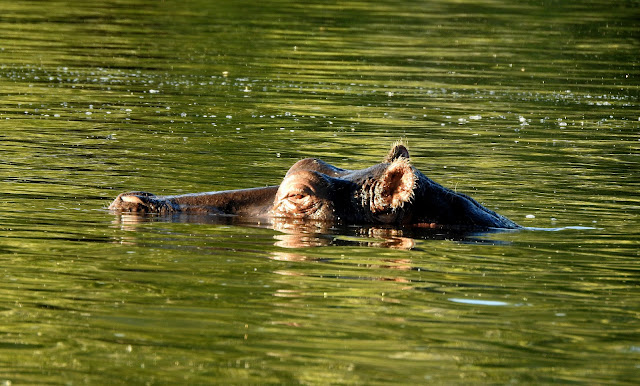
The hippopotamus (Hippopotamus amphibius; /ˌhɪpəˈpɒtəməs/; pl.: hippopotamuses), often shortened to hippo (pl.: hippos), further qualified as the common hippopotamus, Nile hippopotamus and river hippopotamus, is a large semiaquatic mammal native to sub-Saharan Africa. It is one of only two extant species in the family Hippopotamidae, the other being the pygmy hippopotamus (Choeropsis liberiensis or Hexaprotodon liberiensis). Its name comes from the Ancient Greek for "river horse" (ἱπποπόταμος).
After elephants and rhinoceroses, the hippopotamus is the next largest land mammal. It is also the largest extant land artiodactyl. Despite their physical resemblance to pigs and other terrestrial even-toed ungulates, the closest living relatives of the hippopotamids are cetaceans (whales, dolphins, porpoises, etc.), from which they diverged about 55 million years ago.

31-5-2019 THORNTREE CAMP, ZAMBIA - WAHLBERG STRIPED SKINK (Trachylepis striata ssp. wahlbergi)
%20%2020.jpg)
Trachylepis wahlbergii, also known commonly as Wahlberg's striped skink, is a species of lizard in the family Scincidae. The species is native to Southern Africa.
Trachylepis wahlbergii has been considered a subspecies of Trachylepis striata. Whether T. wahlbergii is truly distinct from T. striata is not fully settled.
T. wahlbergii occurs in southern Angola, northern Botswana, northern Namibia, western Mozambique, Zambia, and northern, western and southern Zimbabwe.
%20%2021.jpg)
The specific name, wahlbergi, is in honour of Swedish Naturalist Johan August Wahlberg.
T. wahlbergii is viviparous. In animals, viviparity is the development of the embryo inside the body of the mother, with the maternal circulation providing for the metabolic needs of the embryo's development, until the mother gives birth to a fully or partially developed juvenile that is at least metabolically independent
31-5-2019 THORNTREE CAMP, ZAMBIA - WHITE FRONTED BEE-EATER (Merops bullockoides)

The White-fronted Bee-eater, known scientifically as Merops bullockoides, is a vibrant and slender bird adorned with a striking black mask and a white forehead. Its square tail and bright red throat patch are distinctive features. Measuring at 23 cm in length, the bird's upperparts are a lush green, while its underparts boast a warm cinnamon hue. Its call is a resonant, deep squeak that carries through the air.
To identify the White-fronted Bee-eater, look for its unique combination of colors: a black mask, white forehead, green upperparts, and cinnamon underparts. The square tail and bright red throat patch are also key identifiers. Listen for its deep squeaking call as a helpful auditory clue.

This species thrives in the open savannahs of sub-equatorial Africa, often found near gullies where their insect prey, particularly bees, are abundant.
The White-fronted Bee-eater is widely distributed across the savannah regions of sub-equatorial Africa, where it is a common sight in its preferred habitat.

The White-fronted Bee-eater exhibits a complex social structure, nesting in colonies that can average around 200 individuals. These colonies are not just for breeding but also serve as a communal space for roosting and socializing. The birds demonstrate cooperative breeding, with non-breeding individuals acting as helpers to their kin, significantly increasing the success rate of raising young.

The White-fronted Bee-eater is currently listed as Least Concern on the IUCN Red List, indicating that it is not at immediate risk of population decline or habitat loss at a global scale.

The diet of the White-fronted Bee-eater primarily consists of bees, but it also includes other flying insects, depending on seasonal availability. They employ two hunting strategies: making swift hawking flights from lower branches or gliding down from perches to hover momentarily before snatching their prey mid-flight.
Subscribe to:
Posts (Atom)