TOTAL PAGEVIEWS

TRANSLATE

Showing posts with label PEA BLUE BUTTERFLY (Lampides boeticus). Show all posts

Wednesday, 14 May 2025

31-3-2025 GOATFELL LODGE, SRI LANKA - PEA BLUE BUTTERFLY (Lampides boeticus)


Lampides boeticus, the pea blue, or long-tailed blue, is a small butterfly that belongs to the lycaenids or gossamer-winged family.

The Latin species name boeticus refers to Baetica, a province of the Roman Empire in the Iberian Peninsula . Its common name refers to the long streamers on its hind wings, the male's bright iridescent blue colour, and peas, which is the typical host plant of the butterfly.

This species was first described by Carl Linnaeus in 1767 and was initially named Papilio boeticus.

This species can be found in Europe, Africa, South and Southeast Asia, and Australia. It is also found in the Hawaiian islands. In New Zealand this species is regarded as being self introduced as was first observed in November 1965.
 
This species inhabits the edge of forests, mountain meadows and hot flowery places at an elevation up to 2,700 metres (8,900 ft) above sea level. 

Sunday, 30 April 2023

30-4-2023 MONTE CORONA, VALENCIA - PEA BLUE BUTTERFLY (Lampides boeticus)


This species inhabits the edge of forests, mountain meadows and hot flowery places at an elevation up to 2,700 metres (8,900 ft) above sea level.
This species may have three generations a year. Adults fly from February to early November and are strong migrants. Eggs are white with a greenish tinge and have a disc-shaped form. They can reach a diameter of 0.5 mm. They are laid singly on the flower buds of the host plants.
Old caterpillars are green or reddish-brown, with dark dorsal stripe. They reach a length of 14-15 mm. Pupae reach a length of 9-10 mm. They are light grayish-brown with medium-sized dark spots and dark dorsal stripe.

The larvae feed on flowers, seeds and pods of many Fabaceae species, including Medicago, Crotalaria, Polygala, Sutherlandia, Dolichos, Cytisus, Spartium and Lathyrus species.

Tuesday, 31 December 2019

31-12-2019 MONTE CORONA, VALENCIA - PEA BLUE BUTTERFLY (Lampides boeticus)


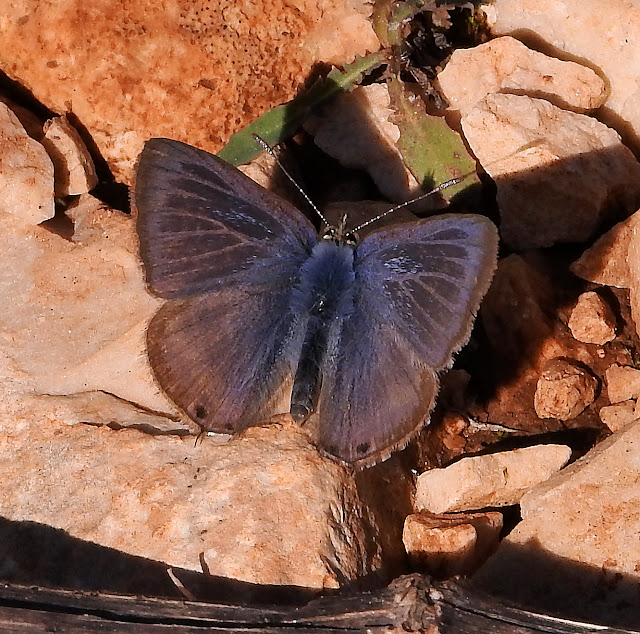
The pea blue butterfly, also known as the Long-tailed Pea Blue, is a widely distributed species with a wingspan of about 2.5–3.0 cm. It is known for the male's purplish-blue upper wings and the female's brown wings with a blueish tinge. A key feature is the "false head" created by two black spots and fine, tail-like filaments on the hindwings, which helps confuse predators. 

Appearance and identification
Males: Have a vivid purplish-blue upper side with dark brown margins.
Females: Have a more muted appearance, with brown upper wings that have a blue-purple wash, especially on the forewings.
Underside: Both sexes share a light brown underside with white, linear markings and a pronounced white band near the outer edge.
"False head": The hindwings have two small black spots on the outer margin, with a sky-blue or metallic green rim, and a fine, tail-like appendage that mimics an antenna.
Size: The wingspan is typically between 2.5 and 3.0 cm. 


Habitat and distribution
Widespread: Found across Europe, Asia, and Africa, and in parts of Australia and New Zealand.
Adaptable: Lives in a variety of habitats, including suburban gardens.
Migratory: This species is a strong and active migrant. 
Behavior and life cycle
Flight: They have a fast and jerky flight style and often stay close to the ground.
Basking: They often bask with their wings partially open, both in the morning and around midday.
Feeding: Adults feed on nectar and may also be attracted to damp soil to absorb minerals.
Pest status: Can be considered a minor pest in gardens, as the larvae feed on leguminous plants like peas and beans.
Ant association: The larvae are sometimes attended by ants, which protect them from predators. 

Tuesday, 10 December 2019

10-12-2019 OLIVA, VALENCIA - PEA BLUE BUTTERFLY (Lampides boeticus)


Lampides boeticus, the pea blue, or long-tailed blue, is a small butterfly that belongs to the lycaenids or gossamer-winged family.

The Latin species name boeticus refers to Baetica, a province of the Roman Empire in the Iberian Peninsula . Its common name refers to the long streamers on its hind wings, the male's bright iridescent blue colour, and peas, which is the typical host plant of the butterfly.

This species was first described by Carl Linnaeus in 1767 and was initially named Papilio boeticus.

This species can be found in Europe, Africa, South and Southeast Asia, and Australia. It is also found in the Hawaiian islands. In New Zealand this species is regarded as being self introduced as was first observed in November 1965.

This species inhabits the edge of forests, mountain meadows and hot flowery places at an elevation up to 2,700 metres (8,900 ft) above sea level.

The wingspan is 24–32 mm for males and 24–34 mm for females. In these small butterflies (although unusually large for their family) the males have a mainly blue violet upper face of the wings with the brown edges, while the females have only a small amount of blue colour in the centre of the wings (sexual dimorphism). Both sexes have a thin, long tail in the hindwings and two black spots in the anal angle. The underface of the wings is ocher and adorned with white markings and with a larger white submarginal streak.