TOTAL PAGEVIEWS

TRANSLATE

Showing posts with label WIRE TAILED SWALLOW (Hirundo smithii). Show all posts

Saturday, 18 May 2024

17-4-2023 KEN RIVERSIDE LODGE, INDIA - WIRE TAILED SWALLOW (Hirundo smithii)

The wire-tailed swallow (Hirundo smithii ) is a small passerine bird in the swallow family. It has two subspecies: H. s. smithii, which occurs throughout Africa, and H. s. filifera, which is found in southern and southeastern Asia. It is mainly resident, but populations in Pakistan and northern India migrate further south in winter. The genus name Hirundo is the Latin word for swallow. The species name smithii commemorates Christen Smith, a Norwegian botanist and geologist.

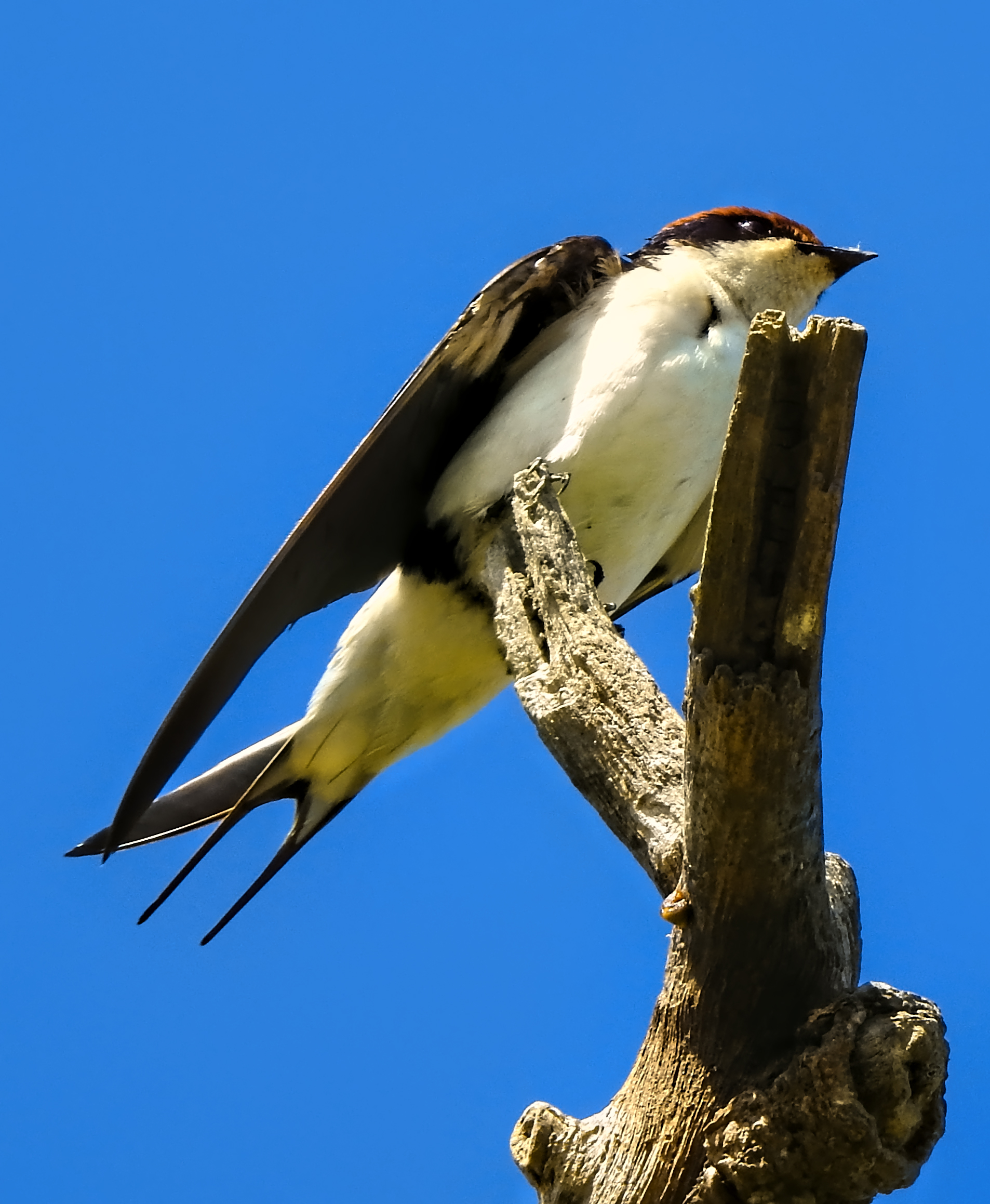
The wire-tailed swallow is a small swallow, measuring 18 cm (7.1 in) in length. It has bright blue upperparts, bright white underparts and a chestnut cap. Immature birds lack tail wires, and have dull brown (rather than chestnut) caps. The species is named for the very long filamentous outermost tail feathers, which trail behind like two wires. The sexes are similar in appearance, but the female has shorter "wires". Juveniles have a brown crown, back and tail. The Asian form, H. s. filifera, is larger and longer-tailed than the abundant African H. s. smithii.


This bird is found in open country near water and human habitation. Wire-tailed swallows are fast flyers and they generally feed on insects, especially flies, while airborne. They are typically seen low over water, with which they are more closely associated than most swallows.

The neat half-bowl nests are lined with mud collected in the swallows' beaks. They are placed on vertical surfaces near water under cliff ledges or nowadays more commonly on man-made structures such as buildings and bridges. The clutch is three to four eggs in Africa, up to five in Asia (Turner and Rose). These birds are solitary and territorial nesters, unlike many swallows, which tend to be colonial.

Monday, 25 December 2023

22-12-2023 PIRANG PONDS, GAMBIA - WIRE TAILED SWALLOW (Hirundo smithii)


The wire-tailed swallow (Hirundo smithii) is a small passerine bird in the swallow family. It has two subspecies: H. s. smithii, which occurs throughout Africa, and H. s. filifera, which is found in southern and southeastern Asia. It is mainly resident, but populations in Pakistan and northern India migrate further south in winter. The genus name Hirundo is the Latin word for swallow. The species name smithii commemorates Christen Smith, a Norwegian botanist and geologist.


The wire-tailed swallow is a small swallow, measuring 18 cm (7.1 in) in length. It has bright blue upperparts, bright white underparts and a chestnut cap. Immature birds lack tail wires, and have dull brown (rather than chestnut) caps. The species is named for the very long filamentous outermost tail feathers, which trail behind like two wires. The sexes are similar in appearance, but the female has shorter "wires". Juveniles have a brown crown, back and tail. The Asian form, H. s. filifera, is larger and longer-tailed than the abundant African H. s. smithii.


This bird is found in open country near water and human habitation. Wire-tailed swallows are fast flyers and they generally feed on insects, especially flies, while airborne. They are typically seen low over water, with which they are more closely associated than most swallows.


The neat half-bowl nests are lined with mud collected in the swallows' beaks. They are placed on vertical surfaces near water under cliff ledges or nowadays more commonly on man-made structures such as buildings and bridges. The clutch is three to four eggs in Africa, up to five in Asia (Turner and Rose). These birds are solitary and territorial nesters, unlike many swallows, which tend to be colonial.


The wire-tailed swallow (Hirundo smithii ) is a small passerine bird in the swallow family. It has two subspecies: H. s. smithii, which occurs throughout Africa, and H. s. filifera, which is found in southern and southeastern Asia. It is mainly resident, but populations in Pakistan and northern India migrate further south in winter. The genus name Hirundo is the Latin word for swallow. The species name smithii commemorates Christen Smith, a Norwegian botanist and geologist.

Tuesday, 16 July 2019

22-5-2019 MANA POOLS, ZIMBABWE - WIRE TAILED SWALLOW (Hirundo smithii)


The wire-tailed swallow is a small bird with a glossy blue back, white underparts, and a chestnut-colored cap, named for its two long, thin tail feathers. It is a fast, aerial insectivore, often seen flying low over water and building its mud nest on vertical surfaces, including human-made structures like bridges and buildings. This species is widespread across sub-Saharan Africa and southern Asia and has a "least concern" conservation status globally. 

Physical characteristics
Size: Measures approximately 18 cm (7.1 in) long.
Plumage: Features glossy blue upperparts, a chestnut forehead and crown, and clean white underparts.
Tail: Distinguished by two very long, thin, wire-like filaments on its outer tail feathers. Females and juveniles have shorter or no "wires" and a duller cap.

Habitat and behavior
Habitat: Prefers open country, such as grasslands, wetlands, and cultivated areas, particularly near water.
Diet: An aerial insectivore that feeds on flying insects like flies, wasps, and termites.
Flight: A very fast flyer that often swoops low over water. 


Nesting and reproduction

Nest: Builds a neat, half-bowl-shaped nest from mud, which is placed on vertical surfaces. Nests are often found under cliff ledges or on man-made structures like bridges, buildings, and culverts.
Territorial: Nests are typically solitary and territorial, unlike some colonial swallow species.
Eggs and incubation: Lays a clutch of 2-4 eggs in Africa and up to 5 in Asia. The female primarily incubates the eggs.
Parental care: Both parents feed the chicks, with the female providing more food. 

Distribution and conservation
Distribution: Found in sub-Saharan Africa and southern Asia. Some populations are resident, while others migrate seasonally.
Conservation status: Globally listed as "least concern" by the IUCN, although some regional statuses may vary.
Threats: The introduction of man-made nest sites has, in fact, benefited this species. 

Sunday, 5 August 2018

13-4-2018 CHOBE RIVER, NAMIBIA - WIRE TAILED SWALLOW (Hirundo smithii)


The wire-tailed swallow (Hirundo smithii) is a small passerine bird in the swallow family. It has two subspecies: H. s. smithii, which occurs throughout Africa, and H. s. filifera, which is found in southern and southeastern Asia. It is mainly resident, but populations in Pakistan and northern India migrate further south in winter. The genus name Hirundo is the Latin word for swallow. The species name smithii commemorates Christen Smith, a Norwegian botanist and geologist.

The wire-tailed swallow, Hirundo smithii, is a diminutive and agile passerine, a member of the swallow family. It is adorned with a lustrous blue plumage on its upperparts and a stark white on the underparts. A chestnut cap crowns its head, adding a touch of warmth to its appearance. The species is particularly noted for its elongated outermost tail feathers, reminiscent of fine wires trailing in flight. These distinctive "wires" are more pronounced in males than in females.

Friday, 13 April 2018

13-4-2018 CHOBE RIVER, NAMIBIA - WIRE TAILED SWALLOW (Hirundo smithii)


The wire-tailed swallow (Hirundo smithii) is a small passerine bird in the swallow family. It has two subspecies: H. s. smithii, which occurs throughout Africa, and H. s. filifera, which is found in southern and southeastern Asia. It is mainly resident, but populations in Pakistan and northern India migrate further south in winter. The genus name Hirundo is the Latin word for swallow. The species name smithii commemorates Christen Smith, a Norwegian botanist and geologist.

The wire-tailed swallow, Hirundo smithii, is a diminutive and agile passerine, a member of the swallow family. It is adorned with a lustrous blue plumage on its upperparts and a stark white on the underparts. A chestnut cap crowns its head, adding a touch of warmth to its appearance. The species is particularly noted for its elongated outermost tail feathers, reminiscent of fine wires trailing in flight. These distinctive "wires" are more pronounced in males than in females.


The wire-tailed swallow is a small swallow, measuring 18 cm (7.1 in) in length. It has bright blue upperparts, bright white underparts and a chestnut cap. Immature birds lack tail wires, and have dull brown (rather than chestnut) caps. The species is named for the very long filamentous outermost tail feathers, which trail behind like two wires. The sexes are similar in appearance, but the female has shorter "wires". Juveniles have a brown crown, back and tail. The Asian form, H. s. filifera, is larger and longer-tailed than the abundant African H. s. smithii.

This bird is found in open country near water and human habitation. Wire-tailed swallows are fast flyers and they generally feed on insects, especially flies, while airborne. They are typically seen low over water, with which they are more closely associated than most swallows.


The neat half-bowl nests are lined with mud collected in the swallows' beaks. They are placed on vertical surfaces near water under cliff ledges or nowadays more commonly on man-made structures such as buildings and bridges. The clutch is three to four eggs in Africa, up to five in Asia (Turner and Rose). These birds are solitary and territorial nesters, unlike many swallows, which tend to be colonial.

The wire-tailed swallow has a wide range that includes Africa and southern to southeastern Asia. The African subspecies, H. s. smithii, is resident across the continent, while the Asian subspecies, H. s. filifera, is found from India to Southeast Asia. In some regions, such as Pakistan and northern India, these birds migrate southward during the winter months.

Renowned for their swift and agile flight, wire-tailed swallows are often seen flying low over water surfaces. They are solitary and territorial when it comes to nesting, which is a departure from the more common colonial nesting habits of many swallows.

The vocalizations of the wire-tailed swallow consist of a series of chirps and trills, a common characteristic of swallow communication.

The species constructs neat half-bowl nests, meticulously lined with mud collected in their beaks. These nests are typically affixed to vertical surfaces near water, such as under cliff ledges, and increasingly on man-made structures like buildings and bridges. Clutch sizes vary from three to four eggs in Africa to up to five in Asia.

These birds are insectivorous, feeding predominantly on flies which they catch mid-flight. Their feeding grounds are usually close to water, where insect prey is abundant.