TOTAL PAGEVIEWS

TRANSLATE

Thursday, 24 May 2018

24-5-2018 MONTE CORONA, VALENCIA - COMMON LANTANA (Lantana camara)


Lantana camara (common lantana) is a species of flowering plant in the verbena family (Verbenaceae), native to the American tropics. It is a very adaptable species, which can inhabit a wide variety of ecosystems; once it has been introduced into a habitat it spreads rapidly; between 45ºN and 45ºS and less than 1,400 metres (4,600 feet) in altitude.

It has spread from its native range to around 50 countries, where it has become an invasive species. It first spread out of the Americas when it was brought to Europe by Dutch explorers and cultivated widely, soon spreading further into Asia and Oceania where it has established itself as a notorious weed, and in Goa Former Estado da Índia Portuguesa it was introduced by the Portuguese.

L. camara can outcompete native species, leading to a reduction in biodiversity. It can also cause problems if it invades agricultural areas as a result of its toxicity to livestock, as well as its ability to form dense thickets which, if left unchecked, can greatly reduce the productivity of farmland by suppressing the pastures (grasses) essential for livestock production and also suppresses crops in cultivated farmlands.

24-5-2018 VILLALONGA RESERVOIR, VALENCIA - WHITE FEATHERLEG DAMSELFLY (Platycnemis latipes)


The white-legged damselfly or blue featherleg (Platycnemis pennipes) is a damselfly of slow-flowing, muddy waters. It occurs from the Atlantic to Siberia and is often abundant throughout its range.

The male has a blue abdomen that is often pale and usually has a greenish thorax. The female is a very pale yellow-green colour with black markings.

This species favours unshaded slow-flowing sections of muddy rivers with abundant floating vegetation. it has been recorded in tidal rivers and the larvae seem well able to tolerate brackish water. It also occurs in muddy streams but is rare in lakes or ponds of any sort. In north-west Europe, it is mostly confined to flowing waters.

Mating is preceded by the male displaying his white legs in a fluttering display flight in front of females. Elongated eggs are laid whilst in tandem, into emergent stems and especially the underside of floating leaves. The larvae live amongst bottom debris and emerge after two years.

After emerging, adults tend to congregate in the shelter of tall vegetation, although some immatures wander away from water and have been found five kilometres away from the nearest breeding site.

15-4-2018 CHOBE RIVER, NAMIBIA - GREATER KUDU (Tragelaphus Strepsiceros) COURTESY OF MRS VALERIE FISHER


The Greater kudu (Tragelaphus strepsiceros) is a woodland antelope found in Africa. Despite occupying such widespread territory, Greater kudus are sparsely populated in most areas due to declining habitat, deforestation, and poaching.

Greater kudus have a narrow body with long legs, and their coats can range from brown/bluish-grey to reddish-brown. They possess between 4 and 12 vertical white stripes along their torso. The head is usually darker in color than the rest of the body and exhibits a small white v-shaped mark that runs between the eyes. Bulls tend to be much larger than cows, and vocalize much more; they also have beards running along their throats and large horns with two and a half twists.

The range of Greater kudu extends from the east in Ethiopia, Tanzania, Eritrea, and Kenya into the south where they are found in Zambia, Angola, Namibia, Botswana, Zimbabwe, and South Africa. Other regions where they occur are the Central African Republic, Chad, the Democratic Republic of the Congo, Djibouti, Malawi, Mozambique, Somalia, Swaziland, and Uganda. These antelopes live in mixed scrub woodlands and bush on abandoned fields and degraded pastures, mopane bush, and acacia in lowlands, hills, and mountains. They will occasionally venture onto plains only if there is a large abundance of bushes but normally avoid such open areas to avoid becoming an easy target for their predators.

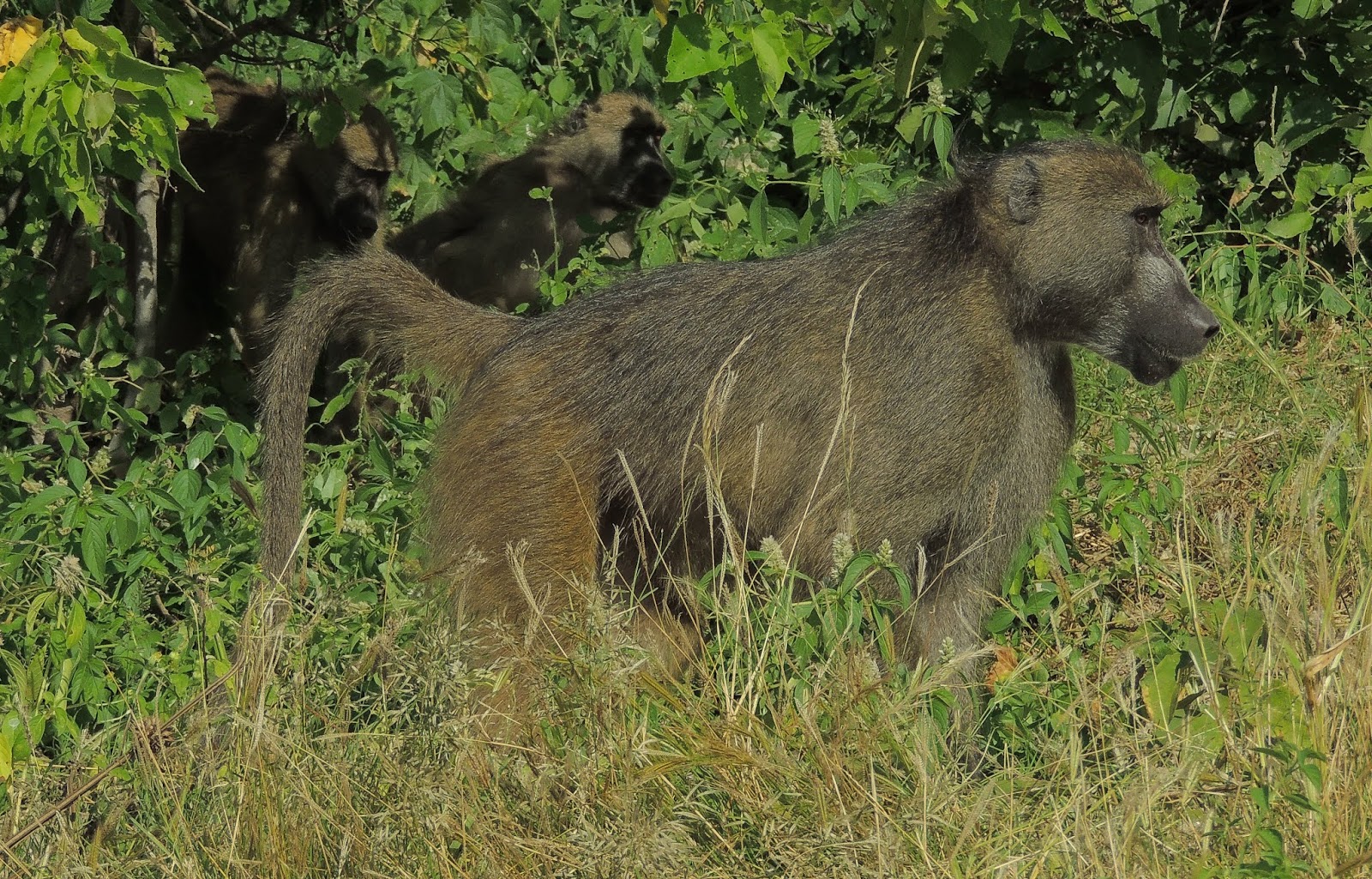
15-4-2018 CHOBE RIVER, NAMIBIA - CHACMA BABOON (Papio ursinus) COURTESY OF MRS VALERIE FISHER


The Chacma baboon (Papio ursinus) is a member of the Old World monkey family. It is one of the largest of all monkeys. Located primarily in southern Africa, the chacma baboon has a wide variety of social behaviors, including a dominance hierarchy, collective foraging, adoption of young by females, and friendship pairings. In general, the species is not threatened, but hunting, trapping, and accidents kill or remove many baboons from the wild, thereby reducing their numbers and disrupting their social structure.

The Chacma baboon is perhaps the longest species of monkey and it is also one of the heaviest. Adult males can in some instances be about twice as long and three times as heavy as adult females. Perhaps the most distinctive feature of this baboon is its long, downward-sloping face. The Chacma baboon is generally dark brown to gray in color, with a patch of rough hair on the nape of its neck. Unlike the males of northern baboon species (Guinea, hamadryas, and Olive baboons), Chacma males do not have a mane. The three subspecies are differentiated by size and color. The Cape chacma is a large, heavy, dark-brown, and has black feet. The Gray-footed chacma is slightly smaller than the Cape chacma, lighter in color and build, and has gray feet. The Ruacana chacma generally appears to be a smaller, less darkly colored version of the Cape chacma.


Chacma baboons are found throughout southern Africa, ranging from South Africa north to Angola, Zambia, and Mozambique. They live in diverse habitats from woodlands to savannas, steppes, and sub-deserts. Chacma baboons are found in the Kalahari Desert as well as on the alpine slopes of the Drakensberg. They usually sleep on hills, cliffs, or large trees and during the day, avoid arid areas with a lack of water.

Chacma baboons are diurnal, spending most of the day on the ground. They are highly sociable animals, living in troops, which consist of 20-80 individuals. The troops include males as well as females with their young. Members of a troop are in close ties with each other, sleeping, feeding, and grooming together. During the day the groups split into smaller subgroups, consisting of 4-5 females with their young and a dominant male, who leads the group and defends it from other males. They are always on the alert, living in troops for protection and watching for predators. When threatened, the baboons give out loud barks. Then the males run to attack while the females and young hide in a safe place among the trees. Chacma baboons communicate by vocalizations, using about 30 different sounds such as grunting, barking, or screaming. They also use gestures such as shoulder shrugs, yawns, or lip-smacking.


Chacma baboons have polygynandrous (promiscuous) mating system. The dominant male of a subgroup competes with other males for mating rights, though females of baboons mate with a number of males during their lives. They breed at any time of the year. The gestation period lasts about six months, yielding a single baby. The newborn infant clings onto its mother’s breast, grabs onto her fur and later rides on her back. The baby is weaned at the age of 8-12 months. By this time, females keep on living within the troop while males usually join another troop. Males become reproductively mature at 5 years old whereas females are mature at 3 years old.

15-4-2018 CHOBE RIVER, NAMIBIA - BROWN HOODED KINGFISHER (Halcyon albiventris) COURTESY OF MRS VALERIE FISHER


The Brown-hooded Kingfisher, Halcyon albiventris, presents a striking figure with its rich brown head adorned with blackish streaks. This bird, approximately 22 cm in length, boasts a broad buffy collar that sits above a brownish-black mantle. Its wing coverts are primarily brownish-black, while the secondary flight feathers exhibit a vibrant turquoise. The rump is a brilliant azure-blue, creating a stark contrast with the white chin and tawny breast, which is marked with dark streaks. The belly is a soft buffy color. A red beak tipped with brown, carmine legs, and dark brown eyes complete the bird's vivid palette. Sexual dimorphism is evident, with the female displaying darker upperparts and more streaked underparts than the male. Juveniles are duller with scalloped whitish underparts.

When identifying the Brown-hooded Kingfisher, look for the distinctive brown head with blackish streaks and the broad buffy collar. The turquoise secondary flight feathers and azure-blue rump are also key features. The red beak with a brown tip and carmine legs are notable, as is the bird's size, which is around 22 cm long. Females and juveniles have their own distinguishing characteristics, with females being darker and juveniles appearing duller with scalloped underparts.


This kingfisher inhabits a variety of environments, including woodlands, grasslands with trees, scrublands, and forest edges. It is also comfortable in cultivated areas, parks, and gardens, and can adapt to suburban settings. While sometimes found near water, it is not strictly tied to aquatic habitats.

The Brown-hooded Kingfisher is a resident of Sub-Saharan Africa, with its range extending from Gabon and Congo to South Africa and Eswatini. It is typically found at elevations below 1,800 meters.

This solitary or sometimes paired bird is known for its ground foraging habits. It has a diverse diet that includes insects, scorpions, reptiles, small birds, rodents, and fish. Remarkably, it has been observed consuming snakes and lizards up to 25 cm in length. Its breeding season spans from September to April, during which it nests in burrows along river banks or in gullies. Post-breeding, the family unit remains together for several weeks.


The Brown-hooded Kingfisher's vocal repertoire includes a song that sounds like a "tiiiu" or a "ki-ti-ti-ti" trill, often accompanied by wing vibrations. When alarmed, it emits a sharp "cheerit."

Breeding occurs mainly between September and April. The kingfisher digs a burrow nest in a river bank, gully, or road cutting, where it raises its young. After the breeding season, the family stays together for a few weeks.

The Brown-hooded Kingfisher feeds on a variety of prey, including insects, scorpions, reptiles, small birds, rodents, and fish. It is an adept hunter, capable of taking on prey such as snakes and lizards up to 25 cm long.

The IUCN has classified the Brown-hooded Kingfisher as a species of Least Concern, thanks to its large range, stable population, and lack of significant threats.

15-4-2018 CHOBE RIVER, NAMIBIA - AFRICAN ELEPHANT (Loxodonta africana) COURTESY OF MRS VALERIE FISHER


The African bush elephant (Loxodonta africana), also known as the African savanna elephant, is a species of elephant native to sub-Saharan Africa. It is one of three extant elephant species and, along with the African forest elephant, one of two extant species of African elephant. It is the largest living terrestrial animal, with fully grown bulls reaching an average shoulder height of 3.04–3.36 metres (10.0–11.0 ft) and a body mass of 5.2–6.9 tonnes (11,000–15,000 lb); the largest recorded specimen had a shoulder height of 3.96 metres (13.0 ft) and an estimated body mass of 10.4 tonnes (23,000 lb). The African bush elephant is characterised by its long prehensile trunk with two finger-like processes; a convex back; large ears which help reduce body heat; and sturdy tusks that are noticeably curved. The skin is grey with scanty hairs, and bending cracks which support thermoregulation by retaining water.


The African bush elephant inhabits a variety of habitats such as forests, grasslands, woodlands, wetlands and agricultural land. It is a mixed herbivore feeding mostly on grasses, creepers, herbs, leaves, and bark. The average adult consumes about 150 kg (330 lb) of vegetation and 230 L (51 imp gal; 61 US gal) of water each day. A social animal, the African bush elephant often travels in herds composed of cows and their offspring. Adult bulls usually live alone or in small bachelor groups. During the mating season, males go through a process called musth; a period of high testosterone levels and heightened aggression. For females, the menstrual cycle lasts three to four months, and gestation around 22 months, the longest of any mammal.

15-4-2018 CHOBE RIVER, NAMIBIA - HIPPOPOTAMUS (Hippopotamus amphibius) COURTESY OF MRS VALERIE FISHER


The hippopotamus (Hippopotamus amphibius) (/ˌhɪpəˈpɒtəməs/; pl.: hippopotamuses; often shortened to hippo (pl.: hippos), further qualified as the common hippopotamus, Nile hippopotamus and river hippopotamus, is a large semiaquatic mammal native to sub-Saharan Africa. It is one of only two extant species in the family Hippopotamidae, the other being the pygmy hippopotamus (Choeropsis liberiensis or Hexaprotodon liberiensis). Its name comes from the ancient Greek for "river horse" (ἱπποπόταμος).

After elephants and rhinoceroses, the hippopotamus is the next largest land mammal. It is also the largest extant land artiodactyl. Despite their physical resemblance to pigs and other terrestrial even-toed ungulates, the closest living relatives of the hippopotamids are cetaceans (whales, dolphins, porpoises, etc.), from which they diverged about 55 million years ago. Hippos are recognisable for their barrel-shaped torsos, wide-opening mouths with large canine tusks, nearly hairless bodies, pillar-like legs, and large size: adults average 1,500 kg (3,300 lb) for bulls (males) and 1,300 kg (2,900 lb) for cows (females). Despite its stocky shape and short legs, it is capable of running 30 km/h (19 mph) over short distances.


Hippos inhabit rivers, lakes, and mangrove swamps. Territorial bulls each preside over a stretch of water and a group of five to thirty cows and calves. Mating and birth both occur in the water. During the day, hippos remain cool by staying in water or mud, emerging at dusk to graze on grasses. While hippos rest near each other in the water, grazing is a solitary activity and hippos typically do not display territorial behaviour on land. Hippos are among the most dangerous animals in the world due to their aggressive and unpredictable nature. They are threatened by habitat loss and poaching for their meat and ivory (canine teeth).

15-4-2018 CHOBE RIVER, NAMIBIA - NILE CROCODILE (Crocodylus niloticus) COURTESY OF MRS VALERIE FISHER


The Nile crocodile (Crocodylus niloticus) is a large crocodilian native to freshwater habitats in Africa, where it is present in 26 countries. It is widely distributed in sub-Saharan Africa, occurring mostly in the eastern, southern, and central regions of the continent, and lives in different types of aquatic environments such as lakes, rivers, swamps and marshlands. It occasionally inhabits deltas, brackish lakes and rarely also saltwater. Its range once stretched from the Nile Delta throughout the Nile River. Lake Turkana in Kenya has one of the largest undisturbed Nile crocodile populations.

Generally, the adult male Nile crocodile is between 3.5 and 5 m (11 ft 6 in and 16 ft 5 in) in length and weighs 225 to 750 kg (496 to 1,653 lb).[5][6] However, specimens exceeding 6.1 m (20 ft) in length and 1,000 kg (2,200 lb) in weight have been recorded. It is the largest predator in Africa, and may be considered the second-largest extant reptile in the world, after the saltwater crocodile (Crocodylus porosus).[8][9] Size is sexually dimorphic, with females usually about 30% smaller than males. The crocodile has thick, scaly, heavily armoured skin.


Nile crocodiles are opportunistic apex predators; a very aggressive crocodile, they are capable of taking almost any animal within their range. They are generalists, taking a variety of prey, with a diet consisting mostly of different species of fish, reptiles, birds, and mammals. As ambush predators, they can wait for hours, days, and even weeks for the suitable moment to attack. They are agile predators and wait for the opportunity for a prey item to come well within attack range. Even swift prey are not immune to attack. Like other crocodiles, Nile crocodiles have a powerful bite that is unique among all animals, and sharp, conical teeth that sink into flesh, allowing a grip that is almost impossible to loosen. They can apply high force for extended periods of time, a great advantage for holding down large prey underwater to drown.


Nile crocodiles are relatively social. They share basking spots and large food sources, such as schools of fish and big carcasses. Their strict hierarchy is determined by size. Large, old males are at the top of this hierarchy and have first access to food and the best basking spots. Crocodiles tend to respect this order; when it is infringed, the results are often violent and sometimes fatal. Like most other reptiles, Nile crocodiles lay eggs; these are guarded by the females but also males, making the Nile crocodiles one of few reptile species whose males contribute to parental care. The hatchlings are also protected for a period of time, but hunt by themselves and are not fed by the parents.

The Nile crocodile is one of the most dangerous species of crocodile and is responsible for hundreds of human deaths every year. It is common and is not endangered, despite some regional declines or extirpations in the Maghreb.

15-4-2018 CHOBE RIVER, NAMIBIA - WHITE FACED WHISTLING DUCK (Dendrocygna viduata) COURTESY OF MRS VALERIE FISHER


The White-faced Whistling Duck, Dendrocygna viduata, is a distinctive species with a long grey bill, elongated head, and relatively long legs. Its plumage is characterized by a black neck and head contrasted with a white face, which can vary in extent regionally. The back and wings are cloaked in dark brown to black, while the underparts are black with fine white barring on the flanks. A chestnut neck completes the ensemble. Both sexes are similarly attired, and juveniles resemble adults but with less pronounced head markings.

When identifying the White-faced Whistling Duck, look for the stark white face against a black head and neck. The species also has a distinctive three-note whistling call that can aid in identification even when the bird is not in sight.

These ducks favor freshwater lakes and reservoirs rich in vegetation, where they can forage for seeds and other plant-based food.

The White-faced Whistling Duck has a curious distribution, found in both sub-Saharan Africa and much of South America. It is thought that human activity may have contributed to their spread across these continents.

22-5-2018 MONTE CORONA, VALENCIA - SPECKLED FOOTMAN MOTH (Coscinia cribraria)


Coscinia cribraria, the speckled footman, is a species of moth belonging to the subfamily Arctiinae within the large family Erebidae. This moth has a widespread distribution in the Palearctic.

Coscinia cribraria has a forewing which has a background colour of dirty white marked with black streaks along the wings and crossbands made up of dark dots, both of which vary in extent. The subspecies arenaria has an almost pure white forewing. The speckled footman has a wingspan of between 30 and 35 mm (1.2 and 1.4 in).

Coscinia cribraria has a wide Palearctic distribution being found from Northwestern Africa Iberia and southern Great Britain east to China and Mongolia. In Europe, north of the Alps, the speckled footman is typically found on sandy heaths and open sandy pine forests. To the south of the Alps, it inhabits on dry mountain meadows with stony or rocky areas and around the Mediterranean this species can be found in habitats like maquis and in open forests.

Wednesday, 23 May 2018

5-4-2018 CHOBE RIVER, NAMIBIA - HIPPOPOTAMUS (Hippopotamus amphibius), COURTESY OF MRS VALERIE FISHER


The hippopotamus (Hippopotamus amphibius) (/ˌhɪpəˈpɒtəməs/; pl.: hippopotamuses; often shortened to hippo (pl.: hippos), further qualified as the common hippopotamus, Nile hippopotamus and river hippopotamus, is a large semiaquatic mammal native to sub-Saharan Africa. It is one of only two extant species in the family Hippopotamidae, the other being the pygmy hippopotamus (Choeropsis liberiensis or Hexaprotodon liberiensis). Its name comes from the ancient Greek for "river horse" (ἱπποπόταμος).


After elephants and rhinoceroses, the hippopotamus is the next largest land mammal. It is also the largest extant land artiodactyl. Despite their physical resemblance to pigs and other terrestrial even-toed ungulates, the closest living relatives of the hippopotamids are cetaceans (whales, dolphins, porpoises, etc.), from which they diverged about 55 million years ago. Hippos are recognisable for their barrel-shaped torsos, wide-opening mouths with large canine tusks, nearly hairless bodies, pillar-like legs, and large size: adults average 1,500 kg (3,300 lb) for bulls (males) and 1,300 kg (2,900 lb) for cows (females). Despite its stocky shape and short legs, it is capable of running 30 km/h (19 mph) over short distances.

5-4-2018 CHOBE RIVER, NAMIBIA - AFRICAN FISH EAGLE (Haliaeetus vocifer) COURTESY OF MRS VALERIE FISHER


The African fish eagle, or African sea eagle, is a majestic bird of prey that graces the skies of sub-Saharan Africa. It is a symbol of national pride, being the national bird of Malawi, Namibia, Zambia, and Zimbabwe. This raptor is known for its striking appearance, with a mostly brown body contrasted by a snow-white head, breast, and tail. The face is featherless and a vivid yellow, matching the color of its formidable, hooked beak, tipped in black. The African fish eagle's eyes are a deep, dark brown, and its powerful black wings carry it effortlessly over open waters.

Adult African fish eagles are unmistakable with their white heads and chests, brown bodies, and large black wings. Females are larger than males, with wingspans reaching up to 2.4 meters, compared to the 2-meter span of males. Juveniles can be identified by their overall brown plumage and paler eyes. The species exhibits sexual dimorphism, with females being heavier, weighing between 3.2 to 3.6 kilograms, while males weigh between 2.0 to 2.5 kilograms.

These eagles are typically found near freshwater lakes, reservoirs, rivers, and sometimes along coastlines at river mouths or lagoons. They thrive in a variety of habitats, including grasslands, swamps, marshes, tropical rainforests, and even desert-bordering coastlines.

The African fish eagle is indigenous to sub-Saharan Africa, with a presence in most areas south of the Sahara Desert. It is commonly seen in regions like the Orange River, the Okavango Delta, and around Lake Victoria and other large Rift Valley lakes.


The African fish eagle is known for its iconic, evocative call, which many consider the essence of Africa. It is a territorial bird, often seen perched high in a tree, surveying its domain. When hunting, it exhibits remarkable prowess, swooping down to snatch fish from the water with its taloned feet.

The call of the African fish eagle is a high-pitched and clear "weee-ah, hyo-hyo" or "heee-ah, heeah-heeah," with the male's call being particularly shrill.

Breeding occurs during the dry season, with pairs believed to mate for life. They maintain and reuse multiple nests, which can grow quite large over time. The female lays one to three eggs, primarily white with reddish speckles, and both parents share incubation duties. Chicks fledge at around 70 to 75 days old and remain dependent on their parents for up to three months.

The African fish eagle primarily feeds on fish, which it catches by swooping from a perch. It has specialized structures on its toes called spiricules to help grasp slippery prey. While fish are the mainstay of its diet, it also consumes waterbirds, small turtles, baby crocodiles, frogs, insects, and occasionally mammals. It is also known to engage in kleptoparasitism, stealing prey from other birds.

15-4-2018 CHOBE RIVER, NAMIBIA - SOUTHERN CARMINE BEE-EATER (Merops nubicoides) COURTESY OF MRS VALERIE FISHER


The Southern Carmine Bee-eater graces the skies from KwaZulu-Natal and Namibia to Gabon, eastern Democratic Republic of the Congo, and Kenya. It is a migratory bird, breeding in Zimbabwe and Zambia from August to November, then moving to South Africa during the summer months, and finally migrating to Equatorial Africa from March to August.

This species is highly sociable, often seen in large flocks. They roost communally in trees or reedbeds and disperse widely during the day. Their agility is showcased as they hawk flying insects from perches or even while following large animals or vehicles to catch prey disturbed by these moving entities.

15-4-2018 CHOBE RIVER, NAMIBIA - AFRICAN PIED KINGFISHER (Ceryle rudis ssp rudis) COURTESY OF MRS VALERIE FISHER


This kingfisher is commonly found perched along the edges of clear lakes and rivers, where it can easily spot and dive for fish.

The pied kingfisher is widely distributed across sub-Saharan Africa and southern Asia, from Turkey to India and China. It is a resident species, with most populations not engaging in long migrations.

The pied kingfisher is often seen bobbing its head and flicking its tail while perched. It is a sociable bird, known to form large roosts at night. Its flight is direct and rapid, sometimes reaching speeds close to 50 km/h.


This species is quite vocal, emitting sharp "chirruk chirruk" notes that contribute to its presence being easily detected.

Breeding season for the pied kingfisher typically occurs from February to April in India. They nest in holes excavated in vertical mud banks above water. The nests are tunnel-like, leading to a chamber where a clutch of three to six white eggs is laid. Cooperative breeding is observed in this species, with non-breeding offspring from previous broods assisting in raising the young.

23-5-2018 ALBUFERA, VALENCIA - COLLARED PRATINCOLE (Glareola pratincola)


The Collared Pratincole, known to some as the Common Pratincole or Red-winged Pratincole, is a distinctive wader belonging to the family Glareolidae. This bird is characterized by its short legs, long pointed wings, and a long forked tail. The bill is short, an adaptation for its aerial feeding habits. Adults typically measure 24–28 cm in length with a wingspan of 60–70 cm. The plumage is a blend of brown on the back and head, with a stark white belly. The underwings are a rich chestnut, presenting a darker appearance from below.

To identify the Collared Pratincole, one must look for its chestnut underwings and deeply forked tail. It can be challenging to distinguish from similar species such as the Black-winged Pratincole and the Oriental Pratincole, especially since the latter also possesses chestnut underwings but has a shorter tail.


The Collared Pratincole thrives in open country and is frequently observed near bodies of water, particularly in the evening as it hunts for insects.

This species graces the warmer regions of Europe, southwest Asia, and Africa with its presence. It is a migratory bird, retreating to tropical Africa to overwinter and is considered a rarity north of its breeding territories.


Pratincoles are unique among waders due to their propensity to capture insect prey on the wing, akin to swallows, though they are also capable of feeding on the ground.


The Collared Pratincole is a colonial nester, with a preference for laying its eggs in shallow scrapes on open ground, often near water. The clutch consists of 2–4 eggs, which are cream in color with black or dark brown markings. Both parents share the responsibility of incubation, which lasts for 17-19 days, and the young are precocial and nidifugous, leaving the nest within 2–3 days. The fledglings take to the skies after 25–30 days.

The Black-winged Pratincole and Oriental Pratincole are the species most similar to the Collared Pratincole. The key to differentiating them lies in the details of the tail length and underwing coloration.


The Collared Pratincole's diet consists primarily of insects, which it adeptly catches in flight, demonstrating its aerial agility.

The Collared Pratincole is listed as Least Concern on the IUCN Red List. It is also a species protected under the Agreement on the Conservation of African-Eurasian Migratory Waterbirds (AEWA).

23-5-2018 ALBUFERA, VALENCIA - PURPLE HERON (Ardea purpurea)


The Purple Heron (Ardea purpurea), a statuesque avian, stands with a height ranging from 70 to 94 cm and boasts a wingspan of 120 to 152 cm. Despite its grand stature, it is a slender creature, tipping the scales at a mere 0.5 to 1.35 kg. This bird is slightly smaller and more svelte than its cousin, the Grey Heron, and is adorned with darker, reddish-brown plumage.

Adult Purple Herons are distinguished by their black foreheads and crowns, with a dark stripe cascading down the back of the neck, culminating in a modest, dangling crest. Their heads and necks are a buffish chestnut, streaked with dark lines, while the mantle dons an oily brown hue. The upper parts and tail are a brownish grey, and the underparts are a mix of chestnut and black. During the breeding season, the beak of the adult brightens, and the eyes gleam with a yellow iris.

The Purple Heron is a denizen of marshes, lagoons, and lakes, often shrouded by dense vegetation. It has a penchant for freshwater habitats, particularly those with expansive reed beds of Phragmites. Coastal mangrove swamps are also within its realm, though less frequently visited.

This heron has a broad range that spans Africa, central and southern Europe, and the southern and eastern Palearctic. While the Western Palearctic populations are migratory, their African and tropical-Asian counterparts are mostly sedentary, save for occasional dispersive movements.


The Purple Heron is a creature of stealth and grace, often retreating to the sanctuary of reed beds. It exhibits a slow, deliberate flight, with its neck retracted and legs trailing behind. On land, it moves with long toes that allow it to traverse floating vegetation or even bushwalk without grasping the branches. Dawn and dusk are its preferred times for activity, with the bird often seen stalking or standing in ambush for its prey.

The heron's vocalization is a subdued "frarnk," a quieter and higher-pitched affair compared to the Grey Heron. It is generally less vocal, but similar guttural sounds may emanate from its colonies.

Purple Herons are colonial breeders, constructing bulky nests from dead reeds or sticks in close proximity to water. They lay about five bluish-green eggs, with both parents sharing incubation duties. The young emerge after approximately four weeks and take their first flight six weeks later.


The Grey Heron (Ardea cinerea) is the most similar species, but the Purple Heron can be differentiated by its smaller size, darker plumage, and the shorter crest on its head.

A versatile predator, the Purple Heron's diet includes fish, rodents, frogs, insects, and more. It employs both stalking and ambush tactics to capture its prey, often waiting motionlessly or slowly stalking its victim.

The International Union for Conservation of Nature (IUCN) has classified the Purple Heron as "Least Concern," despite a global population trend that is on the decline. The primary threat to this species is the drainage and disturbance of wetland habitats, particularly the destruction of reed beds.

23-5-2018 ULLAL DE BOLDOVI, VALENCIA - MALLARD (MALE) (Anas platyrhynchos)


The Mallard, or wild duck (Anas platyrhynchos), is a familiar and widespread dabbling duck with a presence across temperate and subtropical regions of the Americas, Eurasia, and North Africa. It has also been introduced to parts of the Southern Hemisphere. The male is renowned for its iridescent green head and white collar, while the female sports a brown-speckled plumage. Both sexes boast a speculum—a patch of feathers with iridescent purple or blue hues bordered by white. The Mallard's length ranges from 50 to 65 cm, with a wingspan of 81 to 98 cm, and it typically weighs between 0.7 and 1.6 kg.
Males during the breeding season are unmistakable with their glossy green heads, white collars, and purple-tinged brown breasts. Females are mottled brown with buff cheeks and an eye-stripe. Both sexes have the distinctive speculum on their wings. The male's bill is yellowish-orange tipped with black, while the female's is darker, ranging from black to mottled orange and brown.

Tuesday, 22 May 2018

15-4-2018 CHOBE RIVER, NAMIBIA - CAPE BUFFALO (Syncerus caffer caffer) COURTESY OF MRS VALERIE FISHER


The African buffalo (Syncerus caffer) is a large sub-Saharan African bovine. There are five subspecies that are recognized as valid by most authorities:

Syncerus caffer caffer, the Cape buffalo, is the nominotypical subspecies, as well as the largest, found in Southern and East Africa.
S. c. nanus, the forest buffalo, is the smallest subspecies, common in forest areas of Central and West Africa
S. c. brachyceros, the Sudan buffalo, a smaller version of the Cape buffalo, found in the drier, northern areas of Central and West Africa.
S. c. aequinoctialis, the Nile Buffalo, sometimes considered identical to the Sudan buffalo, found in the drier, northern areas of East and Central Africa.
S. c. mathewsi, the mountain buffalo, a disputed subspecies from the Virunga Mountains in Central Africa.

The adult African buffalo's horns are its characteristic feature: they have fused bases, forming a continuous bone shield across the top of the head, referred to as a "boss".

15-4-2018 CHOBE RIVER, NAMIBIA - AFRICAN PIED KINGFISHER (Ceryle rudis ssp rudis)


This kingfisher is commonly found perched along the edges of clear lakes and rivers, where it can easily spot and dive for fish.

The pied kingfisher is widely distributed across sub-Saharan Africa and southern Asia, from Turkey to India and China. It is a resident species, with most populations not engaging in long migrations.

The pied kingfisher is often seen bobbing its head and flicking its tail while perched. It is a sociable bird, known to form large roosts at night. Its flight is direct and rapid, sometimes reaching speeds close to 50 km/h.

This species is quite vocal, emitting sharp "chirruk chirruk" notes that contribute to its presence being easily detected.

15-4-2018 CHOBE RIVER, NAMIBIA - WATER THICK NEE (Barhinus Vermiculatus) COURTESY OF MRS VALERIE FISHER


The Water Thick-knee, also known as the Water Dikkop (Burhinus vermiculatus), presents a striking figure with its 38 to 41 cm (15–16 in) stature and a weight range of 293–320 g (10.3–11.3 oz). This bird is characterized by a robust bill, black with a hint of yellow at the base, broad and blunt wings, and a rather short tail.

When identifying the Water Thick-knee, look for its heavy bill with a yellow base, which is quite distinctive. The wings are broad and blunt, which can be observed when the bird stretches them. The tail is short, which is noticeable when the bird is in flight or when it fans its tail feathers.


The Water Thick-knee is typically found along the edges of lakes, estuaries, and rivers. It also frequents mangroves and some sheltered beaches, often requiring nearby bushes or woodlands for shelter. Its habitat range extends from sea level up to 1,800 m (5,900 ft).

This species enjoys a widespread distribution across sub-Saharan Africa, with sightings reported in countries such as Angola, Botswana, Burkina Faso, and many others, all the way to South Africa.