TOTAL PAGEVIEWS

TRANSLATE

Monday, 11 February 2019

11-2-2019 JALON, ALICANTE - EUROPEAN ROBIN (Erithacus rubecula)


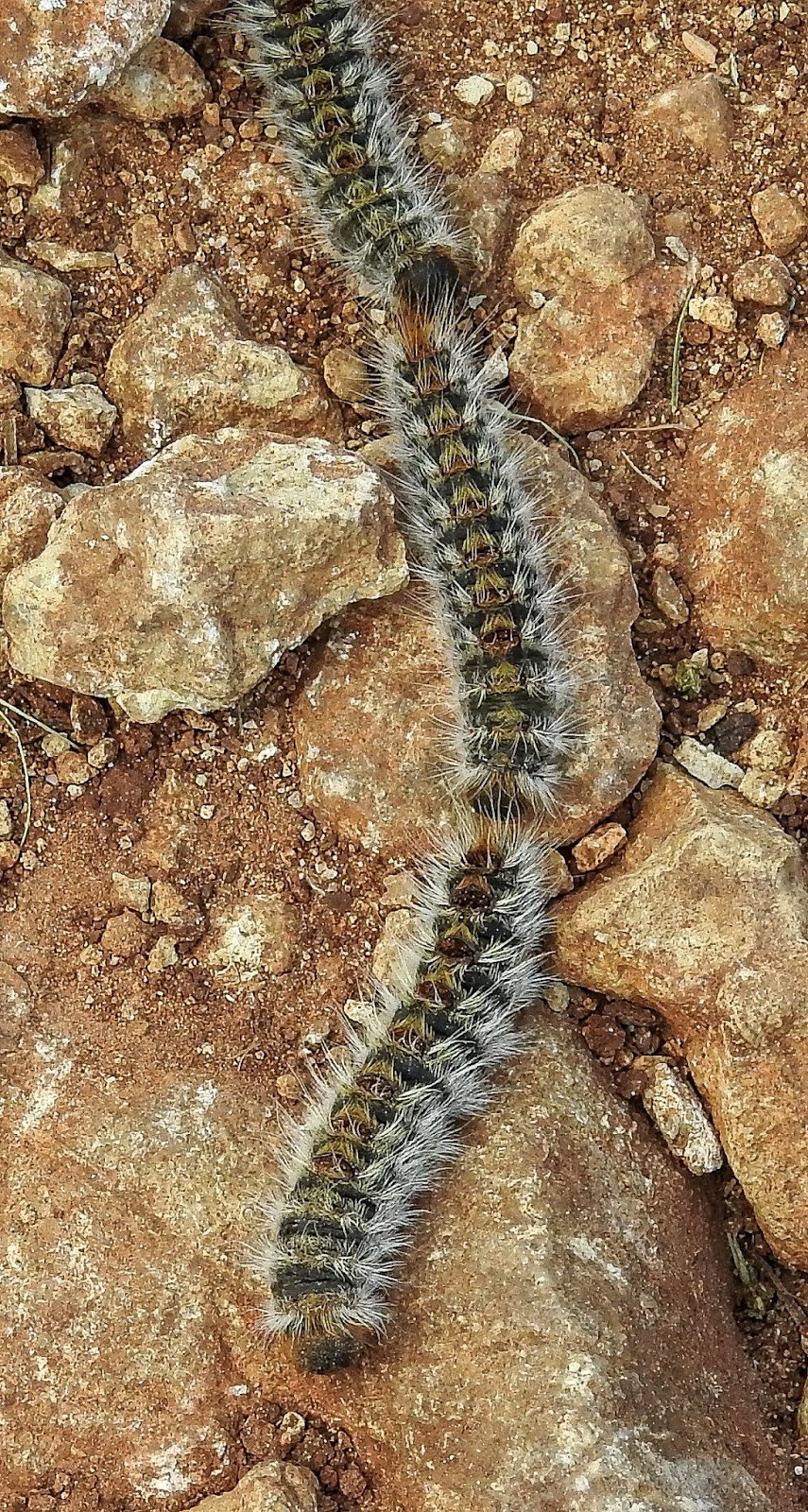
11-2-2019 JALON, ALICANTE - PINE PROCESSIONARY CATERPILLAR (Thaumetopoea pityocampa)


Pine processionary caterpillars are a danger to humans and animals due to their urticating (stinging) hairs, which can cause severe rashes, eye irritation, and in pets, potentially fatal reactions. They are known for forming long, single-file processions when descending trees to pupate. These caterpillars build silky nests in pine trees during the fall and winter and emerge as moths in the summer. 

Key facts

Appearance: They are typically 3 to 4 cm long and orange to brown in color.

Behavior: They form long, single-file "processions" from head to tail, especially when moving from the tree to the ground to burrow and pupate.

Nests: They construct large, silken, tent-like nests on pine trees, often in the branches.

Diet: They feed on pine needles.

Life cycle: Adult moths lay eggs on pine trees in late summer. Caterpillars hatch, grow in nests, and then descend in procession in late winter or early spring to pupate in the soil.

Habitat: Native to the Mediterranean, Middle East, and North Africa, they have been spreading north due to climate change. 


Dangers and risks

Urticating hairs: Each caterpillar has hundreds of thousands of tiny, barbed, stinging hairs that can be easily released into the air.

Human contact: Direct contact can cause a rash that is itchy, painful, and can last for weeks. The hairs can cause inflammation and irritation, and severe reactions, including anaphylactic shock, are possible.

Animal contact: Pets, especially dogs, are at a high risk. They can experience severe reactions if they come into contact with the hairs on their nose or mouth. Symptoms can include swelling, excessive drooling, and chomping. In severe cases, this can lead to tissue damage and requires immediate veterinary care.

Tree damage: They can defoliate trees, weakening them and making them vulnerable to other pests and diseases. 

Safety and prevention
Avoid contact: The best way to stay safe is to avoid areas with pine processionary caterpillars, especially in the spring.

Keep pets on a leash: Keep pets on a leash in wooded areas and be vigilant.

Handle with care: If you must remove nests, avoid touching them and wear protective gear.

Disposal: If you find a procession, do not stand on them or scatter them, as this can release the hairs. Spray the procession with hairspray to disable the hairs, then douse the ground with soapy water and brush thoroughly before disposal.

Emergency: If you or a pet has a reaction, seek medical or veterinary attention immediately. 

11-2-2019 JALON, ALICANTE - WILD DAFFODIL (Narcissus pseudonarcissus)


11-2-2019 JALON, ALICANTE - PLANTAIN FAMILY (Antirrhinum controversum)


Antirrhinum controversum is a subshrub species native to southern Spain, Portugal, and northern Morocco that produces pale-pink flowers and grows between February and November. It thrives in rocky or calcareous soils in sunny to partially shaded, mild-winter areas and can reach heights of 35 to 150 cm. As a species of snapdragon (Antirrhinum), it is part of the Plantaginaceae family and has specific adaptations to its native subtropical environment. 

Physical characteristics
Type: Subshrub
Height: Grows 35 to 150 cm tall
Flowers: Produces dense inflorescences of pale-pink flowers at the end of its stems
Bloom Time: February to November in its native range 
Habitat and ecology
Native Range: Southeastern and southern Spain, Portugal, and northern Morocco
Biome: Favors subtropical biomes
Soil: Indifferent to soil type but has a preference for calcareous soils; it grows in rocky areas, crevices, and on walls

11-2-2019 JALON, ALICANTE - MEDITERRANEAN PALE GLOW-WORM (Nyctophila reichii)


Nyctophila reichii, commonly known as the Mediterranean firefly, is a species of firefly. The species is very common in the southern and eastern part of the Iberian Peninsula.

The Mediterranean firefly is a small beetle, typically measuring 15-18 mm for the male and up to 4 cm for the female. Its body coloration is predominantly black or brown.

These organisms exhibit significant sexual dimorphism, with females tending to have a morphology more similar to that of larvae, while males have a more classic beetle shape.


Females, therefore, are flightless, although they have vestigial wings and have an elongated shape. They are characterized by the ability to generate a large amount of greenish light in the ventral region of the last three abdominal segments. Furthermore, they can expose more of the bioluminescent region by twisting the terminal area of ​​their body.

Males, on the other hand, have a more classic beetle shape, with elytra that cover the entire abdomen and membranous wings that allow flight. Their pronotum is wide, light-colored, with a reddish spot on its surface, and conceals well-developed eyes for detecting the bioluminescence of females. It's worth noting that, unlike other fireflies, these males are not capable of generating bioluminescence.

Sunday, 10 February 2019

10-2-2019 PEGO MARJAL, ALICANTE - COMMON CHAFFINCH (MALE) (Fringilla coelebs)


10-2-2019 PEGO MARJAL, ALICANTE - GLOSSY IBIS (Plegadis falcinellus)


It is the only ibis which is native to Europe. In Spain, a stable reproductive population has settled in the Guadalquivir marshes.
They are easily recognised because they usually fly in a V formation as a group.

This bird usually measures between 55 and 65 centimetres.

The eggs that the glossy ibis lays are greenish blue.

It has a long, curved bill. Adults mostly dark with iridescent green and reddish tones. Very thin white border surrounding the dark facial skin. Dark eyes. Usually gregarious, it is found mainly in salty marshes and shallow wetlands. Unmistakable in most of its range, though American birds are best distinguished from White-faced Ibis by distribution and facial pattern.

10-2-2019 PEGO MARJAL, ALICANTE - BOOTED EAGLE (Hieraaetus pennatus)


The booted eagle (Hieraaetus pennatus) is a medium-sized mostly migratory bird of prey with a wide distribution in the Palearctic and southern Asia, wintering in the tropics of Africa and Asia, with a small, disjunct breeding population in south-western Africa. Like all eagles, it belongs to the family Accipitridae.

The booted eagle has breeding populations in many different regions in both the northern and southern hemisphere. These include southern Europe, North Africa and across Asia, and also in western South Africa and Namibia. The northern populations are migratory spending November to February in Sub-Saharan Africa and South Asia, while the small southern African populations is sedentary. This is a species of wooded, often hilly countryside with some open areas. It breeds in rocky, broken terrain but migrants will use almost any type of habitat other than dense forest. The birds of the Palearctic breeding population tend to nest in coniferous or deciduous woodlands and often in trees.

10-2-2019 OLIVA PLAYA, VALENCIA - BLACK REDSTART (FEMALE) (Phoenicurus ochruros)


The Black Redstart (Phoenicurus ochruros) is a small, charismatic passerine bird, exhibiting a blend of dark and vibrant plumage. Males are distinguished by their dark grey to black upperparts and breast, with a striking orange-red rump and tail. Females and juveniles are more subdued in color, with grey to grey-brown feathers and the same vivid tail coloration that is the hallmark of the species.

Adult males are easily identified by their dark upperparts and black breast, contrasting with the orange-red lower rump and tail. The belly and undertail may vary from blackish-grey to orange-red, depending on the subspecies. Females and juveniles are less conspicuous, with overall greyer tones and a distinctive orange-red rump and tail. The presence of pale fringes on the secondaries forms a whitish wing panel in some subspecies.

The Black Redstart has adapted remarkably to urban environments, often found nesting in crevices or holes within buildings. Originally a dweller of stony mountainous regions, it now thrives in industrial areas with similar structural features.

This species is widely distributed across south and central Europe, Asia, and north-west Africa. It is a resident in milder regions, while populations in the northeast migrate to warmer areas during winter.

The Black Redstart is known for its robin-like movements, including quick ducks of the head and body, and frequent tail flicking. Males possess a rattling song and a tick call, adding to their distinctive presence.

Friday, 8 February 2019

8-2-2019 MONTE CORONA, VALENCIA - HOUSE SPARROW (MALE) (Passer domesticus)


Male house sparrows are distinguished by their vibrant head and throat markings, including a gray crown, white cheeks, and a black bib that can vary in size with age and dominance. They have a brown back with black markings, a black bill, and grey undersides. 

Identification
Head: Grey crown and white cheek patches.
Throat and Chest: A black bib that can be larger in older or more dominant males.
Back: Brown with black markings.
Undersides: Pale grey.
Bill: Black, especially during the breeding season. 

Behavior and diet
Diet: Omnivorous, eating seeds, grains, berries, and insects.
Social: Live in colonies, often in large groups, and forage in flocks for safety.
Dominance: The size of the black bib is thought to be an indicator of a male's dominance.
Aggression: Can be aggressive at garden feeders, sometimes dominating other birds. 

9-2-2019 MONTE CORONA, VALENCIA - MEDITERRANEAN SPOTTED CHAFER (Oxythyrea funesta)


8-2-2019 MONTE CORONA, VALENCIA - HAIRY ROSE BEETLE (Tropinota squalida)


The hairy rose beetle (Tropinota squalida or Tropinota hirta) is a type of flower chafer beetle found in Europe and parts of Asia that feeds on flower pollen and nectar. It is considered a pest because adult beetles damage fruit and ornamental plants by consuming flowers and buds, while the larvae feed on rotting plant material and roots in the soil. Adults are 8–15 mm long, grayish-black, and covered in yellowish hairs, which wear off with age. 

Appearance and identification

Size: Adults are typically between 8 and 15 mm long.
Color: The body is grayish-black.
Hairs: The entire body is covered in thick, yellowish hairs that can wear off over time.
Distinctive markings: Elytra have two rows of white spots on the sides, and males have a longitudinal hollow on the underside of their abdomen. 

Thursday, 7 February 2019

15-5-2018 MONTE CORONA, VALENCIA - HOOKED STRIKING JUMPING SPIDER (Icius hamatus)


This species is mainly present in Portugal, Spain, France, Italy, Poland, Greece and Romania.

The adults of these spiders reach approximately 5–7 millimetres (0.20–0.28 in) of length. They prefer dry and hot habitats ("xerothermic") and can mainly be encountered on sunny bushes, shrubs and walls of houses (synanthropic organism), where they actively pursue their preys.

In males the basic color of the hairy body is rusty brown, with a white longitudinal stripe and a white line on the edge of the opistosoma. The prosoma is mainly rusty brown, while the pedipalps and the legs are whitish. In the females the basic color is mainly brownish or greyish, with darker markings. These spiders have eight eyes with very large anterior median eyes and smaller on each side. Their eyesight is excellent and very useful in their way of hunting.

6-2-2019 ALBUFERA, VALENCIA - WESTERN CATTLE EGRET (Bubulcus ibis ssp. ibis)


The Western Cattle-Egret is a gregarious, white, upland ardeid (Ardeidae), easily recognized by its foraging association with grazing animals and its exaggerated, head-pumping strut. It differs from the Eastern Cattle-Egret (Ardea coromanda) in having less buff-orange breeding plumage in the head and neck regions.

Small, compact white heron with relatively short yellow bill. More frequently seen in dry habitats than other egrets. In breeding season, look for pale salmon color on head and breast and brighter bill. Leg color varies from reddish or yellow during the breeding season to black during the nonbreeding season. Juveniles have dark bill. Always note relatively short, thick neck and short legs compared with other egrets. Often gathers in flocks, frequently following cattle or tractors in fields.


The Western Cattle-Egret is a gregarious, white, upland heron ( Ardeidae ), easily recognized by its foraging association with grazing animals and its exaggerated head-waving. It is distinguished from the Eastern Cattle-Egret (Ardea coromanda) due to having less buffy-orange breeding plumage on the head and neck regions. Its preference for grasslands, lawns, pastures, and grazing animals is quite distinct from that of other herons and egrets, which usually feed in or beside water and not in close association with livestock. In Britain and Europe, it is also known as the buffalo heron, referring to the color of its breeding plumes; but in many languages, it is simply called the cow crane, cow heron, or cowbird, or named after the wild grazing animal with which it is usually associated, e.g., elephant bird, rhinoceros egret, or hippopotamus egret. 
The Western Cattle-Egret's Arabic name, Abu Qerdan, means "father of ticks" and refers to the abundance of ticks on Egyptian herons. Other names that include the word "tick," such as "tickbird," refer to the mistaken belief that they pick attached ticks off grazing animals; instead, most of their prey are insects disturbed by grazing animals. Derivation of the scientific name:Bubulcus(the previous genus) from Latin "belonging to cattle" andibisfrom the Greek in reference to its slightly curved beak like that of the ibis.

6-2-2019 ALBUFERA, VALENCIA - LITTLE EGRET (Egretta garzetta)


6-2-2019 ALBUFERA, VALENCIA - GLOSSY IBIS (Plegadis falcinellus)


6-2-2019 ALBUFERA, VALENCIA - NORTHERN LAPWING (Vanellus vanellus))


6-2-2019 ALBUFERA, VALENCIA - MEADOW PIPIT (Anthus pratensis)


The meadow pipit (Anthus pratensis) is a small passerine bird, which breeds in much of the Palearctic, from southeastern Greenland and Iceland east to just east of the Ural Mountains in Russia, and south to central France and Romania; an isolated population also occurs in the Caucasus Mountains. It is migratory over most of its range, wintering in southern Europe, North Africa, and south-western Asia, but is resident year-round in western Europe, though even here many birds move to the coast or lowlands in winter.
The nest is on the ground hidden in dense vegetation, with two to seven (most often three to five) eggs; the eggs hatch after 11–15 days, with the chicks fledging 10–14 days after hatching. Two broods are commonly raised each year. This species is one of the most important nest hosts of the cuckoo, and it is also an important prey species for merlins and hen harriers.

Its food is primarily insects and other invertebrates, mostly small items less than 5 mm (3⁄16 in) long. It also eats the seeds of grasses, sedges, rushes, and heather, and crowberry berries, mainly in winter.

7-2-2019 MONTE CORONA, VALENCIA - WHITE WALL ROCKET (Diplotaxis erucoides)


Diplotaxis erucoides, the white rocket or white wallrocket, is a species of annual herb of the family Brassicaceae native to West Mediterranean.

Description
Diplotaxis erucoides is an herbaceous plant up to 20–60 centimetres (8–23+1⁄2 in) tall, with green, erect stem, sparsely pubescent, and pinnatisect leaves up to 15 cm long. It has racemes of white flowers with four 6–8 mm petals, four sepals, six stamens and a style with green stigma. The fruit is a 25–33 mm siliqua containing 40–80 seeds in two parallel series.


Diplotaxis erucoides is a ANNUAL growing to 0.5 m (1ft 8in). It is in flower from May to September, and the seeds ripen from June to October. The species is hermaphrodite (has both male and female organs) and is pollinated by Insects.
Suitable for: light (sandy), medium (loamy) and heavy (clay) soils. Suitable pH: mildly acid, neutral and basic (mildly alkaline) soils. It can grow in semi-shade (light woodland) or no shade. It prefers moist soil.

7-2-2019 MONTE CORONA, VALENCIA - AMARYLLIS (Narcissus dubius)


Narcissus dubius (Spanish: meados de zorro) is a species of the genus Narcissus (daffodils) in the family Amaryllidaceae. It is classified in Section Tazettae and is native to northeastern Spain.

Narcissus dubius is a bulbous plant with completely white petals and trumpet, and produces up to six flowers per umbel. Genetic studies indicate that it may be a hybrid of Narcissus assoanus and Narcissus papyraceus. Its range spans Spain and France.

It may be confused with the closely related species Narcissus tazetta, which has a yellow trumpet. Narcissus dubius may also be mistaken for Narcissus papyraceus, which is similar in appearance but twice as large.

Narcissus dubius was described in 1773 by French botanist and Ichthyology Antoine Gouan in his book Illustrationes et Observationes Botanicae 22. It has 25 pairs of chromosomes.