TOTAL PAGEVIEWS

TRANSLATE

Wednesday, 13 February 2019

13-2-2019 BONAIRE, VALENCIA - CABBAGE WHITE BUTTERFLY (Pieris rapae)


Pieris rapae is a small- to medium-sized butterfly species of the whites-and-yellows family Pieridae. It is known in Europe as the small white, in North America as the cabbage white or cabbage butterfly, on several continents as the small cabbage white, and in New Zealand as the white butterfly. The butterfly is recognizable by its white color with small black dots on its wings, and it can be distinguished from P. brassicae by its larger size and the black band at the tip of its forewings.

The caterpillar of this species, often referred to as the "imported cabbageworm", is a pest to crucifer crops such as cabbage, kale, bok choy and broccoli. Pieris rapae is widespread in Europe and Asia; it is believed to have originated in the Eastern Mediterranean region of Europe, and to have spread across Eurasia thanks to the diversification of brassicaceous crops and the development of human trade routes. Over the past two centuries, it spread to North Africa, North America, New Zealand, and Australia, as a result of accidental introductions.

13-2-2019 ALBUFERA, VALENCIA - BLUETHROAT (MALE) (Luscinia svecica)


The Bluethroat (Luscinia svecica) is a small and enchanting passerine, reminiscent of the European robin in stature, measuring 13-14 cm in length. The males are particularly striking with their vibrant throat plumage, which boasts a rich blue central patch framed by black and rust-colored borders, evoking the hues of the Swedish flag. Above, they are a modest brown, save for the black tail adorned with red side patches, and they possess a pronounced white supercilium that stands out against their plumage.

To identify the Bluethroat, look for the male's resplendent throat, which is its most distinguishing feature. Females and juveniles are more subdued, with the females typically displaying a blackish crescent on a cream throat and breast. Juveniles are freckled and spotted with dark brown above. All share the characteristic white supercilium and black tail with red side patches.

The Bluethroat favors wet birch woods or bushy swamps for breeding, finding solace in the dense undergrowth where it can nest in tussocks or low bushes.

This migratory bird breeds across the Palearctic and has a foothold in western Alaska. When the cold season approaches, it retreats to warmer climes, wintering in the Iberian Peninsula, northern Africa, and southern Asia, including the Indian subcontinent.


The Bluethroat is a bird of secretive nature, often found flitting through dense vegetation. It is migratory, with moulting beginning in July after breeding and completed in 40-45 days before the birds embark on their long journey to wintering grounds.

The male Bluethroat is a skilled vocalist with a song that is both varied and highly imitative. Its call is a characteristic chat "chack" noise, which can be heard amidst the underbrush where it dwells.

Bluethroats nest in tussocks or low in dense bushes, preferring the sheltered environment of wet woodlands or swampy areas.

As an insectivorous bird, the Bluethroat's diet consists primarily of insects, which it seeks out in its wetland and swampy habitats.

13-2-2019 BONAIRE, VALENCIA - SPOTLESS STARLING (Sturnus unicolor)


The Spotless Starling, known scientifically as Sturnus unicolor, is a member of the starling family, Sturnidae. It bears a striking resemblance to its cousin, the Common Starling, but is distinguished by its slightly larger size, measuring 21-23 cm in length and weighing between 70-100 grams. Its plumage is a glossy, oily black, which may exhibit purple or green iridescence under bright light. Notably, during the spring and summer, its feathers are completely devoid of spots, while in winter, it sports only minuscule pale spots.

To identify the Spotless Starling, look for its longer throat feathers, which are double the length of those on the Common Starling, creating a pronounced "beard" especially visible when the bird vocalizes. Its legs are a vivid pink, and the bill color changes with the seasons: yellow with a bluish or pinkish base in summer, and a duller, often blackish hue in winter. Juveniles present a dull brown plumage, darker than their common counterparts, with a black bill and brown legs.

The Spotless Starling is quite adaptable, inhabiting a variety of open environments from farmlands and olive groves to urban areas. It thrives particularly well in open grazed holm oak woods and in cities like Gibraltar, where it is a common sight.

This bird has a more restricted range compared to the Common Starling, being native to the Iberian Peninsula, Northwest Africa, southernmost France, and the islands of Sicily, Corsica, and Sardinia. It is largely sedentary, with its population having expanded northward in recent decades.

13-2-2019 ALBUFERA, VALENCIA - EUROPEAN STONECHAT (FEMALE) (Saxicola rubicola)


The European stonechat, Saxicola rubicola, is a small, charming passerine bird, once thought to be a member of the thrush family but now placed within the Old World flycatcher family, Muscicapidae. This species exhibits a striking sexual dimorphism, with males donning a black plumage with vibrant orange throats and females wearing a more subdued brown.

Males in their summer plumage are unmistakable with their black heads, orange throats, and white bellies. They also sport a distinctive white half-collar and small white patches on the wings and rump. Females, on the other hand, are predominantly brown with less pronounced white wing patches. Both sexes have notably short wings, which are shorter than those of their migratory relatives.

The European stonechat favors heathlands, coastal dunes, and open grasslands dotted with shrubs, brambles, and heather. These habitats provide the perfect backdrop for their active foraging and breeding behaviors.

13-2-2019 ALBUFERA, VALENCIA - COMMON KINGFISHER (MALE) (Alcedo atthis)


Tuesday, 12 February 2019

14-11-2016 YANDOBA, MYANMAR - WHITE WAGTAIL (Motacilla alba)


The White wagtail is a slender bird with the characteristic long, constantly wagging tail of its genus. There are a number of other subspecies, some of which may have arisen because of partial geographical isolation, such as the resident British and Irish form, the pied wagtail M. a. yarrellii, which now also breeds in adjacent areas of the neighbouring European mainland. The Pied wagtail exchanges the grey colour of the nominate form with black (or very dark grey in females), but is otherwise identical in its behaviour. Other subspecies, the validity of some of which is questionable, differ in the colour of the wings, back, and head, or other features. Some races show sexual dimorphism during the breeding season. As many as six subspecies may be present in the wintering ground in India or Southeast Asia and here they can be difficult to distinguish.

White wagtails breed throughout Eurasia, only being absent in the Arctic. They also breed in the mountains of Morocco and western Alaska. These birds are residents in the milder parts of their range such as western Europe and the Mediterranean, but migratory in much of the rest of their range. Northern European breeders winter around the Mediterranean and in tropical and subtropical Africa, and Asiatic birds move to the Middle East, India, and Southeast Asia. Birds from the North American population also winter in tropical Asia. White wagtails occupy a wide range of habitats but are absent from deserts. They inhabit grasslands, seashores, rocky shorelines, sand beaches, tidepools, rivers, lakeshores, farmland, gardens, and parks. They are also often found in towns and villages.

12-2-2019 OLIVA, VALENCIA - DOUBLED GOATFOOT SORREL (Oxalis pes-caprae f. pleniflora)


The 'Doubled Goatfoot Sorrel' (Oxalis pes-caprae f. pleniflora) is a double-flowered form of the Bermuda Buttercup, native to South Africa but considered an invasive weed in many parts of the world. It is known for its bright yellow, multi-petaled flowers and its ability to spread rapidly via underground bulbils. 
Key Facts

Scientific Name: Oxalis pes-caprae forma pleniflora.
Common Names: Also known as Bermuda buttercup, African wood-sorrel, Bermuda sorrel, sourgrass, or soursob.
Appearance: This specific form features "doubled" or multi-petaled yellow flowers, in contrast to the typical single-petaled flowers of the common variety. The leaves are long-stalked and divided into three clover-like leaflets, often featuring a brown spot.
Origin & Habitat: It is indigenous to the Cape of Good Hope region of South Africa but has become a widespread, naturalized weed in other regions, including parts of the U.S. (especially coastal California), Europe, and Australia.

12-2-2019 OLIVA, VALENCIA - STORKS BILL (Genus Erodium)


Monday, 11 February 2019

11-2-2019 JALON, ALICANTE - RED VALERIAN (Centranthus ruber)


Red valerian, or Centranthus ruber, is a low-maintenance perennial with bright red, pink, or white flowers that blooms for a long period. Native to the Mediterranean, it thrives in full sun and well-drained soil, can tolerate poor conditions, and self-seeds easily, making it a popular plant for garden walls and rocky areas. It attracts pollinators like bees and butterflies and is also known as Jupiter's Beard. 

Botanical and growing facts
Botanical Name: Centranthus ruber
Common Names: Red valerian, Jupiter's Beard, Keys of Heaven
Native Range: Mediterranean region
Growth Habit: Herbaceous perennial, grows to about 2-3 feet tall and 18-24 inches wide, with a woody base as it matures.
Flowers: Dense clusters of small, star-shaped flowers that are typically red, pink, or white. They bloom from late spring through autumn.
Leaves: Opposite, oval, and pale green.
Soil: Prefers well-drained, alkaline soil, but is very adaptable and tolerates poor soil conditions.

11-2-2019 JALON, ALICANTE - EUROPEAN ROBIN (Erithacus rubecula)


The European robin (Erithacus rubecula), known simply as the robin or robin redbreast in Great Britain and Ireland, is a small insectivorous passerine bird, a member of the chat subfamily of the Old World flycatcher family. It is a plucky little bird, with a length of about 12.5–14.0 cm and a weight of 16–22 g. Both sexes are similarly adorned with an orange breast and face, lined with grey, brown upper-parts, and a whitish belly.
Adult robins can be identified by their orange breast and face, bordered by a bluish-grey on the sides of the neck and chest. The upperparts are brownish, or olive-tinged in British birds, and the belly is whitish. The bill and eyes are black. Juvenile robins are distinguishable by their spotted brown and white plumage, with patches of orange gradually appearing as they mature.

The European robin is a bird of diverse habitats, found in woodlands, gardens, and parks across its range. It is particularly associated with areas where the soil is dug or disturbed, allowing it easy access This bird has a wide distribution across Europe, extending east to Western Siberia and south to North Africa. It is sedentary in most of its range except the far north, where it is migratory.

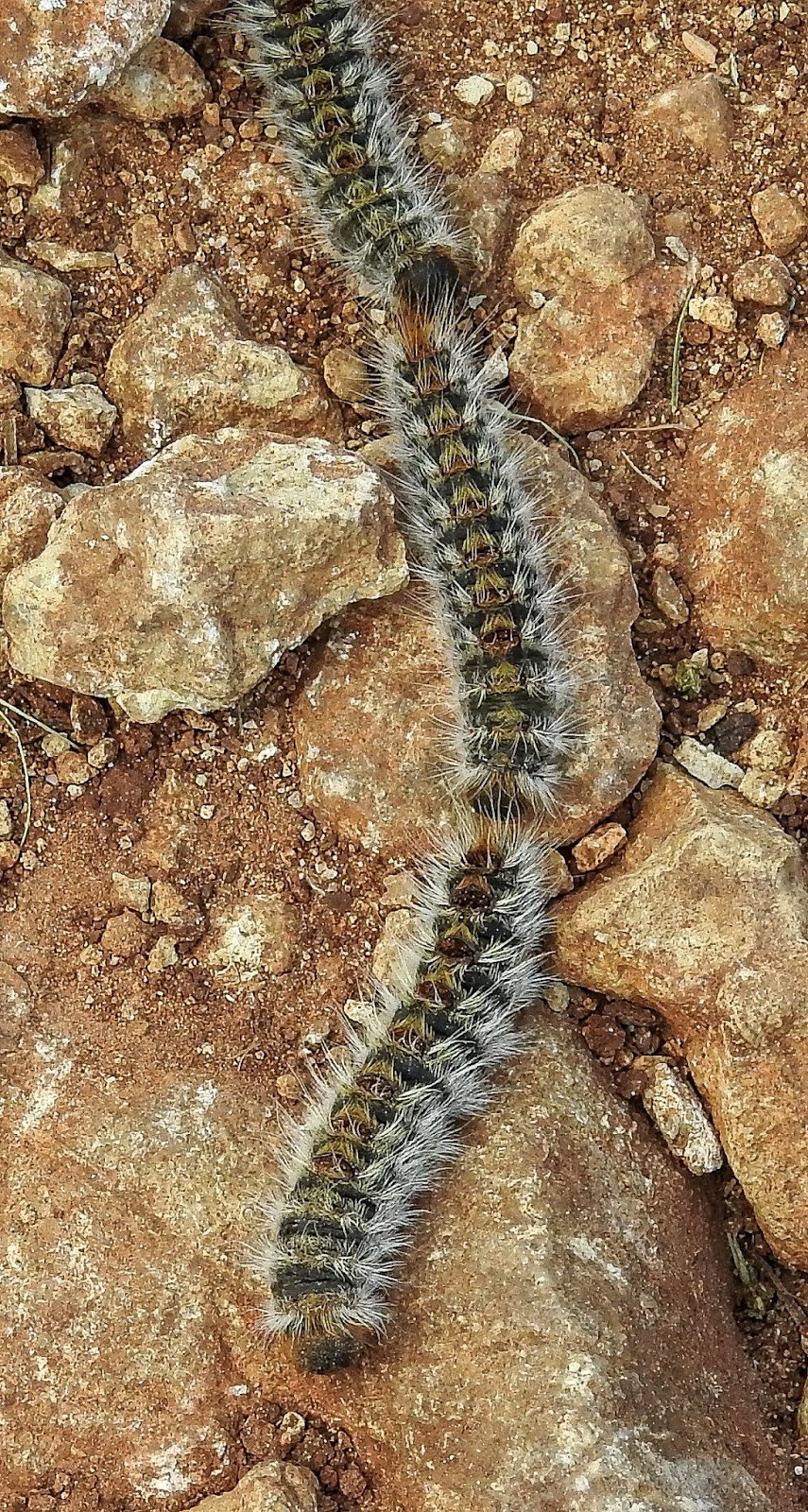
11-2-2019 JALON, ALICANTE - PINE PROCESSIONARY CATERPILLAR (Thaumetopoea pityocampa)


Pine processionary caterpillars are a danger to humans and animals due to their urticating (stinging) hairs, which can cause severe rashes, eye irritation, and in pets, potentially fatal reactions. They are known for forming long, single-file processions when descending trees to pupate. These caterpillars build silky nests in pine trees during the fall and winter and emerge as moths in the summer. 

Key facts

Appearance: They are typically 3 to 4 cm long and orange to brown in color.

Behavior: They form long, single-file "processions" from head to tail, especially when moving from the tree to the ground to burrow and pupate.

Nests: They construct large, silken, tent-like nests on pine trees, often in the branches.

Diet: They feed on pine needles.

Life cycle: Adult moths lay eggs on pine trees in late summer. Caterpillars hatch, grow in nests, and then descend in procession in late winter or early spring to pupate in the soil.

Habitat: Native to the Mediterranean, Middle East, and North Africa, they have been spreading north due to climate change. 


Dangers and risks

Urticating hairs: Each caterpillar has hundreds of thousands of tiny, barbed, stinging hairs that can be easily released into the air.

Human contact: Direct contact can cause a rash that is itchy, painful, and can last for weeks. The hairs can cause inflammation and irritation, and severe reactions, including anaphylactic shock, are possible.

Animal contact: Pets, especially dogs, are at a high risk. They can experience severe reactions if they come into contact with the hairs on their nose or mouth. Symptoms can include swelling, excessive drooling, and chomping. In severe cases, this can lead to tissue damage and requires immediate veterinary care.

Tree damage: They can defoliate trees, weakening them and making them vulnerable to other pests and diseases. 

Safety and prevention
Avoid contact: The best way to stay safe is to avoid areas with pine processionary caterpillars, especially in the spring.

Keep pets on a leash: Keep pets on a leash in wooded areas and be vigilant.

Handle with care: If you must remove nests, avoid touching them and wear protective gear.

Disposal: If you find a procession, do not stand on them or scatter them, as this can release the hairs. Spray the procession with hairspray to disable the hairs, then douse the ground with soapy water and brush thoroughly before disposal.

Emergency: If you or a pet has a reaction, seek medical or veterinary attention immediately. 

11-2-2019 JALON, ALICANTE - WILD DAFFODIL (Narcissus pseudonarcissus)


Narcissus pseudonarcissus, commonly named the wild daffodil or Lent lily (Welsh: Cennin Pedr), is a perennial flowering plant.

This species has pale yellow tepals, with a darker central trumpet. The long, narrow leaves are slightly greyish green in colour and rise from the base of the stem. The plant grows from a bulb. The flowers produce seeds which, when germinated, take five to seven years to produce a flowering plant. (Sexual seed reproduction mixes the traits of both parent flowers, so if garden hybrid cultivars are planted close to wild populations of Narcissus pseudonarcissus, there is a danger that the new seedlings, having hybrid vigour, could out-compete the wild plants.

The species is native to Western Europe from Spain and Portugal east to Germany and north to England and Wales. It is commonly grown in gardens and populations have become established in the Balkans, Australia, New Zealand, the Caucasus, Madeira, British Columbia, Ontario, Newfoundland, Nova Scotia, Oregon, Washington state, much of the eastern United States, and the Falkland Islands. Wild plants grow in woods, grassland and on rocky ground. In Britain native populations have decreased substantially since the 19th century due to intensification of agriculture, clearance of woodland and uprooting of the bulbs for use in gardens. In Germany it was a subject of a national awareness campaign for the protection of wildflowers in 1981.

11-2-2019 JALON, ALICANTE - PLANTAIN FAMILY (Antirrhinum controversum)


Antirrhinum controversum is a subshrub species native to southern Spain, Portugal, and northern Morocco that produces pale-pink flowers and grows between February and November. It thrives in rocky or calcareous soils in sunny to partially shaded, mild-winter areas and can reach heights of 35 to 150 cm. As a species of snapdragon (Antirrhinum), it is part of the Plantaginaceae family and has specific adaptations to its native subtropical environment. 

Physical characteristics
Type: Subshrub
Height: Grows 35 to 150 cm tall
Flowers: Produces dense inflorescences of pale-pink flowers at the end of its stems
Bloom Time: February to November in its native range 
Habitat and ecology
Native Range: Southeastern and southern Spain, Portugal, and northern Morocco
Biome: Favors subtropical biomes
Soil: Indifferent to soil type but has a preference for calcareous soils; it grows in rocky areas, crevices, and on walls

11-2-2019 JALON, ALICANTE - MEDITERRANEAN PALE GLOW-WORM (Nyctophila reichii)


Nyctophila reichii, commonly known as the Mediterranean firefly, is a species of firefly. The species is very common in the southern and eastern part of the Iberian Peninsula.

The Mediterranean firefly is a small beetle, typically measuring 15-18 mm for the male and up to 4 cm for the female. Its body coloration is predominantly black or brown.

These organisms exhibit significant sexual dimorphism, with females tending to have a morphology more similar to that of larvae, while males have a more classic beetle shape.


Females, therefore, are flightless, although they have vestigial wings and have an elongated shape. They are characterized by the ability to generate a large amount of greenish light in the ventral region of the last three abdominal segments. Furthermore, they can expose more of the bioluminescent region by twisting the terminal area of ​​their body.

Males, on the other hand, have a more classic beetle shape, with elytra that cover the entire abdomen and membranous wings that allow flight. Their pronotum is wide, light-colored, with a reddish spot on its surface, and conceals well-developed eyes for detecting the bioluminescence of females. It's worth noting that, unlike other fireflies, these males are not capable of generating bioluminescence.

Sunday, 10 February 2019

10-2-2019 PEGO MARJAL, ALICANTE - COMMON CHAFFINCH (MALE) (Fringilla coelebs)


10-2-2019 PEGO MARJAL, ALICANTE - GLOSSY IBIS (Plegadis falcinellus)


It is the only ibis which is native to Europe. In Spain, a stable reproductive population has settled in the Guadalquivir marshes.
They are easily recognised because they usually fly in a V formation as a group.

This bird usually measures between 55 and 65 centimetres.

The eggs that the glossy ibis lays are greenish blue.

It has a long, curved bill. Adults mostly dark with iridescent green and reddish tones. Very thin white border surrounding the dark facial skin. Dark eyes. Usually gregarious, it is found mainly in salty marshes and shallow wetlands. Unmistakable in most of its range, though American birds are best distinguished from White-faced Ibis by distribution and facial pattern.

10-2-2019 PEGO MARJAL, ALICANTE - BOOTED EAGLE (Hieraaetus pennatus)


The booted eagle (Hieraaetus pennatus) is a medium-sized mostly migratory bird of prey with a wide distribution in the Palearctic and southern Asia, wintering in the tropics of Africa and Asia, with a small, disjunct breeding population in south-western Africa. Like all eagles, it belongs to the family Accipitridae.

The booted eagle has breeding populations in many different regions in both the northern and southern hemisphere. These include southern Europe, North Africa and across Asia, and also in western South Africa and Namibia. The northern populations are migratory spending November to February in Sub-Saharan Africa and South Asia, while the small southern African populations is sedentary. This is a species of wooded, often hilly countryside with some open areas. It breeds in rocky, broken terrain but migrants will use almost any type of habitat other than dense forest. The birds of the Palearctic breeding population tend to nest in coniferous or deciduous woodlands and often in trees.

10-2-2019 OLIVA PLAYA, VALENCIA - BLACK REDSTART (FEMALE) (Phoenicurus ochruros)


The Black Redstart (Phoenicurus ochruros) is a small, charismatic passerine bird, exhibiting a blend of dark and vibrant plumage. Males are distinguished by their dark grey to black upperparts and breast, with a striking orange-red rump and tail. Females and juveniles are more subdued in color, with grey to grey-brown feathers and the same vivid tail coloration that is the hallmark of the species.

Adult males are easily identified by their dark upperparts and black breast, contrasting with the orange-red lower rump and tail. The belly and undertail may vary from blackish-grey to orange-red, depending on the subspecies. Females and juveniles are less conspicuous, with overall greyer tones and a distinctive orange-red rump and tail. The presence of pale fringes on the secondaries forms a whitish wing panel in some subspecies.

The Black Redstart has adapted remarkably to urban environments, often found nesting in crevices or holes within buildings. Originally a dweller of stony mountainous regions, it now thrives in industrial areas with similar structural features.

This species is widely distributed across south and central Europe, Asia, and north-west Africa. It is a resident in milder regions, while populations in the northeast migrate to warmer areas during winter.

The Black Redstart is known for its robin-like movements, including quick ducks of the head and body, and frequent tail flicking. Males possess a rattling song and a tick call, adding to their distinctive presence.

Friday, 8 February 2019

8-2-2019 MONTE CORONA, VALENCIA - HOUSE SPARROW (MALE) (Passer domesticus)


Male house sparrows are distinguished by their vibrant head and throat markings, including a gray crown, white cheeks, and a black bib that can vary in size with age and dominance. They have a brown back with black markings, a black bill, and grey undersides. 

Identification
Head: Grey crown and white cheek patches.
Throat and Chest: A black bib that can be larger in older or more dominant males.
Back: Brown with black markings.
Undersides: Pale grey.
Bill: Black, especially during the breeding season. 

Behavior and diet
Diet: Omnivorous, eating seeds, grains, berries, and insects.
Social: Live in colonies, often in large groups, and forage in flocks for safety.
Dominance: The size of the black bib is thought to be an indicator of a male's dominance.
Aggression: Can be aggressive at garden feeders, sometimes dominating other birds. 

9-2-2019 MONTE CORONA, VALENCIA - MEDITERRANEAN SPOTTED CHAFER (Oxythyrea funesta)