TOTAL PAGEVIEWS

TRANSLATE

Sunday, 25 February 2024

25-2-2024 ESTANY CULLERA, VALENCIA - EURASIAN GREAT CORMORANT (Phalacrocorax carbo)

The great cormorant (Phalacrocorax carbo), known as the black shag or kawau in New Zealand, formerly also known as the great black cormorant across the Northern Hemisphere, the black cormorant in Australia, and the large cormorant in India, is a widespread member of the cormorant family of seabirds. The genus name is Latinised Ancient Greek, from φαλακρός (phalakros, "bald") and κόραξ (korax, "raven"), and carbo is Latin for "charcoal".

It breeds in much of the Old World, Australia, and the Atlantic coast of North America.


The 80–100 cm (30–40 in) long white-breasted cormorant P. c. lucidus, found in sub-Saharan Africa, has a white neck and breast. It is often treated as a full species, Phalacrocorax lucidus (e.g. Sibley & Monroe 1990, Sinclair, Hockey & Tarboton 2002).

In addition to the Australasian and African forms, other geographically distinct subspecies are recognised, including P. c. sinensis (western Europe to east Asia), P. c. maroccanus (north-western Africa), and P. c. hanedae (Japan).

Some authors treat all these as allospecies of a P. carbo superspecies group.

In New Zealand, the subspecies P. c. novaehollandiae is known as the black shag or by its Māori name: "kawau". The syntype is in the collection of the Museum of New Zealand Te Papa Tongarewa.


The great cormorant is a large black bird, but there is a wide variation in size in the species' wide range. Weight is reported to vary from 1.5 kg (3 lb 5 oz) to 5.3 kg (11 lb 11 oz).[8] Males are typically larger and heavier than females, with the nominate race (P. c. carbo) averaging about 10% larger in linear measurements than the smallest race in Europe (P. c. sinensis). The lightest average weights cited are in Germany (P. c. sinensis), where 36 males averaged 2.28 kg (5 lb 1⁄2 oz) and 17 females averaged 1.94 kg (4 lb 4+1⁄2 oz).[10] The highest come from Prince Edward Island in Canada (P. c. carbo), where 11 males averaged 3.68 kg (8 lb 2 oz) and 11 females averaged 2.94 kg (6 lb 7+1⁄2 oz). Length can vary from 70 to 102 cm (27+1⁄2 to 40 in) and wingspan from 121 to 160 cm (47+1⁄2 to 63 in). They are tied as the second largest extant species of cormorant after the flightless cormorant, with the Japanese cormorant averaging at a similar size. In bulk if not in linear dimensions, the blue-eyed shag species complex of the Southern Oceans are scarcely smaller at average.[10] It has a longish tail and yellow throat-patch. Adults have white patches on the thighs and on the throat in the breeding season. In European waters it can be distinguished from the common shag by its larger size, heavier build, thicker bill, lack of a crest and plumage without any green tinge. In eastern North America, it is similarly larger and bulkier than double-crested cormorant, and the latter species has more yellow on the throat and bill and lack the white thigh patches frequently seen on great cormorants. Great cormorants are mostly silent, but they make various guttural noises at their breeding colonies.


This is a very common and widespread bird species. It feeds on the sea, in estuaries, and on freshwater lakes and rivers. Northern birds migrate south and winter along any coast that is well-supplied with fish.

In Serbia, the cormorant lives in Vojvodina. However, after 1945 many artificial lakes were formed in Serbia; some of them became potential habitats for cormorants. Currently, on the Lake Ćelije, formed in 1980, there is a resident colony of cormorants, who nest there and are present throughout the year, except January–February 1985 and February 2012 when the lake surface was completely frozen.

The type subspecies, P. c. carbo, is found mainly in Atlantic waters and nearby inland areas: on western European coasts and east across the Palearctic to Siberia and to North Africa, the Faroe Islands, Iceland and Greenland; and on the eastern seaboard of North America. The subspecies P. c. novaehollandiae is found in Australian waters.

Saturday, 24 February 2024

18-2-2024 MONTE CORONA, VALENCIA - SEED BUG (Horvathiolus superbus)


Horvathiolus superbus is a species of seed bug in the family Lygaeidae, found in the Palearctic. 

18-2-2024 MONTE CORONA, VALENCIA - VARIEGATED LADY BEETLE (Hippodamia variegata)


Hippodamia variegata, the Adonis ladybird, also known as the variegated ladybug (US) and spotted amber ladybeetle (Aus), is a species of ladybeetle belonging to the family Coccinellidae, subfamily Coccinellinae.

This species is native in the Palearctic, but has also spread to the Nearctic and Oriental region. It has been found outside its native range countries such as Australia, South Africa, Kenya, India, China, Canada, the United States, and Chile, often through intended introduction to control crop pests.

This species mainly inhabits fields, meadows, gardens and shrubs, more than bushes and trees. It prefers dry, rough vegetation.

Hippodamia variegata grow up to 3–5.5 millimetres (0.12–0.22 in). These beetles have a slightly convex and rather elongated body. The first segment of the anterior legs of males is greatly expanded. Head is black, with dark eyes and white spots. Pronotum is black, with a white-yellowish border and a central black mask shaped marking. Elytra are red or orange, with a very variable number of black points (from zero up to thirteen). One black spot surrounded by white is located on the scutellum. The legs are blackish brown, with brown ends. The underside of the body is black.

18-2-2024 MONTE CORONA, VALENCIA - WOLF SPIDER (Wadicosa fidelis)

Wadicosa fidelis (Wolf Spider sp.)

The coloration of this spider is extremely variable, varying between dark brown, grey and nearly black.

Wadicosa fidelis is the commonest wolf spider (lycosidae sp.) living near water.

It is commonly encountered running about on damp ground close to the waterline and sometimes upon the water surface.

This female carries a large blue eggsac which she drags around until the eggs hatch.


18-2-2024 MONTE CORONA, VALENCIA - HAIRY ROSE BEETLE (Tropinota squalida)

Tropinota squalida is a species of beetle belonging to the family Scarabaeidae, subfamily Cetoniinae.

These beetles are mainly found in France, Italy, Greece, Portugal, former Yugoslavia, Spain, in the Near East and in North Africa.

Larvae feed on roots, while the adults can be encountered from May through July feeding on flowers. They are 10–15 millimetres (0.39–0.59 in) long.

Head, scutellum and elytra are dark-brown, with a thick and long tawny hair on elytra and abdomen. Elytra show two series of white spots on the sides of the central hull. Scutellun is rounded and hairy, but glabrous in the posterior. The fifth humeral slot is bifurcated.


17-2-2024 MONTE CORONA, VALENCIA - EGYPTIAN BIRD GRASSHOPPER (Anacridium aegyptium)

Anacridium aegyptium is one of the largest European grasshoppers. Adult males grow up to 30–56 mm (1.2–2.2 in) long, while females reach 46–70 mm (1.8–2.8 in) in length. Their bodies are usually gray, brown, or olive-coloured, and their antennae are relatively short and robust. The tibiae of the hind legs are blue, while the femora are orange. The hind femora have characteristic dark marks. They are also easily identified by their characteristic eyes, which have vertical black and white stripes. Their pronota show a dorsal orange stripe and several small white spots. The wings are clear with dark marks.


A fairly common species, the Egyptian grasshopper is present in most of Europe, the Afrotropical realm, eastern Palearctic realm, the Near East, and North Africa, and has recently been observed in Cape Town, South Africa.

These grasshoppers inhabit trees and shrubs, scrub land, maquis, and orchards in warm and bright environments, at an elevation from sea level to 1,500 m.

Anacridium aegyptium is one of the largest European grasshoppers. Adult males grow up to 30–56 mm (1.2–2.2 in) long, while females reach 46–70 mm (1.8–2.8 in) in length. Their bodies are usually gray, brown, or olive-coloured, and their antennae are relatively short and robust. The tibiae of the hind legs are blue, while the femora are orange. The hind femora have characteristic dark marks. They are also easily identified by their characteristic eyes, which have vertical black and white stripes. Their pronota show a dorsal orange stripe and several small white spots. The wings are clear with dark marks.

This species is a folivore, essentially feeding on leaves of various plants. It is a solitary species, harmless to crops. Adults are mainly seen in August and September, but they are active throughout the year. After mating, these grasshoppers overwinter as adults. Spawning occurs in spring just under the soil surface and the nymphs appear in April. These grasshoppers undergo several molts. Nymphs differ from adults in appearance; their color varies from yellow to bright green and ocher and the wings are absent or small, as they are gradually developed after each molt.

14-2-2024 MONTE CORONA, VALENCIA - MEDITERRANEAN PALE GLOW-WORM (Nyctophila reichii)


 Nyctophila reichii, commonly known as the Mediterranean firefly, is a species of firefly. The species is very common in the southern and eastern part of the Iberian Peninsula.

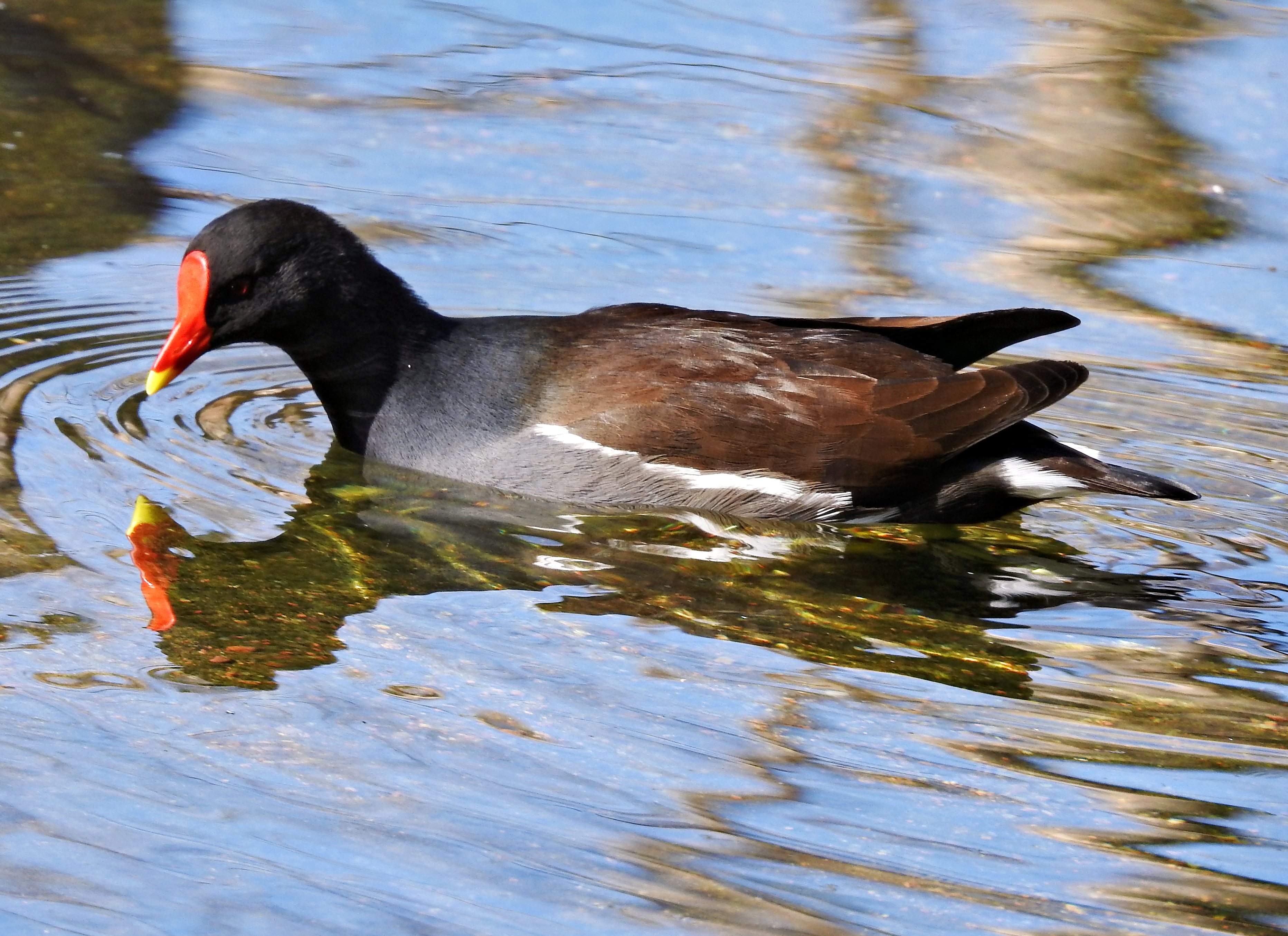
2-2-2024 BIOPARC, VALENCIA - EUROPEAN MOORHEN (Gallinula chloropus)

The common moorhen (Gallinula chloropus), also known as the waterhen or swamp chicken, is a bird species in the rail family (Rallidae). It is distributed across many parts of the Old World.

The common moorhen lives around well-vegetated marshes, ponds, canals and other wetlands. The species is not found in the polar regions or many tropical rainforests. Elsewhere it is likely the most common rail species, except for the Eurasian coot in some regions.

The closely related common gallinule of the New World has been recognized as a separate species by most authorities, starting with the American Ornithologists' Union and the International Ornithological Committee in 2011.

The moorhen is a distinctive species, with predominantly black and brown plumage, with the exception of a white under-tail, white streaks on the flanks, yellow legs and a red frontal shield. The bill is red with a yellow tip. The young are browner and lack the red shield. The frontal shield of the adult has a rounded top and fairly parallel sides; the tailward margin of the red unfeathered area is a smooth waving line. In the related common gallinule (Gallinula galeata) of the Americas, the frontal shield has a fairly straight top and is less wide towards the bill, giving a marked indentation to the back margin of the red area.

The common moorhen gives a wide range of gargling calls and will emit loud hisses when threatened. A midsized to large rail, it can range from 30 to 38 cm (12 to 15 in) in length and span 50 to 62 cm (20 to 24 in) across the wings. The body mass of this species can range from 192 to 500 g (6.8 to 17.6 oz).

This is a common breeding and resident bird in marsh environments, rivers, well-vegetated lakes and even in city parks. Populations in areas where the waters freeze, such as eastern Europe, will migrate to more temperate climates. In China, common moorhen populations are largely resident south of the Yangtze River, whilst northern populations migrate in the winter, therefore these populations show high genetic diversity.

This species will consume a wide variety of vegetable material and small aquatic creatures. They forage beside or in the water, sometimes walking on lilypads or upending in the water to feed. They are often secretive, but can become tame in some areas. Despite loss of habitat in parts of its range, the common moorhen remains plentiful and widespread.

The birds are territorial during breeding season, and will fight with other members of their species, as well as other water birds such as ducks, to drive them out of their territory. The nest is a basket built on the ground in dense vegetation. Laying starts in spring, between mid-March and mid-May in Northern hemisphere temperate regions. About 8 eggs are usually laid per female early in the season; a brood later in the year usually has only 5–8 or fewer eggs. Nests may be re-used by different females. Incubation lasts about three weeks. Both parents incubate and feed the young. These fledge after 40–50 days, become independent usually a few weeks thereafter, and may raise their first brood the next spring. When threatened, the young may cling to the parents' body, after which the adult birds fly away to safety, carrying their offspring with them.

2-2-2024 BIOPARC, VALENCIA - ADDAX (MALE) (Addax nasomaculatus)


The addax (Addax nasomaculatus), also known as the white antelope and the screwhorn antelope, is an antelope native to the Sahara Desert. The only member of the genus Addax, it was first described scientifically by Henri de Blainville in 1816. As suggested by its alternative name, the pale antelope has long, twisted horns – typically 55 to 80 cm (22 to 31 in) in females and 70 to 85 cm (28 to 33 in) in males. Males stand from 105 to 115 cm (41 to 45 in) at the shoulder, with females at 95 to 110 cm (37 to 43 in). They are sexually dimorphic, as the females are smaller than the males. The colour of the coat depends on the season – in the winter, it is greyish-brown with white hindquarters and legs, and long, brown hair on the head, neck, and shoulders; in the summer, the coat turns almost completely white or sandy blonde.

The addax mainly eats grasses and leaves of any available shrubs, leguminous herbs and bushes. They are well-adapted to exist in their desert habitat, as they can live without water for long periods of time. Addax form herds of five to 20 members, consisting of both males and females. They are led by the oldest female. Due to its slow movements, the addax is an easy target for its predators: humans, lions, leopards, cheetahs and African wild dogs. Breeding season is at its peak during winter and early spring. The natural habitat of the addax are arid regions, semideserts and sandy and stony deserts.

The addax is a critically endangered species of antelope, as classified by the IUCN. Although extremely rare in its native habitat due to unregulated hunting, it is quite common in captivity. The addax was once abundant in North Africa; however it is currently only native to Chad, Mauritania, and Niger. It is extirpated from Algeria, Egypt, Libya, Sudan, and Western Sahara, but has been reintroduced into Morocco and Tunisia.

Friday, 23 February 2024

2-2-2024 BIOPARC, VALENCIA - HOUSE SPARROW (FEMALE) (Passer domesticus)


You can find House Sparrows most places where there are houses (or other buildings), and few places where there aren’t. Along with two other introduced species, the European Starling and the Rock Pigeon, these are some of our most common birds. Their constant presence outside our doors makes them easy to overlook, and their tendency to displace native birds from nest boxes causes some people to resent them. But House Sparrows, with their capacity to live so intimately with us, are just beneficiaries of our own success.

House Sparrows in flocks have a pecking order much the way chickens in a farmyard do. You can begin to decipher the standings by paying attention to the black throats of the males. Males with larger patches of black tend to be older and dominant over males with less black. By wearing this information on their feathers, sparrows can avoid some fights and thereby save energy.

2-2-2024 BIOPARC, VALENCIA - WESTERN CATTLE EGRET (Bubulcus ibis ssp. ibis)


The western cattle egret (Bubulcus ibis) is a species of heron (family Ardeidae) found in the tropics, subtropics and warm temperate zones. Most taxonomic authorities lump this species and the eastern cattle egret together (called the cattle egret), but some (including the International Ornithologists' Union) separate them. Despite the similarities in plumage to the egrets of the genus Egretta, it is more closely related to the herons of Ardea. Originally native to parts of Asia, Africa and Europe, it has undergone a rapid expansion in its distribution and successfully colonised much of the rest of the world in the last century.

It is a white bird adorned with buff plumes in the breeding season. It nests in colonies, usually near bodies of water and often with other wading birds. The nest is a platform of sticks in trees or shrubs. Western cattle egrets exploit drier and open habitats more than other heron species. Their feeding habitats include seasonally inundated grasslands, pastures, farmlands, wetlands and rice paddies. They often accompany cattle or other large mammals, catching insect and small vertebrate prey disturbed by these animals. Some populations of the cattle egret are migratory and others show post-breeding dispersal.

The adult cattle egret has few predators, but birds or mammals may raid its nests, and chicks may be lost to starvation, calcium deficiency or disturbance from other large birds. This species maintains a special relationship with cattle, which extends to other large grazing mammals; wider human farming is believed to be a major cause of their suddenly expanded range. The cattle egret removes ticks and flies from cattle and consumes them. This benefits both species, but it has been implicated in the spread of tick-borne animal diseases.

Tuesday, 20 February 2024

19-2-2024 BELLUS, VALENCIA - EURASIAN GREAT CORMORANT (Phalacrocorax carbo)

The great cormorant (Phalacrocorax carbo), known as the black shag or kawau in New Zealand, formerly also known as the great black cormorant across the Northern Hemisphere, the black cormorant in Australia, and the large cormorant in India, is a widespread member of the cormorant family of seabirds. The genus name is Latinised Ancient Greek, from φαλακρός (phalakros, "bald") and κόραξ (korax, "raven"), and carbo is Latin for "charcoal".

It breeds in much of the Old World, Australia, and the Atlantic coast of North America.

This is a very common and widespread bird species. It feeds on the sea, in estuaries, and on freshwater lakes and rivers. Northern birds migrate south and winter along any coast that is well-supplied with fish.


The great cormorant feeds on fish caught through diving. This bird feeds primarily on wrasses, but it also takes sand smelt, flathead and common soles. The average weight of fish taken by great cormorants increased with decreasing air and water temperature. Cormorants consume all fish of appropriate size that they are able to catch in summer and noticeably select for larger, mostly torpedo-shaped fish in winter. Thus, the winter elevation of foraging efficiency described for cormorants by various researchers is due to capturing larger fish not due to capturing more fish. In some freshwater systems, the losses of fish due to overwintering great cormorants were estimated to be up to 80 kg per ha each year (e.g. Vltava River, Czech Republic).

This cormorant forages by diving and capturing its prey in its beak. The duration of its dives is around 28 seconds, with the bird diving to depths of about 5.8 metres (19 ft 0 in). About 60% of dives are to the benthic zone and about 10% are to the pelagic zone, with the rest of the dives being to zones in between the two. Studies suggest that their hearing has evolved for underwater usage, possibly aiding their detection of fish. These adaptations also have a cost on their hearing ability in air which is of lowered sensitivity. 

19-2-2024 BELLUS, VALENCIA - ALMOND BLOSSOM (Prunus amygdalus)


The almond (Prunus amygdalus, syn. Prunus dulcis) is a species of small tree from the genus Prunus, cultivated worldwide for its seed, a culinary nut. Along with the peach, it is classified in the subgenus Amygdalus, distinguished from the other subgenera by corrugations on the shell (endocarp) surrounding the seed.

The fruit of the almond is a drupe, consisting of an outer hull and a hard shell with the seed, which is not a true nut. Shelling almonds refers to removing the shell to reveal the seed. Almonds are sold shelled or unshelled. Blanched almonds are shelled almonds that have been treated with hot water to soften the seedcoat, which is then removed to reveal the white embryo. Once almonds are cleaned and processed, they can be stored over time. Almonds are used in many cuisines, often featuring prominently in desserts, such as marzipan.

The almond tree prospers in a moderate Mediterranean climate with cool winter weather. Native to Iran and surrounding countries including the Levant, today it is rarely found wild in its original setting. Almonds were one of the earliest domesticated fruit trees, due to the ability to produce quality offspring entirely from seed, without using suckers and cuttings. Evidence of domesticated almonds in the Early Bronze Age has been found in the archeological sites of the Middle East, and subsequently across the Mediterranean region and similar arid climates with cool winters.

20-2-2024 POTRIES, VALENCIA - EUROPEAN SERIN (MALE) (Serinus serinus)


The European serin is a small short-tailed bird, 11–12 cm in length. The upper parts are dark-streaked greyish green, with a yellow rump. The yellow breast and white belly are also heavily streaked. The male has a brighter yellow face and breast, yellow wing bars and yellow tail sides. The song of this bird is a buzzing trill, very familiar in Mediterranean countries.

It breeds across southern and central Europe and North Africa. Southern and Atlantic coast populations are largely resident, but the northern breeders migrate further south in Europe for the winter. Open woodland and cultivation, often with some conifers, is favoured for breeding. It builds its nest in a shrub or tree, laying 3–5 eggs. It forms flocks outside the breeding season, sometimes mixed with other finches.

The food is mainly seeds, and, in the breeding season, insects. This small serin is an active and often conspicuous bird.

20-2-2024 ADOR CAMPO, VALENCIA - MEADOW PIPIT (Anthus pratensis)

The meadow pipit (Anthus pratensis) is a small passerine bird, which breeds in much of the Palearctic, from southeastern Greenland and Iceland east to just east of the Ural Mountains in Russia, and south to central France and Romania; an isolated population also occurs in the Caucasus Mountains. It is migratory over most of its range, wintering in southern Europe, North Africa, and south-western Asia, but is resident year-round in western Europe, though even here many birds move to the coast or lowlands in winter.


This is a widespread and often abundant small pipit, 14.5–15 cm (5+1⁄2–6 in) long and 15–22 g (0.53–0.78 oz) weight. It is an undistinguished-looking species on the ground, mainly brown above and buff below, with darker streaking on most of its plumage; the tail is brown, with narrow white side edges. It has a thin bill and pale pinkish-yellow legs; the hind claw is notably long, longer than the rest of the hind toes. The call is a weak tsi-tsi. The simple repetitive song is given in a short song flight. Birds breeding in Ireland and western Scotland are slightly darker coloured than those in other areas, and are often distinguished as the subspecies A. p. whistleri, though it intergrades clinally with nominate A. p. pratensis found in the rest of the species' range.

It is similar to the red-throated pipit A. cervinus, which is more heavily streaked and (in summer only) has an orange-red throat, and to the tree pipit A. trivialis, which is slightly larger, less heavily streaked, and has stronger facial markings and a shorter hind claw. The song of the meadow pipit accelerates towards the end while that of the tree pipit slows down. 

Monday, 19 February 2024

18-2-2024 POTRIES, VALENCIA - COMMON SUN BEETLE (Amara aenea)

Amara aenea is a ground beetle common in almost the whole of Europe and Northern Asia. Its range covers also parts of Northern Africa. It is known as the common sun beetle.

Amara aenea adults are predators that eat other insects, such as the apple maggot and soybean aphid, which are considered pests by the agriculture industry. As such, this beetle is under study for use in integrated pest management. Larvae are omnivorous.

The adults feed on the developing seed of Poa trivialis and smooth meadow grass Poa pratensis.


Sunday, 18 February 2024

21-9-2015 MONTE CORONA, VALENCIA - CABBAGE LOOPER MOTH (Trichoplusia ni)


The cabbage looper (Trichoplusia ni) is a medium-sized moth in the family Noctuidae, a family commonly referred to as owlet moths. Its common name comes from its preferred host plants and distinctive crawling behavior. Cruciferous vegetables, such as cabbage, bok choy, and broccoli, are its main host plant; hence, the reference to cabbage in its common name. The larva is called a looper because it arches its back into a loop when it crawls.

While crucifers are preferred, over 160 plants can serve as hosts for the cabbage looper larvae. The adult cabbage looper is a migratory moth that can be found across North America and Eurasia, as far south as Florida and as far north as British Columbia. Its migratory behavior and wide range of host plants contribute to its broad distribution.

The cabbage looper larva is a minor vegetable pest, especially for crucifers. While it is not significantly destructive, it is becoming difficult to manage due to its broad distribution and resistance to many insecticides. Numerous methods are being researched in order to control this species.

18-2-2024 VILLALONGA RESERVOIR, VALENCIA - RED ADMIRAL BUTTERFLY (Vanessa atalanta)


The range of Red Admirals extends around the Northern Hemisphere, from northern Canada to Guatemala in the western hemisphere, and from Scandinavia and northern Russia south to North Africa and China in the east. It is established on Bermuda, the Azores, and the Canary Islands in the Atlantic, and the Hawaiian islands in the Pacific. It has been introduced to and breeds in New Zealand as well.

Red Admirals tend to be found in moist environments such as marshes, woods, fields, and well-watered gardens. These butterflies cannot stand extreme winter cold and are forced to migrate southward during the winter months to warmer climates. During this migration they can be found in habitats ranging from subtropics to tundras.

18-2-2024 POTRIES, VALENCIA - GREY WAGTAIL (Motacilla cinerea)


The grey wagtail (Motacilla cinerea) is a member of the wagtail family, Motacillidae, measuring around 18–19 cm overall length. The species looks somewhat similar to the yellow wagtail but has the yellow on its underside restricted to the throat and vent. Breeding males have a black throat. The species is widely distributed, with several populations breeding in Eurosiberia and migrating to tropical regions in Asia and Africa. The species is always associated with running water when breeding, although they may use man-made structures near streams for the nest. Outside the breeding season, they may also be seen around lakes, coasts and other watery habitats. Like other wagtails, they frequently wag their tail and fly low with undulations and they have a sharp call that is often given in flight.

18-2-2024 POTRIES, VALENCIA - EUROPEAN GOLDFINCH (Carduelis carduelis)

Beautiful little finch with a sharp pink bil, cherry-red face, and brilliant black-and-yellow flashes in the wings. Western birds (Europe east to far western Central Asia) have a black-and-white cowl; eastern birds (rest of Central Asia) lack this cowl, and are grayer overall, with more white on the wing. Juvenile (seen in late summer and autumn) has a plain head but is told easily by bold wing pattern. Uses a wide array of wooded and open habitats, from forests and gardens to steppe grasslands and meadows; often feeds on seeding thistles. Forms flocks in autumn and winter, gathering at food sources. Can be inconspicuous, but often detected by pleasant bubbling and twittering calls and song.