TOTAL PAGEVIEWS

TRANSLATE

Sunday, 29 April 2018

12-4-2018 VICTORIA FALLS, ZIMBABWE - CHOBE DWARF GECKO (Lygodactylus chobiensis)


The Okavango dwarf gecko or Chobe dwarf gecko (Lygodactylus chobiensis) is a species of gecko found along the Chobe and Zambesi Rivers and into the Okavango Delta, and into Mozambique, Zimbabwe and Zambia.

A large dwarf gecko (normally 25–30 mm in snout–vent length) with males being slightly larger than the females. It has a blue-grey back covered with large pale spots and a yellow belly. The male throat may be black or pale yellow and has two dark chevrons.

They mature at around 9 months and have a lifespan of 18 months.

12-4-2018 VICTORIA FALLS, ZIMBABWE - GUTTURAL TOAD (Sclerophrys gutturalis)


Sclerophrys gutturalis, the African common toad or guttural toad, is a species of toad in the family Bufonidae. It is found in Africa in a region stretching from Kenya west to Angola and south to South Africa. This includes southern Angola, Botswana, Democratic Republic of the Congo, Ethiopia, Eswatini, Kenya, Lesotho, Malawi, Mauritius, Mozambique, Namibia, Réunion, Somalia, South Africa, Tanzania, Zambia, and Zimbabwe.[citation needed] Its natural habitats include forest, savanna and wetland areas. In particular, subtropical or tropical dry forest, subtropical or tropical moist lowland forest, subtropical or tropical moist montane forest, dry savanna, moist savanna, temperate shrubland, subtropical or tropical dry shrubland, subtropical or tropical moist shrubland, subtropical or tropical dry lowland grassland, subtropical or tropical seasonally wet or flooded lowland grassland, subtropical or tropical high-altitude grassland, intermittent rivers, freshwater lakes, intermittent freshwater lakes, freshwater marshes, intermittent freshwater marshes, arable land, pastureland, rural gardens, urban areas, heavily degraded former forest, ponds, and canals and ditches.


The guttural toad is a large species with males growing to a snout-to-vent length of up to 90 mm (3.5 in) and females 120 mm (4.7 in). The upper surface is buffish brown with variable irregular dark brown markings. There are two pairs of brown spots between the eyes making a cross-like mark, and there is often a pale stripe down the spine. The arms are edged by distinctive white tubercles and there is a red patch on the back of the thighs. The underparts are pale and granular and the male has a dark throat. The parotid glands are prominent and the toes are only slightly webbed.

6-4-2018 THORNYBUSH GAME LODGE, SOUTH AFRICA - INCOLOROUS PEARL MOTH (Hodebertia testalis)


Hodebertia is a genus of micro-moth of the family Crambidae. It contains only one species, Hodebertia testalis, and is found in the tropics, but ranges north to parts of Europe on occasion.

Adults are white, with two ragged brown arcs across each wing. The larvae feed on Hibiscus, Gomphocarpus and Asclepias species (including Asclepias curassavica).

Hodebertia testalis is an African tropical species which has been recorded in the Democratic Republic of Congo, Kenya, Madagascar, Mozambique, Réunion, Saint Helena, Somalia, South Africa and Zambia. It is occasionally found in Europe and has been reported from Croatia, England (St Mary's, Isles of Scilly), France, Greece, Italy, Portugal, Spain and Switzerland. Elsewhere it has been found in Australia (Queensland), India, Indonesia, Japan, Saudi Arabia, Sri Lanka, Syria, Taiwan and Yemen.

24-4-2018 JOHANNESBURG, SOUTH AFRICA - RUFOUS NECKED WRYNECK (Jynx ruficollis)


The red-throated wryneck, also known as the rufous-necked wryneck or red-breasted wryneck, is a member of the woodpecker family, though its behavior and morphology are quite distinct from the typical woodpecker. This slim, elongated bird measures approximately 19 cm (7.5 inches) in length and is characterized by a small head, fine bill, long fan-shaped tail, and cryptic plumage intricately patterned in greys and browns. Both sexes are similar in appearance, with males being slightly larger.

In the field, the red-throated wryneck can be identified by its brown upperparts, barred and mottled in dark shades, and a grey rump with speckles of brown and black. The chin, throat, and breast of the nominate subspecies are red, while the lower breast and belly are white with dark streaks. The wings are brown above and more buff-toned below. The bill is grey, the irides are chestnut, and the legs are also grey.

The red-throated wryneck favors open grasslands with trees, particularly acacia, as well as miombo woodlands. It can also be found in semi-open woodlands, forest edges, clearings, and man-made habitats such as farmland, parks, and gardens, provided there are trees present.

This species is resident in much of sub-Saharan Africa, with its range extending from Nigeria and Cameroon in the north to South Africa and Eswatini in the south. It is found at altitudes ranging from 600 to 3,300 meters (2,000 to 10,800 feet).

The red-throated wryneck typically perches upright on a branch, often with its tail and wings pointing vertically down. When threatened, it will twist its neck and head in a snake-like manner while making a hissing sound. It flies with a bouncing motion typical of woodpeckers and is territorial, with pairs defending their space through calls from prominent perches.


The bird's call is a series of repeated harsh, shrill notes, slower than that of the Eurasian wryneck. It also has an alarm call and makes wheezing squeaks as a chick, which later develop into a buzzing sound.

The red-throated wryneck nests in pre-existing holes, usually in trees, and prefers old barbet or woodpecker nests. The clutch typically consists of three or four white eggs, which are incubated by both sexes for 12-15 days. The chicks are fed by both adults for 25-26 days until they fledge, and there are usually two broods.

The red-throated wryneck is unlikely to be confused with other species, except possibly with the Eurasian wryneck during its wintering period within the African species' range. However, the red-throated wryneck can be distinguished by its red throat, larger size, and overall browner appearance.

The diet of the red-throated wryneck is almost entirely composed of ants at all stages of their life cycles. It forages mostly on the ground, probing into ant hills, and occasionally feeds on termites and other small invertebrates.

The red-throated wryneck has a very extensive range, and its population is large and increasing. It is evaluated as a species of least concern by the International Union for Conservation of Nature (IUCN).

6-4-2018 THORNYBUSH GAME LODGE, SOUTH AFRICA - RED BILLED OXPECKER (Buphagus erythrorhynchus)


The red-billed oxpecker, known scientifically as Buphagus erythrorynchus, is a passerine bird distinguished by its mutualistic relationship with large mammals. It is a member of the Buphagidae family, characterized by its striking red bill.

Adult red-billed oxpeckers exhibit a sharp contrast between their red bills and predominantly brown plumage. Juveniles, however, are darker in color and possess an olive bill that transitions to the adult's red as they mature, a process taking approximately four months. In flight, these birds are robust and purposeful, easily recognized by their hissy, crackling calls.

The red-billed oxpecker is a denizen of the open savannahs of sub-Saharan Africa, where it thrives in the expansive grasslands dotted with acacia trees.

6-4-2018 THORNYBUSH GAME LODGE, SOUTH AFRICA - SOUTHERN RED BILLED HORNBILL (Tockus rufirostris)


The Southern red-billed hornbill, Tockus rufirostris, is a distinguished member of the Bucerotidae family, gracing the savannas and drier bushlands of southern Africa with its presence. This bird is characterized by its striking red bill and the streaks of blackish plumage that extend from its ear coverts down the side of its neck.

Upon observing this species, one will note the sexual dimorphism where males are generally larger with slightly longer bills. The male's lower mandible may exhibit varying degrees of black pigmentation. Both sexes boast a yellow iris surrounded by pale orbital skin, ranging from pink to greyish hues. The throat is a pristine white, and the wing coverts are adorned with conspicuous spots.


The Southern red-billed hornbill is a native inhabitant of the savannas and dryer bushlands, thriving in these open environments where it can forage and nest.

This hornbill's range extends from Malawi and Zambia to southern Angola, northeastern Namibia, Botswana, Zimbabwe, eastern Eswatini, and northern South Africa, including Transvaal and northern KZN province. It is also found in the upper Zambezi valley of Mozambique, though it is mostly absent from the eastern lowlands.


A notable behavior of the Southern red-billed hornbill is its unique call, an accelerating series of notes that culminates in a crescendo of double notes. Unlike its congeners, this species does not engage in wing-raising displays.

The vocal repertoire of this hornbill includes a distinctive call that starts with a series of "kuk kuk kuk" notes and ends with a flourish of double notes, "kuk-we kuk-we."


The Southern red-billed hornbill can be confused with other red-billed hornbills, but it can be distinguished by its unique combination of yellow iris, pale orbital skin, and the pattern of blackish streaking on the neck.

The conservation status of the Southern red-billed hornbill is not explicitly mentioned, but given its wide distribution, it may not currently be of significant conservation concern. However, like all wildlife, it would benefit from ongoing habitat protection and monitoring.

6-4-2018 THORNYBUSH GAME LODGE, SOUTH AFRICA - EASTERN PARADISE WHYDAH (Vidua paradisaea)


The Long-tailed Paradise Whydah, also known as the Eastern Paradise Whydah, is a small passerine bird with a rather unassuming appearance outside of the breeding season. These birds are characterized by their short, stubby bills and are primarily granivorous, feeding on seeds that have ripened and fallen to the ground.

Distinguishing between male and female Long-tailed Paradise Whydahs can be challenging when they are not in breeding plumage. Generally, the birds resemble ordinary sparrows with short tails. Females typically have grey bills and greyish-brown feathers with blackish streaks, and their under tail feathers are more white. Males, outside of the breeding season, have browner plumage with black stripes on the crown, black facial markings, and a deeper brown chest with a creamier abdomen. During breeding, males undergo a dramatic transformation, developing black heads and backs, rusty colored breasts, bright yellow napes, and white abdomens. Their most striking feature is the elongated black tail feathers, which can grow up to 36 centimeters or more.

These birds inhabit grasslands, savannas, and open woodlands, preferring bushed grassland areas around cultivation. They tend to avoid proximity to surface waters.

The Long-tailed Paradise Whydah is found across Sub-Saharan Africa, where it is a resident species.

Long-tailed Paradise Whydahs are social birds, often roosting in flocks during both breeding and non-breeding seasons. They are brood parasites, laying their eggs in the nests of other songbirds without destroying the original eggs. Males have the ability to mimic the songs of their host species, which plays a role in mating.

6-4-2018 THORNYBUSH GAME LODGE, SOUTH AFRICA - GREY GO AWAY BIRD (Corythaixoides concolor)


The Grey go-away-bird (Crinifer concolor) is a bold and common turaco of the southern Afrotropics. They regularly form groups that forage in tree tops, or dust bathe on the ground. Within their range, their unique combination of color, appearance, and habits precludes confusion with other bird species.

These birds have an almost uniform smoky-grey plumage with long tails and a wispy, back-swept crest of some 6 to 7 cm in length. The crest can be raised almost vertically when excited. The strong, decurved beak is black and the gape and tongue strikingly pink. The plumage is darkest grey on the chin and throat, and palest around the eyes and on the belly. The breast plumage is washed slightly olive.

Grey go-away-birds are native to southern Angola, southern DRC, Zambia, southern Tanzania, Malawi, Mozambique, Namibia, Botswana, Zimbabwe, South Africa, and Eswatini. They inhabit arid to moist, and relatively open savanna woodlands, especially where Acacia trees are present. They frequent the edges of miombo woodland and occur commonly along water courses, dry riparian forests, and in Acacia woodland on alluvium. They also frequent farms, suburban gardens, and parks. They require water and disperse along tributaries of desert rivers when water flows. They have no regular migrations but wander about irregularly in search of food and water.

Grey go-away-birds are social and can form groups and parties numbering even 20-30 individuals. They spend the days moving about in search of food near the treetops. Their flight is rather slow and labored, but they can cover long distances. Once in the open treetops, however, these birds can run along tree limbs and jump from branch to branch. Especially when disturbed, they make their presence known by their characteristically loud and nasal 'kweh' or 'go-way' calls.

4-4-2018 PHINDA FOREST LODGE, SOUTH AFRICA - FORK TAILED DRONGO (Dicrurus adsimilis)


The fork-tailed drongo, also known as the common drongo or African drongo, is a member of the Dicruridae family. It is a small bird with a distinctive fork-shaped tail, red-brownish eyes, and an entirely black plumage that exhibits a blue-green iridescence in certain lights. Both sexes are similar in appearance, with the underside of the bird being uniformly black, contrasting with the glossy black-blue upper body.

When identifying the fork-tailed drongo, look for its robust black beak, red eyes, and the deeply forked black tail. Juveniles can be distinguished by their dark brown tone, less pronounced tail fork, and lack of glossy shine on the lower body. During flight, the darker remiges of the D. a. adsimilis subspecies are particularly noticeable.

The fork-tailed drongo inhabits wooded habitats, including woodlands and savannas, and is tolerant of arid climates. It can be found at elevations up to 2200 meters.

This species is widespread across Africa south of the Sahara, with four recognized subspecies varying in range and physical characteristics. It was once thought to range into Asia, but the Asian species is now classified as the black drongo (D. macrocercus).

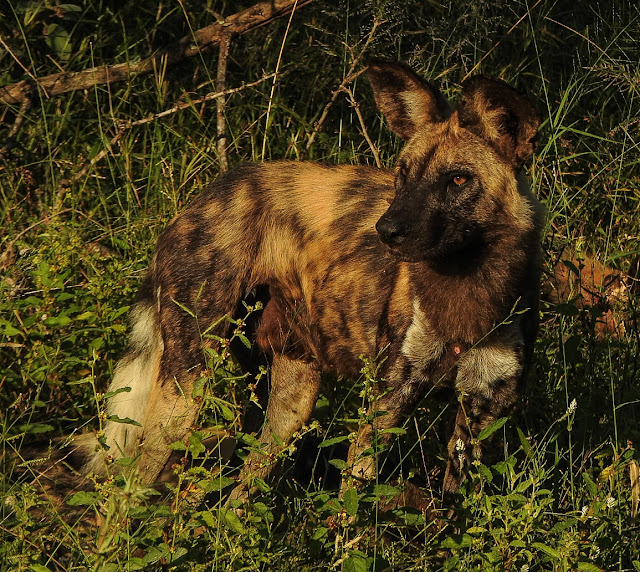
4-4-2018 PHINDA FOREST LODGE, SOUTH AFRICA - AFRICAN WILD DOG (Lycaon pictus)


The African wild dog (Lycaon pictus) is the largest wild canine in Africa, and the only extant member of the genus Lycaon; it is distinguished from Canis by dentition highly specialized for a hypercarnivorous diet, and by a lack of dewclaws. Although not as prominent in African folklore or culture as other African carnivores, the African wild dog has been respected in several hunter-gatherer societies, particularly those of the predynastic Egyptians and the San people.

The fur of African wild dogs consists entirely of stiff bristle hairs with no underfur. They gradually lose their fur as they age, and older specimens become almost naked. Fur color varies geographically, with northeastern African specimens tending to be predominantly black with small white and yellow patches, while southern African ones are more brightly colored, sporting a mix of brown, black, and white coats. Their muzzle is usually black, gradually shading into brown on the cheeks and forehead. A black line extends up the forehead, turning blackish-brown on the back of the ears. A few specimens sport a brown teardrop-shaped mark below the eyes. The back of the head and neck are either brown or yellow. A white patch occasionally occurs behind the forelegs, with some specimens having completely white forelegs, chests, and throats. The tail is usually white at the tip, black in the middle, and brown at the base. Some specimens lack the white tip entirely or may have black fur below the white tip. These coat patterns can be asymmetrical, with the left side of the body often having different markings from that of the right.


African wild dogs are native to sub-Saharan Africa. The majority of the species' population occurs in Southern Africa and southern East Africa. More specifically in countries such as Botswana, Namibia, Zimbabwe, Angola, Benin, Burkina Faso, Niger, Central African Republic, Chad, Malawi, Mozambique, Senegal, South Africa, South Sudan, Sudan, Ethiopia, Kenya, Tanzania, Zambia. African wild dogs are mostly found in savanna, and arid zones, open plains, shrubland, and semi-desert, generally avoiding forested areas. This preference is likely linked to their hunting habits, which require open areas that do not obstruct vision or impede pursuit. Nevertheless, they will travel through the scrub, woodland, and montane areas in pursuit of prey. Forest-dwelling populations of African wild dogs occur in the Harenna Forest, a wet montane forest in the Bale Mountains of Ethiopia. At least one record exists of a pack being sighted on the summit of Mount Kilimanjaro.


African wild dogs are very social animals, living in packs with separate dominance hierarchies for males and females. Packs consist of 2 to 27 adults and yearling pups. Uniquely among social carnivores, the females rather than the males disperse from the natal pack once sexually mature. Males rarely disperse, and when they do, they are invariably rejected by other packs already containing males. African wild dogs are specialized diurnal pack hunters, which catch their prey by chasing them to exhaustion in a pursuit clocking at up to 66 km/h (41 mph) for 10 to 60 minutes. They have a higher success rate when it comes to killing prey even though they are smaller than lions and leopards.

Their hunting strategies differ according to prey, with wildebeest being rushed at to panic the herd and isolate a vulnerable individual, whereas territorial antelopes, which defend themselves by running in wide circles, are captured by cutting off their escape routes. Medium-sized prey is often killed in 2-5 minutes, whereas larger prey such as wildebeest may take half an hour to pull down. Unlike most social predators, African wild dogs will regurgitate food for adult as well as young family members. They are not aggressive creatures and don't fight over food. Pups old enough to eat solid food are given first priority at kills, eating even before the dominant pair; subordinate adult dogs help feed and protect the pups.


African wild dogs are monogamous. Every pack has a dominant breeding pair that mates for life. Populations in East Africa have no fixed breeding season, whereas those in Southern Africa usually breed during the April-July period. During this period, the female is closely accompanied by a single male, which keeps other members of the same sex at bay. African wild dogs produce more pups than any other canid, with litters containing around 6 to 16 pups, with an average of 10, thus indicating that a single female can produce enough young to form a new pack every year. The gestation period lasts 69-73 days. After giving birth, the mother stays close to the pups in the den, while the rest of the pack hunts. She typically drives away pack members approaching the pups until the latter are old enough to eat solid food at 3 to 4 weeks of age. The pups leave the den around the age of 3 weeks and are suckled outside. At the age of 5 weeks, the pups are weaned and are fed regurgitated meat by the other pack members. By 7 weeks, they begin to take on an adult appearance, with noticeable lengthening in the legs, muzzle, and ears. Once the pups reach the age of 8 to 10 weeks, the pack abandons the den and the young follow the adults during hunts. Both males and females become reproductively mature when they are 12-18 months old.

Saturday, 28 April 2018

4-4-2018 PHINDA FOREST LODGE, SOUTH AFRICA - SOUTHEAST AFRICAN CHEETAH (Acinonyx jubatus jubatus)


The Southeast African cheetah (Acinonyx jubatus jubatus) is the nominate cheetah subspecies native to East and Southern Africa. The Southern African cheetah lives mainly in the lowland areas and deserts of the Kalahari, the savannahs of Okavango Delta, and the grasslands of the Transvaal region in South Africa. In Namibia, cheetahs are mostly found in farmlands. In India, four cheetahs of the subspecies are living in Kuno National Park in Madhya Pradesh after having been introduced there.

From the early Pleistocene, the earliest African cheetah fossils have been found in the lower beds of the Olduvai Gorge site in northern Tanzania, although cheetah fossils in Southern Africa were found to be 3.5 to 3.0 million years old. The Southeast African cheetah is the second-oldest subspecies.

Cheetahs from Africa and Asia were previously considered as genetically identical with each other. DNA research and analysis started in the early 1990s and showed that the Southern and East African cheetahs are indeed separate subspecies.


The cheetah is a medium-sized cat. An adult male cheetah's total size can measure from 168 to 213 cm (66 to 84 in) and 162 to 200 cm (64 to 79 in) for females. Adult cheetahs are 70 to 90 cm (28 to 35 in) tall at the shoulder. Males are slightly taller than females and have slightly bigger heads with wider incisors and longer mandibles.

Measurements taken of wild cheetahs in Namibia indicate that the females range in head-and-body length from 113 to 140 cm (44 to 55 in) with 59.5 to 73.0 cm (23.4 to 28.7 in) long tails, and weigh between 21.0 and 63.0 kg (46.3 and 138.9 lb); males range in head-and-body length from 113 to 136 cm (44 to 54 in) with 60 to 84 cm (24 to 33 in) long tails, and weigh between 28.5 and 65.0 kg (62.8 and 143.3 lb).

The cheetah has a bright yellow or sometimes a golden coat, and its fur is slightly thicker than that of other subspecies. The white underside is very distinct, especially on the neck and breast, and it has less spotting on its belly. The spots on the face are more pronounced, and as a whole its spots seem more dense than those of most other subspecies. The tear marks are notably thicker at the corners of the mouth, and almost all of them have distinct brown mustache markings. Like the Asiatic cheetah, it is known to have fur behind its tail and have both white and black tips at the end of its tail. However, the cheetah may also have only a black tip at the end of its tail.

In desert areas, such as the Kalahari, cheetahs are somewhat smaller and lighter in weight, with thinner, bright-colored fur, a trait the Northwest African cheetah also has.

6-4-2018 THORNYBUSH GAME LODGE, SOUTH AFRICA - RED BILLED OXPECKER (Buphagus erythrorhynchus)


The red-billed oxpecker, known scientifically as Buphagus erythrorynchus, is a passerine bird distinguished by its mutualistic relationship with large mammals. It is a member of the Buphagidae family, characterized by its striking red bill.

Adult red-billed oxpeckers exhibit a sharp contrast between their red bills and predominantly brown plumage. Juveniles, however, are darker in color and possess an olive bill that transitions to the adult's red as they mature, a process taking approximately four months. In flight, these birds are robust and purposeful, easily recognized by their hissy, crackling calls.

The red-billed oxpecker is a denizen of the open savannahs of sub-Saharan Africa, where it thrives in the expansive grasslands dotted with acacia trees.


This species is widespread across the eastern savannahs of sub-Saharan Africa, from the Central African Republic and South Sudan in the north, extending southwards to the northern and eastern regions of South Africa.

Outside of breeding seasons, red-billed oxpeckers congregate in large, sociable flocks. They exhibit a fascinating behavior of nesting in tree holes, which they line with hair plucked from livestock. Their diet primarily consists of insects, but they are particularly known for perching on large mammals to feed on ticks and blood, a behavior that has earned them their name.


The red-billed oxpecker's vocalizations are distinctive, described as a hissy, crackling "trik-quisss," which can be heard as they interact with each other or while in flight.

Breeding red-billed oxpeckers lay clutches of two to five eggs, with three being the average, in nests lined with hair from animals such as impala.

The red-billed oxpecker can be confused with its close relative, the yellow-billed oxpecker, although the latter is less common in Southern Africa where their ranges overlap.


An adult red-billed oxpecker can consume a significant number of blood-engorged ticks or thousands of larvae in a single day. While ticks are a part of their diet, these birds have a preference for blood, often pecking at wounds on mammals to keep them open for feeding.

The IUCN Red List classifies the red-billed oxpecker as Least Concern, indicating that the species currently faces no significant threats to its survival.

6-4-2018 THORNYBUSH GAME LODGE, SOUTH AFRICA - COMMON WARTHOG (Phacochoerus Africus)


Warthogs are sparsely-haired wild pigs found across sub-Saharan Africa. These unique animals have large heads and bodies with short legs, coarse manes down their backs, and long, thin tails they hold upright when running. Their most distinctive features are the large bumps on their faces that look like warts—hence their name.

These fleshy growths help protect warthogs, shielding their eyes and faces when they’re fighting, which occurs between males during mating season. These warts are also covered in short hairs that help them feel vibrations in the ground so they can sense nearby threats while grazing. Warthogs are also well-known for their two sets of tusks—a pair of long, protruding lower tusks that measure around 15 centimetres (six inches) each and are used when fighting, and a pair of upper tusks that form a 60-centimetre (two-foot) long semicircle.

There are two warthog species, the widespread common warthog and the desert warthog. Common warthogs have larger tusks and more extensive manes than their desert cousins, and are commonly found across sub-Saharan Africa in open plains, grassland savannahs, and woodlands. Desert warthogs, on the other hand, have longer legs and less body fat, which makes them well adapted to the drier conditions of semi-arid regions of Somalia, Ethiopia, and Kenya.

Both species eat a predominantly herbivorous diet of roots, bulbs, bark, grasses, berries, and other plants, using their snouts to dig through the soil to find food and kneeling on their padded knees to eat short grass. They also eat worms, insects, and carrion. While largely solitary animals, a female warthog sometimes lives in communal groups—known as ‘sounders’—with other females and their piglets. However, she chases off her current litter before birthing the next after a gestation of around six months. Males and females only come together to mate.

Warthogs play important roles in the ecosystems of African savannahs and grasslands. As grazers, they aerate the soil with their snouts while scavenging for food, which supports plant growth. Their abandoned burrows provide homes for other wildlife, while the parasites that live on their skin provide food for birds. Warthogs are also key prey for lions, leopards, hyenas, and wild dogs, helping support these predator populations.

While not currently endangered, warthog numbers are declining across Africa due to poaching, droughts, and habitat loss. Preserving these unique animals is a priority for maintaining healthy ecosystems.

6-4-2018 PHINDA FOREST LODGE, SOUTH AFRICA - GIANT BLONDE SNAIL (Lissachatina immaculata)


Lissachatina immaculata is a species of very large, air-breathing land snail, a terrestrial pulmonate gastropod mollusk in the family Achatinidae.

Usually grows to 12–15 cm.

L. immaculata immaculata

L. immaculata panthera

Subspecies within this species include:

Lissachatina immaculata immaculata
Lissachatina immaculata panthera
Lissachatina immaculata mozambique
Lissachatina immaculata two-tone
 
This species occurs in Southeastern Africa.

5-4-2018 PHINDA FOREST LODGE, SOUTH AFRICA - AFRICAN STRIPED SKINK (Trachylepis striata)


The African striped skink (Trachylepis striata), commonly called the striped skink, is a species of lizard in the skink family (Scincidae). The species is widespread in East Africa and Southern Africa. It is not a close relation to the Australian striped skink, Ctenotus taeniolatus.

T. striata is brown or bronze-coloured with two yellowish stripes that run lengthwise on either side of the spine. Both sexes grow to a total length (including tail) of 25 cm (9.8 in). Their tails are often missing due to predators.

The African striped skink (Trachylepis striata), or simply the striped skink, is a common species of skink found widely across sub-Saharan Africa. It typically has a sleek, streamlined body with distinctive striping along its sides, which differentiates it from similar species. The coloration and pattern can vary, but generally, it features a combination of brown, grey, and olive tones.

The African striped skink (Trachylepis striata), or simply the striped skink, is a common species of skink found widely across sub-Saharan Africa. It typically has a sleek, streamlined body with distinctive striping along its sides, which differentiates it from similar species. The coloration and pattern can vary, but generally, it features a combination of brown, grey, and olive tones.


The African striped skink is known for its adaptability to various habitats, ranging from woodlands and savannas to human-altered environments. It primarily feeds on insects and other small invertebrates. It is known for its agility and quick movements, which aid in both foraging for food and evading predators.

The African striped skink usually breeds in the warmer months. They are oviparous, laying eggs which hatch after an incubation period. Details on the exact duration of incubation and specific breeding behaviors are not yet known.

The population of African striped skink is unknown, but it has a wide range and it is common. It is listed as least concern on the IUCN Red List. 

27-4-2018 OLIVA MARJAL. VALENCIA - MALLARD (JUVENILE) (Anas platyrhynchos)


The Mallard, or wild duck (Anas platyrhynchos), is a familiar and widespread dabbling duck with a presence across temperate and subtropical regions of the Americas, Eurasia, and North Africa. It has also been introduced to parts of the Southern Hemisphere. The male is renowned for its iridescent green head and white collar, while the female sports a brown-speckled plumage. Both sexes boast a speculum—a patch of feathers with iridescent purple or blue hues bordered by white. The Mallard's length ranges from 50 to 65 cm, with a wingspan of 81 to 98 cm, and it typically weighs between 0.7 and 1.6 kg.


Males during the breeding season are unmistakable with their glossy green heads, white collars, and purple-tinged brown breasts. Females are mottled brown with buff cheeks and an eye-stripe. Both sexes have the distinctive speculum on their wings. The male's bill is yellowish-orange tipped with black, while the female's is darker, ranging from black to mottled orange and brown.


Mallards are found in a variety of wetlands, including parks, small ponds, rivers, lakes, and estuaries. They prefer water depths less than 0.9 meters and are drawn to areas with aquatic vegetation.


This species is distributed across the Northern and Southern Hemispheres, from Alaska to Mexico, the Hawaiian Islands, across the Palearctic, and down to southeastern and southwestern Australia and New Zealand.

Mallards are social birds that often form large flocks outside the breeding season. They are adaptable and can thrive in urban areas. The species is migratory in the northern parts of its range.


The female Mallard is known for its quintessential "quack," while the male's call is a quieter and deeper version of the female's. Vocalizations can vary by region, with urban ducks being louder than their rural counterparts.


Breeding pairs form in the fall, with the female laying 8 to 13 creamy white to greenish-buff eggs. Incubation lasts 27 to 28 days, and ducklings are precocial, swimming immediately after hatching.


Similar species include the American black duck, which is darker than the Mallard, and the mottled duck, which has slightly different coloration and lacks the white edge on the speculum.


Mallards are omnivorous, feeding on a variety of foods including seeds, plant matter, insects, crustaceans, and small animals. Their diet varies with the season and breeding cycle.

The Mallard is classified as Least Concern by the IUCN. However, it is considered invasive in some regions, where it can hybridize with and threaten local duck species.

4-4-2018 PHINDA GAME RESERVE,SOUTH AFRICA - SOUTHERN WHITE RHINOCEROS (Ceratotherium simum ssp simum)


The southern white rhinoceros or southern white rhino (Ceratotherium simum simum) is one of the two subspecies of the white rhinoceros (the other being the much rarer northern white rhinoceros). It is the most common and widespread subspecies of rhinoceros.

The southern white rhinoceros is the nominate subspecies; it was given the scientific name Ceratotherium simum simum by the English explorer William John Burchell in the 1810s. The subspecies is also known as Burchell's rhinoceros (Ceratotherium simum burchellii) after Burchell and Oswell's rhinoceros (Ceratotherium simum oswellii) after William Cotton Oswell, respectively. However, these are considered synonyms of its original scientific name.

Ceratotherium simum kiaboaba (or Rhinoceros kiaboaba), also known as straight-horned rhinoceros, was proposed as a different subspecies (or species) found near Lake Ngami and north of the Kalahari Desert. However, it is now considered part of the southern white rhinoceros and ranges throughout southern Africa.

Lifespan is up to 50 years in the wild.


Following the phylogenetic species concept, research in 2010 suggested the southern and northern white rhinoceros may be different species, rather than subspecies, in which case the correct scientific name for the northern subspecies is Ceratotherium cottoni and the southern subspecies should be known as simply Ceratotherium simum. Distinct morphological and genetic differences suggest the two proposed species have been separated for at least a million years.

The southern white rhinoceros is one of largest and heaviest land animals in the world. It has an immense body and large head, a short neck and broad chest. Females weigh around 1,600–1,700 kg (3,530–3,750 lb) and males around 2,000–2,300 kg (4,410–5,070 lb), with specimens of up to 3,600 kilograms (7,940 lb) considered reliable, and larger sizes up to 4,500 kg (9,920 lb) claimed but not verified.[3][4][5][6][7][8] The head-and-body length is 3.35–4 m (11.0–13.1 ft) and a shoulder height of 160–186 cm (5.25–6.10 ft).[4][7] It has two horns on its snout. The front horn is larger than the other horn and averages 60 cm (24 in) in length and can reach 166 cm (65 in) in females.[9][7] Females usually have longer but thinner horns than the males, who have larger but shorter ones. The southern white rhinoceros also has a prominent muscular hump that supports its large head. The colour of this animal can range from yellowish brown to slate grey. Most of its body hair is found on the ear fringes and tail bristles, with the rest distributed sparsely over the rest of the body. The southern white rhino has a distinctive flat, broad mouth that is used for grazing. Southern white rhinos are strictly herbivores (graminivores) that feed on short grasses.


Little is known about southern white rhinoceros mating habits, but females reproduce every 2–3 years. They give birth to a single calf, after a gestation period that lasts around 16 months. Males are never directly involved in the raising of calves; in rare instances, certain rogue individuals may even kill calves that they perceive as future competition, both for resources and bloodline dominance. Newborn calves weigh about 45 kg (100 pounds) at birth. Young usually become independent in 2–3 years.

The southern white rhino lives in the grasslands, savannahs, and shrublands of southern Africa, ranging from South Africa to Zambia. About 98.5% of southern white rhino live in just five countries: South Africa, Namibia, Zimbabwe, Kenya and Uganda.

The southern white rhino is listed as Near Threatened; it is mostly threatened by habitat loss and poaching for rhino horn for use in traditional Chinese medicine.

The southern white rhino was nearly extinct near the end of the 19th century having been reduced to a population of approximately 20–50 animals in KwaZulu-Natal due to sport hunting and land clearance. Numbers increased rapidly from 1992 to 2010, due to intensive protection and translocation efforts, however population growth then slowed as poaching increased, with numbers declining from 2012 to 2017. An approximate 15% decline in estimated numbers between 2012 and 2017 was primarily due to reductions in populations within South Africa's Kruger National Park. Poaching rates peaked in 2014 and as of December 2017, there were an estimated 18,064 southern white rhino in the wild with populations being assessed as Near Threatened since 2002.

White rhino trophy hunting was legalized and regulated in 1968, and after initial miscalculations is now generally seen to have assisted in the species' recovery by providing incentives for landowners to boost rhino populations.

5-4-2018 PHINDA FOREST LODGE, SOUTH AFRICA - PLAINS ZEBRA (Equus quagga)


The Plains zebra (Equus quagga, formerly Equus burchellii) is the most common and geographically widespread species of zebra. It is the most recognizable grazing animal on the African continent. Their closest relatives are donkeys and horses. The sparkling coat of zebras reflects more than 70% of incoming heat, which is likely to help them survive under the scorching African sun. Each of these animals has its own unique stripe pattern, which helps identify individuals. Additionally, the striped coat is used as ideal camouflage, allowing zebras to remain unspotted by predators in the grass.


The Plains zebra is dumpy bodied with relatively short legs and a skull with a convex forehead and a somewhat concave nose profile. The neck is thicker in males than in females. The ears are upright and have rounded tips. As with all wild equids, the Plains zebra has an erect mane along the neck and a tuft of hair at the end of the tail. It is boldly striped in black and white and no two individuals look exactly alike. Compared to other species, the Plains zebra has broader stripes. The stripes are vertical on the fore part of the body and tend towards the horizontal on the hindquarters. Northern zebra populations have narrower and more defined striping; southern populations have varied but lesser amounts of striping on the under parts, the legs, and the hindquarters. Southern populations also have brown "shadow" stripes between the black and white coloring. These are absent or poorly expressed in northern zebras. The natal coat of a foal is brown and white and the brown darkens with age.


Plains zebras are intermediate in size between the larger Grévy's zebra and the smaller mountain zebra and tend to have broader stripes than both. Great variation in coat patterns exists between clines and individuals. The plains zebra's habitat is generally, but not exclusively, treeless grasslands and savanna woodlands, both tropical and temperate. They generally avoid desert, dense rainforest and permanent wetlands. Zebras are preyed upon by lions and spotted hyenas, Nile crocodiles and, to a lesser extent, leopards, cheetahs and African wild dogs.


Plains zebras are a highly social species, forming harems with a single stallion, several mares and their recent offspring; bachelor groups also form. Groups may come together to form herds. The animals keep watch for predators; they bark or snort when they see a predator and the harem stallion attacks predators to defend his harem.

The plains zebra remains common in game reserves, but is threatened by human activities, such as hunting for its meat and hide, as well as competition with livestock and encroachment by farming on much of its habitat. The loss of open grasslands due to woody plant encroachment increases predation risk and therewith habitat. Plains zebra are listed as near threatened by the IUCN as of 2016. The species population is stable and not endangered, though populations in most countries have declined sharply.