
Friday, 12 April 2019
Thursday, 11 April 2019
1-4-2019 VALENCIA CITY, VALENCIA - EURASIAN COLLARED DOVE (Streptopelia decaocto)

The Eurasian collared dove, also known as the collared dove or Turkish dove (Streptopelia decaocto), is a bird of modest size, presenting a grey-buff to pinkish-grey plumage that is slightly darker above than below. It is recognized by its distinctive black half-collar edged with white on its nape, from which it derives its name. The species exhibits a blue-grey underwing patch and a tail that is grey-buff above, with dark grey and white-tipped feathers below. The sexes appear similar, with juveniles displaying a less developed collar and a brown iris.
To identify the Eurasian collared dove, look for its medium size, slimmer and longer-tailed body compared to a rock pigeon, and a shorter stature than the wood pigeon. The red legs, black bill, and red iris surrounded by a small area of bare skin, which may appear white or yellow, are key features. The bird's song, a three-part cooing "goo-GOO-goo," and a harsh screeching call are also distinctive identifiers.
This species is often found in proximity to human habitation, particularly where food is plentiful and trees are available for nesting. It is not uncommon to see these doves frequenting bird tables and farms.
Originally from warm temperate and subtropical Asia, the Eurasian collared dove has expanded its range dramatically, colonizing colder countries and becoming a permanent resident in many. Its range now includes Europe, North America, and the Caribbean.

Wednesday, 10 April 2019


10-4-2019 BONAIRE, VALENCIA - BOAR THISTLE (Galactites tomentosus)

Galactites tomentosus, the purple milk thistle, is a biennial herbaceous plant belonging to the genus Galactites of the Asteraceae family.
Galactites tomentosus is a hemicryptophyte plant up to 1 metre (3 ft 3 in) tall. The stem is erect and pubescent, branched at the top. The leaves are green, long and pinnatisect, lanceolate, mottled with white markings, while the underside is whitish and covered with matted woolly hairs. The margins of the leaves bear strong thorns.

The flower heads are quite large – about 3 centimetres (1.2 in) in diameter. The involucre of the flower head is covered by hairy scales ending with a single grooved thorn. The central flowers are hermaphrodite and are pollinated by insects, while external flowers are sterile; their color varies from white or pink to lilac-purple.

The flowering period extends from April through July and the seeds ripen from August through September. The fruits are achenes with whitish hairy appendages (pappus).
The genus name derives from the Greek γάλα (= "milk"), referring to the dense white hairs covering the stems and leaves of this species, the species name tomentosus means hairy in Latin.

This plant is distributed around the Mediterranean Basin, from Greece to the Iberian Peninsula, Morocco and Madeira and Canary Islands. It has been introduced to the Azores.

This plant prefers sunny places and usually grows on the uncultivated or barren grounds, waste places, well-drained soils, pastures and roadsides.
It is an edible plant.


10-4-2019 ALBUFERA, VALENCIA - GREY HERON (Ardea cinerea)
%2020.jpg)
The Grey Heron (Ardea cinerea) is a statuesque wading bird belonging to the family Ardeidae. It is a familiar sight in both rural and urban settings, often seen standing stoically along the water's edge. An adult Grey Heron is a large bird, reaching up to 100 cm in height, with a wingspan between 155 to 195 cm. It weighs between 1 to 2 kg. The plumage is predominantly ashy-grey above, with a greyish-white underbelly and some black on the flanks. A striking feature is the white head and neck adorned with a broad black stripe that extends from the eye to the black crest. The beak is pinkish-yellow, long, and sharply pointed, while the legs are a brown hue.
When identifying the Grey Heron, look for the white head with the black supercilium and crest, the long grey neck, and the ashy-grey wings and back. The underparts are lighter, and the legs are long and brown. Juveniles can be distinguished by their duller grey neck and smaller crest. The beak is a useful indicator of age, being brighter in breeding adults.
10-4-2019 ALBUFERA, VALENCIA - GREY HERON (Ardea cinerea)
%2021.jpg)
Large wader (approx 102 cm or 3.5 ft) with an also large wingspan (approx 175 cm or 5.5 ft). Stylized silhouette and long neck. Greyish plumage in general. White head in adults with black forelock and long, black feathers like a plume. Light neck with dark lines. Ashen back and dark spot on the shoulders. Lighter belly. Long, sharp, yellow bill. Yellow legs. Silhouette in flight with neck folded in the shape of an "s" and stretched legs.
Its habitats are principally Wetlands, River and Riverside
It lives in all types of wetlands with salty or fresh water in winter. In the breeding season it needs wetlands with nearby tree vegetation. Also in Reservoirs, lagoons, ditches and irrigation ponds, stream banks, coast line.
%2022.jpg)
This pecies is present in the province all year round, both as a wintering one and in the breeding period. There are also specimens in migratory passage. Gregarious during the reproductive season and lonelier during the rest of the year. Nest in trees or groves of riparian vegetation. One laying of 2 to 5 eggs. The Grey Heron feeds on fish, micromammals, small reptiles, including snakes, amphibians and insects. It shows a very calm behaviour when foraging. This bird explores the water while being very still, waiting for a prey to appear. Once sighted, it shoots the bill as if it were a harpoon.
For its elegant appearance and slow and calm flight herons awaken curiosity and intrigue in many people. One of the most curious things about these birds is their ability to remain quiet for hours perched on one leg. They can remain this way and with the neck shrunk, only showing the head and the bill between the wings, a lot of time if they are not bothered.


Tuesday, 9 April 2019
18-11-2017 HANNINGFIELD RESERVOIR, ESSEX - EUROPEAN GOLDFINCH (Carduelis carduelis)
%2021.jpg)
The European goldfinch is known for its sociable nature, often forming flocks in the winter. It is a frequent visitor to bird feeders, particularly in the colder months.
The goldfinch's song is a delightful, silvery twittering, while its call is a melodic tickeLIT. Its song comprises a tinkling medley of trills and twitters, always including the tri-syllabic call phrase.
The female goldfinch solely constructs the nest, which is often situated several meters above ground, camouflaged by leaves. The nest is made of mosses and lichens, lined with plant down, and secured with spider silk. Eggs are laid at daily intervals, typically resulting in a clutch of 4-6 eggs. Incubation lasts 11-13 days, with the female being fed by the male. Both parents feed the chicks, which fledge 13-18 days after hatching.
Goldfinches have a preference for small seeds, such as those from thistles and teasels, but will also consume insects when feeding young. They are particularly drawn to bird feeders offering niger seed.
8-11-2017 HANNINGFIELD RESERVOIR, ESSEX - EURASIAN BULLFINCH (FEMALE) (Pyrrhula pyrrhula)

The Eurasian bullfinch, also known simply as the bullfinch in its native range, is a robust bird with a distinctive bull-headed appearance. It is a member of the finch family, Fringillidae, and is recognized by its grey upper parts and black flight feathers. The male is particularly striking with his rich red underparts.
Adult males can be identified by their black cap and face, contrasting with their bright red underparts. Females and juveniles are more subdued, with grey-buff underparts. All ages have a white rump and wing bars that are quite noticeable in flight. The bill is short and thick, suited to their seed-eating habits.
The Eurasian bullfinch prefers mixed woodlands with a good proportion of conifers. It is also commonly found in parklands and gardens, where it can nest and forage.
This species is widespread across Europe and temperate Asia. While largely resident, northern populations may migrate southward during winter months.
Outside of breeding season, the Eurasian bullfinch is not known to form large flocks, typically seen in pairs or small family groups.

The call of the Eurasian bullfinch is a soft, melancholic whistle, often transcribed as “peeu” or “pew.” Its song, which is a mix of scratchy warbles and soft whistles, is usually only heard at close range. Remarkably, with patience, these birds can be trained to mimic specific melodies.
Nests are constructed in bushes or trees, with a preference for vegetation that is at least four meters in height and breadth. The female lays a clutch of four to seven pale blue, red-brown mottled eggs. The species is notable for its unusual spermatozoa structure and can produce multiple broods from early May to mid-July.
The Eurasian bullfinch has a diet consisting mainly of seeds and buds from fruit trees, which can sometimes lead to conflicts with orchard keepers. In autumn and early winter, they show a preference for ash and hawthorn seeds. When provided with wild bird cover, they favor kale, quinoa, and millet.
The Eurasian bullfinch is currently listed as Least Concern on the IUCN Red List, indicating that it is not at immediate risk of population decline.
Monday, 8 April 2019
18-11-2017 HANNINGFIELD RESERVOIR, ESSEX - COMMON CHAFFINCH (MALE) (Fringilla coelebs)
%20(Fringilla%20coelebs)%2020.jpg)
The Common chaffinch (Fringilla coelebs) is a common and widespread small passerine bird in the finch family. The English name of this species comes from the Old English ‘ceaffinc’, where ceaf is ‘chaff’ and finc ‘finch’. Chaffinches were likely given this name because after farmers thresh their crops, these birds sometimes spend weeks picking through heaps of discarded chaff for grain.
Common chaffinches have a herbivorous and carnivorous (insectivorous) diet. Outside the breeding season, they mainly eat seeds and other plant material that they find on the ground. During the breeding season, their diet switches to invertebrates, especially defoliating caterpillars. The young are entirely fed with invertebrates which include caterpillars, aphids, earwigs, spiders, and grubs (the larvae of beetles).
%20(Fringilla%20coelebs)%2021.jpg)
The adult male Common chaffinch has a black forehead and a blue-grey crown, nape and upper mantle. The rump is a light olive-green; the lower mantle and scapulars form a brown saddle. The side of the head, throat and breast are a dull rust-red merging to pale creamy pink on the belly. The central pair of tail feathers are dark grey with a black shaft streak. The rest of the tail is black apart from the two outer feathers on each side which have white wedges. Each wing has a contrasting white panel on the coverts and a buff-white bar on the secondaries and inner primaries. The flight feathers are black with white on the basal portions of the vanes. The secondaries and inner primaries have pale yellow fringes on the outer web whereas the outer primaries have a white outer edge. After the autumn moult, the tips of the new feathers have a buff fringe that adds a brown cast to the coloured plumage. The ends of the feathers wear away over the winter so that by the spring breeding season the underlying brighter colours are displayed. The eyes have dark brown irises and the legs are grey-brown. In winter the bill is a pale grey and slightly darker along the upper ridge or culmen, but in spring the bill becomes bluish-grey with a small black tip. The adult female is much duller in appearance than the male. The head and most of the upperparts are shades of grey-brown. The underparts are paler. The lower back and rump are a dull olive green. The wings and tail are similar to those of the male. The juvenile resembles the female.
%20(Fringilla%20coelebs)%2022.jpg)
The breeding range of Common chaffinches includes northwestern Africa and most of Europe and extends eastwards across temperate Asia to the Angara River and the southern end of Lake Baikal in Siberia. There are also distinctive populations in the Azores, the Canary Islands, and the Madeira Islands in the Atlantic Ocean. Common chaffinches are partial migrants; birds that breed in warmer regions are sedentary, while those breeding in the colder northern areas of their range winter further south. These birds prefer wooded areas and inhabit mixed and conifer forests and lower montane deciduous forests. They are also common in parks, gardens, orchards, agricultural areas, and hedgerows.
Common chaffinches are social birds. Outside the breeding season, they form flocks, sometimes mixed with bramblings, and forage for seeds on the ground. They feed by day, often in open country but also in trees, and also occasionally make short sallies to catch insects in the air. They seldom take food directly from plants and only very rarely use their feet for handling food. Common chaffinches communicate using various types of calls and songs. The males have a strong voice and typically sing two or three different song types, and there are regional dialects also. They sing from exposed perches to attract a mate and their song may be heard from far. The common call of these birds is a sharp 'pink-pink' sound. During the flight chaffinches often produce 'yup-yup' and when alarmed they emit a 'seee' call.
%20(Fringilla%20coelebs)%2023.jpg)
Common chaffinches are monogamous and often form long-lasting pair bonds. The time of breeding usually depends on the spring temperature and is earlier in southwest Europe and later in the northeast. A male attracts a female to his territory through song. Nests are built entirely by the female and are usually located in the fork of a bush or a tree several meters above the ground. The nest has a deep cup and is lined with a layer of thin roots and feathers. The female lays a clutch of 4-5 eggs, which are smooth and slightly glossy, but very variable in color. They range from pale-blueish green to light red with purple-brown blotches, spots, or steaks. The eggs are incubated for 10-16 days by the female. The chicks are altricial, hatching nearly naked with closed eyes, and are fed by both parents but mainly by the female, who broods them for around 6 days. The nestlings fledge 11-18 days after hatching and leave the nest; however, they are then still assisted with feeding by both parents for a further 3 weeks. The parents only very rarely start a second brood, but when they do so it is always in a new nest. Young chaffinches are able to breed when they are 1 year old.
8-4-2019 GANDIA MARJAL, VALENCIA - MALLARD (FEMALE) (Anas platyrhynchos)

The Mallard, or wild duck (Anas platyrhynchos), is a familiar and widespread dabbling duck with a presence across temperate and subtropical regions of the Americas, Eurasia, and North Africa. It has also been introduced to parts of the Southern Hemisphere. The male is renowned for its iridescent green head and white collar, while the female sports a brown-speckled plumage. Both sexes boast a speculum—a patch of feathers with iridescent purple or blue hues bordered by white. The Mallard's length ranges from 50 to 65 cm, with a wingspan of 81 to 98 cm, and it typically weighs between 0.7 and 1.6 kg.
Males during the breeding season are unmistakable with their glossy green heads, white collars, and purple-tinged brown breasts. Females are mottled brown with buff cheeks and an eye-stripe. Both sexes have the distinctive speculum on their wings. The male's bill is yellowish-orange tipped with black, while the female's is darker, ranging from black to mottled orange and brown.

Mallards are found in a variety of wetlands, including parks, small ponds, rivers, lakes, and estuaries. They prefer water depths less than 0.9 meters and are drawn to areas with aquatic vegetation.
This species is distributed across the Northern and Southern Hemispheres, from Alaska to Mexico, the Hawaiian Islands, across the Palearctic, and down to southeastern and southwestern Australia and New Zealand.
Mallards are social birds that often form large flocks outside the breeding season. They are adaptable and can thrive in urban areas. The species is migratory in the northern parts of its range.

The female Mallard is known for its quintessential "quack," while the male's call is a quieter and deeper version of the female's. Vocalizations can vary by region, with urban ducks being louder than their rural counterparts.
Breeding pairs form in the fall, with the female laying 8 to 13 creamy white to greenish-buff eggs. Incubation lasts 27 to 28 days, and ducklings are precocial, swimming immediately after hatching.
Mallards are omnivorous, feeding on a variety of foods including seeds, plant matter, insects, crustaceans, and small animals. Their diet varies with the season and breeding cycle.
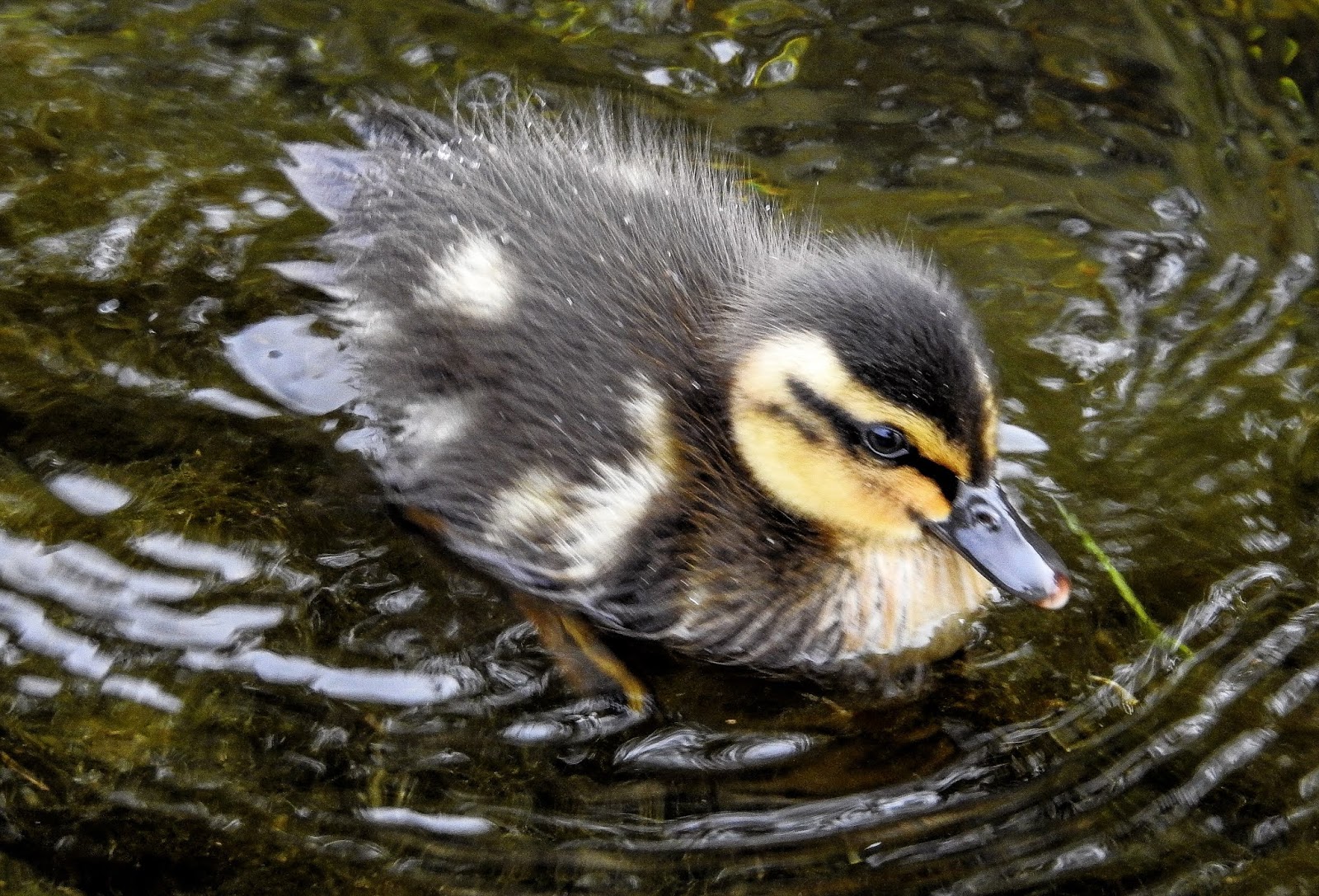
8-4-2019 GANDIA MARJAL, VALENCIA - MALLARD (FEMALE AND YOUNG) (Anas platyrhynchos)
%20(Anas%20platyrhynchos)%2020.jpg)
Female mallards (hens) are primarily brown and mottled for camouflage, are responsible for building the nest and raising the young, and have a loud, quacking call. They lay 5 to 14 eggs, which they incubate for about 28-30 days before leading the mobile ducklings to water once they dry off.
Females are mottled brown with an orange bill, which helps them blend in with their surroundings.
Unlike the males, they do not have a bright green head or a white collar.
Both sexes have iridescent blue-purple speculum feathers edged with white on their wings, which are prominent in flight.
The female builds a shallow, ground-level nest by pulling nearby vegetation towards her and lining it with grasses, leaves, and down from her own breast.
She lays between 5 and 14 eggs, usually about nine to thirteen.
The eggs are incubated for approximately 28 to 30 days.
Ducklings are mobile and able to feed themselves soon after hatching, but the female guides them to food sources.
She leads them to water once their downy feathers are dry, which happens about 10 hours after hatching.
A key reason females lay so many eggs is that not all chicks are expected to survive to maturity.
They will stay with their mother for about two months before they are able to fly.
Only the female mallard makes the classic, loud quacking sound; the male makes a quieter, rasping sound.
During a period of vulnerability after breeding, both sexes molt their flight feathers and are temporarily flightless.
Female mallards, like other dabbling ducks, are omnivores, eating both plants and small invertebrates.
8-4-2019 MONTE CORONA, VALENCIA - NORTHERN YELLOW SAC SPIDER (Cheiracanthium mildei)

Cheiracanthium mildei is a species of spider from the family Cheiracanthiidae. C. mildei is commonly known as the northern yellow sac spider, a name it partially shares with many other spiders of its genus. Alternatively its also called the long-legged sac spider.
C. mildei is native to Europe and North Africa through the Caucasus to Central Asia. It is introduced to the United States and parts of South America. It widespread across the northeastern United States and eastern Canada, and can be found outside, or more commonly inside houses. It is thought to have been introduced into America from Europe by English colonists.[citation needed]
C. mildei is a dominant predator of S. littoralis (a moth species) in Africa and Mid Eastern regions. The mechanism of predation include causing direct death by consuming the larvae and causing indirect death by dispersing larvae from its host plants.
8-4-2019 GANDIA MARJAL, VALENCIA - YELLOW IRIS (Iris pseudacorus)

Iris pseudacorus, the yellow flag, yellow iris, or water flag, is a species of flowering plant in the family Iridaceae. It is native to Europe, western Asia and northwest Africa. Its specific epithet pseudacorus means "false acorus", referring to the similarity of its leaves to those of Acorus calamus (sweet flag), as they have a prominently veined mid-rib and sword-like shape. However, the two plants are not closely related.
This herbaceous flowering perennial plant grows to 100–150 cm (39–59 in), or a rare 2 m (6 ft 7 in) tall, with erect leaves up to 90 cm (35 in) long and 3 cm (1.2 in) broad. The flowers are bright yellow, 7–10 cm (2.8–3.9 in) across, with the typical iris form. The fruit is a dry capsule 4–7 cm (1.6–2.8 in) long, containing numerous pale brown seeds.
I. pseudacorus grows best in very wet conditions, and is common in wetlands, where it tolerates submersion, low pH, and anoxic soils. The plant spreads quickly, by both rhizome and water-dispersed seed. It fills a similar niche to that of Typha and often grows with it, though usually in shallower water. While it is primarily an aquatic or marginal plant, the rhizomes can survive prolonged dry conditions.
Large I. pseudacorus stands in western Scotland form a very important feeding and breeding habitat for the endangered corncrake.
I. pseudacorus is one of two iris species native to the United Kingdom, the other being Iris foetidissima (stinking iris).


8-4-2019 GANDIA MARJAL, VALENCIA - PURPLE HERON (Ardea purpurea)

The Purple Heron (Ardea purpurea), a statuesque avian, stands with a height ranging from 70 to 94 cm and boasts a wingspan of 120 to 152 cm. Despite its grand stature, it is a slender creature, tipping the scales at a mere 0.5 to 1.35 kg. This bird is slightly smaller and more svelte than its cousin, the Grey Heron, and is adorned with darker, reddish-brown plumage.
Adult Purple Herons are distinguished by their black foreheads and crowns, with a dark stripe cascading down the back of the neck, culminating in a modest, dangling crest. Their heads and necks are a buffish chestnut, streaked with dark lines, while the mantle dons an oily brown hue. The upper parts and tail are a brownish grey, and the underparts are a mix of chestnut and black. During the breeding season, the beak of the adult brightens, and the eyes gleam with a yellow iris.
The Purple Heron is a denizen of marshes, lagoons, and lakes, often shrouded by dense vegetation. It has a penchant for freshwater habitats, particularly those with expansive reed beds of Phragmites. Coastal mangrove swamps are also within its realm, though less frequently visited.
This heron has a broad range that spans Africa, central and southern Europe, and the southern and eastern Palearctic. While the Western Palearctic populations are migratory, their African and tropical-Asian counterparts are mostly sedentary, save for occasional dispersive movements.

The Purple Heron is a creature of stealth and grace, often retreating to the sanctuary of reed beds. It exhibits a slow, deliberate flight, with its neck retracted and legs trailing behind. On land, it moves with long toes that allow it to traverse floating vegetation or even bushwalk without grasping the branches. Dawn and dusk are its preferred times for activity, with the bird often seen stalking or standing in ambush for its prey.
The heron's vocalization is a subdued "frarnk," a quieter and higher-pitched affair compared to the Grey Heron. It is generally less vocal, but similar guttural sounds may emanate from its colonies.
Purple Herons are colonial breeders, constructing bulky nests from dead reeds or sticks in close proximity to water. They lay about five bluish-green eggs, with both parents sharing incubation duties. The young emerge after approximately four weeks and take their first flight six weeks later.
A versatile predator, the Purple Heron's diet includes fish, rodents, frogs, insects, and more. It employs both stalking and ambush tactics to capture its prey, often waiting motionlessly or slowly stalking its victim.

Sunday, 7 April 2019
18-11-2017 HANNINGFIELD RESERVOIR, ESSEX - BRITISH BLUE TIT (Cyanistes caeruleus ssp. obscurus)
%2020.jpg)
The blue tit is a delicate little bird, weighing in at around 11g – half the size of a robin. Often considered our most attractive garden bird, the blue tit is extremely colourful, with a bright blue cap, white face, black stripes across the eyes, bright yellow breast and blue, green and white wings.
Caterpillars are a favourite for blue tits, but they also eat other insects, spiders, fruit and seeds. They are regular visitors to garden bird feeders, feasting on mixed bird seed, whole shelled peanuts, fat balls and sunflower hearts. Extremely acrobatic, they will often hang upside down from branches to access food. During the winter, blue tits join up with other tit species in search of food.
%2021.jpg)
Blue tits are found in deciduous and mixed woodland, hedges, gardens and parks across the UK. They are one of our most common birds, with an estimated population of around 3.4 million pairs.
Like all birds, blue tits can see ultra-violet light – the front of their head glows brightly under UV light, and this is how females are thought to choose their partners.
Blue tits start looking for a place to nest as early as January, usually beginning to build their nest by late March. They favour cosy cavities: rot holes and cracks in trees, old woodpecker nests, crevices in walls and nest boxes.
%2022.jpg)
Once a nest site is located, blue tits will begin building a nest out of moss, hair, leaves, feathers and spider webs. Unlike many other birds, blue tits will usually only raise a single brood each spring. They lay around 7–14 eggs, and won’t begin incubating until all of the eggs have been laid.
The clutch is usually laid from late April to early May, and incubation takes round 15 days. The male will bring the female food during this period. Once hatched, the chicks spend approximately three weeks in the nest before fledging.
A sure sign of the start of spring is the sight of blue tits zipping back and forth to nest boxes, beaks full of moss. Find out when, where and how long blue tits nest, when their chicks fledge, and how important it is that they time things just right.
The blue tit’s colourful feathers make this bird easy to spot. Look out for it perched on trees in woodland or foraging for a bite to eat on garden bird feeders, and listen for its high-pitched ‘tsee-tsee-tsee-chu-chu-chu’ song.
The blue tit is a common, widespread species. Its population has grown by 21% since 1970. You can lend these birds a helping hand by placing bird feeders in your garden, particularly during the winter when food is scarce.
Subscribe to:
Comments (Atom)