TOTAL PAGEVIEWS

TRANSLATE

Tuesday, 18 June 2019

7-6-2019 MOREMI CAMP, BOTSWANA - BLACK WINGED STILT (Himantopus himantopus)


The black-winged stilt is a black and white wading bird with incredibly long legs. They live in a variety of wetlands, from marshes to coastal lagoons. They wade through the water, plucking insects from the surface.

The Black-winged stilt (Himantopus himantopus) is one of the most fascinating waders seen on the banks of the many water-bodies in our country. Proportionately the longest legged of the waders, with the exception of the flamingo, the tall, lanky, slender-necked, Blackwinged stilt presents a stark visual contrast. Its black wings and white neck and underparts give it the distinctive look of a formally dressed dinner guest! The bright red legs and red iris provide an added dash of colour. In winter both sexes are fairly similar in appearance with dabs of greyish-brown on their heads and necks. The sooty-brown wings of the female are, however, duller than those of the male, which have an added metallic, blue-green sheen. With the onset of summer the adult male sports darker spots on his head extending down to his neck.


Members of the genus Himantopus, are a very variable species, (upto eight are recognised) of which the Black-winged is one. They have an extremely broad breeding range, from temperate to tropical climates and from rain forests to deserts, spreading over Eurasia, Africa, Australia and the Americas. Most members of this family are, however, nomadic, moving as conditions change, with a few northern hemisphere populations migrating over short distances.

The Black-winged stilt is both a resident and a visitor in India. Every winter it makes its way south in small flocks and settles on the edges of marshes, lakes, rivers and tidal areas all over the Indian peninsula. In summer these flocks move northwards again, to nest in the lakes and rivers of northern India, north-west Pakistan and Afghanistan.


A masterpiece of evolution, the Black-winged stilt fits perfectly into a special eco-niche in the shallows which few other waders have managed to exploit as successfully. This eco-niche consists of reasonably clear water, rich in aquatic life, ranging in depth from four to twelve inches. At this depth its long wading legs give the stilt an edge over most other waders like sandpipers and the diminutive stints, allowing them to explore comparatively deeper areas thereby reducing competition, by providing a wider feeding zone. Interestingly, in this feeding zone, most ducks too find themselves `out of their depth' as the area is too shallow for them to `upend' easily. This small, specific area is, therefore, almost exclusively the preserve of the stilt.

The stilt's legs dangle gracefully under its body in flight. Interestingly, the bird lowers or raises them as the need arises, using them to adjust its air-speed and also as a `rudder'.


The stilt's remarkable legs, almost ten inches long, are usually stretched neatly out behind the bird when flying, though for short hops they merely dangle about. Much to my amusement I discovered that the bird, despite the awkward length of its legs is still able to scratch its head with one foot outstretched over a wing. While flying the stilt must use a fairly rapid wing-beat and interestingly, it adjusts its air-speed by raising or lowering its legs, which are also used as rudders of sorts. To land, the bird glides gracefully downwards, wings held horizontally, and pushes its legs forward at the very last moment to come to a running or hopping halt. While observing flocks of stilts, their acrobatic techniques provide considerable entertainment. I have occasionally seen a bird drop its legs in the air, hover above the ground like an aircraft and then descend vertically on both feet. No less fascinating is the manner in which the delicate wader moves along the shoreline. It proceeds through the water with a jerky, high-stepping gait, lifting each leg well out of the water by bending its knee at right angles, before placing the foot gingerly down again in front.

7-6-2019 MOREMI CAMP, BOTSWANA - BLACK CRAKE (Zapornia flavirostra)


The Black Crake, known scientifically as Zapornia flavirostra, is a rather striking waterbird from the rail and crake family, Rallidae. Adults typically measure between 19 to 23 centimeters in length, featuring a short tail and notably long toes. The plumage is predominantly black, with a subtle brown olive hue on the wings and upperparts that is often imperceptible in natural light. The bird's eye is a vivid red, complemented by a yellow bill—aptly reflected in its binomial name—and legs and feet of a reddish hue, which may appear duller outside of the breeding season.

Both sexes of the Black Crake are similar in appearance, though males are marginally larger and most exhibit a hooked upper mandible—a feature less common in females. Juveniles display brown upperparts with a dark grey head and underparts, and their bill is a greenish yellow. Their legs and feet are a muted red. The downy chicks are uniformly black, a common trait among rails.

The Black Crake favors freshwater marshes teeming with vegetation, which provides essential cover. Unlike many of its rail relatives, this species is often observed in the open, thanks to its less secretive nature.

This bird is widespread across sub-Saharan Africa, save for regions that are particularly arid. It is known to undertake seasonal movements in response to drought conditions.

The Black Crake is diurnal and exhibits a certain boldness, often feeding in close proximity to humans. It is a common to abundant species that has adapted well to human-altered landscapes, such as areas affected by deforestation. Notably, the species is seldom hunted due to the unpalatable nature of its flesh.


The primary vocalization of the Black Crake is a duet commencing with a throaty chattering "krrrok-kraaaa," followed by a dove-like cooing "coo-crr-COO."

During the breeding season, the Black Crake becomes fiercely territorial and aggressive, even towards birds of similar size. Both sexes contribute to constructing a deep, neat bowl-shaped nest from wetland plants, which may be situated in marsh vegetation, on the ground, or occasionally elevated in a bush. The clutch typically consists of two to six eggs, which are cream or white with brown or chestnut spots. Incubation, lasting 13 to 19 days, is a shared duty, sometimes aided by offspring from previous broods. The precocial chicks venture from the nest within a few days of hatching and are fed by their parents and helpers for several weeks thereafter, achieving flight by 5 to 6 weeks of age and independence at 6 to 12 weeks.

The Black Crake's diet is varied, including invertebrates, small fish, frogs, seeds, bird eggs, and it will scavenge on carcasses. It forages on the ground or climbs reeds to capture prey, including flying insects. A peculiar behavior is observed when it perches on hippopotamuses and warthogs to remove parasites.

The Black Crake is currently classified as Least Concern on the IUCN Red List, indicating that it does not face any immediate threat of extinction.

7-6-2019 MOREMI CAMP, BOTSWANA - BATELEUR EAGLE (JUVENILE)(Terathopius ecaudatus)


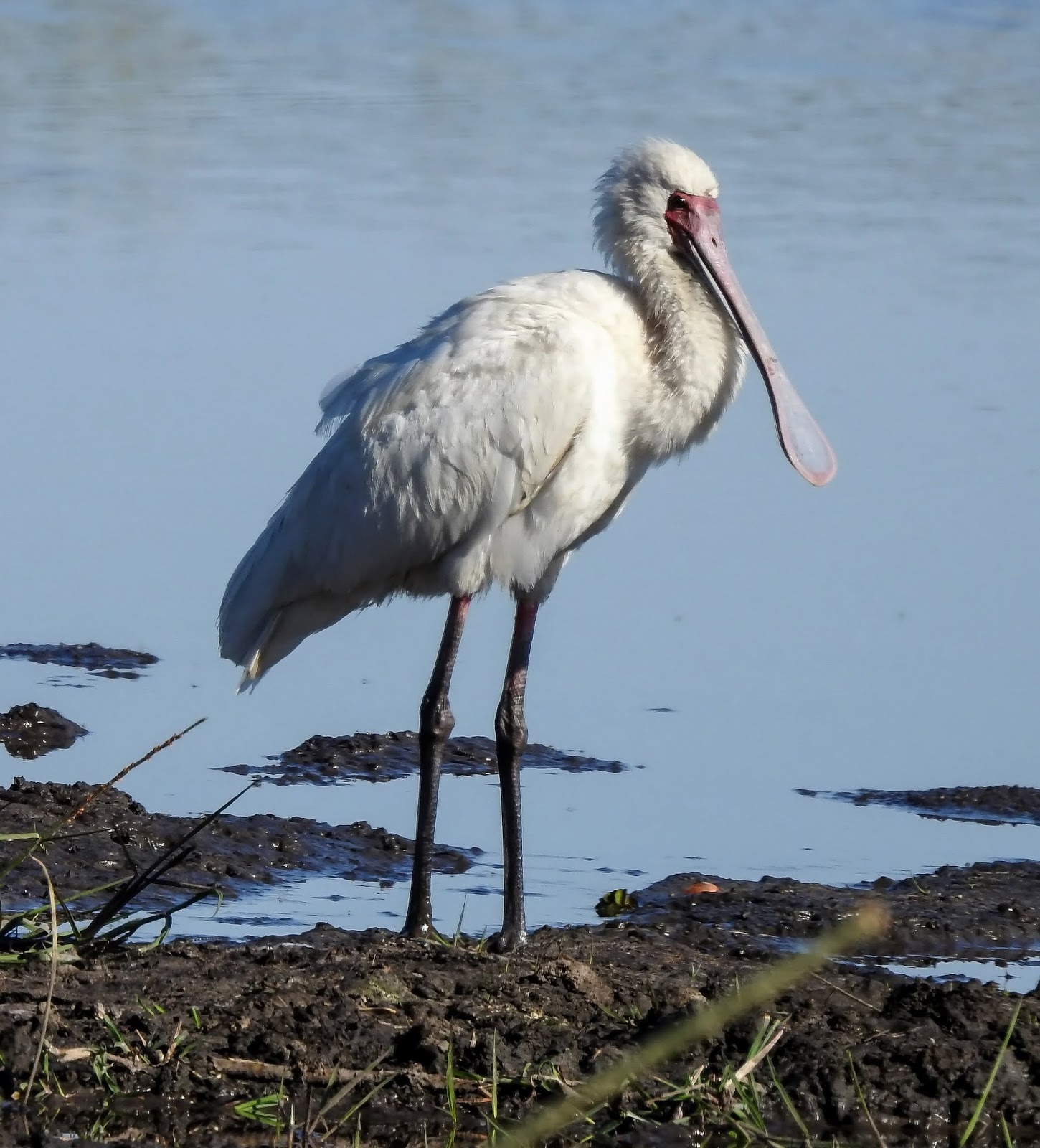
7-6-2019 MOREMI CAMP, BOTSWANA - AFRICAN SPOONBILL (Platalea alba)


The African spoonbill, Platalea alba, is a striking wading bird belonging to the ibis and spoonbill family, Threskiornithidae. This species is characterized by its long legs, which facilitate wading through marshy wetlands, and its distinctive long grey spatulate bill, which is used to sift through shallow waters for food. Adult birds are predominantly white with red legs and a red face, while immature birds can be identified by their yellow bills and the absence of red on their faces.

When identifying the African spoonbill, look for a large, all-white bird with a unique spoon-shaped bill. During flight, unlike herons, spoonbills keep their necks outstretched. Breeding adults will exhibit more vibrant red coloration on their legs and face, and their bill will be grey. Juveniles can be distinguished by their paler bill color and lack of red facial markings.


The African spoonbill is found in marshy wetlands that have open shallow water. It prefers environments where it can wade and forage for food, such as in reedbeds or along the edges of bodies of water.

This bird has a widespread presence across Africa and Madagascar, with sightings reported in countries including Botswana, Kenya, Mozambique, Namibia, South Africa, and Zimbabwe.


African spoonbills are known for their methodical feeding technique, swinging their open bills side-to-side in the water to catch prey. They are sociable birds, often nesting in colonies, but they typically do not share these colonies with storks or herons. Their long legs and thin, pointed toes are perfectly adapted for navigating through varying water depths.

The African spoonbill is generally silent, but it may make soft grunting noises during the breeding season.


Breeding season for the African spoonbill occurs in the winter and extends into spring. During this time, males display more pronounced plumage and brighter colors. Nests are constructed from sticks and reeds in trees above water and lined with leaves. Females lay three to five eggs, primarily in April or May. Both parents share the responsibility of incubating the eggs for up to 29 days. After hatching, the chicks are cared for by both parents for approximately 20 to 30 days, becoming ready to fly four weeks post-fledging.


The African spoonbill can be confused with the common spoonbill; however, it lacks the crest found on the latter. Additionally, the common spoonbill has a yellowish bill, whereas the African spoonbill's bill is grey.

The diet of the African spoonbill includes a variety of fish, molluscs, amphibians, crustaceans, insects, and larvae. Its specialized bill allows it to efficiently sift through water to capture these prey items.


The African Spoonbill's diet consists mainly of fish and aquatic invertebrates such as crustaceans or shellfishes, insects, larvae, and mollusks.
 
The African Spoonbill begins to breed in the winter. The breeding period starts in the winter and lasts throughout the spring. It usually breeds in colonies from late March through September. The female may lay 3-5 eggs during the month of April or May.

This bird's eggs are usually spotted with colored dots of red, brown, or blue. It lays its eggs mostly in a nest platform of sticks or reeds in a tree near water, but its nest can also be found in swamp reeds, among rocks, marsh plants, or cliffs. These nests are either near the ground or in trees over water.

The inside of the nest is often lined with leaves. The egg undergoes incubation for up to 29 days by both parents. After hatching the young are cared for by both parents for 20-30 days. Soon after. They begin to fly after another four weeks.

The African Spoonbill is usually a shy and alert bird. It is usually found singly, but can also be encountered in pairs or in groups. It is usually silent, except for an occasional grunt when alarmed. This bird travels by flight. It flies with its neck and legs extended, while flapping its wings steadily in the air.

18-6-2019 OLIVA, VALENCIA - WAVED UMBER MOTH (Menophra abruptaria)


Menophra abruptaria, the waved umber, is a moth of the family Geometridae. The species was first described by Carl Peter Thunberg in 1792. It is found in south-western North Africa, southern Europe and Anatolia; in the north, it is found from England to Switzerland, south-western Germany, Bangladesh . The wingspan is 36–42 mm. Adults are on wing from April to June. Normally, there is one generation per year, although there can be a partial second generation in summer.

The larvae feed on Ligustrum ovalifolium and Syringa vulgaris.


A distinctive species, occurring reasonably commonly in the south of England and Wales, becoming scarcer into the northernmost English counties.

It inhabits woodland, parks and gardens, and flies in a single generation from April into June.

The larvae feed on garden privet (Ligustrum ovalifolium) and lilac (Syringa vulgaris).

18-6-2019 MONTE CORONA, VALENCIA - TROPICAL TENT SPIDER (Cyrtophora citricola)


Cyrtophora citricola, also known as the tropical tent-web spider, is an orb-weaver spider in the family Araneidae. It is found in Asia, Africa, Australia, Costa Rica, Hispaniola, Colombia, and Southern Europe and in 2000, it was discovered in Florida. C. citricola differs from many of its close relatives due its ability to live in a wide variety of environments. In North America and South America, the spider has caused extensive damage to agricultural operations.

C. citricola is in the orb web spider family, but its orb webs are considered atypical. They have a thick silk strand barrier above the orb and a thinner barrier below the orb. This gives the webs a horizontal mesh-like appearance. The spider has developed distinct and specific prey-capturing techniques using its unconventional webs. The prey flies into the upper mesh layer of the web and is deflected into the orb web. The spider then collects and stores the prey in its web. The difference in C. citricola's web silk stems from physiological variations in its spinning apparatuses, as compared to other closely related species. Its webs are non-adhesive and do not require daily respinning.

18-6-2019 OLIVA, VALENCIA - MELODIOUS WARBLER (Hippolais polyglotta)


The Melodious Warbler, known scientifically as Hippolais polyglotta, is a medium-sized member of the Old World warbler family. It measures between 12 to 13 centimeters in length, presenting a plain brown back and wings, with a more yellowish hue on the underparts. This bird is distinguished by its strong and pointed bill, as well as its brown legs. Both sexes appear identical, a common trait among warblers, while juveniles exhibit a paler belly.

When identifying the Melodious Warbler, look for its brown upper parts which are less green than those of its eastern counterpart, the Icterine Warbler. The underparts are a distinct yellowish color. Its song is a delightful babble, less varied than the Icterine's but more fluent and sustained, without mimicked sounds. Listen also for a rattling "trrrr", similar to a House Sparrow, a soft "tuk", and a chattering "chret-chet".


This species thrives in open woodlands adorned with bushes. It is also found in forest edges, thickets, riverside vegetation, orchards, and gardens, which provide ample foraging opportunities and nesting sites.

The Melodious Warbler is a migratory bird, breeding in the warmth of southwest Europe and northwest Africa, and seeking winter refuge in the sub-Saharan regions of Africa. Its breeding territories span from the Iberian Peninsula to Germany and Italy, and in North Africa, it is found from Western Sahara to Tunisia.

The Melodious Warbler exhibits typical warbler behavior, being mainly insectivorous. It is known for its pleasant and melodious song, which it uses to communicate and establish territory during the breeding season.

Song & Calls
The warbler's song is a charming and melodious babble, more consistent and smooth than that of the Icterine Warbler but with less variety and no mimicry. Its calls include a rattling "trrrr", a subdued "tuk", and a chattering "chret-chet".


During the breeding season, the Melodious Warbler lays a clutch of three to five eggs. The nest is artfully constructed from fine grasses, stems, soft twigs, flakes of bark, and lichen, typically situated in a tree or bush.

The Melodious Warbler can be confused with the Icterine Warbler, but it can be distinguished by its browner upper parts and yellower underparts, as well as its song and calls.

Insects form the mainstay of the Melodious Warbler's diet, but it will also consume other small food items, including berries, to supplement its nutrition.

The International Union for Conservation of Nature (IUCN) has classified the Melodious Warbler as "Least Concern", indicating a stable population across its wide range.

Monday, 17 June 2019

7-6-2019 MOREMI CAMP, BOTSWANA - SAVANNAH ELEPHANT (Loxodonta Africana)


7-6-2019 KHWAI CAMP, BOTSWANA - SMALL ORANGE TIP BUTTERFLY (Colotis evagore ssp. antigone)


7-6-2019 KHWAI CAMP, BOTSWANA - AFRICAN GREY HORNBILL (Lophoceros nasutus)


In spite of it's top heavy appearance the beak of the grey hornbill is made up of a light skin of keratin overlying a bony support. The beak has lots tiny holes that are air chambers, resulting in the beak being incredibly light. The large bill may be the reason why hornbills have the first two neck vertebrae fused together.

Nesting african grey hornbills are monogamous.

When nesting natural cavities are used.

The female lays two to four white eggs.

The female undergoes a molt of all her flight and tail feathers at the time of egg laying. These are re-grown by the time she emerges from the nest.


To protect their young from predators the female seals herself inside the nest using mud, droppings, fruit pulp and her own feathers, leaving only a narrow slit through which the male will feed her and the young. Her mate will bring her and the chicks food as often as 10-20 times a day.

When the chicks are about half-grown, it gets a little cramped inside the nest, the female will break out and rebuild the wall. Both parents will then feed the chicks.

The young grey hornbills break their way out of the nest only when they are ready to fledge.

It's fair to say that African Grey Hornbills are not only beautiful, they are incredible parents.

7-6-2019 KHWAI CAMP, BOTSWANA - AFRICAN BROAD BORDERED GRASS YELLOW BUTTERFLY (Eurema brigitta ssp. brigitta)


7-6-2019 KHWAI CAMP, BOTSWANA - BURCHELL'S STARLING (Lamprotornis australis)


Burchell's starling (Lamprotornis australis) or Burchell's glossy-starling is a species of starling in the family Sturnidae. The monogamous and presumably sedentary species is native to dry and mesic woodlands and savannah of southern Africa. The name of this bird commemorates the English naturalist William John Burchell.

This species is found in Angola, Botswana, Eswatini, Mozambique, Namibia, South Africa, Zambia, and Zimbabwe. It is absent from miombo woodland, but is present in westerly gusu woodlands.

In the Kalahari they associate with camelthorn trees and also feed on their flowers. Their food includes flowers, fruit and small animals. They breed during the summer months.

The species is not threatened and is locally common in conservation areas.

7-6-2019 KHWAI CAMP, BOTSWANA - BRADFIELD'S HORNBILL (Lophoceros bradfieldi)


Bradfield's hornbills are African birds found in southern Africa's woodlands, characterized by a black back, white belly, and an orange beak. They are medium-sized, live solitarily or in pairs, and primarily eat fruits, insects, and small reptiles. A key identification feature is the small white corners on the tail, which are visible in flight. 

Identification Appearance: Black back and wings with a white belly and a red-orange beak. The tail has small white corners that are conspicuous in flight. They have a black eye mask.Size: Medium-sized, about \(50-57\) cm (\(20-22\) in) long.Females: Smaller than males and have turquoise facial skin.Call: A long, insistent series of piping notes. 


Habitat and diet Habitat: Woodland areas, especially those with mopane and Zambezi teak trees, in northeastern Namibia, northern Botswana, southern Angola, and eastern Zimbabwe.

Diet: Primarily feed on fruits, large insects like locusts and beetles, nuts, and small reptiles. They also hunt for flying insects. 

Reproduction Nesting: Typically nest in natural tree cavities.Clutch size: Usually lay 3 eggs.Incubation: The female incubates the eggs alone for about 4 weeks.Parental care: After the chicks hatch, the female leaves the nest to help the male with hunting. The chicks stay in the nest for about 2 months. 

Conservation status Status: Classified as "Least Concern" by the IUCN. However, the population is likely declining due to habitat loss from logging. 

6-6-2019 KHWAI CAMP, BOTSWANA - WATTLED CRANE (Grus carunculata)


The wattled crane (Grus carunculata) is a large, threatened species of crane found in wetlands and grasslands of eastern and southern Africa, ranging from Ethiopia to South Africa. Some authorities consider it the sole member of the genus Bugeranus.

At a height known to range from 150 to 175 cm (4 ft 11 in to 5 ft 9 in), it is the largest crane in Africa and is the second tallest species of crane in the world, after the sarus crane. It is also the tallest flying bird native to Africa third only among all birds to the two species of ostrich. The wattled crane is taller and, despite the appearance of gracility imparted by its sharp but slim beak and slender neck and legs, is the heaviest on average of several very large, long-legged waders in Africa (i.e. the 2 largest African storks, shoebill, greater flamingo, goliath heron).[10] It is also roughly the fourth heaviest African flying bird after the great white pelican, the much more sexually dimorphic kori bustard and cape vulture.[10] The wingspan is 230–260 cm (7 ft 7 in – 8 ft 6 in), the length is typically 110 to 140 cm (3 ft 7 in to 4 ft 7 in) and weight is 6.4–8.28 kg (14.1–18.3 lb) in females and 7.5–9 kg (17–20 lb) in males.[11][12][13] Among standard measurements, the wing chord length is 61.3–71.7 cm (24.1–28.2 in), the exposed culmen is 12.4–18.5 cm (4.9–7.3 in) and the tarsus is 23.2–34.2 cm (9.1–13.5 in).


Going on standard measurements, it is the second largest proportioned crane after the sarus species, outsizing in these respects even the ostentatiously heavier red-crowned crane. Three adult wattled cranes averaged 8.15 kg (18.0 lb). The back and wings are ashy gray. The feathered portion of the head is dark slate gray above the eyes and on the crown, but is otherwise white, including the wattles, which are almost fully feathered and hang down from under the upper throat. The breast, primaries, secondaries, and tail coverts are black. The secondaries are long and nearly reach the ground. The upper breast and neck are white all the way to the face. The skin in front of the eye extending to the base of the beak and tip of the wattles is red and bare of feathers and covered by small round wart-like bumps. Wattled cranes have long bills and black legs and toes. Males and females are virtually indistinguishable, although males tend to be slightly larger. Juveniles have tawny body plumage, lack the bare skin on the face, and have less prominent wattles. The generation length (in years) is 13.


The wattled crane occurs in eleven countries in eastern and southern Africa, including an isolated population in the Ethiopia Highlands. More than half of the world's wattled cranes occur in Zambia, but the single largest concentration occurs in the Okavango Delta of Botswana.The wattled crane has been spotted in Uganda for the first time in 2011, seen in the Kibimba Rice region in the eastern side of the country. This sighting brings the total number of bird species in Uganda to 1040.

In April 2018, a new population of Wattled Cranes was discovered in Angola.

Wattled cranes inhabit fairly inaccessible wetlands under most conditions. It requires shallow marsh-like habitats with a good deal of sedge-based vegetation. All cranes are omnivorous. The principal food of the wattled crane is mainly aquatic eating the tubers and rhizomes of submerged sedges and water lilies. It is one of the more herbivorous of extant cranes. The other primary portion of the diet consists of aquatic insects. They will supplement the diet with snails, amphibians and snakes when the opportunity arises. Roughly 90% of foraging done by this species occurs in shallow waters. They typically forage by digging vigorously with their bill into the muddy soil. On occasion, it will eat grain and grass seed as well, but does so much less often than the other three African crane species.

6-6-2019 KHWAI CAMP, BOTSWANA - WATER THICK NEE (Barhinus Vermiculatus)


6-6-2019 KHWAI CAMP, BOTSWANA - SOUTHERN REEDBUCK (Redunca arundinum)


The southern reedbuck, rietbok or common reedbuck (Redunca arundinum) is a diurnal antelope typically found in southern Africa. It was first described by Pieter Boddaert, a Dutch physician and naturalist, in 1785. It is placed in the genus Redunca and family Bovidae. This antelope has an average mass of 58 kg (128 lb) and a body length of about 134–167 cm (53–66 in).

The southern reedbuck is larger than the other species in Redunca, namely R. redunca (Bohor reedbuck) and R. fulvorufula (mountain reedbuck). It stands 80–90 cm (31–35 in) at the shoulder. Females weigh 48 kg (106 lb), while the males weigh 68 kg (150 lb). It has distinctive dark lines running down the front of each of its forelegs and lower hindlegs and whitish rings around the eyes. It has a lifespan of 10 years.

The coat is silky and almost woolly. The color of its coat ranges between light- and greyish-brown, and may be lighter on the neck and chest. A small, black, bare glandular patch can be noticed at the base of each ear. White fur covers the underparts and the areas near the lips and chin. The tail is white underside, and appears short and bushy. Southern reedbucks measure an average of 85 cm (33 in) at the shoulder. Females lack horns. Males bear forward-curving horns, about 35–45 cm (14–18 in) long, with the base having a distinct band of pale, rubbery tissue.


Southern reedbucks live in pairs or alone. Sometimes, they form herds consisting of about 20 members. They prefer to lie in grass or reed beds in the heat of the day and feed during sunrise and sunset, or sometimes even at night. Old reedbucks are permanently territorial, with territories around 35-60 hectares, and generally live with a single female, preventing contact with rival males. Females and young males perform an 'appeasement dance' for older males. During the dance, the bucks run around speedily and take considerably long jumps, with the tail curled up and scented air being released from a pocket in the groin at every bounce, making a popping sound. Within this territory, it is active all the time in summer, but it is nocturnal in the wet season. It regularly uses paths to reach good sites to rest, graze, and drink water. Average lifetime home ranges have been estimated as 123 ha for females and 74 ha for males.

Their main predators include lions, leopards, cheetahs, spotted hyenas, Cape hunting dogs, African rock pythons and nile crocodiles. They can camouflage themselves in the grasslands due to their coats, which are almost the same color. If startled or attacked, they stand still, then either hide or flee with an odd rocking-horse movement, and cautiously look back to ensure the danger is gone, generally. They use vocalizations like a shrill whistle through their nostrils and a clicking noise to alert others about danger.

6-6-2019 KHWAI CAMP, BOTSWANA - NILE MONITOR (Varanus niloticus)


6-6-2019 KHWAI CAMP, BOTSWANA - SOUTH AFRICAN HIPPOPOTAMUS (JUVENILE) (Hippopotamus amphibius ssp. capensis)


South African hippos are large, semi-aquatic mammals found in rivers, lakes, and wetlands, now concentrated in provinces like KwaZulu-Natal and Mpumalanga, Limpopo, and reintroduced in the Eastern and Western Cape. They are herbivorous, spending their days in water and grazing at night, and are considered one of the most dangerous animals in Africa due to their aggressive and unpredictable nature, particularly when feeling threatened. 

Habitat and distribution
Current locations: Primarily found in KwaZulu-Natal, Mpumalanga, and Limpopo. 
Reintroduced areas: They have been reintroduced into the Eastern and Western Cape provinces. 
Habitat preference: They prefer deep bodies of water and slow-moving rivers with shallow banks, but are also found in lakes and mangrove swamps. 


Behavior and lifestyle

Daily routine: Hippos spend the day in the water to stay cool, emerging at dusk to graze on grass for several hours, sometimes traveling many miles from the water's edge. 
Social structure: They are gregarious, often living in groups called pods or schools of five to 20 individuals, which can increase to larger numbers in the dry season when water is scarce. 


Breeding: Calves are born in the water after a gestation period of about 240 days and can swim immediately. The mother will initially hide her newborn in reeds for a few days. 


Danger and conservation

Dangerous animals: Hippos are known to be highly aggressive and are responsible for more human fatalities in Africa than most other large animals, often due to feeling threatened. 
Threats: Habitat loss and poaching for meat and ivory are the biggest threats to hippos. 
Conservation status: The hippopotamus is listed as a vulnerable species by the IUCN Red List of Threatened Species. 

6-6-2019 KHWAI CAMP, BOTSWANA - HADADA IBIS (Bostrychia hagedash)


The Hadada ibis is a large, grey-brown bird native to sub-Saharan Africa, named for its distinctive "haa-daa-daa" call. They primarily eat insects, worms, and snails, which they find by probing the ground with their sensitive, curved bills. Hadadas live in pairs or small groups during the day, but gather in large roosts at night, and build solitary, basket-shaped nests in trees or on man-made structures. 

Habitat and distribution
Habitat: They live in a variety of habitats, including wooded streams, grasslands, savanna woodlands, and man-made environments like large gardens and sports fields.

Distribution: They are native to sub-Saharan Africa and are common in many countries in that region. 

Diet and feeding
Diet: Primarily carnivorous, they eat insects, worms, millipedes, snails, crustaceans, and small reptiles. They are also the only known ibis species to eat fruits and vegetables.


Feeding method: They use their long, curved, and sensitive beaks to probe the ground and shallow water for hidden prey, relying on touch to find food. 
Behavior and breeding

Calls: The name "Hadada" comes from their loud, raucous call, which sounds like "ha-da-da".

Nesting: They build solitary nests out of sticks, often on tree branches or telephone poles.

Parental care: Both male and female parents incubate the eggs and feed the chicks by regurgitating food.

Social structure: They are monogamous and typically breed in pairs. During the day they forage in pairs or small groups, but roost in large communal groups at night.