TOTAL PAGEVIEWS

TRANSLATE

Tuesday, 23 July 2019

30-5-2019 RIVER ZAMBESI , ZAMBIA - GABAR GOSHAWK (Micronisus gabar)


The Gabar Goshawk, a bird of prey from the Accipitridae family, is a polymorphic species exhibiting two distinct color forms. The more common pale morph has a predominantly grey plumage with a striking white rump. Its chest, thighs, and underwings are adorned with white and grey barring, and it sports a dark grey, barred tail. The rarer dark morph, comprising about a quarter of the population, is cloaked almost entirely in black. Adult Gabar Goshawks have dark eyes, long legs, and a red cere, while juveniles display a yellow cere and legs, and their plumage is a browner shade with less defined barring. Females are notably larger than males, with males weighing between 90-173 grams and females between 167-240 grams. The species measures 28-36 cm in body length with a wingspan of approximately 63 cm.

To identify the Gabar Goshawk, look for the white rump and barred underparts in the pale morph, or the striking black plumage in the dark morph. The long legs and red cere in adults are also distinctive features. Juveniles can be recognized by their yellow cere and legs, and their generally browner, less neatly barred plumage.

The Gabar Goshawk is found in open woodlands, particularly favoring dry Acacia savanna and broad-leaved woodlands with species such as Brachystegia, Terminalia, and Colosphermum mopane. In arid regions like the Karoo and Namib Desert, it is typically associated with tree-lined watercourses and has been known to adapt to urban environments.

30-5-2019 RIVER ZAMBESI , ZAMBIA - AFRICAN JACANA (Actophilornis africanus)


The African Jacana, Actophilornis africanus, is a distinctive wader known for its remarkable ability to traverse floating vegetation with its elongated toes and claws. This bird exhibits a striking chestnut plumage on its upperparts, complemented by black wingtips, rear neck, and an eyestripe. Adults boast a chestnut underpart, while juveniles display a white underpart with a chestnut belly patch. A blue bill, extending into a coot-like head shield, and grey legs and toes complete its unique appearance.

To identify the African Jacana, look for its long toes and claws, which are adapted for walking on lily pads and other floating vegetation. The adult's chestnut underparts contrast with the juveniles' white underparts and chestnut belly patch. The blue bill with a frontal shield and the bird's size, ranging from 23 to 31 cm in length, are also key identification features.


The African Jacana thrives in shallow lakes, where it can be seen gracefully walking on floating vegetation, a habitat it prefers and is uniquely adapted to inhabit.

This species enjoys a wide distribution across sub-Saharan Africa, where it is commonly found in suitable wetland habitats.

The African Jacana is sedentary, with some seasonal dispersion. It exhibits a polyandrous mating system, where a dominant female mates with multiple males. The males are solely responsible for incubating the eggs and rearing the chicks, showcasing remarkable adaptations for parental care, such as the ability to carry chicks under their wings.

Breeding occurs throughout sub-Saharan Africa. The African Jacana lays four brown eggs marked with black, in a nest that floats amidst the vegetation. The male takes on the role of incubating the eggs and caring for the young, a testament to the species' unique breeding system.


The African Jacana might be confused with the Madagascar Jacana, which is similar in size. However, the latter is geographically isolated to Madagascar, reducing the likelihood of confusion within the African Jacana's range.

The diet consists primarily of insects and other invertebrates, which the African Jacana deftly picks from the water's surface or from the floating vegetation it frequents.

The IUCN Red List classifies the African Jacana as Least Concern, indicating that, currently, there are no immediate threats to its population levels.

29-5-2019 THORNTREE CAMP, ZAMBIA - FLATTIES SPIDER (Family Selenopidae)


Selenopidae, also called wall crab spiders, wall spiders and flatties, is a family of nocturnal, free-ranging, araneomorph spiders first described by Eugène Simon in 1897. It contains over 281 species in nine genera, of which Selenops is the most well-known. This family is just one of several families whose English name includes the phrase "crab spider". These spiders are often called "Flatties" due to their flattened dorsal profile. The Afrikaans name for these spiders is "Muurspinnekop," which translates directly to "wall spider." The name Selenopidae comes from the greek moon goddess, Selene, as their eyes resemble the moon.

29-5-2019 THORNTREE CAMP, ZAMBIA - CHINSPOT BATIS (Batis molitor)


The Chinspot Batis is a small, active bird native to sub-Saharan Africa, known for the female's distinct chestnut throat spot, which gives the species its name. These birds are common in savannas and woodlands, where they forage for insects solitarily or in pairs, and are characterized by their black and white or grey plumage and a characteristic "three-blind-mice" call. 

Key facts
Appearance: A dumpy, flycatcher-like bird, approximately 12-13 cm long.
Male: Has a black throat and a broad black chest band.
Female: Has a chestnut throat spot and a chestnut chest band.
Both: Have grey caps, white eyestripes, and prominent white wing stripes.

Habitat: Prefers savanna, broadleaf woodlands, and edges of montane forests. They are also found in orchards and gardens but avoid dense forests and plantations.


Diet: Primarily insectivorous, eating flies, beetles, wasps, and other insects. They glean insects from leaves and branches or catch them in flight.

Behavior:
Social: Often found singly or in pairs, but will join mixed-species flocks. Males defend their territory year-round.
Vocalization: Makes a distinctive three-note, downslurred "three-blind-mice" call.


Breeding:
Nest: Both parents build a cup-shaped nest from plant fibers and spiderwebs, often camouflaged with lichen.
Eggs: Lays 1-4 eggs, with both parents incubating for about 18 days.
Chicks: Fledge after about 16-18 days and stay with parents for another 6-14 weeks.

Distribution: Widespread in sub-Saharan Africa, from Kenya and Angola southwards.

Conservation Status: Listed as "least concern" by the IUCN due to stable populations and wide distribution. 

29-5-2019 THORNTREE CAMP, ZAMBIA - SOUTHERN WHITE RHINOCEROS (Ceratotherium simum ssp simum)


The southern white rhinoceros or southern white rhino (Ceratotherium simum simum) is one of the two subspecies of the white rhinoceros (the other being the much rarer northern white rhinoceros). It is the most common and widespread subspecies of rhinoceros.

The southern white rhinoceros is the nominate subspecies; it was given the scientific name Ceratotherium simum simum by the English explorer William John Burchell in the 1810s. The subspecies is also known as Burchell's rhinoceros (Ceratotherium simum burchellii) after Burchell and Oswell's rhinoceros (Ceratotherium simum oswellii) after William Cotton Oswell, respectively. However, these are considered synonyms of its original scientific name.


Ceratotherium simum kiaboaba (or Rhinoceros kiaboaba), also known as straight-horned rhinoceros, was proposed as a different subspecies (or species) found near Lake Ngami and north of the Kalahari Desert. However, it is now considered part of the southern white rhinoceros and ranges throughout southern Africa.

Lifespan is up to 50 years in the wild.

Following the phylogenetic species concept, research in 2010 suggested the southern and northern white rhinoceros may be different species, rather than subspecies, in which case the correct scientific name for the northern subspecies is Ceratotherium cottoni and the southern subspecies should be known as simply Ceratotherium simum. Distinct morphological and genetic differences suggest the two proposed species have been separated for at least a million years.


The southern white rhinoceros is one of largest and heaviest land animals in the world. It has an immense body and large head, a short neck and broad chest. Females weigh around 1,600–1,700 kg (3,530–3,750 lb) and males around 2,000–2,300 kg (4,410–5,070 lb), with specimens of up to 3,600 kilograms (7,940 lb) considered reliable, and larger sizes up to 4,500 kg (9,920 lb) claimed but not verified. The head-and-body length is 3.35–4 m (11.0–13.1 ft) and a shoulder height of 160–186 cm (5.25–6.10 ft). It has two horns on its snout. The front horn is larger than the other horn and averages 60 cm (24 in) in length and can reach 166 cm (65 in) in females. Females usually have longer but thinner horns than the males, who have larger but shorter ones. The southern white rhinoceros also has a prominent muscular hump that supports its large head. The colour of this animal can range from yellowish brown to slate grey. Most of its body hair is found on the ear fringes and tail bristles, with the rest distributed sparsely over the rest of the body. The southern white rhino has a distinctive flat, broad mouth that is used for grazing. Southern white rhinos are strictly herbivores (graminivores) that feed on short grasses.


Little is known about southern white rhinoceros mating habits, but females reproduce every 2–3 years. They give birth to a single calf, after a gestation period that lasts around 16 months. Males are never directly involved in the raising of calves; in rare instances, certain rogue individuals may even kill calves that they perceive as future competition, both for resources and bloodline dominance. Newborn calves weigh about 45 kg (100 pounds) at birth. Young usually become independent in 2–3 years.

The southern white rhino lives in the grasslands, savannahs, and shrublands of southern Africa, ranging from South Africa to Zambia. About 98.5% of southern white rhino live in just five countries: South Africa, Namibia, Zimbabwe, Kenya and Uganda.

The southern white rhino is listed as Near Threatened; it is mostly threatened by habitat loss and poaching for rhino horn for use in traditional Chinese medicine.

29-5-2019 THORNTREE CAMP, ZAMBIA - AFRICAN OPENBILL (Anastomus lamelligerus)


The African openbill (Anastomus lamelligerus) is a species of stork from the family Ciconiidae. It is widely distributed in Sub-Saharan Africa and western regions of Madagascar. This species is considered common to locally abundant across its range, although it has a patchy distribution. Some experts consider there to be two sub-species, A. l. lamelligerus distributed on the continent and A. l. madagascariensis living on the island of Madagascar. Scientists distinguish between the two sub-species due to the more pronounced longitudinal ridges on the bills of adult A. l. madagascariensis. The Asian openbill (Anastomus oscitans) found in Asia is the African openbill’s closest relative. The two species share the same notably large bill of a peculiar shape that gives them their name. 

Monday, 22 July 2019

31-5-2019 THORNTREE CAMP, ZAMBIA - COLLARED PALM THRUSH (Cichladusa arquata)


The collared palm thrush (Cichladusa arquata) is a species of bird in the family Muscicapidae. It is found in Botswana, Burundi, Democratic Republic of the Congo, Kenya, Malawi, Mozambique, Rwanda, Tanzania, Uganda, Zambia, and Zimbabwe. Its natural habitats are dry savannah and subtropical or tropical moist shrubland.


The Collared Palm-Thrush is a medium-sized bird from Africa, characterized by its dark greyish-brown plumage and a distinctive pale collar or streaks on its neck and breast. It is known for its melodious song and its diet of insects, fruits, and seeds, which it typically forages for on the ground. Its natural habitats are woodlands, dry savannahs, and riverine areas. Scientific name: \(Cichladusa\ arquata\)

Physical description:Measures about 20–23 cm (8–9 inches) in length.Has a dark greyish-brown or olive-brown body.Features a pale collar on its neck or distinctive black streaks on the breast.The juvenile has a streaked breast and lacks the adult's collar marking.Habitat and range:Inhabits woodlands, dry savannahs, and subtropical/tropical moist shrubland.Frequently found in riverine habitats.Geographically distributed across parts of Africa, including Botswana, Burundi, the Democratic Republic of the Congo, Kenya, Malawi, Mozambique, Namibia, Rwanda, Tanzania, Uganda, Zambia, and Zimbabwe.Behavior and diet:Forages on the ground for insects, fruits, and seeds, and will also glean food from foliage.Males have a melodious song to attract females and establish territory, which can include mimicry of other birds' calls.The species is generally listed as "Least Concern" by the IUCN. 

26-5-2019 MANA POOLS, ZIMBABWE - WHITE FRONTED BEE-EATER (Merops bullockoides)


The White-fronted Bee-eater, known scientifically as Merops bullockoides, is a vibrant and slender bird adorned with a striking black mask and a white forehead. Its square tail and bright red throat patch are distinctive features. Measuring at 23 cm in length, the bird's upperparts are a lush green, while its underparts boast a warm cinnamon hue. Its call is a resonant, deep squeak that carries through the air.

To identify the White-fronted Bee-eater, look for its unique combination of colors: a black mask, white forehead, green upperparts, and cinnamon underparts. The square tail and bright red throat patch are also key identifiers. Listen for its deep squeaking call as a helpful auditory clue.


This species thrives in the open savannahs of sub-equatorial Africa, often found near gullies where their insect prey, particularly bees, are abundant.

The White-fronted Bee-eater is widely distributed across the savannah regions of sub-equatorial Africa, where it is a common sight in its preferred habitat.

The White-fronted Bee-eater exhibits a complex social structure, nesting in colonies that can average around 200 individuals. These colonies are not just for breeding but also serve as a communal space for roosting and socializing. The birds demonstrate cooperative breeding, with non-breeding individuals acting as helpers to their kin, significantly increasing the success rate of raising young.


The White-fronted Bee-eater is currently listed as Least Concern on the IUCN Red List, indicating that it is not at immediate risk of population decline or habitat loss at a global scale.

The diet of the White-fronted Bee-eater primarily consists of bees, but it also includes other flying insects, depending on seasonal availability. They employ two hunting strategies: making swift hawking flights from lower branches or gliding down from perches to hover momentarily before snatching their prey mid-flight.

26-5-2019 MANA POOLS, ZIMBABWE - SOUTHERN LION (FEMALE) (Panthera leo ssp. melanochaita)


Panthera leo melanochaita is a lion subspecies in Southern and East Africa. In this part of Africa, lion populations are regionally extinct in Lesotho, Djibouti and Eritrea, and are threatened by loss of habitat and prey base, killing by local people in retaliation for loss of livestock, and in several countries also by trophy hunting. Since the turn of the 21st century, lion populations in intensively managed protected areas in Botswana, Namibia, South Africa and Zimbabwe have increased, but declined in East African range countries. In 2005, a Lion Conservation Strategy was developed for East and Southern Africa.

Results of a phylogeographic study indicate that lion populations in southern and eastern Africa form a major clade distinct from lion populations in West Africa, Central Africa and Asia. In 2017, the Cat Classification Task Force of the IUCN Cat Specialist Group subsumed lion populations according to the major clades into two subspecies, namely P. l. leo and P. l. melanochaita. Within P. l. melanochaita three subclades are clearly distinguishable. One from northeastern Africa, another one from southwestern Africa and a third one from southeastern Africa.

The type specimen for P. l. melanochaita was a black-maned lion from the Cape of Good Hope, known as the Cape lion. Phylogeographic analysis of lion samples from Gabon and the Republic of the Congo indicate their close genetic relation to P. l. melanochaita samples from Namibia and Botswana. It has been referred to as the Southern lion, Southern African lion, East-Southern African lion[8] and the "southern subspecies".


Average head-to-body length of male lions is 2.47–2.84 m (8 ft 1 in – 9 ft 4 in) with a weight ranging from 150–225 kg (331–496 lb) averaging 187.5 kg (413 lb) in Southern Africa and 145.4–204.7 kg (321–451 lb) averaging 174.9 kg (386 lb) in East Africa. Females average 83–165 kg (183–364 lb) in Southern Africa and 90–167.8 kg (198–370 lb) in East Africa. Males in northern Kruger National Park weighed 200.01 kg (440.9 lb) on average, whereas females weighed 143.52 kg (316.4 lb) on average, and males in southern Kruger National Park weighed 186.55 kg (411.3 lb) on average and females weighed 118.37 kg (261.0 lb), though there was an outbreak of tuberculosis in southern park at the time. Skeletal muscles make up 58.8% of the lion's body weight.


The largest known lion measured 3.35 m (11.0 ft) in length and weighed 375 kg (825 lb). An exceptionally heavy male lion near Mount Kenya weighed 272 kg (600 lb). The longest wild lion reportedly was a male shot near Mucusso National Park in southern Angola in 1973. In 1936, a man-eating lion shot in 1936 in eastern Transvaal weighed about 313 kg (690 lb), and was considered to have been one of the heaviest wild lions. In 1963, two lions in Tanzania weighed 320 and 360 kg (700 and 800 lb) after killing several livestock.


In the 19th and 20th centuries, lion type specimens were described on the basis of their mane size and colour. Mane colour varies from sandy, tawny, isabelline, light reddish yellow to dark brown and black. Mane length varies from short to extending to knee joints and under the belly. Lions without a mane were observed in the Tsavo area.

Mane development is related to age: older males have more extensive manes than younger ones; manes continue to grow up to the age of four to five years, long after lions become sexually mature. Males living in the Kenyan highlands above elevations of 800 m (2,600 ft) develop heavier manes than lions in the more humid and warmer lowlands of eastern and northern Kenya.  Average ambient temperature, nutrition and testosterone influence the colour and size of the mane. Its length is an indicator for age and fighting ability of the lion. In Serengeti National Park, female lions favour males with dense and dark manes as mates.


The Serengeti and Maasai Mara National Parks and Selous Game Reserve are lion strongholds in East Africa with stable lion populations
In East and Southern Africa, lion populations declined in:

In Ethiopia, where lion populations declined since at least the early 20th century due to trophy hunting by Europeans, killing of lions by local people out of fear, for illegal sale of skins and during civil wars. As of 2009, between seven and 23 lions were estimated to live in Nechisar National Park located in the Ethiopian Highlands. This small protected area is encroached by local people and their livestock. In 2012, lions were documented in cloud forest habitat of Kafa Biosphere Reserve.

Somalia since the early 20th century. Intensive poaching since the 1980s and civil unrest posed a threat to lion persistence.


Uganda to near extinction in the 20th century. In 2010, the lion population in Uganda was estimated at 408 ± 46 individuals in three protected areas including Queen Elizabeth, Murchison Falls and Kidepo Valley National Parks. Other protected areas in the country probably host less than 10 lions. Lions in Queen Elizabeth National Park form a contiguous population with lions in Virunga National Park.
Kenya in the 1990s due to poisoning of lions and poaching of lion prey species. At least 108 lions were killed between 2001 and 2006 in the Amboseli−Tsavo West−Tsavo East National Park network. As of 2006, there were an estimated 675 lions in the Tsavo national parks, out of the 2,000 total in Kenya. Between 2004 and 2013, lion guardians around Amboseli National Park identified 65 lions in an area of 3,684 km2 (1,422 sq mi). 


Lion populations in Kenya and Tanzania are fragmented over 17 patches ranging in size from 86 to 127,515 km2 (33 to 49,234 sq mi).
Rwanda and Tanzania due to killing of lions during the Rwandan Civil War and ensuing refugee crisis in the 1990s. A small population was present in Rwanda's Akagera National Park, estimated at 35 individuals at most in 2004. Lions were reintroduced to this national park in 2015.
Malawi and Zambia due to illegal hunting of prey species in protected areas.


Botswana due to intensive hunting and conversion of natural habitats for settlements since the early 19th century. In Northern Tuli Game Reserve, 19 lions died between 2005 and 2011 due to poaching, trophy hunting and snaring.
Namibia due to massive killing of lions by farmers since at least the 1970s. In 2010, the small and isolated lion population in the Kalahari was estimated at 683 to 1,397 individuals in three protected areas, the Kgalagadi Transfrontier Park, the Kalahari Gemsbok and Gemsbok National Parks.

South Africa since the early 19th century in the Natal and Cape Provinces south of the Orange River, where the Cape lion population was eradicated by 1860. A few decades later, lions in the Highveld north of the Orange River were also eradicated. In Transvaal, lions occurred historically in the Highveld as well, but were restricted to eastern Transvaal's Bushveld by the 1970s.

 Between 2000 and 2004, 34 lions were reintroduced to eight protected areas in the Eastern Cape Province, including Addo Elephant National Park. In Venetia Limpopo Nature Reserve, 18 lions were trophy hunted and 11 euthanized between 2005 and 2011.

Contemporary lion distribution and habitat quality in East and Southern Africa was assessed in 2005, and Lion Conservation Units (LCU) mapped. Between 2002 and 2012, educated guesses for size of populations in these LCUs ranged from 33,967 to 32,000 individuals.[44][39] The LCUs Ruaha−Rungwa, Serengeti−Mara, Tsavo−Mkomazi and Selous in East Africa, as well as Luangwa, Kgalagadi, Okavango−Hwange, Mid−Zambezi, Niassa and Greater Limpopo in Southern Africa are currently considered lion strongholds. These LCUs host more than 500 individuals each, and the population trend is stable there as of 2012.

Lions, which can be grouped into the northeastern clade are found in Somalia, Northern Kenya and Ethiopia, with a larger hybridization zone to the Northern lion subspecies (P. l. leo) in Ethiopia.

26-5-2019 MANA POOLS, ZIMBABWE - SOUTHERN AFRICAN CROCODILE (Crocodylus niloticus ssp. cowiei)


Southern African crocodiles are primarily the powerful Nile crocodile, apex ambush predators that hunt fish, birds, and large mammals like zebra, known for their strong bite, armored skin, and unique nesting habits where females guard eggs and help hatchlings emerge, with sexes determined by nest temperature. They're large reptiles, often over 16 feet, with males significantly bigger than females, living in rivers and swamps and reaching impressive sizes, with some growing over 20 feet long. 

Key Facts

Species: Nile Crocodile (Crocodylus niloticus).

Size: Males average around 16 feet (5m) but can exceed 20 feet; females are 30% smaller.

Habitat: Rivers, lakes, and freshwater swamps across much of Africa, including Southern Africa's warmer regions.

Diet: Opportunistic carnivores; young eat insects, adults eat fish, birds, reptiles, and mammals, using ambush tactics.


Hunting: Ambush predators, they wait for prey near water's edge and use powerful jaws and spinning to tear off chunks of meat.

Reproduction: Females nest in sandy banks, guarding nests aggressively; sex is temperature-dependent (warmer = male, cooler = female).

Parental Care: Both parents guard the nest; mother helps hatchlings out of eggs and carries them to water.

Unique Features: Can hold breath for 15 mins (longer with practice), have a valve to keep water out when mouth is open underwater, and possess a 4-chambered heart like birds/mammals.

Behavior: Gregarious in water ("floats"), use loud bellows and snout slaps for courtship.

Danger: Highly aggressive and responsible for numerous human fatalities in Africa. 

26-5-2019 MANA POOLS , ZIMBABWE - WHITE CRESTED HELMETSHRIKE (Prinops plumatus)


The white-crested helmetshrike (Prionops plumatus), also known as the white helmetshrike, is a species of passerine bird in the Vanga family Vangidae, formerly usually included in the Malaconotidae.

It is found in Angola, Benin, Botswana, Burkina Faso, Burundi, Cameroon, Central African Republic, Chad, Democratic Republic of the Congo, Ivory Coast, Eritrea, Eswatini, Ethiopia, Gambia, Ghana, Guinea, Guinea-Bissau, Kenya, Malawi, Mali, Mauritania, Mozambique, Namibia, Niger, Nigeria, Rwanda, Senegal, Sierra Leone, Somalia, South Africa, Sudan, Tanzania, Togo, Uganda, Zambia, and Zimbabwe.


Its natural habitats are subtropical or tropical dry forests, dry savanna, moist savanna, and subtropical or tropical dry shrubland.

It is a gregarious bird and is found in small, active parties that are always on the move as they forage among the foliage or on the ground. They chatter noisily to one another as they move through their territory.


A sociable, cartoon-like, black-and-white helmetshrike with a grayish crest and a piercing yellow eye and eye-wattle. Groups fly with a labored flight action, showing a conspicuous pied pattern. Close-knit parties of 5 to 10 birds forage restlessly in mixed- or single-species flocks in broadleaf woodland and arid savanna, looking for insects at middle and lower levels. Groups give strange ratcheting and ringing calls, including clicks and whistles.

White-crested Helmet-shrikes are common residents on the reserve and are often seen moving around and hunting in family groups. Their most common food sources are moths and caterpillars but they will eat other invertebrates given the chance. During the summer months they feed mainly in the trees, dropping to the ground to feed in the winter.

26-5-2019 MANA POOLS, ZIMBABWE - BLACK WINGED STILT (Himantopus himantopus)


The Black-winged Stilt, Himantopus himantopus, is a slender wader known for its strikingly long, pink legs and contrasting black-and-white plumage. This elegant bird is a member of the avocet and stilt family, Recurvirostridae.
Adult Black-winged Stilts measure 33–36 cm in length. They possess a long, thin black bill and display a distinctive black and white coloration. The head and neck are predominantly white, with variable black markings depending on the sex and subspecies. Males typically have a glossy or greenish sheen on their black backs, while females exhibit a more brownish tinge. During flight, their long legs trail behind, and their wingbeats are steady.

These birds favor marshes, shallow lakes, and ponds as their breeding grounds. They are also known to inhabit coastal areas during migration and in the winter months.

The Black-winged Stilt has a wide range, extending across Europe, Asia, and Africa. Some populations migrate to coastal regions in winter, while others in milder climates may remain resident or engage in short-range movements.

Black-winged Stilts are often seen foraging in shallow waters, gracefully picking insects and crustaceans from the surface. They are known to nest in small groups, sometimes alongside avocets, and exhibit a variety of courtship behaviors, including intricate displays and duets.


The flight call of the Black-winged Stilt is a sharp and clear kleek, typically heard during its aerial maneuvers.

Nests are simple bare spots on the ground near water. These birds are communal nesters and may breed in loose colonies. They have been known to breed as far north as Britain, with recent successful breeding events recorded in Southern and Northern England.

The Black-winged Stilt can be confused with other stilt species, such as the Black-necked Stilt (H. mexicanus) in the Americas, the White-backed Stilt (H. melanurus), and the Pied Stilt (H. leucocephalus) in Australasia and New Zealand.

Their diet consists mainly of insects and crustaceans, which they deftly pick from the water's surface or from wet sand.

The IUCN lists the Black-winged Stilt as Least Concern, indicating a stable global population. However, they are protected under the Agreement on the Conservation of African-Eurasian Migratory Waterbirds, highlighting the importance of international cooperation in their conservation.

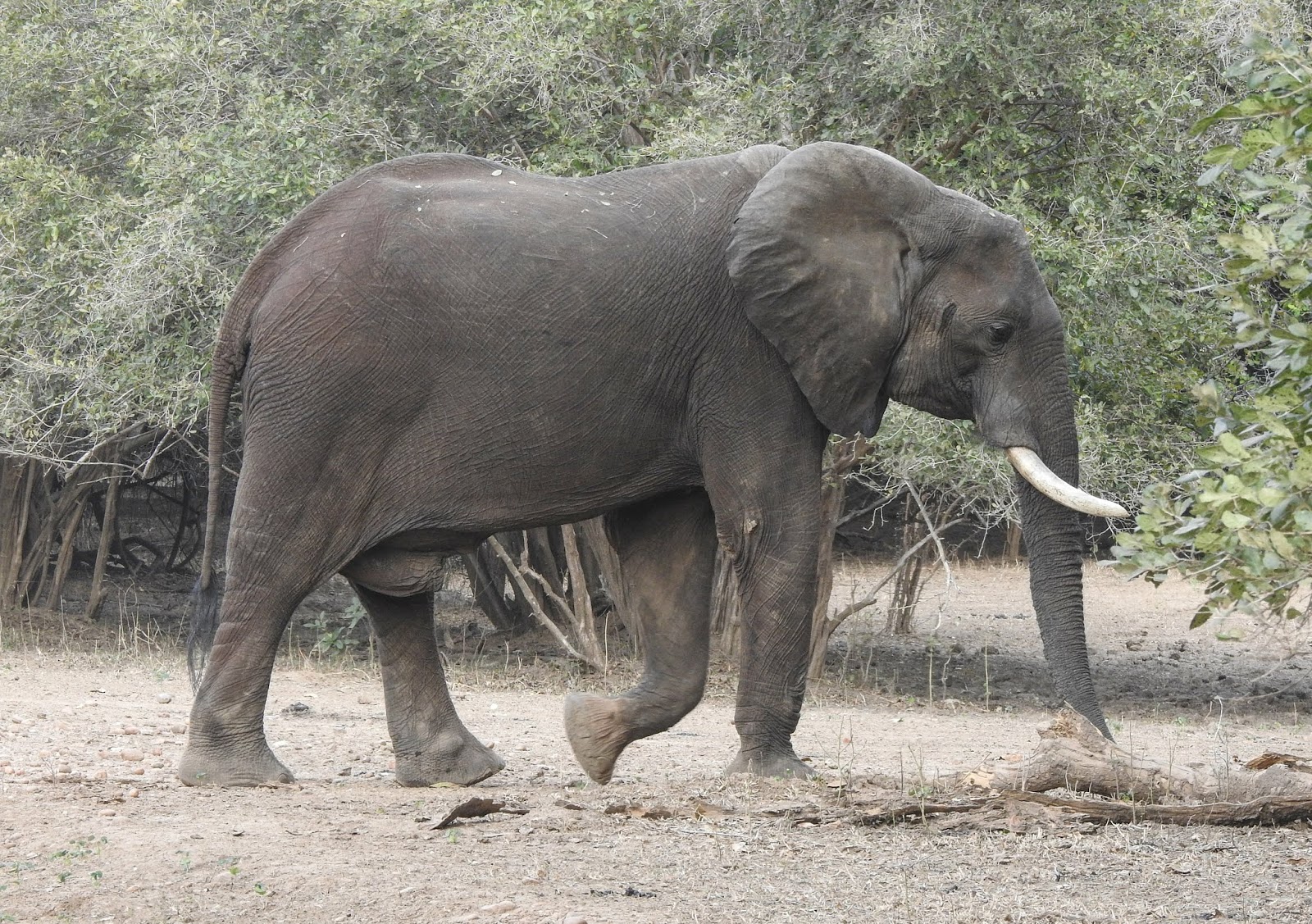
25-5-2019 SOMALISA, ZIMBABWE - AFRICAN SAVANNA ELEPHANT (Loxodonta Africana)


The African bush elephant (Loxodonta africana), also known as the African savanna elephant, is a species of elephant native to sub-Saharan Africa. It is one of three extant elephant species and, along with the African forest elephant, one of two extant species of African elephant. It is the largest living terrestrial animal, with fully grown bulls reaching an average shoulder height of 3.04–3.36 metres (10.0–11.0 ft) and a body mass of 5.2–6.9 tonnes (5.7–7.6 short tons); the largest recorded specimen had a shoulder height of 3.96 metres (13.0 ft) and an estimated body mass of 10.4 tonnes (11.5 short tons). The African bush elephant is characterised by its long prehensile trunk with two finger-like processes; a convex back; large ears which help reduce body heat; and sturdy tusks that are noticeably curved. The skin is grey with scanty hairs, and bending cracks which support thermoregulation by retaining water.


The African bush elephant inhabits a variety of habitats such as forests, grasslands, woodlands, wetlands and agricultural land. It is a mixed herbivore feeding mostly on grasses, creepers, herbs, leaves, and bark. The average adult consumes about 150 kg (330 lb) of vegetation and 230 L (51 imp gal; 61 US gal) of water each day. A social animal, the African bush elephant often travels in herds composed of cows and their offspring. Adult bulls usually live alone or in small bachelor groups. During the mating season, males go through a process called musth, a period of high testosterone levels and heightened aggression. For females, the menstrual cycle lasts three to four months, and gestation around 22 months, the longest of any mammal.


Since 2021, the African bush elephant has been listed as Endangered on the IUCN Red List. It is threatened foremost by habitat destruction, and in parts of its range also by poaching for meat and ivory. Between 2003 and 2015, the illegal killing of 14,606 African bush elephants was reported by rangers across 29 range countries. Chad is a major transit country for smuggling of ivory in West Africa. This trend was curtailed by raising penalties for poaching and improving law enforcement. Poaching of the elephant has dated back to the 1970s and 80s, which were considered the largest killings in history. In human culture, elephants have been extensively featured in literature, folklore and media, and are most valued for their large tusks in many places.


Savanna elephants live in a rather complex social hierarchy. These animals gather into family units, consisting of about 10 females and their offspring. Reaching maturity, male calves usually leave the family unit, forming bachelor herds or living solitarily. As a general rule, males socialize with these family groups only when mating. Meanwhile, several family herds may gather together, making up a 'clan'. Each clan is dominated by a female matriarch and can consist of as many as several hundred elephants. African bush elephants are very careful and protective animals. Allomothering is a common practice in this species: females can raise calves of other females of their herd.

They protect and care for the calves of the herd, while all adults are sleeping. If a calf strays too far, these allomothers are responsible for retrieving the baby. These active animals are constantly on the move. These elephants forage during the daytime hours, wandering the home range of their herd. Savanna elephants freely communicate with conspecifics both verbally and non-verbally.


The African bush elephant is the largest and heaviest living land animal. Under optimal conditions where individuals are capable of reaching full growth potential, fully grown mature males are about 3.20 m (10.5 ft) tall at the shoulder and weigh 6.0 t (6.6 short tons) on average (with 90% of fully grown males under optimal conditions being between 3.04–3.36 m (10.0–11.0 ft) and 5.2–6.9 t (5.7–7.6 short tons).

 Mature fully grown females are smaller at about 2.60 m (8 ft 6 in) tall at the shoulder and 3.0 t (3.3 short tons) in weight on average under optimal growth conditions (with 90% of fully grown females ranging between 2.47–2.73 m (8 ft 1 in – 8 ft 11 in) and 2.6–3.5 t (2.9–3.9 short tons) in optimal conditions).

The maximum recorded shoulder height of an adult bull is 3.96 m (13.0 ft), with this individual having an estimated weight of 10.4 t (11.5 short tons). Another individual with a similar weight of more than 10 t (9.8 long tons; 11 short tons) was found in Kenya in 2025, making it one of the largest elephants ever recorded. Elephants attain their maximum stature when they complete the fusion of long-bone epiphyses, occurring in males around the age of 40 and females around 25 years of age.

25-5-2019 MANA POOLS, ZIMBABWE - YELLOW PANSY BUTTERFLY (Junonia hierta)


Junonia hierta, the yellow pansy, is a species of nymphalid butterfly found in the Palaeotropics. It is usually seen in open scrub and grassland habitats.

The male upper side is bright yellow. The costa of the forewing has a broad triangular jet-black projection downwards at the discocellulars, and the dorsum has a triangular projection upwards near the tornus; this black margin narrows near the middle of the termen and bears on the apex two short transverse preapical white streaks crossed by the black veins. Below these is an obscure ocellus that is sometimes absent. The anterior half and the terminal margin of the hindwing is black, and the dorsum is broadly shaded with brown while the anterior black area has a large brilliant blue spot. The cilia of both forewings and hindwings are white alternated with brown.

The underside of the forewing is pale yellow. The cell is crossed by three laterally black-margined orange-yellow bars, beyond that is a short, broad, irregular jet-black oblique band from costa to base of vein 4. The hindwing is greyish yellow, and in the dry season its form is strongly irrorated (sprinkled) with dusky scales. With a prominent transverse brown discal fascia, its margins are highly sinuous. There is a brownish broad shade on the middle of the termen and some obscure lunular marks on the basal area. The antennae is pale, and the head, thorax and abdomen are dark brownish black; beneath that is a dull ochraceous white. 

The female is similar, although the colours are duller. The cell of the upper side forewing has a more or less complete transverse black fascia and another at the discocellulars. A blue-centered well-marked ocelli is in interspaces 2 and 5 on the disc of the forewing, and smaller ocelli in interspaces 2 and 5 on the disc of the hindwing. The forewings and hindwings have a fairly well-defined pale subterminal line, though the blue spot on the anterior black area on the hindwing is small and ill-defined; the rest is as the male. The underside is also as the male, but generally has heavier and more clearly defined markings.

22-7-2019 MONTE CORONA, VALENCIA - COMMON GERANIUM BRONZE BUTTERFLY (Cacyreus marshalli)


The geranium bronze or brun des pélargoniums in French (Cacyreus marshalli), is a butterfly in the family Lycaenidae.
The geranium bronze butterfly is native to South Africa. The butterfly was first introduced to Europe in the late 20th century, where it has quickly spread to many southern and eastern European regions.

Since its introduction to Europe, the geranium bronze butterfly has become a pest to cultivated Pelargonium and Geranium plant species. Currently, efforts are being made to contain the spread of the geranium bronze butterflies as well as to determine the most effective pesticide for the species.

22-7-2019 VILLALONGA RESERVOIR, VALENCIA - EPAULET SKIMMER DRAGONFLY (MALE) (Orthetrum chrysostigma)


Orthetrum chrysostigma, the epaulet skimmer, is a species of dragonfly in the family Libellulidae. It is found in Algeria, Angola, Benin, Botswana, Burkina Faso, Cameroon, Central African Republic, Chad, the Democratic Republic of the Congo, Ivory Coast, Egypt, Equatorial Guinea, Ethiopia, Gambia, Ghana, Guinea, Israel, Kenya, Liberia, Libya, Malawi, Mali, Mauritania, Morocco, Mozambique, Namibia, Niger, Nigeria, Senegal, Sierra Leone, Somalia, South Africa, Sudan, Tanzania, Togo, Uganda, Zambia, Zimbabwe, and possibly Burundi as well as Canary Islands, and Portugal. It was recorded in the Maltese Islands in 2010.
Its natural habitats are subtropical or tropical moist lowland forests, dry savanna, moist savanna, subtropical or tropical dry shrubland, subtropical or tropical moist shrubland, rivers, intermittent rivers, shrub-dominated wetlands, swamps, freshwater lakes, intermittent freshwater lakes, freshwater marshes, intermittent freshwater marshes, and freshwater springs. The adults prey on various flying insects. The bodies of adult males are blue, and those of young and females are yellow and brown.

22-7-2019 VILLALONGA RESERVOIR, VALENCIA - COMMON SANDPIPER (Actitis hypoleucos)


The Common Sandpiper, Actitis hypoleucos, is a small wader of the Palearctic region, easily recognized by its greyish-brown upperparts and pristine white underparts. Adults typically measure between 18-20 cm in length, with a wingspan of 32-35 cm. They possess short, dark-yellowish legs and feet, and a bill that is pale at the base with a dark tip.

In the field, look for the Common Sandpiper's distinctive stiff-winged flight pattern, just above the water's surface. During the non-breeding season, they appear duller and exhibit more noticeable barring on the wings, which is most visible at close range. Juveniles display heavier barring above and buff edges to their wing feathers. The species can be differentiated from the similar Spotted Sandpiper by its darker legs and feet and the crisper wing pattern, especially in flight.

These birds are often found near freshwater sources, where they nest on the ground in close proximity to the water's edge.