Sunday, 20 September 2020


31-3-2017 MIAMI, FLORIDA - WILSON'S SNIPE (Gallinago delicata)

The Wilson's snipe (Gallinago delicata) is a small, stocky wader, a member of the shorebird family Scolopacidae. It is characterized by its mottled brown plumage on top, pale underparts, and a distinctive long, straight, dark bill. Adults measure between 23–28 cm in length, with a wingspan of 39–45 cm, and weigh from 79–147 g. Their legs are short and greenish-grey, and they possess pointed wings, which aid in their agile flight.
To identify Wilson's snipe, look for the dark stripe through the eye, flanked by lighter stripes above and below. The species is differentiated from the common snipe by a narrower white trailing edge on the wings and a unique tail feather count—Wilson's snipe has eight pairs of tail feathers, as opposed to the seven typical of the common snipe.
Wilson's snipe favors marshes, bogs, tundra, and wet meadows for breeding. It is also a year-round resident along the U.S. Pacific coast.
This bird breeds across Canada and the northern United States, extending to the Chukchi Peninsula in Russia. The eastern population migrates to the southern United States, the Caribbean, and northern South America.
Wilson's snipe is known for its elusive nature, often hiding close to ground vegetation and flushing only when approached closely. It exhibits a zig-zag flight pattern to evade predators. During courtship, males perform a "winnowing" display, consisting of high, circling flights followed by shallow dives, producing a distinctive sound reminiscent of the boreal owl's call.
Nesting occurs in well-hidden ground locations. The species' breeding behavior is influenced by climate change, with birds arriving at breeding grounds earlier and departing later than in the past.

Saturday, 19 September 2020


19-9-2020 GANDIA, VALENCIA - BLUE WINGED GRASSHOPPER (Oedipoda caerulescens)

The blue-winged grasshopper, Oedipoda caerulescens, is a grasshopper in the genus Oedipoda.
This species occurs in Europe, North Africa and Asia. It was recently rediscovered in the Maltese islands.
Oedipoda caerulescens is a medium-sized grasshopper, between 15 and 21 mm for males and between 22 and 28 mm for females. The body coloration varies greatly depending on the substrate on which the animals have developed: reddish brown, gray, yellowish, or even completely dark or bright. The forewings are crossed most often by two or three pale bands, but the most striking characteristic, very visible when the insect flies away, is the bright coloration of the hind wings, a beautiful turquoise highlighted with a black marginal stripe. Furthermore, the posterior femora have a notch on their upper surface. At rest, confusion is possible with other Oedipoda species such as O. germanica.
Oedipoda caerulescens frequents dry areas with low and open vegetation: dunes, heathlands, grasslands on sand and sunlit limestone rocks. Many stations correspond to land recently used for human activities, such as coal spoil heaps, quarries and pits, the ballast of railway tracks, etc. It is exclusively a terrestrial insect, and its cryptic coloration often matches its substrate. It presses itself to the ground and remains motionless, and jumps only at the very close approach of danger. A remarkable behavior is the "hook" landing which serves to confuse potential attackers. Thus, the grasshopper lands and swings round to face the direction it has come from. The sudden disappearance of the blue hind wings of the adult makes it difficult for predators to shift quickly enough to a different kind of search to relocate the prey. The female lays her eggs in bare, dry soil. In this species, acoustic emissions are virtually nonexistent. The diet consists mainly of grasses.


Friday, 18 September 2020


Thursday, 17 September 2020
8-9-2019 MONTE CORONA, VALENCIA - GEOMETER MOTH (Charissa mucidaria)
%2020.jpg)
Charissa mucidaria, commonly known as the coppery taupe, is a species of geometer moth in the family Geometridae. It is native to the western Palaearctic region, particularly southern Europe and North Africa.
Here are the key facts about this species:
The moth, also called the coppery taupe, has a scientific name of Charissa mucidaria and belongs to the Geometridae family. It is typically yellow-tan to greyish-brown with a wingspan between 20–30 mm.
Native to Southern Europe and North Africa, it is often found in rocky habitats. Adults fly from March to May and again from July to September and are active at night. The larvae, known as "inchworms," feed on plants like Sedum and Rumex.
Synonyms for the species include Charissa lusitanica and Charissa ochracearia. The species is included in biodiversity studies.
17-9-2020 MONTE CORONA, VALENCIA - SMALL BLOOD VEIN MOTH (Scopula imitaria)
%2020.jpg)
Scopula imitaria, the small blood-vein, is a moth of the family Geometridae. It was first described by Jacob Hübner in 1799 and it is found throughout Europe and in North Africa.
The wingspan is 12–26 mm. (1st generation); the next generation is typically much smaller and reaches no more than 18 mm. The forewing leading edge (costa) forms an acute angle with the outer edge forming a sharp point. The hindwings also come to a sharp angle in the middle of the outer edge (a "tail").
The pattern and colouring are variable. The wings are reddish, yellowish or orange to light brown. The lines and marginal line are almost always clear, but fine. The median crossline is clearly developed and inclined slightly diagonally to the inner and outer crossline. It is slightly curved and very weakly wavy and often accompanied by a distal facing shadow. The interior and exterior crosslines are slightly wavy (more clearly than the median line). The hindwings have the pattern, however they often lack the inner crossline. The outer cross line shows a pointed bulge outwards, which follows the "tail" of the perimeter. Discal flecks are only sometimes present or weak, They are more pronounced on the hindwing. The discal fleck of the hindwings sits on the outside of the medium line or in the "shadow". On the forewing it is basal to the median line.
16-9-2020 L'ESTANY CULLERA, VALENCIA - GREYLAG GOOSE (Anser anser)
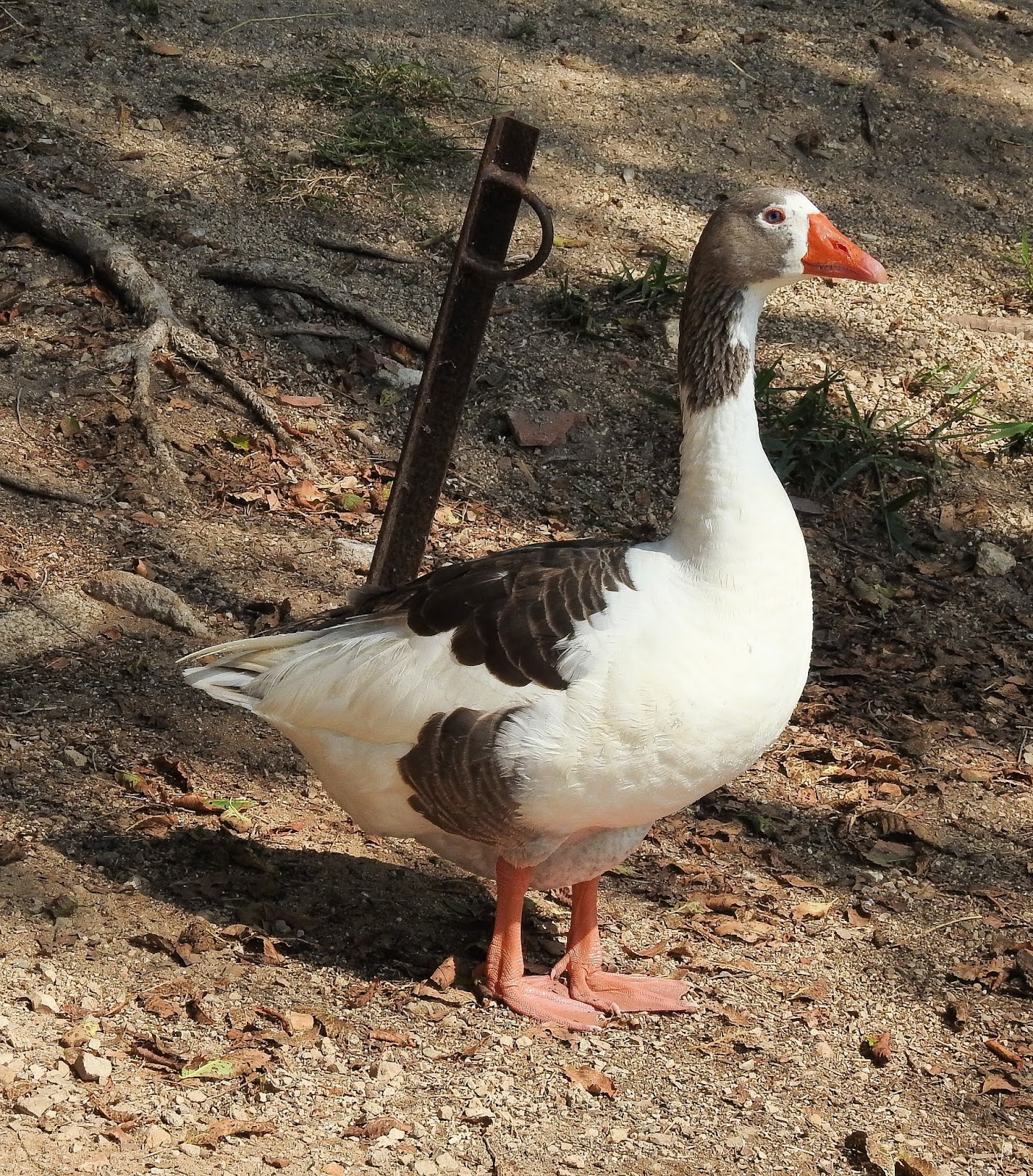
The Greylag Goose (Anser anser) is a large and robust member of the waterfowl family Anatidae, easily recognized by its mottled and barred grey and white plumage. It boasts an orange beak, pink legs, and a sizeable stature, measuring between 74 and 91 centimeters in length and weighing an average of 3.3 kilograms. This species is the progenitor of most domestic goose breeds and exhibits a wide distribution across Europe and Asia.
Adult Greylag Geese have a rotund body, a thick and long neck, and a large head and bill. Their legs and feet are pink, and their bill is orange or pink with a white or brown nail. The wingspan ranges from 147 to 180 centimeters. Males are typically larger than females, and the eastern subspecies rubirostris is larger than the nominate subspecies. The plumage is greyish brown with a darker head and paler underparts, with black spotting that varies among individuals. Juveniles can be identified by their lack of black speckling and greyish legs.
Greylag Geese breed in a variety of wetland habitats, including moorlands, marshes, lakes, and coastal islands. They prefer areas with dense vegetation for cover. In winter, they occupy semi-aquatic habitats such as estuaries, marshes, flooded fields, and agricultural lands.

The Greylag Goose has a Palearctic distribution, with the western subspecies breeding from Iceland to central Europe and the eastern subspecies from Romania to northeastern China. Northern populations often migrate southwards to spend the winter in warmer regions, while many populations are resident year-round.
Greylag Geese are known for their lifelong monogamous pair bonds. They are gregarious and form flocks, which provides safety in numbers. Family groups stay together, migrating southwards in autumn and separating the following year. They are herbivorous, feeding mainly on grasses, and can cause damage to agricultural crops.
The call of the Greylag Goose is a loud cackling, similar to that of domestic geese. They use various calls for different situations and can recognize individual geese by voice. Flocks produce a sound reminiscent of baying hounds.
Greylag Geese mate for life and nest on the ground among vegetation. They lay a clutch of three to five eggs, which the female incubates. Both parents defend and rear the young, who are precocial and leave the nest shortly after hatching..


16-9-2020 RACO DE OLLA, VALENCIA - GREATER FLAMINGO (Phoenicopterus roseus)

The greater flamingo, Phoenicopterus roseus, stands as the most widespread and largest member of the flamingo family. This majestic bird is adorned with pinkish-white plumage, save for the red wing coverts and contrasting black primary and secondary flight feathers. The bill is a striking pink with a black tip, and the legs are a uniform pink, completing the iconic look of this species.
Adult greater flamingos can be identified by their height, ranging from 110 to 150 cm, and their weight between 2 and 4 kg. The largest males can reach up to 187 cm tall and weigh 4.5 kg. Observers should note the distinctive coloration, with the majority of the body being pinkish-white, red wing coverts, and black flight feathers. The pink bill with a black tip and entirely pink legs are also key identification features. The call of the greater flamingo is reminiscent of a goose-like honking.
Greater flamingos favor mudflats and shallow coastal lagoons with saline water, where they can be seen stirring the mud with their feet in search of food.
This species is common in the Old World, with a range that includes Northern and Sub-Saharan Africa, the Indian Subcontinent, the Middle East, the Levant, and Southern Europe. Notably, they are found in coastal regions and along water bodies such as the Nile River, the Persian Gulf, the Gulf of Aden, the Red Sea, and the Mediterranean.


Subscribe to:
Comments (Atom)