This Blog contains Wildlife, Plants and Bird Photos from Walks, Safaris, Birding Trips and Vacations. Most of the pictures have been taken with my Nikon P900 and P950X cameras. Just click on any image for a larger picture. On the right column under the Blog Archive are the entries by date. Below that under Animal categories all the diffent species of Animals, Birds, Insects and Plants contained in the website are listed. Clicking on any entry will show all the entries for that species.
TOTAL PAGEVIEWS
TRANSLATE
Monday, 29 November 2021
Sunday, 28 November 2021
2-6-2019 LINYANTI CAMP, BOTSWANA - COMMON BULBUL (Pycnonotus barbatus)
The common bulbul, or Pycnonotus barbatus, is a passerine bird belonging to the bulbul family. It is characterized by a fairly short, thin bill with a slightly downward curve on the upper mandible. The plumage is similar for both sexes, featuring a dark brown head and upperparts. The bird's bill, legs, and feet are black, and it possesses a dark brown eye with an inconspicuous dark eye-ring. With a length of about 18 cm (7.1 in), the common bulbul has a notably long tail.
When identifying the common bulbul, look for its dark brown head and upperparts, and its long tail. The black bill, legs, and feet are also distinctive, as is the dark brown eye. The eye-ring may be difficult to discern. The bird's overall length and silhouette are key features to observe.
The common bulbul is adaptable and can be found in a variety of habitats including woodland, coastal bush, forest edges, riverine bush, montane scrub, and mixed farming areas. It also thrives in exotic thickets, gardens, and parks.
This species is a widespread resident breeder across much of Africa, and has even been found breeding as far north as southern Spain. Its range extends from Morocco to Tunisia, southern Mauritania to western Chad and northern Cameroon, central Nigeria to Gabon and southern Congo, eastern Chad to northern and central Sudan and eastern Egypt, and in southeastern Sudan, western, central, and eastern Ethiopia, and Eritrea.
2-6-2019 LINYANTI CAMP, BOTSWANA - ZAMBESI CRESTED BARBET (Trachyphonus vaillantii ssp. nobilis)
The crested barbet, Trachyphonus vaillantii, is a small, vibrantly colored bird, easily recognized by its thick bill and speckled plumage. Its face is a mosaic of yellow and red, adorned with a modest black crest. The belly mirrors the face with yellow and red speckles, while the wings are black with white dots. A striking black band encircles its neck. The bird's overall yellow hue, peppered with black and white feathers and red at the body's end, provides excellent camouflage in its natural bush habitat. The crested barbet's call is a distinctive trill.
When identifying the crested barbet, look for its unique coloration and markings. The combination of a yellow and red speckled face, a small black crest, and a broad black neck band are key features. The bird's trilling call can also serve as an auditory clue to its presence.
The crested barbet thrives in a variety of environments, including forests, savannahs, suburban gardens, woodland thickets, and areas near watercourses.
Saturday, 27 November 2021
2-6-2019 LINYANTI CAMP, BOTSWANA - SOUTHERN LION (MALE) (Panthera leo ssp. melanochaita)
The Southern Lion (*Panthera leo melanochaita) is a subspecies covering East & Southern African lions, known for diverse manes (sandy to black, variable length), powerful hunting (mostly by females), social pride life, and being Vulnerable due to habitat loss and human conflict, with threats including poaching, though some protected populations thrive. They are big, meaty carnivores, using roars for communication, and rare white lions appear in this group.
Key Characteristics
Range & Classification: Includes lions from Southern & East Africa, distinct from West/Central African populations, covering areas like Kruger, Maasai Mara, and Zambia.
Appearance: Varies from light buff to dark brown fur; manes differ greatly in color and length; males develop heavier manes in cooler highlands.
White Lions: A rare genetic variation (leucism) occasionally seen in the Kruger/Timbavati area, not albinos.
Size: Males are large, with longer manes as they age, sometimes reaching knee length, notes Fandom.
Behavior & Diet
Social Structure: Live in prides with related females and dominant males, with young males eventually pushed out.
Hunting: Females do most hunting (90%), targeting wildebeest, zebra, antelope; they stalk and suffocate prey.
Vocalization: Roars can travel 8km; communicate with meows, grunts, growls, and body language.
Conservation Status & Threats
IUCN Status: Classified as Vulnerable due to significant population decline (around 33%).
Major Threats: Habitat loss, human-lion conflict (retaliatory killings), snaring, poaching, and prey depletion.
Conservation: While populations decline overall, some areas (Botswana, Namibia, South Africa) see increases due to focused conservation efforts.
2-6-2019 LINYANTI CAMP, BOTSWANA - BROWN SNAKE EAGLE (Circaetus cinereus)
The Brown Snake Eagle, with its scientific name Circaetus cinereus, is a robust bird of prey belonging to the Accipitridae family. It is characterized by its predominantly dark brown plumage, which may exhibit a purplish sheen under certain lighting conditions. The wings are similarly colored, save for the contrasting whitish-grey unmarked flight feathers. A relatively short tail displays brown and grayish cream bars, visible during flight.
This medium-sized eagle is distinguished by its large head and bare legs, setting it apart from other brownish eagles in Africa. Juveniles resemble adults but may show sparse white feather bases, with southern individuals displaying more pronounced white speckling. The species can be confused with a juvenile Bateleur in poor light, but the Bateleur has more varied coloration, brown eyes, a shorter tail, and shorter legs.
The Brown Snake Eagle inhabits open woods and wooded savanna, often favoring areas with gulleys or wooded hillocks that interrupt flat terrain. It shows a preference for more densely wooded areas compared to related snake eagles and can be found from sea level up to elevations of 2,000 meters.
Widely distributed across Africa, this species is found from southeastern Mauritania and Senegal to Guinea, Sierra Leone, and across to southern Chad, Sudan, South Sudan, and into southern Somalia, Kenya, Uganda, and the southern Democratic Republic of the Congo. Its range extends down through southern Africa to parts of Namibia, Botswana, Zimbabwe, and northeastern and eastern South Africa.
The Brown Snake Eagle is a solitary bird, with breeding pairs rarely seen together. It exhibits territorial display flights, which can escalate to erratic butterfly-like movements and, in intense situations, talon interlocking and cartwheeling. This species is not migratory but may exhibit nomadic tendencies.
Its vocalizations include a hoarse, guttural "hok-hok-hok-hok," often used in territorial displays, and a softer "kwee-oo" likely serving as a contact call at the nest.
Breeding occurs from November to July in the northern part of its range and mainly from December to July in Zimbabwe and February to October in Kenya. Nests are relatively small and placed in flat-topped trees or on electric pylons. A single egg is laid and incubated primarily by the female for about 50 days. The juvenile remains in the nest for 60-100 days before fledging.
The Brown Snake Eagle may be confused with the juvenile Bateleur or other medium-sized brown eagles, but its large head, bare legs, and specific tail barring help differentiate it.
This eagle preys predominantly on snakes, both venomous and non-venomous, using its thick-skinned legs as protection against bites. It hunts from perches or hillocks, often decapitating large snakes before bringing them to the nest. Alternate prey includes monitor lizards, toads, francolins, guineafowl, chickens, rats, and possibly other mammals.
The Brown Snake Eagle is classified as Least Concern by the IUCN, with a broad range and a presence over 23.3 thousand square kilometers. Although it may be naturally scarce and potentially declining, it does not currently require immediate conservation attention.
2-6-2019 LINYANTI, BOTSWANA - MAGPIE SHRIKE (Corvinella melanoleuca)
The magpie shrike is a long-tailed, black and white bird native to African savannas that hunts insects and small vertebrates by dropping onto them from a perch. It is known for its large size, glossy black head, white wing patches, and very long tail, which can be nearly as long as its body. These birds are social, live in small family groups, and are listed as a species of "least concern".
Physical characteristics
Size: 34–50 cm in length, including the long tail.
Plumage: Glossy black with white patches on the wings and a long, floppy, graduated tail.
Sexual dimorphism: The flanks are white in females and black in males.
Habitat and distribution
Habitat: Found in dry and moist savannas and sparse broadleaf woodlands. They often move into recently burned areas to forage.
Distribution: Native to eastern and southeastern Africa, including areas in Kenya, Tanzania, Angola, Namibia, Zambia, Zimbabwe, Botswana, and South Africa.
Behavior and diet
Hunting: Perch-and-wait predators that drop down on prey like insects, small lizards, and nestlings.
Social Structure: Live in small, non-migratory family groups of 3 to 10 birds.
Vocalizations: Noisy birds that make a shrill, starling- or parrot-like "pleeee-eouuu" and harsh, grating cries.
Food storage: Like other shrikes, they are known to impale prey on thorns or barbed wire to store for later, which is why some shrikes are informally called "butcher birds".
Reproduction
Courtship: Includes dancing and flight displays, with the male offering food to the female.
Nesting: Lays 2–6 eggs in a cup-shaped nest.
Incubation and care: The female incubates the eggs for about 16 days, often with food provided by the male and other group members. Both parents and previous offspring help care for the chicks, who leave the nest after 15–19 days.
Conservation status
Global status: Least Concern (LC) according to the IUCN.
Local status: Also listed as Least Concern in South Africa.
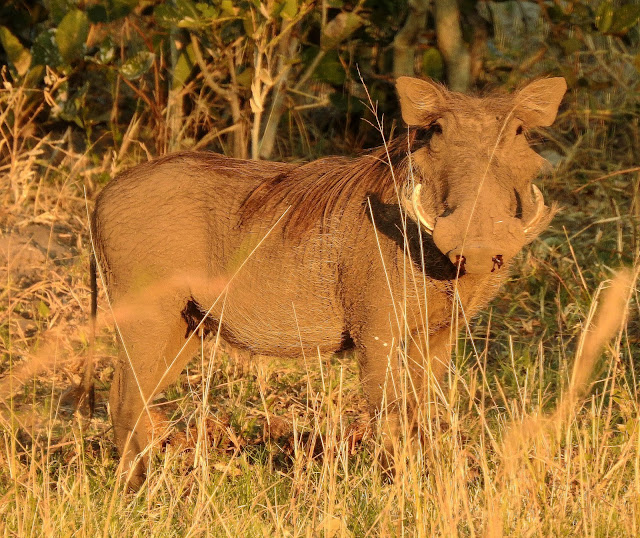
2-6-2019 LINYANTI, BOTSWANA - COMMON WARTHOG (Phacochoerus Africus)
The Common warthog (Phacochoerus africanus) is a wild member of the pig family (Suidae) found in sub-Saharan Africa. It is the only pig species that has adapted to grazing and savanna habitats.
Common warthogs are found in sub-Saharan Africa. They live in grasslands, savanna, open bushlands, and woodlands. These animals prefer open areas and avoid rainforests, thickets, cool montane grasslands, and severe deserts.
A warthog has two pairs of tusks protruding from the mouth and curving upwards. The lower pair, which is far shorter than the upper pair, becomes razor-sharp by rubbing against the upper pair every time the mouth is opened and closed. The upper canine teeth can grow to 25.5 cm (10.0 in) long and have a wide elliptical cross-section, being about 4.5 cm (1.8 in) deep and 2.5 cm (0.98 in) wide. A tusk will curve 90° or more from the root, and will not lie flat on a table, as it curves somewhat backward as it grows. The tusks are not used for digging, but are used for combat with other hogs and in defense against predators - the lower set can inflict severe wounds. Common warthog ivory is taken from the constantly growing canine teeth. The tusks, particularly the upper set, work in much the same way as elephant tusks with all designs scaled down. Tusks are carved predominantly for the tourist trade in eastern and southern Africa. The head of the Common warthog is large, with a mane down the spine to the middle of the back. Sparse hair covers the body. Its color is usually black or brown. Tails are long and end with a tuft of hair. Common warthogs do not have subcutaneous fat and the coat is sparse, making them susceptible to extreme environmental temperatures.
Friday, 26 November 2021
2-6-2019 LINYANTI CAMP, BOTSWANA - AFRICAN WATTLED LAPWING (Vanellus senegallus)
The African wattled lapwing (Vanellus senegallus), also known as the Senegal wattled plover or simply wattled lapwing, is a large lapwing, a group of largish waders in the family Charadriidae. It is a resident breeder in most of sub-Saharan Africa outside the rainforests, although it has seasonal movements.
These are conspicuous and unmistakable birds. They are large brown waders with a black crown, white forehead and large yellow facial wattles. The tail is white, tipped black, and the long legs are yellow.
In flight, the upperwings have black flight feathers and brown coverts separated by a white bar. The underwings are white with black flight feathers. The African wattled lapwing has a loud peep-peep call.
This species is a common breeder in wet lowland habitats, especially damp grassland. It often feeds in drier habitats, such as golf courses, picking insects and other invertebrates from the ground. It lays three or four eggs on a ground scrape.
The African wattled lapwing is one of the species to which the Agreement on the Conservation of African-Eurasian Migratory Waterbirds (AEWA) applies. Occurs across sub-Saharan Africa; in southern Africa it is fairly common in Zimbabwe, northern Botswana and Namibia (including the Caprivi Strip), north-eastern South Africa, Swaziland and central and southern Mozambique. It generally prefers waterlogged grassland at streams, seeps edges of marshes and flood plains, as well as exposed areas along the edges of lakes and pans, burnt grassland and cultivated land.
Monogamous, territorial solitary nester, with the male defending its territory vigorously against intruders (mainly other African wattled lapwings) by striking them with its wings. Displays and fights are most intense at the beginning of the breeding season, as later males only call and use threat postures to defend their territory.
The nest (see image below) is a shallow depression in the ground, several of which are created by the male before the female chooses one to be lined thickly with grass stems, roots, pebbles and dry dung. It is typically placed on bare ground in short or burnt grassland, or occasionally small islands in marshy areas.
Egg-laying season is from July-December, peaking from September-October.
It lays 2-4 eggs, which are incubated by both sexes for about 28-32 days, often mobbing predators which come to close.
The chicks leave the nest within 24 hours, and are always tended by at least one adult, fledging at about 40 days old but only leaving the family group at the start of the following breeding season.
It is currently not threatened, in fact it may have benefited from the modification of habitats by humans.
2-6-2019 LINYANTI, BOTSWANA - LARGE DEVILTHORN (Dicerocaryum eriocarpum)
Dicerocaryum eriocarpum, or Large Devilthorn, is a Kalahari perennial herb known for its hairy, two-spined fruits that stick to animals for dispersal, earning its name and causing flat tires, but it's also called "Bushman's soap" because its leaves and roots contain saponins, creating a soapy lather for washing hands or cleaning, with edible leaves and potential uses for livestock, offering both nuisance and utility in the African bush.
Plant Characteristics
Growth: Prostrate, creeping, ground-dwelling perennial with hairy stems.
Flowers: Small, trumpet-shaped, pale to deep pink or mauve, with darker spots.
Leaves: Opposite, broadly ovate, with toothed edges.
Fruit/Seeds: Circular, hairy, with two sharp, central spines that embed in animal feet and tires.
3-6-2019 LINYANTI, BOTSWANA - GREAT EGRET (Ardea alba)
Great Egrets usually stay in habitats that have areas of either saltwater or freshwater nearby. They are seen near marshes, ditches, canals, ponds, tidal flats, rivers, streams, swamps, lakes, estuaries (or water passages where the ocean tide meets a river current), and flooded farm fields. Great Egrets are usually solitary birds when not nesting. But they also can gather together from surrounding areas to form a place where a large group can rest or sleep, called a communal roost. Frequently, several pairs build nests in the same tree and form a colony; but occasionally a pair may nest alone. Great Egrets often share colonial nesting sites, or rookeries, with other egret species, herons, and other wading birds as well.
They build their nests in trees, thickets, or shrubs 10-90 feet above water or ground. Nesting colonies are usually located in extremely tall trees. Great Egrets build large platform-style nests using sticks and line the nests with plant material. Both parents help to build the nest, incubate (to sit on and keep the eggs warm) the eggs, and feed their young. The young will be able to fly in 6-7 weeks after hatching.
Within the colony, Great Egrets are territorial and aggressive, defending their space with sharp bill jabs and harsh calls.
3-6-2019 LINYANTI CAMP, BOTSWANA - AFRICAN OPENBILL (Anastomus lamelligerus)
The African openbill (Anastomus lamelligerus) is a species of stork from the family Ciconiidae. It is widely distributed in Sub-Saharan Africa and western regions of Madagascar. This species is considered common to locally abundant across its range, although it has a patchy distribution. Some experts consider there to be two sub-species, A. l. lamelligerus distributed on the continent and A. l. madagascariensis living on the island of Madagascar. Scientists distinguish between the two sub-species due to the more pronounced longitudinal ridges on the bills of adult A. l. madagascariensis. The Asian openbill (Anastomus oscitans) found in Asia is the African openbill’s closest relative. The two species share the same notably large bill of a peculiar shape that gives them their name.
2-6-2019 LINYANTI, BOTSWANA - DICKINSON'S KESTREL (Falco dickinsonii)
Dickinson's kestrel (Falco dickinsoni) is a bird of prey of southern and eastern Africa belonging to the falcon family Falconidae. It is named after John Dickinson, an English physician and missionary who collected the type specimen. It is also known as the white-rumped kestrel. Its closest relatives are the grey kestrel and banded kestrel and the three are sometimes placed in the subgenus Dissodectes.
It is a fairly small, stocky kestrel with a large, square head. It is 27–30 cm (11–12 in) long with a wingspan of 61–68 cm (24–27 in) and a weight of 167–246 g (5.9–8.7 oz). The female is about 4% larger and 10-20% heavier than the male. The plumage is mostly dark grey with a pale head and rump. The tail is grey with narrow black bars and a broad subterminal band. The underside of the flight feathers are also barred. The cere and feet are yellow and there is bare yellow skin around the eye. The bill is dark grey and the eyes are brown. Juvenile birds are grey-brown with barred flanks and without the paler head and rump. They have a greenish cere and eye-ring.
It is usually silent but has a high-pitched alarm and contact call. At the nest, a soft, mewing call attracts the young for feeding.
It inhabits savanna and open woodland, particularly swampy areas near water. It favours miombo woodland and is typically associated with palm trees (such as Hyphaene and Borassus species) and is also often found near baobab trees. It occurs in coconut plantations in some areas.
Its range covers most of Mozambique, Zimbabwe, Zambia and Malawi along with north-eastern South Africa (mainly in Kruger National Park), northern Botswana, north-east Namibia, eastern Angola, southern Democratic Republic of the Congo and parts of Tanzania. It is an occasional visitor to Kenya. The total range is about 3,400,000 km2 (1,300,000 sq mi). It is generally rather scarce but is commoner in some areas such as Zanzibar and Pemba Islands. Loss of palm trees is a potential threat to the species.
3-6-2019 LINYANTI CAMP, BOTSWANA - COMMON WATERBUCK (Kobus ellipsiprymnus ssp. ellipsiprymnus)
The waterbuck (Kobus ellipsiprymnus) is a large antelope found widely in sub-Saharan Africa. It is in the genus Kobus of the family Bovidae. It was first described by Irish naturalist William Ogilby in 1833. Its 13 subspecies are grouped under two varieties: the common or ellipsiprymnus waterbuck and the defassa waterbuck. Their coat colour varies from brown to grey. The long, spiral horns, present only on males, curve backward, then forward, and are 55–99 cm (22–39 in) long.
Waterbucks are rather sedentary in nature. As gregarious animals, they may form herds consisting of six to thirty individuals. These groups are either nursery herds with females and their offspring or bachelor herds. Males start showing territorial behaviour from the age of five years, but are most dominant from six to nine. The waterbuck cannot tolerate dehydration in hot weather, and thus inhabits areas close to sources of water.
Predominantly a grazer, the waterbuck is mostly found on grassland. In equatorial regions, breeding takes place throughout the year, but births are at their peak in the rainy season. The gestational period lasts 7–8 months, followed by the birth of a single calf.
Waterbucks inhabit scrub and savanna areas along rivers, lakes, and valleys. Due to their requirement for grasslands and water, waterbucks have a sparse ecotone distribution. The IUCN lists the waterbuck as being of least concern. More specifically, the common waterbuck is listed as of least concern, while the defassa waterbuck is near threatened.
The population trend for both is downwards, especially that of the defassa, with large populations being eliminated from certain habitats because of poaching and human disturbance.
Subscribe to:
Comments (Atom)
%2030.jpg)
%2030.jpg)
%2031.jpg)
%2032.jpg)
%2034.jpg)
%2020.jpg)
%2021.jpg)
%2020.jpg)
%2021.jpg)
%2022.jpg)
%2023.jpg)

%2020.jpg)
%2030.jpg)
%2021.jpg)
%2022.jpg)
%2023.jpg)