TOTAL PAGEVIEWS

TRANSLATE

Sunday, 28 November 2021

2-6-2019 LINYANTI CAMP, BOTSWANA - COMMON BULBUL (Pycnonotus barbatus)


The common bulbul, or Pycnonotus barbatus, is a passerine bird belonging to the bulbul family. It is characterized by a fairly short, thin bill with a slightly downward curve on the upper mandible. The plumage is similar for both sexes, featuring a dark brown head and upperparts. The bird's bill, legs, and feet are black, and it possesses a dark brown eye with an inconspicuous dark eye-ring. With a length of about 18 cm (7.1 in), the common bulbul has a notably long tail.

When identifying the common bulbul, look for its dark brown head and upperparts, and its long tail. The black bill, legs, and feet are also distinctive, as is the dark brown eye. The eye-ring may be difficult to discern. The bird's overall length and silhouette are key features to observe.

The common bulbul is adaptable and can be found in a variety of habitats including woodland, coastal bush, forest edges, riverine bush, montane scrub, and mixed farming areas. It also thrives in exotic thickets, gardens, and parks.

This species is a widespread resident breeder across much of Africa, and has even been found breeding as far north as southern Spain. Its range extends from Morocco to Tunisia, southern Mauritania to western Chad and northern Cameroon, central Nigeria to Gabon and southern Congo, eastern Chad to northern and central Sudan and eastern Egypt, and in southeastern Sudan, western, central, and eastern Ethiopia, and Eritrea.

2-6-2019 LINYANTI CAMP, BOTSWANA - ZAMBESI CRESTED BARBET (Trachyphonus vaillantii ssp. nobilis)


It is found in forests, savannah, suburban gardens, woodland thickets and watercourses in Angola, Botswana, Burundi, Democratic Republic of the Congo, Eswatini, Malawi, Mozambique, Namibia, Rwanda, South Africa, Tanzania, Uganda, Zambia, and Zimbabwe.

2-6-2021 LINYANTI, BOTSWANA - VERREAUX'S EAGLE OWL (Bubo lacteus)


28-11-2021 LLUTXENT, VALENCIA - EURASIAN BLACKCAP (MALE) (Sylvia atricapilla)


28-11-2021 LLUTXENT, VALENCIA - EUROPEAN GOLDFINCH (Carduelis carduelis)


28-11-2021 LLUTXENT, VALENCIA - COMMON CHAFFINCH (FEMALE) (Fringilla coelebs)


28-11-2021 LLUTXENT, VALENCIA - EUROPEAN STONECHAT (MALE) (Saxicola rubicola)


28-11-2021 LLUTXENT, VALENCIA - EUROPEAN ROBIN (Erithacus rubecula)


28-11-2021 LLUTXENT, VALENCIA - EUROPEAN STONECHAT (FEMALE) (Saxicola rubicola)


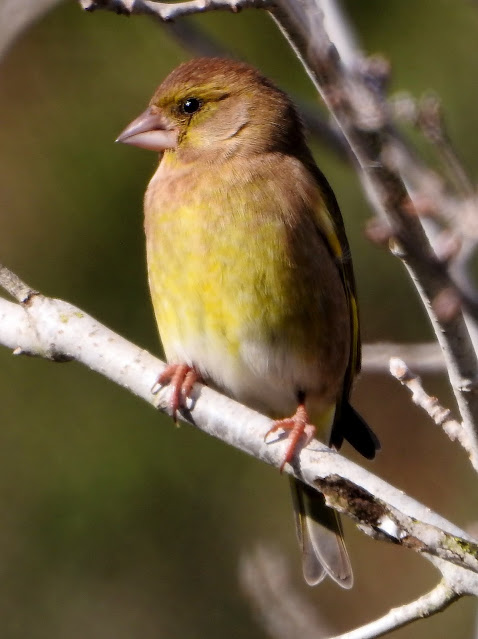
28-11-2021 LLUTXENT, VALENCIA - EUROPEAN GREENFINCH (Chloris chloris)


Saturday, 27 November 2021

2-6-2019 LINYANTI CAMP, BOTSWANA - SOUTHERN LION (MALE) (Panthera leo ssp. melanochaita)


2-6-2019 LINYANTI CAMP, BOTSWANA - BROWN SNAKE EAGLE (Circaetus cinereus)


27-11-2021 MONTE CORONA, VALENCIA - TEQUILA AGAVE (Agave tequilana)


2-6-2019 LINYANTI, BOTSWANA - MAGPIE SHRIKE (Corvinella melanoleuca)


The magpie shrike is a long-tailed, black and white bird native to African savannas that hunts insects and small vertebrates by dropping onto them from a perch. It is known for its large size, glossy black head, white wing patches, and very long tail, which can be nearly as long as its body. These birds are social, live in small family groups, and are listed as a species of "least concern". 

Physical characteristics
Size: 34–50 cm in length, including the long tail.
Plumage: Glossy black with white patches on the wings and a long, floppy, graduated tail.
Sexual dimorphism: The flanks are white in females and black in males. 

Habitat and distribution
Habitat: Found in dry and moist savannas and sparse broadleaf woodlands. They often move into recently burned areas to forage.
Distribution: Native to eastern and southeastern Africa, including areas in Kenya, Tanzania, Angola, Namibia, Zambia, Zimbabwe, Botswana, and South Africa. 


Behavior and diet
Hunting: Perch-and-wait predators that drop down on prey like insects, small lizards, and nestlings.
Social Structure: Live in small, non-migratory family groups of 3 to 10 birds.
Vocalizations: Noisy birds that make a shrill, starling- or parrot-like "pleeee-eouuu" and harsh, grating cries.
Food storage: Like other shrikes, they are known to impale prey on thorns or barbed wire to store for later, which is why some shrikes are informally called "butcher birds". 

Reproduction
Courtship: Includes dancing and flight displays, with the male offering food to the female.
Nesting: Lays 2–6 eggs in a cup-shaped nest.
Incubation and care: The female incubates the eggs for about 16 days, often with food provided by the male and other group members. Both parents and previous offspring help care for the chicks, who leave the nest after 15–19 days. 

Conservation status
Global status: Least Concern (LC) according to the IUCN.
Local status: Also listed as Least Concern in South Africa. 

26-11-2021 MONTE CORONA, VALENCIA - CARPET MOTH (Catarhoe basochesiata)


26-11-2021 MONTE CORONA, VALENCIA - SHIELDBACK KATYDID


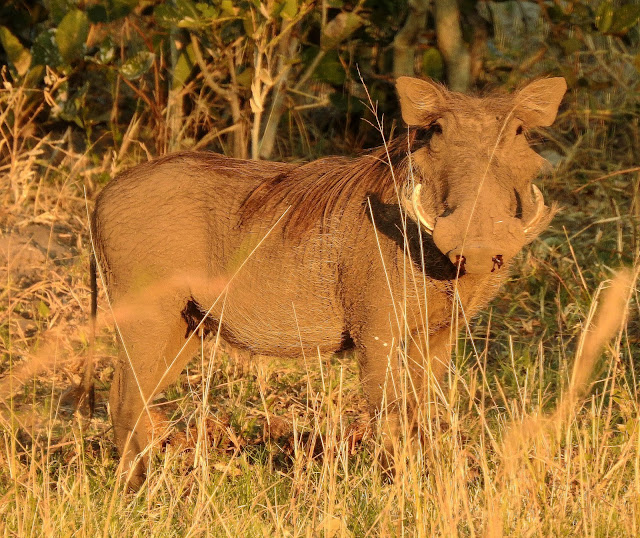
2-6-2019 LINYANTI, BOTSWANA - COMMON WARTHOG (Phacochoerus Africus)


The Common warthog (Phacochoerus africanus) is a wild member of the pig family (Suidae) found in sub-Saharan Africa. It is the only pig species that has adapted to grazing and savanna habitats.

Common warthogs are found in sub-Saharan Africa. They live in grasslands, savanna, open bushlands, and woodlands. These animals prefer open areas and avoid rainforests, thickets, cool montane grasslands, and severe deserts.

A warthog has two pairs of tusks protruding from the mouth and curving upwards. The lower pair, which is far shorter than the upper pair, becomes razor-sharp by rubbing against the upper pair every time the mouth is opened and closed. The upper canine teeth can grow to 25.5 cm (10.0 in) long and have a wide elliptical cross-section, being about 4.5 cm (1.8 in) deep and 2.5 cm (0.98 in) wide. A tusk will curve 90° or more from the root, and will not lie flat on a table, as it curves somewhat backward as it grows. The tusks are not used for digging, but are used for combat with other hogs and in defense against predators - the lower set can inflict severe wounds. Common warthog ivory is taken from the constantly growing canine teeth. The tusks, particularly the upper set, work in much the same way as elephant tusks with all designs scaled down. Tusks are carved predominantly for the tourist trade in eastern and southern Africa. The head of the Common warthog is large, with a mane down the spine to the middle of the back. Sparse hair covers the body. Its color is usually black or brown. Tails are long and end with a tuft of hair. Common warthogs do not have subcutaneous fat and the coat is sparse, making them susceptible to extreme environmental temperatures.

Friday, 26 November 2021

2-6-2019 LINYANTI CAMP, BOTSWANA - AFRICAN WATTLED LAPWING (Vanellus senegallus)


The African wattled lapwing (Vanellus senegallus), also known as the Senegal wattled plover or simply wattled lapwing, is a large lapwing, a group of largish waders in the family Charadriidae. It is a resident breeder in most of sub-Saharan Africa outside the rainforests, although it has seasonal movements.

These are conspicuous and unmistakable birds. They are large brown waders with a black crown, white forehead and large yellow facial wattles. The tail is white, tipped black, and the long legs are yellow.


In flight, the upperwings have black flight feathers and brown coverts separated by a white bar. The underwings are white with black flight feathers. The African wattled lapwing has a loud peep-peep call.

This species is a common breeder in wet lowland habitats, especially damp grassland. It often feeds in drier habitats, such as golf courses, picking insects and other invertebrates from the ground. It lays three or four eggs on a ground scrape.


The African wattled lapwing is one of the species to which the Agreement on the Conservation of African-Eurasian Migratory Waterbirds (AEWA) applies. Occurs across sub-Saharan Africa; in southern Africa it is fairly common in Zimbabwe, northern Botswana and Namibia (including the Caprivi Strip), north-eastern South Africa, Swaziland and central and southern Mozambique. It generally prefers waterlogged grassland at streams, seeps edges of marshes and flood plains, as well as exposed areas along the edges of lakes and pans, burnt grassland and cultivated land.


Monogamous, territorial solitary nester, with the male defending its territory vigorously against intruders (mainly other African wattled lapwings) by striking them with its wings. Displays and fights are most intense at the beginning of the breeding season, as later males only call and use threat postures to defend their territory.

The nest (see image below) is a shallow depression in the ground, several of which are created by the male before the female chooses one to be lined thickly with grass stems, roots, pebbles and dry dung. It is typically placed on bare ground in short or burnt grassland, or occasionally small islands in marshy areas.
 
Egg-laying season is from July-December, peaking from September-October.
It lays 2-4 eggs, which are incubated by both sexes for about 28-32 days, often mobbing predators which come to close.
The chicks leave the nest within 24 hours, and are always tended by at least one adult, fledging at about 40 days old but only leaving the family group at the start of the following breeding season.

It is currently not threatened, in fact it may have benefited from the modification of habitats by humans.


2-6-2019 LINYANTI, BOTSWANA - SOUTH AFRICAN FOXGLOVE (Ceratotheca triloba)


2-6-2019 LINYANTI, BOTSWANA - GREAT EGRET (Ardea alba)

https://www.inaturalist.org/taxa/144455-Ardea-alba