This Blog contains Wildlife, Plants and Bird Photos from Walks, Safaris, Birding Trips and Vacations. Most of the pictures have been taken with my Nikon P900 and P950X cameras. Just click on any image for a larger picture. On the right column under the Blog Archive are the entries by date. Below that under Animal categories all the diffent species of Animals, Birds, Insects and Plants contained in the website are listed. Clicking on any entry will show all the entries for that species.
TOTAL PAGEVIEWS
TRANSLATE
Thursday, 30 December 2021
Wednesday, 29 December 2021
29-5-2019 SOMALISA CAMP, ZIMBABWE - SOUTHERN YELLOW BILLED HORNBILL (Tockus leucomelas)
The southern yellow-billed hornbill (Tockus leucomelas) is a hornbill found in southern Africa. Yellow-billed hornbills feed mainly on the ground, where they forage for seeds, small insects, spiders and scorpions. This hornbill species is a common and widespread resident of dry thornveldt and broad-leafed woodlands. They can often be seen along roads and water courses.
It is a medium-sized bird, 48–60 cm (19–24 in) in length, 132–242 g (0.29–0.53 lb) in weight and is characterized by a long yellow and down-curved beak. This beak is huge in comparison to its body and can account for up 1/6th of the entire body length. Male beaks are on average 90 mm long while female beaks are an average of 74 mm. Males are generally bigger than females but there is overlap between the sexes. The size difference of the beak is a fairly reliable way of differentiating sex in wild hornbills.
The casque that characterizes all hornbills is of a very modest size in the southern yellow-billed hornbill. It is small, but it covers almost the entire length of the beak in males (less so in females), and may give the impression that they do not actually have a casque. As in all hornbills, the size of the beak actually intrudes on the frontal vision of the bird and the first two neck vertebrae are fused together.
Also, like most other hornbills, they possess a long tail, long eyelashes, stubby legs and stubby toes. The front three toes are fused together near the base.
They have white belly, grey neck, and black back plumage with abundant white spots and stripes. The neck has gray spots and the chest is lightly striated with black. Southern yellow-billed hornbills have no plumage pigmentation save for melanin, which can only produce shades of black and white. The eyes are usually yellow, though brown has also been seen. The skin around the eyes and in the malar stripe is pinkish. The related eastern yellow-billed hornbill from north-eastern Africa has blackish skin around the eyes.
These birds are near endemic to the dry savannas of southern Africa, where they can be found across all longitudes, from Angola and Namibia in the west to Mozambique and KwaZulu-Natal in the east, including Botswana, Zimbabwe and northern South Africa.
The southern yellow-billed hornbill lives mostly in the dry, open savannas, but they are also very partial to woodlands when they can find them. When in woodlands, they seem to prefer acacia and broadleaved woodlands. The highest reported concentration of southern yellow-billed hornbill is in open mopane scrub.
Monday, 27 December 2021
30-5-2019 THORNTREE CAMP, ZAMBIA - VERVET MONKEY (Chlorocebus pygerythrus)
The vervet monkey (Chlorocebus pygerythrus), or simply vervet, is an Old World monkey of the family Cercopithecidae native to Africa. The term "vervet" is also used to refer to all the members of the genus Chlorocebus. The five distinct subspecies can be found mostly throughout Southern Africa, as well as some of the eastern countries. These mostly herbivorous monkeys have black faces and grey body hair color, ranging in body length from about 40 cm (16 in) for females, to about 50 cm (20 in) for males.
In addition to behavioral research on natural populations, vervet monkeys serve as a nonhuman primate model for understanding genetic and social behaviors of humans. They have been noted for having human-like characteristics, such as hypertension, anxiety, and social and dependent alcohol use. Vervets live in social groups ranging from 10 to 70 individuals, with males moving to other groups at the time of sexual maturity. Studies done on vervet monkeys involve their communication and alarm calls, specifically in regard to kin and group recognition, and particular predator sightings.
The vervet monkey ranges throughout much of Southern and East Africa, being found from Ethiopia and extreme southern South Sudan all the way down to South Africa. It is not found west of the East African Rift or the Luangwa River, where it is replaced by the closely related malbrouck (C. cynosuros) species. The vervet monkey inhabits savanna, riverine woodland, coastal forest, and mountains up to 4000 m (13,100 ft). They are adaptable and able to persist in secondary and/or highly fragmented vegetation, including cultivated areas, and sometimes are found living in both rural and urban environments. Annual home range size has been observed to be as high as 176 ha, with an average population density of 54.68 animals/km2.
Vervet monkeys that are naturalised (introduced by humans) are found in Cape Verde, Ascension Island, Saint Helena, St Kitts and Nevis, and Barbados. Dania Beach, Florida, is home to about 40 introduced vervets.
Sunday, 26 December 2021
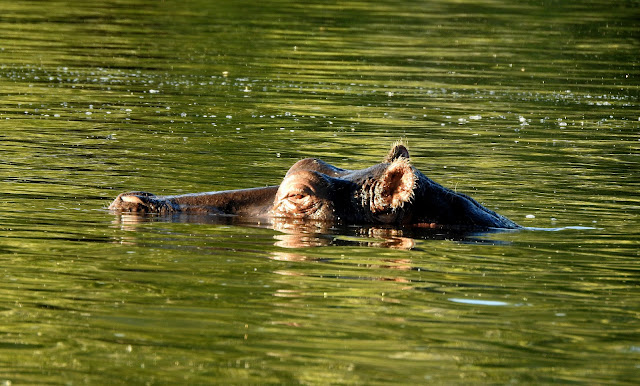
30-5-2019 RIVER ZAMBESI , ZAMBIA - HIPPOPOTAMUS (Hippopotamus amphibius)
The hippopotamus (Hippopotamus amphibius; /ˌhɪpəˈpɒtəməs/; pl.: hippopotamuses), often shortened to hippo (pl.: hippos), further qualified as the common hippopotamus, Nile hippopotamus and river hippopotamus, is a large semiaquatic mammal native to sub-Saharan Africa. It is one of only two extant species in the family Hippopotamidae, the other being the pygmy hippopotamus (Choeropsis liberiensis or Hexaprotodon liberiensis). Its name comes from the Ancient Greek for "river horse" (ἱπποπόταμος).
After elephants and rhinoceroses, the hippopotamus is the next largest land mammal. It is also the largest extant land artiodactyl. Despite their physical resemblance to pigs and other terrestrial even-toed ungulates, the closest living relatives of the hippopotamids are cetaceans (whales, dolphins, porpoises, etc.), from which they diverged about 55 million years ago.
31-5-2019 THORNTREE CAMP, ZAMBIA - WAHLBERG STRIPED SKINK (Trachylepis striata ssp. wahlbergi)
Trachylepis wahlbergii, also known commonly as Wahlberg's striped skink, is a species of lizard in the family Scincidae. The species is native to Southern Africa.
Trachylepis wahlbergii has been considered a subspecies of Trachylepis striata. Whether T. wahlbergii is truly distinct from T. striata is not fully settled.
T. wahlbergii occurs in southern Angola, northern Botswana, northern Namibia, western Mozambique, Zambia, and northern, western and southern Zimbabwe.
The specific name, wahlbergi, is in honour of Swedish Naturalist Johan August Wahlberg.
T. wahlbergii is viviparous. In animals, viviparity is the development of the embryo inside the body of the mother, with the maternal circulation providing for the metabolic needs of the embryo's development, until the mother gives birth to a fully or partially developed juvenile that is at least metabolically independent
31-5-2019 THORNTREE CAMP, ZAMBIA - WHITE FRONTED BEE-EATER (Merops bullockoides)
The White-fronted Bee-eater, known scientifically as Merops bullockoides, is a vibrant and slender bird adorned with a striking black mask and a white forehead. Its square tail and bright red throat patch are distinctive features. Measuring at 23 cm in length, the bird's upperparts are a lush green, while its underparts boast a warm cinnamon hue. Its call is a resonant, deep squeak that carries through the air.
To identify the White-fronted Bee-eater, look for its unique combination of colors: a black mask, white forehead, green upperparts, and cinnamon underparts. The square tail and bright red throat patch are also key identifiers. Listen for its deep squeaking call as a helpful auditory clue.
This species thrives in the open savannahs of sub-equatorial Africa, often found near gullies where their insect prey, particularly bees, are abundant.
The White-fronted Bee-eater is widely distributed across the savannah regions of sub-equatorial Africa, where it is a common sight in its preferred habitat.
The White-fronted Bee-eater exhibits a complex social structure, nesting in colonies that can average around 200 individuals. These colonies are not just for breeding but also serve as a communal space for roosting and socializing. The birds demonstrate cooperative breeding, with non-breeding individuals acting as helpers to their kin, significantly increasing the success rate of raising young.
The White-fronted Bee-eater is currently listed as Least Concern on the IUCN Red List, indicating that it is not at immediate risk of population decline or habitat loss at a global scale.
The diet of the White-fronted Bee-eater primarily consists of bees, but it also includes other flying insects, depending on seasonal availability. They employ two hunting strategies: making swift hawking flights from lower branches or gliding down from perches to hover momentarily before snatching their prey mid-flight.
31-5-2019 THORNTREE CAMP, ZAMBIA - AFRICAN PIED WAGTAIL (Motacilla aguime)
The African pied wagtail, or African wagtail, (Motacilla aguimp) is a species of bird in the family Motacillidae.
The African pied wagtail is found in sub-Saharan Africa from the Eastern Cape north to extreme southern Egypt and from Guinea to western Eritrea and Somalia. It is a vagrant to Burkina Faso, Gambia, Mauritania and the Western Cape.
The African pied wagtail inhabits subtropical or tropical seasonally wet or flooded lowland grassland, rivers, and, sometimes, freshwater marshes. In some areas it is commensal with humans in towns and villages.
31-5-2019 THORNTREE CAMP, ZAMBIA - AFRICAN DARTER (Anhinga rufa)
The African darter (Anhinga rufa), sometimes called the snakebird, is a water bird of sub-Saharan Africa and Iraq.
The African darter is a member of the darter family, Anhingidae, and is closely related to American (Anhinga anhinga), Oriental (Anhinga melanogaster), and Australasian (Anhinga novaehollandiae) darters.
The African darter is 80 cm (31 in) long. Like other anhingas, it has a very long neck. The male is mainly glossy black with white streaking; females and immature birds are browner. The African darter differs in appearance from the American darter most recognisably by its thin white lateral neck stripe against a rufous background colour. The pointed bill prevents confusion with cormorants.
The African darter is found throughout sub-Saharan Africa wherever large bodies of water occur; overall the species remains widespread and common.
The only non-African subspecies, the Levant darter (Anhinga rufa chantrei), occurred at Lake Amik (Amik Gölü) in south-central Turkey, in the Hula Valley lake and marshes in northern Israel and in the Mesopotamian Marshes of the lower Euphrates and Tigris rivers in southern Iraq. The Turkish population disappeared during the 1930s and the Israeli population during the drainage of the Hula in the 1950s. In Khuzestan, 110 birds were counted in 1990, but the subspecies was feared extinct as a result of oil spills during the Gulf War and the drainage of the Mesopotamian Marshes that followed it. However, a small population was documented in the Hawizeh Marshes in 2007. The drainage of the marshes was interrupted and reversed after the Iraq War.
Saturday, 25 December 2021
Friday, 24 December 2021
31-5-2019 THORNTREE CAMP, ZAMBIA - TAWNY FLANKED PRINIA (Prinia subflava)
The tawny-flanked prinia (Prinia subflava) is a small passerine bird belonging to the genus Prinia in the family Cisticolidae, a family of Old World warblers. It is widespread and common in most parts of Africa south of the Sahara. The plain prinia (P. inornata) of southern Asia was formerly included in this species but is now usually considered to be a separate species.
The tawny-flanked prinia is 11–12 cm (4.3–4.7 in) in length with a long, narrow, graduated tail[6] and a fairly long, slender bill. The tail is often held erect or waved from side to side. The upperparts are grey-brown with rufous-brown edges to the flight feathers and a rufous tinge to the rump. The throat and breast are whitish while the flanks and vent are warm buff. There is a whitish stripe over the eye and the lores are dark. The tail feathers have a white tip and a dark subterminal band.
The sexes are similar in appearance. Non-breeding birds have a longer tail than breeding birds. Juveniles have pale yellow underparts and a yellowish bill. There are many recognised subspecies.
The call is short, wheezy and rapidly repeated. The song is a monotonous series of shrill notes. The male often sings from an exposed perch.
The pale prinia (P. somalica) of North-east Africa is similar but paler and greyer with whitish flanks. It inhabits drier, more open habitats than the tawny-flanked prinia. The river prinia (P. fluviatilis) of West Africa is also paler and greyer and has a longer tail. It is restricted to waterside vegetation.
There are ten subspecies distributed across most parts of sub-Saharan Africa except for the driest and wettest areas. It is absent from much of the Congo Basin, southern Namibia, south-west Botswana and the western half of South Africa. It is found amongst shrubs and grass in a variety of habitats including woodland, savanna and cultivated areas. It adapts well to man-made habitats and is not considered to be threatened.
It feeds on insects and other invertebrates. It forages in small flocks which move through shrubs and undergrowth.
The nest is purse-shaped and made of strips of grass woven together. It is built one to two metres above the ground. Two to four eggs are laid; they are variable in ground colour and usually have brown or purple spots or blotches.
31-5-2019 THORNTREE CAMP, ZAMBIA - BROWN HOODED KINGFISHER (Halcyon albiventris)
The brown-hooded kingfisher (Halcyon albiventris) is a species of bird in the subfamily Halcyoninae, the tree kingfishers. It has a brown head and blackish and turquoise wings. It is found in Sub-Saharan Africa, living in woodland, scrubland, forest edges, and also suburban areas. The International Union for Conservation of Nature (IUCN) has assessed it as being of least concern.
This species was described as Alcedo albiventris by Giovanni Antonio Scopoli in 1786. Four subspecies are recognised: Halcyon albiventris albiventris, H. a. orientalis, H. a. prentissgrayi and H. a. vociferans. Subspecies hylophila and erlangeri have also been described, but they are not considered distinct enough.
The brown-hooded kingfisher is about 22 cm (8.7 in) long. The head is brown, with blackish streaks. There is a broad buffy collar above the brownish-black mantle. The wing coverts are mostly brownish-black, and the secondary flight feathers are turquoise. The rump is azure-blue. The chin is white, the breast is tawny with some dark streaks, and the belly is buffy. The beak is red, tipped brown, the legs are carmine, and the eyes are dark brown. The female has dark brown upperparts, and its underparts are more streaked than the male. The juvenile bird is duller, with scalloped whitish underparts. The subspecies differ in shade and streaking.
This kingfisher is found in Sub-Saharan Africa, in Gabon, Congo, the Democratic Republic of the Congo, Angola, Kenya, Tanzania, Zambia, Somalia, Mozambique, Malawi, Zimbabwe, Botswana, Namibia, South Africa and Eswatini. It occurs below 1,800 m (5,900 ft) in elevation, living in woodland, grassland with trees, scrubland, forest edge, and also cultivations, parks and gardens. It sometimes occurs near water, and can adapt to suburban habitats. Most populations do not migrate, but there is evidence of seasonal movements in some areas.
This kingfisher is generally seen alone or in pairs. It usually forages on the ground, mainly feeding on insects, and also eating scorpions, reptiles, small birds, rodents and fishes. Eating snakes and lizards as long as 25 cm (9.8 in) has been reported. The song, given while vibrating the wings, is a tiiiu or ki-ti-ti-ti trill, and a sharp cheerit is given when alarmed. The breeding season is mainly between September and April. A burrow nest is dug in a river bank, gully or road cutting. The family stays together for a few weeks after breeding.
Subscribe to:
Comments (Atom)
%20%2020.jpg)
%20%2021.jpg)
%2020.jpg)
%2021.jpg)
%2020.jpg)
%2021.jpg)
%2022.jpg)