TOTAL PAGEVIEWS

TRANSLATE

Monday, 10 January 2022

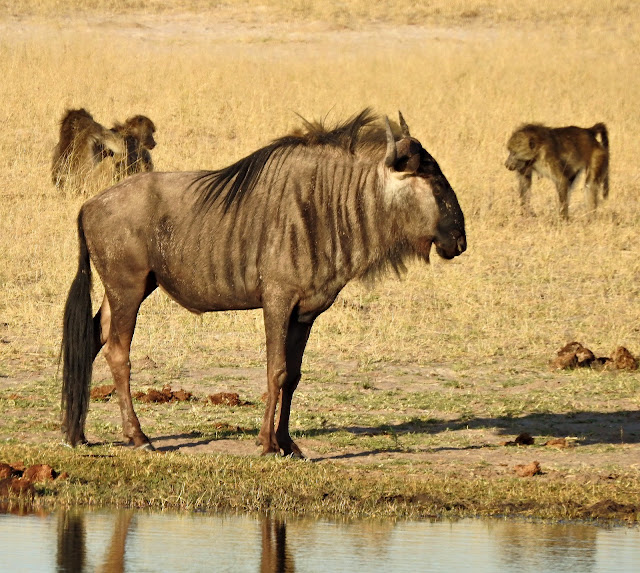
28-5-2019 SOMALISA CAMP, ZIMBABWE - COMMON WILDEBEEST (Connochaetes taurinus)


The blue wildebeest (Connochaetes taurinus), also called the common wildebeest, white-bearded gnu or brindled gnu, is a large antelope and one of the two species of wildebeest. It is placed in the genus Connochaetes and family Bovidae, and has a close taxonomic relationship with the black wildebeest. The blue wildebeest is known to have five subspecies. This broad-shouldered antelope has a muscular, front-heavy appearance, with a distinctive, robust muzzle. Young blue wildebeest are born tawny brown, and begin to take on their adult coloration at the age of 2 months. The adults' hues range from a deep slate or bluish-gray to light gray or even grayish-brown. Both sexes possess a pair of large curved horns.

The blue wildebeest is an herbivore, feeding primarily on short grasses. It forms herds which move about in loose aggregations, the animals being fast runners and extremely wary. The mating season begins at the end of the rainy season and a single calf is usually born after a gestational period of about 8.5 months. The calf remains with its mother for 8 months, after which it joins a juvenile herd. Blue wildebeest are found in short-grass plains bordering bush-covered acacia savannas in southern and eastern Africa, thriving in areas that are neither too wet nor too arid. Three African populations of blue wildebeest take part in a long-distance migration, timed to coincide with the annual pattern of rainfall and grass growth on the short-grass plains where they can find the nutrient-rich forage necessary for lactation and calf growth.

The blue wildebeest is native to Angola, Botswana, Eswatini, Kenya, Mozambique, South Africa, Tanzania, Zambia, and Zimbabwe. Today, it is extinct in Malawi, but has been successfully reintroduced in Namibia. The southern limit of the blue wildebeest range is the Orange River, while the western limit is bounded by Lake Victoria and Mount Kenya. The blue wildebeest is widespread and is being introduced into private game farms, reserves, and conservancies. The International Union for Conservation of Nature and Natural Resources rates the blue wildebeest as being of least concern. The population has been estimated to be around 1.5 million, and the population trend is stable.


The blue wildebeest is a herbivore, feeding primarily on the short grasses which commonly grow on light, and alkaline soils that are found in savanna grasslands and on plains. The animal's broad mouth is adapted for eating large quantities of short grass and it feeds both during the day and night. When grass is scarce, it will also eat the foliage of shrubs and trees. Wildebeest commonly associate with plains zebras as the latter eat the upper, less nutritious grass canopy, exposing the lower, greener material which the wildebeest prefer. Whenever possible, the wildebeest likes to drink twice daily and due to its regular requirement for water, it usually inhabits moist grasslands and areas with available water sources. The blue wildebeest drinks 9 to 12 litres of water every one to two days. Despite this, it can also survive in the arid Kalahari Desert, where it obtains sufficient water from melons and water-storing roots and tubers.

In a study of the dietary habits of the wildebeest, the animals were found to be feeding on the three dominant kinds of grass of the area, namely: Themeda triandra, Digitaria macroblephara, and Pennisetum mezianum. The time spent grazing increased by about 100% during the dry season. Though the choice of the diet remained the same in both the dry and the wet season, the animals were more selective during the latter.

28-5-2019 SOMALISA CAMP, ZIMBABWE - SOUTHERN GROUND HORNBILL (Bucorvus leadbeateri)


The southern ground hornbill (Bucorvus leadbeateri) is one of two species of ground hornbill, both of which are found solely within Africa, and is the largest species in the hornbill order worldwide. It can be found in the southern regions of Africa, ranging from Kenya to South Africa. Within these regions, they inhabit both woodlands and savannas. The other species of the genus Bucorvus is the Abyssinian ground hornbill, B. abyssinicus.

Southern ground hornbills are carnivorous and hunt mostly on the ground. Their food ranges from insects to small vertebrates. Their nests are often found in high tree cavities or other shallow cavities, such as rock holes in cliff faces. These birds are a long-lived species, having lifespans in the range of 50–60 years, and up to 70 in captivity. In relation to their long lives, they do not reach sexual maturity until 4–6 years old, and begin breeding around 10 years old. Their sex can be identified by the colour of their throats: the male's is pure red and the female's is a deep violet-blue.


Southern ground hornbills are a culturally pervasive and important species in southern Africa. Kruger National Park, located within South Africa, lists southern ground hornbills as one of their 'Big Six' bird species.[6] However, their numbers have been declining, due in part to persecution, habitat destruction, cultural beliefs, and other factors. They are listed globally as 'Vulnerable' by the IUCN as of 2018, and as 'Endangered' in South Africa, Lesotho, Namibia and Eswatini.

Southern ground hornbill groups are very vocal: contact is made by calls in chorus which can usually be heard at distances of up to 3 kilometres (1.86 mi). The calls allow each group to maintain its territory, which must be as large as 100 square kilometres (40 sq mi) even in the best habitat.

Southern ground hornbills can be found from northern Namibia and Angola to northern South Africa and southern Zimbabwe to Burundi and Kenya. They require a savanna habitat with large trees for nesting and dense but short grass for foraging.


This is a large bird, at 90 to 129 cm (2 ft 11 in to 4 ft 3 in) long. Females weigh 2.2 to 4.6 kilograms (4.9 to 10.1 lb), while the larger males weigh 3.5 to 6.2 kilograms (7.7 to 13.7 lb).[citation needed] The average weight of eight females was 3.34 kg (7.4 lb) whilst that of eight males was 4.2 kg (9.3 lb); thus they average around 35% percent heavier than any Asian hornbill species.[9] Wingspan is from 1.2 to 1.8 m (3 ft 11 in to 5 ft 11 in). The wing chord is 49.5 to 61.8 cm (19.5 to 24.3 in), the tail from 29 to 36 cm (11 to 14 in), the tarsus from 13 to 15.5 cm (5.1 to 6.1 in) and the culmen from 16.8 to 22.1 cm (6.6 to 8.7 in). Stevenson and Fanshawe report that the Abyssinian ground hornbill is the larger species on average, at 110 cm (43 in), than the southern species, at 102 cm (40 in), but published maximum weights and standard measurements indicate the southern species is slightly larger. Average weights are not known for the Abyssinian species.

The southern ground hornbill is black with vivid red patches of bare skin on the face and throat (yellow in juvenile birds)—as well as being one of few birds with eyelashes—which are believed to keep dust out of the birds' eyes while they forage during the dry season. The white tips of the wings (primary feathers) seen in flight are another diagnostic characteristic. The beak is black and slightly curved and presents a casque, more developed in males. Female southern ground hornbills are smaller and have violet-blue skin on their throats. Juveniles to six years old lack the prominent red pouch, having a duller patch of grey in its place.


The southern ground hornbill is a vulnerable species, mainly confined to national reserves and national parks. They live in groups of 5 to 10 individuals including adults and juveniles. Often, neighbouring groups engage in aerial pursuits. These birds are apex predator and thus ecologically important. They forage on the ground, where they feed on reptiles, frogs, snails, insects and mammals up to the size of hares. Southern ground hornbills rarely drink. Their range is limited at its western end by the lack of trees in which to build nests.

The southern ground hornbill is an obligate cooperative breeder, with each breeding pair always assisted by at least two other birds. Experiments in captivity have found that birds without six years experience as helpers at the nest are unable to breed successfully if they do become breeders. This suggests that unaided pairs cannot rear young and that the skill gained in helping as a juvenile is essential for rearing young as an adult.

In captivity, a maximum lifespan of 70 years is recorded, and it is generally believed that the life expectancy of a bird that survives long enough to fledge is as high as thirty years or more, which is comparable to that of more famously long-lived birds like the wandering albatross.

28-5-2019 SOMALISA CAMP, ZIMBABWE - WHITE BACKED VULTURE (Gyps africanus)


The white-backed vulture is a typical vulture, with only down feathers on the head and neck, very broad wings and short tail feathers. It has a white neck ruff. The adult's whitish back contrasts with the otherwise dark plumage. Juveniles are largely dark. This is a medium-sized vulture; its body mass is 4.2 to 7.2 kg (9.3–15.9 lb), it is 78 to 98 cm (31 to 39 in) long and has a 1.96 to 2.25 m (6 ft 5 in to 7 ft 5 in) wingspan.
 
The white-backed vulture occurs from Senegal, Gambia and Mali in the west, throughout the Sahel region to Ethiopia and Somalia in the east, through East Africa into Mozambique, Zimbabwe, Botswana, Namibia and South Africa in the south. It is the most widespread and common vulture in Africa with an estimated range of 24,300,000 km2 (9,400,000 sq mi), but has undergone rapid population declines in recent years.


The white-backed vulture, like many African vultures, has suffered a rapid decline. When it was first assessed in 1988 it was classified as a Least concern species owing to a large range and population. It was reassessed from a Least Concern to Near Threatened species in the 2007 IUCN Red List after the beginnings of a major decline were noticed. In 2012, more information was available about population trends, and the estimates suggested that within the next three generations the white-backed vulture would decrease by 50%. Consequently it was added to the list of Endangered species. In October 2015, it was further uplisted to Critically Endangered because the decline had reach a magnitude that puts the vulture at an extreme risk of extinction.

Sunday, 9 January 2022

28-5-2019 SOMALISA CAMP, ZIMBABWE - SOUTHERN LION (MALE) (Panthera leo ssp. melanochaita)


The Southern lion is a lion subspecies from Southern and East Africa. In this region, lion populations were referred to by several regional names, including Katanga lion, Transvaal lion, Kalahari lion, Southeast African lion, Southwest African lion, Masai lion, Serengeti lion, Tsavo lion, and Uganda lion. It has also been referred to as 'Eastern-Southern African lion', 'Southern lion', and as 'southern subspecies'.

The fur of Southern lions varies in color from light buff to dark brown. They have rounded ears and a black tail tuft. Mane color varies from sandy, tawny, isabelline, and light reddish yellow to dark brown and black. Mane length varies from short to extending to knee joints and under the belly. Lions without a mane were observed in the Tsavo area. Mane development is related to age: older males have more extensive manes than younger ones; manes continue to grow up to the age of four to five years, long after lions become reproductively mature. Males living in the Kenyan highlands develop heavier manes than lions in the more humid and warmer lowlands of eastern and northern Kenya. White lions have occasionally been encountered in and around South Africa's Kruger National Park and the adjacent Timbavati Private Game Reserve. Their whitish fur is a rare morph caused by a double recessive allele. It has normal pigmentation in the eyes and skin. They were removed from the wild in the 1970s, thus decreasing the white lion gene pool.


Southern lions are found in East and Southern Africa. They are grouped into three clades. Lions, which can be grouped into the North East African clade are found in Somalia, Northern Kenya, and Ethiopia. Lions, which can be grouped into the South East African clade are found in Southern Kenya, Western DRC, Tanzania, Mozambique, Malawi, Zambia, southern Namibia, and South Africa, with a larger hybridization zone to the southwestern lion clade in the Kruger National Park area (Great Limpopo Transfrontier Park). Lions, which can be grouped into the South West African clade are found in Angola, Northern Namibia, Northern Botswana, and western Zimbabwe, extending southeast into the Tuli block. There is a larger hybridization zone in the southeastern clade around the Kruger National Park.


Little is known about the behavior of Southern lions. In general, lions can be active at any time of the day but their activity generally peaks after dusk with a period of socializing and grooming. Most hunting often takes place at dusk. Apart from that African lions spend much of their time resting. They rest in order to save energy, in the absence of prey, or to escape the midday heat. African lions are highly social animals, gathering in groups or prides, which include up to 3 male lions and multiple lionesses with their young. Prides are defended by males, who patrol and mark the territory. However, there's harsh competition between males for the territory and position in the pride. In a case, if another male overcomes the leading male of the pride, he usually kills all cubs, sired by the previous male. Meanwhile, males do not tend to hunt due to their slow speed and eye-catching appearance. Instead, hunting is left to females of the pride, who hunt in groups, cooperating with each other during their hunting trips. The females are excellent hunters: they are faster and more agile than males, able to hunt down animals that are much bigger and faster than them. Lions have a large repertoire of vocalizations. Most of them are variations of growling, snarling, meowing, and roaring. Other sounds produced include purring, puffing, bleating, and humming. Roaring is used for advertising their presence. Lions most often roar at night, a sound that can be heard from a distance of 8 km (5 mi).

30-12-2021 MONTE CORONA, VALENCIA - NORTHERN CADDISFLIES (Tribe Stenophylacini)


Thursday, 6 January 2022

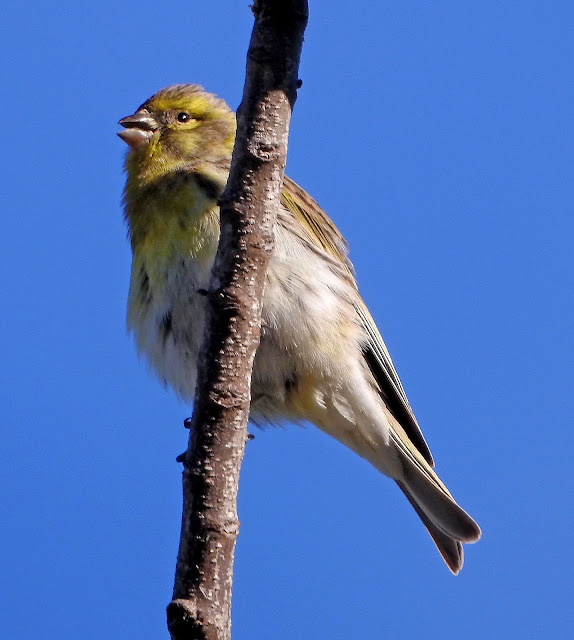
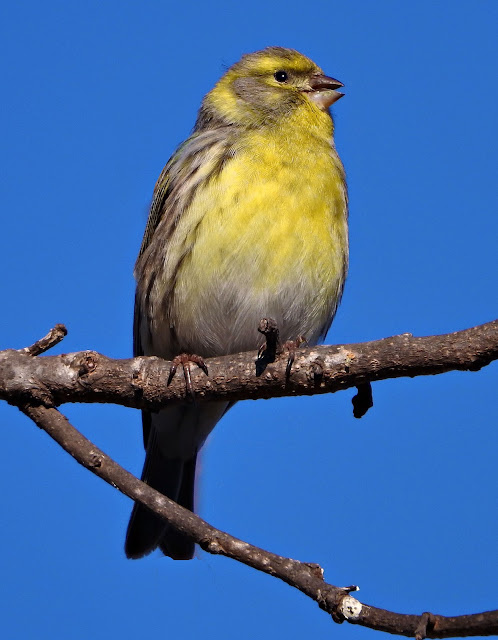
6-1-2022 VILLALONGA RESERVOIR, VALENCIA - EUROPEAN SERIN (MALE) (Serinus serinus)


6-1-2022 POTRIES, VALENCIA - MALLARD (MALE) (Anas platyrhynchos)


6-1-2022 POTRIES, VALENCIA - MALLARD (FEMALE) (Anas platyrhynchos)


6-1-2022 POTRIES, VALENCIA - SPECKLED WOOD BUTTERFLY (Pararge aegeria)


6-1-2022 ADOR CAMPO, VALENCIA - EUROPEAN SERIN (MALE) (Serinus serinus)


6-1-2022 ADOR CAMPO, VALENCIA - EURASIAN KESTREL (Falco tinnunculus)


6-1-2022 ADOR CAMPO, VALENCIA - LARGE WHITE BUTTERFLY (Pieris brassicae)