This Blog contains Wildlife, Plants and Bird Photos from Walks, Safaris, Birding Trips and Vacations. Most of the pictures have been taken with my Nikon P900 and P950X cameras. Just click on any image for a larger picture. On the right column under the Blog Archive are the entries by date. Below that under Animal categories all the diffent species of Animals, Birds, Insects and Plants contained in the website are listed. Clicking on any entry will show all the entries for that species.
TOTAL PAGEVIEWS
TRANSLATE
Thursday, 13 January 2022
Wednesday, 12 January 2022
Tuesday, 11 January 2022
28-5-2019 SOMALISA CAMP, ZIMBABWE - NATAL SPURFOWL (Pternistis natalensis)
The Natal spurfowl is a medium-sized brownish francolin with a distinctive appearance, including a scaled (marbled) appearance on its underparts and a lack of bare skin around the eyes and throat. It is commonly found in savannas and woodlands, where it nests in a shallow ground scrape. This species is known for its loud, raucous "kak-kreek" call and its diet of roots, seeds, insects, and fruit.
Physical characteristics
Appearance: Mottled brown back, with a distinctive scaled pattern on the underparts caused by brown and white-edged feathers.
Bill and legs: Bright orange-red bill and legs.
Head: Lacks bare skin around the eyes and throat, a key distinguishing feature from other spurfowl species.
Sexes: Both sexes have similar plumage, but males are heavier and have longer leg spurs.
Juveniles: Similar to adults, but with duller legs and bill.
Habitat and behavior
Habitat: Prefers savanna, but also found in coastal forests, woodlands, and areas with dense understory. It prefers areas with tall trees and shrubby undergrowth.
Activity: Most active in the early morning and late afternoon, when males often call.
Nesting: Creates a shallow ground scrape lined with grass and some feathers, typically in a well-concealed spot under dense scrub.
Eggs: Lays between 4 and 8 creamy-colored eggs, with a 21-day incubation period.
Diet
Primarily subsists on roots, tubers, seeds, and beans.
Opportunistically eats insects like termites and ants, as well as flowers and fallen fruit.
Other facts
Call: A loud, raucous "kak-kreek" sound.
Conservation status: The species is considered abundant to locally common and is suspected to have a stable population, though it is sometimes threatened by over-hunting.
Monday, 10 January 2022
28-5-2019 SOMALISA CAMP, ZIMBABWE - COMMON WILDEBEEST (Connochaetes taurinus)
The blue wildebeest (Connochaetes taurinus), also called the common wildebeest, white-bearded gnu or brindled gnu, is a large antelope and one of the two species of wildebeest. It is placed in the genus Connochaetes and family Bovidae, and has a close taxonomic relationship with the black wildebeest. The blue wildebeest is known to have five subspecies. This broad-shouldered antelope has a muscular, front-heavy appearance, with a distinctive, robust muzzle. Young blue wildebeest are born tawny brown, and begin to take on their adult coloration at the age of 2 months. The adults' hues range from a deep slate or bluish-gray to light gray or even grayish-brown. Both sexes possess a pair of large curved horns.
The blue wildebeest is an herbivore, feeding primarily on short grasses. It forms herds which move about in loose aggregations, the animals being fast runners and extremely wary. The mating season begins at the end of the rainy season and a single calf is usually born after a gestational period of about 8.5 months. The calf remains with its mother for 8 months, after which it joins a juvenile herd. Blue wildebeest are found in short-grass plains bordering bush-covered acacia savannas in southern and eastern Africa, thriving in areas that are neither too wet nor too arid. Three African populations of blue wildebeest take part in a long-distance migration, timed to coincide with the annual pattern of rainfall and grass growth on the short-grass plains where they can find the nutrient-rich forage necessary for lactation and calf growth.
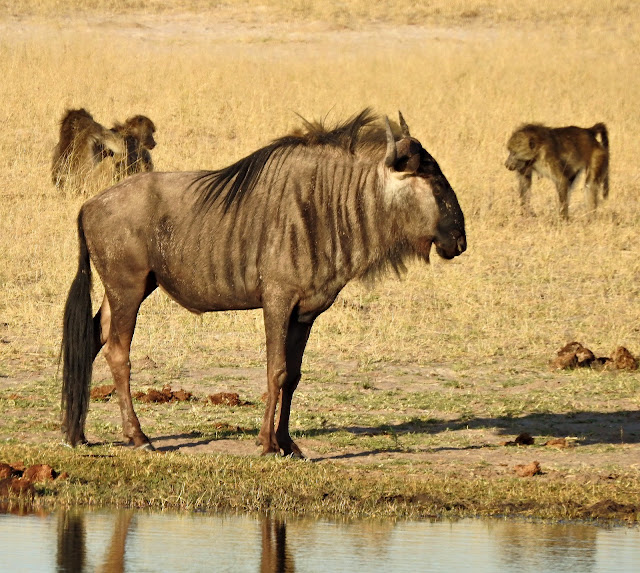
The blue wildebeest is native to Angola, Botswana, Eswatini, Kenya, Mozambique, South Africa, Tanzania, Zambia, and Zimbabwe. Today, it is extinct in Malawi, but has been successfully reintroduced in Namibia. The southern limit of the blue wildebeest range is the Orange River, while the western limit is bounded by Lake Victoria and Mount Kenya. The blue wildebeest is widespread and is being introduced into private game farms, reserves, and conservancies. The International Union for Conservation of Nature and Natural Resources rates the blue wildebeest as being of least concern. The population has been estimated to be around 1.5 million, and the population trend is stable.
The blue wildebeest is a herbivore, feeding primarily on the short grasses which commonly grow on light, and alkaline soils that are found in savanna grasslands and on plains. The animal's broad mouth is adapted for eating large quantities of short grass and it feeds both during the day and night. When grass is scarce, it will also eat the foliage of shrubs and trees. Wildebeest commonly associate with plains zebras as the latter eat the upper, less nutritious grass canopy, exposing the lower, greener material which the wildebeest prefer. Whenever possible, the wildebeest likes to drink twice daily and due to its regular requirement for water, it usually inhabits moist grasslands and areas with available water sources. The blue wildebeest drinks 9 to 12 litres of water every one to two days. Despite this, it can also survive in the arid Kalahari Desert, where it obtains sufficient water from melons and water-storing roots and tubers.
In a study of the dietary habits of the wildebeest, the animals were found to be feeding on the three dominant kinds of grass of the area, namely: Themeda triandra, Digitaria macroblephara, and Pennisetum mezianum. The time spent grazing increased by about 100% during the dry season. Though the choice of the diet remained the same in both the dry and the wet season, the animals were more selective during the latter.
28-5-2019 SOMALISA CAMP, ZIMBABWE - SOUTHERN GROUND HORNBILL (Bucorvus leadbeateri)
The southern ground hornbill (Bucorvus leadbeateri) is one of two species of ground hornbill, both of which are found solely within Africa, and is the largest species in the hornbill order worldwide. It can be found in the southern regions of Africa, ranging from Kenya to South Africa. Within these regions, they inhabit both woodlands and savannas. The other species of the genus Bucorvus is the Abyssinian ground hornbill, B. abyssinicus.
Southern ground hornbills are carnivorous and hunt mostly on the ground. Their food ranges from insects to small vertebrates. Their nests are often found in high tree cavities or other shallow cavities, such as rock holes in cliff faces. These birds are a long-lived species, having lifespans in the range of 50–60 years, and up to 70 in captivity. In relation to their long lives, they do not reach sexual maturity until 4–6 years old, and begin breeding around 10 years old. Their sex can be identified by the colour of their throats: the male's is pure red and the female's is a deep violet-blue.
Southern ground hornbills are a culturally pervasive and important species in southern Africa. Kruger National Park, located within South Africa, lists southern ground hornbills as one of their 'Big Six' bird species.[6] However, their numbers have been declining, due in part to persecution, habitat destruction, cultural beliefs, and other factors. They are listed globally as 'Vulnerable' by the IUCN as of 2018, and as 'Endangered' in South Africa, Lesotho, Namibia and Eswatini.
Southern ground hornbill groups are very vocal: contact is made by calls in chorus which can usually be heard at distances of up to 3 kilometres (1.86 mi). The calls allow each group to maintain its territory, which must be as large as 100 square kilometres (40 sq mi) even in the best habitat.
Southern ground hornbills can be found from northern Namibia and Angola to northern South Africa and southern Zimbabwe to Burundi and Kenya. They require a savanna habitat with large trees for nesting and dense but short grass for foraging.
This is a large bird, at 90 to 129 cm (2 ft 11 in to 4 ft 3 in) long. Females weigh 2.2 to 4.6 kilograms (4.9 to 10.1 lb), while the larger males weigh 3.5 to 6.2 kilograms (7.7 to 13.7 lb).[citation needed] The average weight of eight females was 3.34 kg (7.4 lb) whilst that of eight males was 4.2 kg (9.3 lb); thus they average around 35% percent heavier than any Asian hornbill species.[9] Wingspan is from 1.2 to 1.8 m (3 ft 11 in to 5 ft 11 in). The wing chord is 49.5 to 61.8 cm (19.5 to 24.3 in), the tail from 29 to 36 cm (11 to 14 in), the tarsus from 13 to 15.5 cm (5.1 to 6.1 in) and the culmen from 16.8 to 22.1 cm (6.6 to 8.7 in). Stevenson and Fanshawe report that the Abyssinian ground hornbill is the larger species on average, at 110 cm (43 in), than the southern species, at 102 cm (40 in), but published maximum weights and standard measurements indicate the southern species is slightly larger. Average weights are not known for the Abyssinian species.
The southern ground hornbill is black with vivid red patches of bare skin on the face and throat (yellow in juvenile birds)—as well as being one of few birds with eyelashes—which are believed to keep dust out of the birds' eyes while they forage during the dry season. The white tips of the wings (primary feathers) seen in flight are another diagnostic characteristic. The beak is black and slightly curved and presents a casque, more developed in males. Female southern ground hornbills are smaller and have violet-blue skin on their throats. Juveniles to six years old lack the prominent red pouch, having a duller patch of grey in its place.
The southern ground hornbill is a vulnerable species, mainly confined to national reserves and national parks. They live in groups of 5 to 10 individuals including adults and juveniles. Often, neighbouring groups engage in aerial pursuits. These birds are apex predator and thus ecologically important. They forage on the ground, where they feed on reptiles, frogs, snails, insects and mammals up to the size of hares. Southern ground hornbills rarely drink. Their range is limited at its western end by the lack of trees in which to build nests.
The southern ground hornbill is an obligate cooperative breeder, with each breeding pair always assisted by at least two other birds. Experiments in captivity have found that birds without six years experience as helpers at the nest are unable to breed successfully if they do become breeders. This suggests that unaided pairs cannot rear young and that the skill gained in helping as a juvenile is essential for rearing young as an adult.
In captivity, a maximum lifespan of 70 years is recorded, and it is generally believed that the life expectancy of a bird that survives long enough to fledge is as high as thirty years or more, which is comparable to that of more famously long-lived birds like the wandering albatross.
Subscribe to:
Comments (Atom)
%2020.jpg)
%2021.jpg)