TOTAL PAGEVIEWS

TRANSLATE

Saturday, 15 January 2022

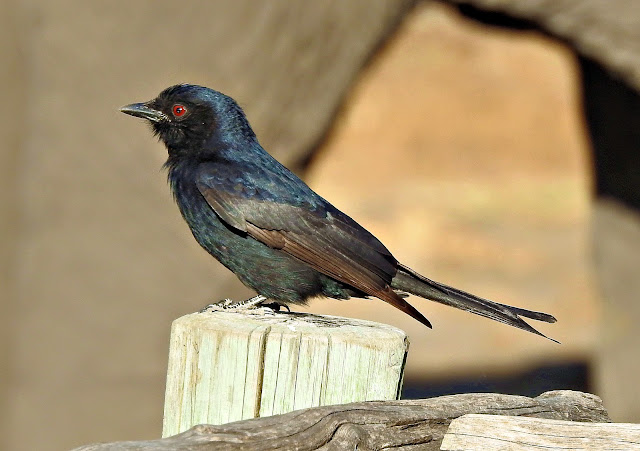
28-5-2019 SOMALISA CAMP, ZIMBABWE - EASTERN FORK TAILED DRONGO (Dicrurus adsimilis ssp. fugax)


The East African Fork-Tailed Drongo (Dicrurus adsimilis fugax) is a medium-sized passerine songbird. It is also known as the Common Drongo, the African Drongo, or the Savannah Drongo.

The East African Fork-Tailed Drongo is glossy black, with duller black wings. It has patches of brown feathers. It has a large head, and a light-grey thick, hooked beak, with nasal bristles (hairs). It has orange-brown eyes. It has short legs. The feathers on its tail curve outwards, forming a fork tail.


The term "eastern fork-tailed drongo" refers to Sharpe's Drongo (\(<<!nav>>Dicrurussharpeisharpei<<!/nav>>\)) or can be a less common way to refer to the Fork-tailed Drongo (\(<<!nav>>Dicrurusadsimilis<<!/nav>>\)), which has populations in eastern Africa. Both are black, fork-tailed birds, with the fork-tailed drongo being more widespread in sub-Saharan Africa and Sharpe's drongo primarily found in eastern and central Africa's forests. They are known for their bright red eyes and ability to mimic other birds to steal food. Sharpe's Drongo (\(Dicrurussharpei\)) Identification: An all-black bird with a deep fork in its tail and a glossy, blue-green sheen on its head and upperparts.

Habitat: Found primarily in forest habitats, particularly in eastern
 Africa.

Behavior: Mimics other birds, including warning calls, to steal food. 

Identification: A black bird with a deeply forked tail, red eyes, and a slight blue-green gloss on its upperparts.Habitat: Inhabits more open country across sub-Saharan Africa and is absent from dense forests and high-altitude areas.

Behavior: Known for mimicking the alarm calls of other birds to steal food. 

Thursday, 13 January 2022

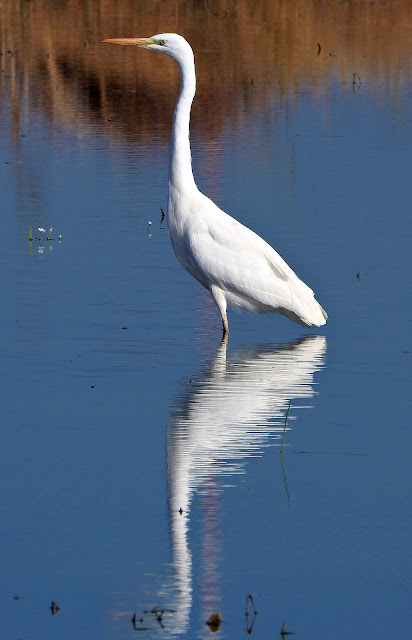
12-1-2022 CREU DE LONGA, VALENCIA - GREAT EGRET (Ardea alba)


12-1-2022 CREU DE LONGA, VALENCIA - GREY HERON (Ardea cinerea)


12-1-2022 CATARROJA, VALENCIA - EURASIAN KESTREL (Falco tinnunculus)


12-1-2022 CATARROJA, VALENCIA - BLACK REDSTART (FEMALE) (Phoenicurus ochruros)


12-1-2022 CATARROJA, VALENCIA - LITTLE EGRET (Egretta garzetta)


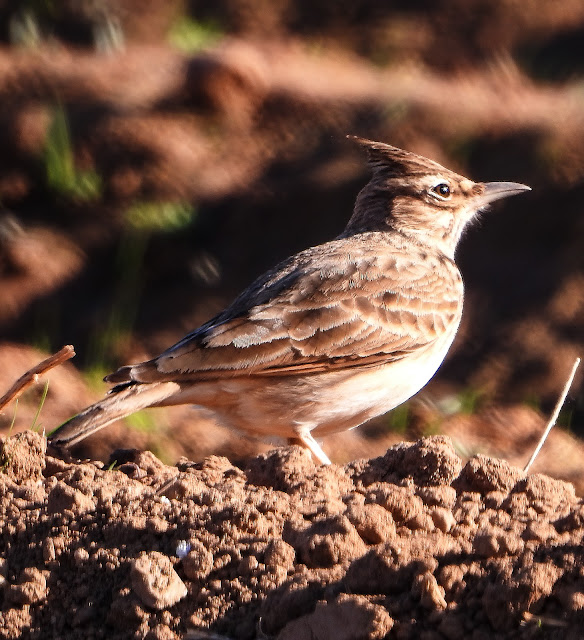
12-1-2022 CATARROJA, VALENCIA - CRESTED LARK (Galerida cristata)


12-1-2022 CATARROJA, VALENCIA - MEADOW PIPIT (Anthus pratensis)


12-1-2022 CREU DE LONGA, VALENCIA - EURASIAN GREAT CORMORANT (Phalacrocorax carbo)


Wednesday, 12 January 2022

12-1-2022 EL PALMAR, VALENCIA - EUROPEAN STONECHAT (FEMALE) (Saxicola rubicola)


12-1-2022 ULLAL DE BALDOVI, VALENCIA - WESTERN SWAMPHEN (Porphyrio porphyrio)


12-1-2022 CATARROJA, VALENCIA - CATTLE EGRET (Bubulcus ibis)


28-5-2019 SOMALISA CAMP, ZIMBABWE - SOUTHERN YELLOW BILLED HORNBILL (Tockus leucomelas ssp parvior


The southern yellow-billed hornbill (Tockus leucomelas) is a hornbill found in southern Africa. Yellow-billed hornbills feed mainly on the ground, where they forage for seeds, small insects, spiders and scorpions. This hornbill species is a common and widespread resident of dry thornveldt and broad-leafed woodlands. They can often be seen along roads and water courses.

It is a medium-sized bird, 48–60 cm (19–24 in) in length, 132–242 g (0.29–0.53 lb) in weight and is characterized by a long yellow and down-curved beak. This beak is huge in comparison to its body and can account for up 1/6th of the entire body length. Male beaks are on average 90 mm long while female beaks are an average of 74 mm. Males are generally bigger than females but there is overlap between the sexes. The size difference of the beak is a fairly reliable way of differentiating sex in wild hornbills.

Tuesday, 11 January 2022

28-5-2019 SOMALISA CAMP, ZIMBABWE - RED BILLED FRANCOLIN (Pternistis-adspersus)


The red-billed spurfowl (Pternistis adspersus), also known as the red-billed francolin, is a species of bird in the family Phasianidae. It is found in Southern Africa, including Angola, Botswana, Namibia, South Africa, Zambia, and Zimbabwe.

The species exhibits sexual dimorphism in size. Males are larger, measuring 38 cm (15 in) in length and weighing 340–635 g (12.0–22.4 oz), whereas females measure 33 cm (13 in) in length and weigh 340–549 g (12.0–19.4 oz). The species has barred underparts (in contrast to the related Natal spurfowl) and a conspicuous yellow eye-ring.


The red-billed spurfowl was described in 1838 by the English naturalist George Robert Waterhouse from specimens collected by James Edward Alexander on his expedition to Namaqualand and Damaraland. Waterhouse coined the binomial name Francolinus adspersus and noted that the specimens had come near the Fish River in what is now Namibia. The specific epithet adspersus is Latin for "sprinkling". The species is now placed in the genus Pternistis that was introduced by the German naturalist Johann Georg Wagler in 1832. The red-billed spurfowl is considered as monotypic: the proposed subspecies mesicus is not recognised.

28-5-2019 SOMALISA CAMP, ZIMBABWE - NATAL SPURFOWL (Pternistis natalensis)


The Natal spurfowl is a medium-sized brownish francolin with a distinctive appearance, including a scaled (marbled) appearance on its underparts and a lack of bare skin around the eyes and throat. It is commonly found in savannas and woodlands, where it nests in a shallow ground scrape. This species is known for its loud, raucous "kak-kreek" call and its diet of roots, seeds, insects, and fruit. 

Physical characteristics
Appearance: Mottled brown back, with a distinctive scaled pattern on the underparts caused by brown and white-edged feathers.
Bill and legs: Bright orange-red bill and legs.
Head: Lacks bare skin around the eyes and throat, a key distinguishing feature from other spurfowl species.
Sexes: Both sexes have similar plumage, but males are heavier and have longer leg spurs.
Juveniles: Similar to adults, but with duller legs and bill. 


Habitat and behavior

Habitat: Prefers savanna, but also found in coastal forests, woodlands, and areas with dense understory. It prefers areas with tall trees and shrubby undergrowth.

Activity: Most active in the early morning and late afternoon, when males often call.
Nesting: Creates a shallow ground scrape lined with grass and some feathers, typically in a well-concealed spot under dense scrub.
Eggs: Lays between 4 and 8 creamy-colored eggs, with a 21-day incubation period. 

Diet
Primarily subsists on roots, tubers, seeds, and beans.
Opportunistically eats insects like termites and ants, as well as flowers and fallen fruit. 

Other facts
Call: A loud, raucous "kak-kreek" sound.
Conservation status: The species is considered abundant to locally common and is suspected to have a stable population, though it is sometimes threatened by over-hunting. 

11-1-2022 OLIVA CANAL LES FONTS, VALENCIA - LITTLE EGRET (Egretta garzetta)