TOTAL PAGEVIEWS

TRANSLATE

Saturday, 15 January 2022

15-4-1991 PANAMA, CENTRAL AMERICA - BLUE FOOTED BOOBY

The blue-footed booby (Sula nebouxii) is a marine bird native to subtropical and tropical regions of the eastern Pacific Ocean. It is one of six species of the genus Sula – known as boobies. It is easily recognizable by its distinctive bright blue feet, which is a sexually selected trait and a product of their diet. Males display their feet in an elaborate mating ritual by lifting them up and down while strutting before the female. The female is slightly larger than the male and can measure up to 90 cm (35 in) long with a wingspan up to 1.5 m (5 ft).

The natural breeding habitats of the blue-footed booby are the tropical and subtropical islands of the Pacific Ocean. It can be found from the Gulf of California south along the western coasts of Central and South America to Peru. About half of all breeding pairs nest on the Galápagos Islands. Its diet mainly consists of fish, which it obtains by diving and sometimes swimming under water in search of its prey. It sometimes hunts alone, but usually hunts in groups.

The blue-footed booby usually lays one to three eggs at a time. The species practices asynchronous hatching, in contrast to many other species whereby incubation begins when the last egg is laid and all chicks hatch together. This results in a growth inequality and size disparity between siblings, leading to facultative siblicide in times of food scarcity. This makes the blue-footed booby an important model for studying parent–offspring conflict and sibling rivalry.

The blue-footed booby is distributed among the continental coasts of the eastern Pacific Ocean from California to the Galápagos Islands south into Peru. It is strictly a marine bird. Its only need for land is to breed and rear young, which it does along the rocky coasts of the eastern Pacific.

A booby may use and defend two or three nesting sites, which consist of bare black lava in small divots in the ground, until they develop a preference for one a few weeks before the eggs are laid. These nests are created as parts of large colonies. While nesting, the female turns to face the sun throughout the day, so the nest is surrounded by excrement. 

15-1-2022 MONTE CORONA, VALENCIA - BUFF TAILED BUMBLE BEE (Bombus terrestris ssp. lusitanicus)


Bombus terrestris, the buff-tailed bumblebee or large earth bumblebee, is one of the most numerous bumblebee species in Europe. It is one of the main species used in greenhouse pollination, and so can be found in many countries and areas where it is not native, such as Tasmania. Moreover, it is a eusocial insect with an overlap of generations, a division of labour, and cooperative brood care. The queen is monandrous which means she mates with only one male. B. terrestris workers learn flower colours and forage efficiently.


B. terrestris is part of the order Hymenoptera, which is composed of ants, bees, and wasps. The family Apidae specifically consists of bees. It is also part of the subfamily Apinae. There are 14 tribe lineages within Apinae, and B. terrestris is in the bumblebee tribe, Bombini. It is in the genus Bombus, which consists entirely of bumblebees, and the subgenus Bombus sensu stricto. This subgenus contains closely related species such as Bombus affinis, Bombus cryptarum, Bombus franklini, Bombus ignitus, Bombus lucorum, Bombus magnus, Bombus occidentalis, and Bombus terricola. There are nine recognized subspecies: B. terrestris africanus, B. terrestris audax, B. terrestris calabricus, B. terrestris canariensis, B. terrestris dalmatinus, B. terrestris lusitanicus, B. terrestris sassaricus, B. terrestris terrestris and B. terrestris xanthopus, each with a distinctive coloration scheme.


Like in most social bees, there are three main social caste divisions in B. terrestris. This ensures a division of labor and efficient colony functioning. Queens become the main female individual to reproduce in a future colony. There is only one per colony. Her sole responsibility is to lay eggs after she founds a nest. This fate is determined for larvae that receive more food, have longer instar stages, and higher levels of juvenile hormone biosynthesis. Workers, an entirely female caste, mainly forage for food, defend the colony, and tend to the growing larvae. They are usually sterile for most of the colony cycle and do not raise their own young. Unlike queens and workers, which develop from fertilized diploid eggs, drones, or male bees, are born from unfertilized, haploid eggs. Drones leave the colony shortly after reaching adulthood to find a mate outside the nest. Mating is their sole role in the colony.

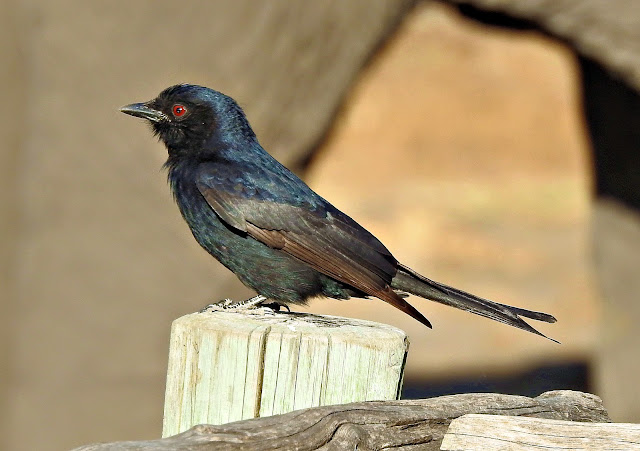
28-5-2019 SOMALISA CAMP, ZIMBABWE - EASTERN FORK TAILED DRONGO (Dicrurus adsimilis ssp. fugax)


The East African Fork-Tailed Drongo (Dicrurus adsimilis fugax) is a medium-sized passerine songbird. It is also known as the Common Drongo, the African Drongo, or the Savannah Drongo.

The East African Fork-Tailed Drongo is glossy black, with duller black wings. It has patches of brown feathers. It has a large head, and a light-grey thick, hooked beak, with nasal bristles (hairs). It has orange-brown eyes. It has short legs. The feathers on its tail curve outwards, forming a fork tail.


The term "eastern fork-tailed drongo" refers to Sharpe's Drongo (\(<<!nav>>Dicrurussharpeisharpei<<!/nav>>\)) or can be a less common way to refer to the Fork-tailed Drongo (\(<<!nav>>Dicrurusadsimilis<<!/nav>>\)), which has populations in eastern Africa. Both are black, fork-tailed birds, with the fork-tailed drongo being more widespread in sub-Saharan Africa and Sharpe's drongo primarily found in eastern and central Africa's forests. They are known for their bright red eyes and ability to mimic other birds to steal food. Sharpe's Drongo (\(Dicrurussharpei\)) Identification: An all-black bird with a deep fork in its tail and a glossy, blue-green sheen on its head and upperparts.


Habitat: Found primarily in forest habitats, particularly in eastern
 Africa.

Behavior: Mimics other birds, including warning calls, to steal food. 

Identification: A black bird with a deeply forked tail, red eyes, and a slight blue-green gloss on its upperparts.Habitat: Inhabits more open country across sub-Saharan Africa and is absent from dense forests and high-altitude areas.

Behavior: Known for mimicking the alarm calls of other birds to steal food. 

Thursday, 13 January 2022

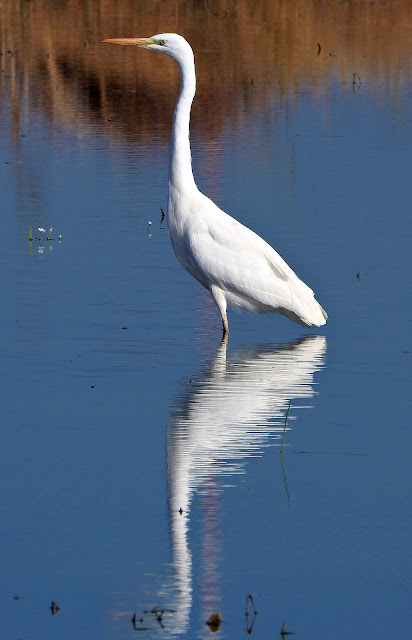
12-1-2022 CREU DE LONGA, VALENCIA - GREAT EGRET (Ardea alba)


12-1-2022 CREU DE LONGA, VALENCIA - GREY HERON (Ardea cinerea)


12-1-2022 CATARROJA, VALENCIA - EURASIAN KESTREL (Falco tinnunculus)


12-1-2022 CATARROJA, VALENCIA - BLACK REDSTART (FEMALE) (Phoenicurus ochruros)


12-1-2022 CATARROJA, VALENCIA - LITTLE EGRET (Egretta garzetta)


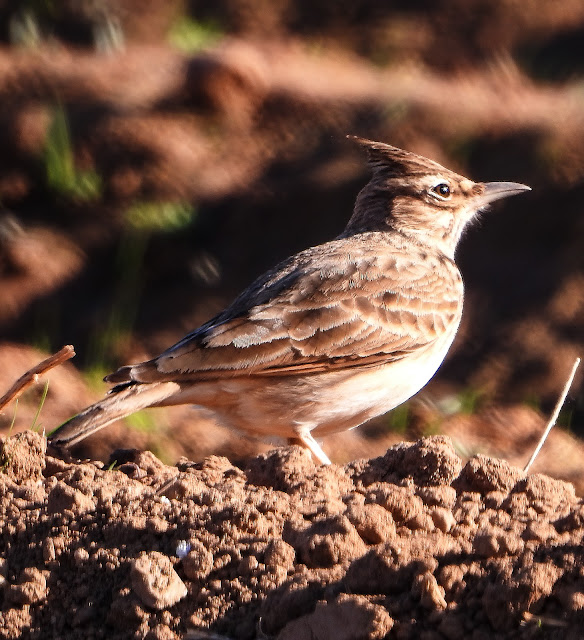
12-1-2022 CATARROJA, VALENCIA - CRESTED LARK (Galerida cristata)


12-1-2022 CATARROJA, VALENCIA - MEADOW PIPIT (Anthus pratensis)


12-1-2022 CREU DE LONGA, VALENCIA - EURASIAN GREAT CORMORANT (Phalacrocorax carbo)


Wednesday, 12 January 2022

12-1-2022 EL PALMAR, VALENCIA - EUROPEAN STONECHAT (FEMALE) (Saxicola rubicola)


12-1-2022 ULLAL DE BALDOVI, VALENCIA - WESTERN SWAMPHEN (Porphyrio porphyrio)


12-1-2022 CATARROJA, VALENCIA - CATTLE EGRET (Bubulcus ibis)


28-5-2019 SOMALISA CAMP, ZIMBABWE - SOUTHERN YELLOW BILLED HORNBILL (Tockus leucomelas ssp parvior


The southern yellow-billed hornbill (Tockus leucomelas) is a hornbill found in southern Africa. Yellow-billed hornbills feed mainly on the ground, where they forage for seeds, small insects, spiders and scorpions. This hornbill species is a common and widespread resident of dry thornveldt and broad-leafed woodlands. They can often be seen along roads and water courses.

It is a medium-sized bird, 48–60 cm (19–24 in) in length, 132–242 g (0.29–0.53 lb) in weight and is characterized by a long yellow and down-curved beak. This beak is huge in comparison to its body and can account for up 1/6th of the entire body length. Male beaks are on average 90 mm long while female beaks are an average of 74 mm. Males are generally bigger than females but there is overlap between the sexes. The size difference of the beak is a fairly reliable way of differentiating sex in wild hornbills.

Tuesday, 11 January 2022

28-5-2019 SOMALISA CAMP, ZIMBABWE - RED BILLED FRANCOLIN (Pternistis-adspersus)


The red-billed spurfowl (Pternistis adspersus), also known as the red-billed francolin, is a species of bird in the family Phasianidae. It is found in Southern Africa, including Angola, Botswana, Namibia, South Africa, Zambia, and Zimbabwe.

The species exhibits sexual dimorphism in size. Males are larger, measuring 38 cm (15 in) in length and weighing 340–635 g (12.0–22.4 oz), whereas females measure 33 cm (13 in) in length and weigh 340–549 g (12.0–19.4 oz). The species has barred underparts (in contrast to the related Natal spurfowl) and a conspicuous yellow eye-ring.


The red-billed spurfowl was described in 1838 by the English naturalist George Robert Waterhouse from specimens collected by James Edward Alexander on his expedition to Namaqualand and Damaraland. Waterhouse coined the binomial name Francolinus adspersus and noted that the specimens had come near the Fish River in what is now Namibia. The specific epithet adspersus is Latin for "sprinkling". The species is now placed in the genus Pternistis that was introduced by the German naturalist Johann Georg Wagler in 1832. The red-billed spurfowl is considered as monotypic: the proposed subspecies mesicus is not recognised.