TOTAL PAGEVIEWS

TRANSLATE

Friday, 11 February 2022

3-6-2019 LINYANTI CAMP, BOTSWANA - SMITH'S BUSH SQUIRREL (Paraderus Cepapi)


Smith's bush squirrel (Paraxerus cepapi), also known as the yellow-footed squirrel or tree squirrel, is an African bush squirrel which is native to woodlands of the southern Afrotropics.

It is found in Angola, Botswana, the DRCongo, Malawi, Mozambique, Namibia, South Africa, Tanzania, Zambia, and Zimbabwe. It is a common rodent which is diurnal by nature.

Its total length is 350 mm (14 in), half of which is tail; weight 200 g (7.1 oz). The coat colour varies throughout the region. In the western and arid parts of its range, it is pale grey, and in the eastern localities, more brown. Its head and legs are a rusty colour. Colouration on the chest varies from yellowish to buff in the east, to white in the west. This squirrel's belly is white. These alert and ever busy creatures carry their long tails extended backwards.

Smith's bush squirrels are primarily vegetarian, but like most rodents, they take insect prey and use their front feet to manipulate food items when feeding. They scatter-hoard seeds next to tree trunks or grass tufts, thereby facilitating tree regeneration.


Essentially arboreal animals, they also spend a great deal of time on the ground, foraging for food. When disturbed, Smith's bush squirrels always seek the refuge of trees. At night, territorial family groups nest together in holes in trees. Offspring become sexually mature between six and nine months old, when they are forcibly evicted by the breeding pair. The males are mainly responsible for territorial defense, although females also chase intruders when they care for dependent pups. To promote group cohesion, a common scent is shared by mutual grooming, which is an important facet of the social fibre of this species. Smith's bush squirrels are diligent in their grooming and a mother tree squirrel holds her offspring down with her fore legs while grooming it with licks, nibbles, and scratches with her claws.

A conspicuous feature of their behaviour when under threat is 'mobbing': all the members of the colony make harsh clicking sounds while they flick their tails, building up momentum and gradually getting louder. In some areas, they are solitary, or are found in small family groups; a lone tree squirrel relies on its wits when in danger and always keeps a branch or the trunk of a tree between it and the enemy. Smith's bush squirrels are always alert, and when alarmed, run away with great speed, making for the nearest tree where they lie motionless, flattened against a branch.

Thursday, 10 February 2022

3-6-2019 LINYANTI CAMP, BOTSWANA - HOLUB'S GOLDEN WEAVER (Ploceus xanthops)


Holub's golden weaver (Ploceus xanthops), also known as the African golden weaver, is a species of bird in the family Ploceidae. The common name commemorates the Czech naturalist Emil Holub. It is found from Gabon to Uganda and Kenya, south to northern Namibia, northern Botswana and eastern South Africa. They have a yellow on their heads and light yellow eyes. They live for four years. Their usual call sounds like "chichi-chichi-chi-squirr ski-wee" but there is some variation from regions so some contact calls are a short "chirp.

Males differentiate from the females because of their full yellow heads, bright greenish-yellow body and the bit of orange under their chins that continues to the upper breast. The coloring on the females are duller and they only have the yellow coloring on the forehead. The males and the females share several similar characteristics, dull brown wings on the upper portion and then the lower portion having a yellow coloring. As they have light yellow eyes, black bills and pink legs. When the birds are younger they are a dull olive color with only the tail, chin and throat having the yellow coloring. Their eyes are dark brown and their bill is a pale brown.


They live in seventeen countries which are Angola, Botswana, Burundi, Congo, The Democratic Republic of the Congo, Eswantini, Gabon, Kenya, Malawi, Mozambique, Namibia, Rwanda, South Africa, United Republic of Tanzania, Uganda, Zambia and Zimbabwe. They live in areas that are inland from freshwater which includes forests, savannas, shrublands, grasslands, and wetlands.[5] They cover a range of different habitats which includes bushy areas with tall grass. They can also be found on forest margins or the side of a stream. From East South Africa to West Angola they can be found on the coast. There is not much research so they are assumed to be sedentary. They live at elevations of 1,200 to 2,300 meters. They do not migrate for seasons and the furthest distance recorded was ten kilometers.

The Holub's Golden Weaver is omnivorous and eats a diet of invertebrate fruits, seed and nectar. The insects include beetle larvae, termites, grasshoppers, praying mantis, tabanid flies and spiders. The fruit includes guavas, figs and rhus pyroides. The seeds of grass and exocite pins along with the nectar of ruttya and erythrina. They will sometimes eat the petals of flowers as well.


They are monogamous couples that breed anytime between the months of January–April but they start as early as September in South Africa, Zambia and Malawi. Breeding happens in colonies of two to three territorial males. Male birds perch beside a female, make specific movements and sing a song stretch (song that changes the speed or duration of an audio signal without affecting its pitch). The males build the nest that is two to two and a half meters up from tall bushes or reeds. Usually this is done over water and the females make the lining. Researchers have also found old nests from Brown Firefinch, White-collared Oliveback and Zebra Waxbill. They lay clutches of eggs that range from one to three that range from being a solid pink, blue or white to having red and lilac freckles. The incubation time is fourteen to fifteen days and after hatching they spend nineteen to twenty two days in the nest where they are fed by both parents.

3-6-2019 LINYANTI CAMP, BOTSWANA - CRESTED FRANCOLIN (Ortygornis sephaena ssp. zambesiae)


The crested francolin, known scientifically as Ortygornis sephaena, is a distinguished member of the Phasianidae family. This bird is adorned with a notable crest, which gives it its common name.

When attempting to identify the crested francolin, look for its characteristic crest and the overall brown plumage with intricate patterns that provide excellent camouflage in its natural habitat.

The crested francolin is a bird of southern Africa, where it frequents a variety of habitats, adapting well to its surroundings.

This species is widely distributed across southern Africa, indicating a healthy and stable population in this region.

Observations of the crested francolin's behavior reveal a bird that is well-adapted to its environment, exhibiting typical behaviors of the Phasianidae family.

3-6-2019 LINYANTI CAMP, BOTSWANA - LITTLE BEE-EATER (Merops pasillas)


The little bee-eater (Merops pusillus ) is a near passerine bird species in the bee-eater family, Meropidae. They are residents in much of Sub-Saharan Africa. They should not be confused with the little green bee-eater (Merops orientalis ). Migration is limited to seasonal movements depending on rainfall patterns.

Members of this species, like other bee-eaters, are rich and brightly-coloured slender birds. They have green upper parts, yellow throats, black gorgets, and rich brown upper breasts fading to buffish ochre on the belly. Their wings are green and brown, and their beaks are black. They reach a length of 15–17 cm, which makes them the smallest African bee-eater. Sexes are alike. Often silent, their call is a soft "seep."


These are abundant and tame birds, familiar throughout their range. There have been estimated to be between 60-80 million little bee-eaters. They breed in open country with bushes, preferably near water. Just as the name suggests, bee-eaters predominantly eat insects, especially bees, wasps and hornets, who are caught in the air by sorties from an open perch. This species often hunts from low perches, maybe only a metre or less high. Before eating their meal, a bee-eater removes the sting by repeatedly hitting the insect on a hard surface.

Unlike most bee-eaters, these are solitary nesters, making a tunnel in sandy banks, or sometimes in the entrance to an Aardvark den. They lay 4 to 6 spherical white eggs. Both the male and the female take care of the eggs. These birds roost communally, lined up on a tree branch.

3-6-2019 LINYANTI CAMP, BOTSWANA - DAY WATER LILY (Nymphaea nouchali)


3-6-2019 LINYANTI CAMP, BOTSWANA - HIPPOPOTAMUS (Hippopotamus amphibius)


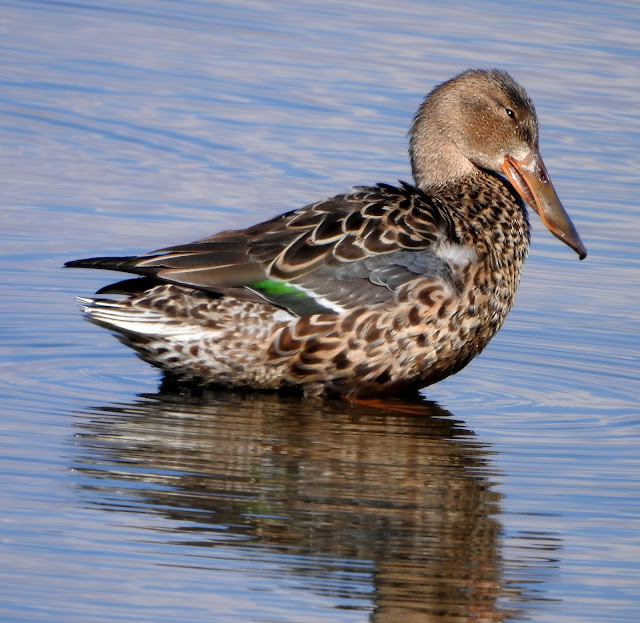
9-2-2022 MARJAL DE MOROS, VALENCIA - NORTHERN SHOVELER (FEMALE)


9-2-2022 MARJAL DE MOROS, VALENCIA - GREEN WINGED TEAL (MALE) (Anas crecca)


9-2-2022 MARJAL DE MOROS, VALENCIA - GREEN WINGED TEAL (FEMALE) (Anas crecca)


9-2-2022 MARJAL DE MOROS, VALENCIA - WESTERN SWAMPHEN (Porphyrio porphyrio)


Tuesday, 8 February 2022

4-6-2019 LINYANTI CAMP, BOTSWANA - SOUTHERN YELLOW BILLED HORNBILL (Tockus leucomelas ssp parvior)


Distribution: Southern Africa; from south-west Angola and Namibia across Botswana, Zimbabwe and southern Zambia east to southern Malawi, western Mozambique and northern South Africa. 

Description: 40 cm. Male 153-242 g; female 138-211 g. Combination of pied plumage and yellow bill diagnostic within range. Small slender hornbill with pied plumage and long yellow bill. Male has broad bill and low casque extending to tip. Female is smaller, with smaller bill and shorter casque. Juvenile is like adult but with shorter dull yellow bill with brown spots. 

Voice: The call is similar to Red-billed Hornbill’s but somewhat deeper and more liquid; a series of chucking notes uttered singly, or in a series sometimes leading into a continuous bubbling call kok-kok-kok …korkorkorkork. 


Habits: The Southern yellow-billed hornbill occurs in savannah and open woodlands, often along rivers and grasslands with scattered trees; in the west also in more arid semi-deserts and thorn-bush country. It feeds on the ground or low in the bushes, by walking and running to catch small prey. It does not dig in the ground like the Red-billed Hornbill does, instead it searches on the ground or in the leaf litter and on branches and snatches animals up with its powerful bill. The food is mainly small invertebrates such as ants and termites, especially during the dry season, but when available also grasshoppers, beetles, caterpillars, centipedes and scorpions. It also takes some vertebrate prey such as bird eggs and nestlings and rodents during years of abundance, as well as some fruits and seeds. It is usually found in resident pairs or small family flocks and it can stay in the home range all year. It is territorial and sedentary in most areas; the pair will fly out to feed in the morning and come home to the same roost in the evening. In some areas with a long dry season, like the Kalahari Desert, it will move out in search of better feeding grounds when not breeding.    

Monday, 7 February 2022

7-2-2022 MONTE CORONA, VALENCIA - LABYRINTH SPIDER (Agelena labyrinthica)


7-2-2022 BAYREN CASTLE GANDIA, VALENCIA - BLACK NIGHTSHADE


7-2-2022 PLA XIQUET GANDIA, VALENCIA - BLACK REDSTART (MALE) (Phoenicurus ochruros)


7-2-2022 BAYREN CASTLE GANDIA, VALENCIA - WALL BROWN BUTTERFLY (Lasiommata megera)


7-2-2022 BAYREN CASTLE GANDIA, VALENCIA - OLD WORLD SWALLOWTAIL BUTTERFLY (Papilio machaon)


7-2-2022 BAYREN CASTLE GANDIA, VALENCIA - ALMOND BLOSSOM (Prunus amygdalus)


7-2-2022 MONTE CORONA, VALENCIA - SPINY TOAD (Bufo spinosus)