TOTAL PAGEVIEWS

TRANSLATE

Tuesday, 22 February 2022

4-6-2019 LINYANTI CAMP, BOTSWANA - JAMESON'S FIREFINCH (Lagonosticta rhodopareia)


Jameson's firefinch is a small, native African bird found in savannas and woodlands, known for the male's red plumage and the species' tendency to live in pairs or small flocks. Its diet consists mainly of grass seeds and small insects, and it is a host for the parasitic Village Indigobird, which lays its eggs in their nests. 
Key facts
Classification: It belongs to the order Passeriformes and the family Estrildidae.

Appearance:
Size: Approximately 
 11cm long and weighs around 10g.

Male: Reddish plumage on the face, chest, and underparts; it has a blue-gray bill and black undertail coverts.

Female: More subdued brownish tones with a reddish rump, and the same blue-gray bill and black undertail coverts.


Habitat: Found in eastern and southern Africa, including savannas, woodlands, and scrub, often near water or along forest edges.

Diet: Primarily forages on the ground for fallen grass seeds, but also eats small insects like ants and termites.

Behavior:
Usually seen in pairs or small groups.
Vocalizes with a short trill, according to eBird.

Breeding:
Nests are oval-shaped, made of dry grass, and lined with soft grass or feathers.
Lays 2–7 eggs, with a clutch size of 3–4 is more typical, and both parents incubate the eggs and feed the chicks.
Breeding often peaks during the summer months.

Conservation Status: Listed as Least Concern on the IUCN Red List.
Parasitism: The Village Indigobird is a brood parasite that lays its eggs in the Jameson's firefinch's nest, as noted by Wildlife Vagabond. 

22-2-2022 XERACO STATION, VALENCIA - EUROPEAN SERIN (Serinus serinus)


Monday, 21 February 2022

4-6-2019 LINYANTI CAMP, BOTSWANA - DOUBLE BANDED SANDGROUSE (Pterocles bicinctus)


The double-banded sandgrouse (Pterocles bicinctus ) is a species of ground-living bird in the family Pteroclidae. It is found in arid parts of southern Africa.

A moderate sized bird with a plump body, the double-banded sandgrouse has a small pigeon-like head and long wings and tail. The general colour of the plumage is light brown with darker mottling and rows of whitish specks. The male is distinguished by having a conspicuous black and white band on its forehead and a chestnut throat area delineated by another black and white band. Both sexes have an area of bare yellow skin surrounding their eye and the male has an orange beak. The female is smaller and duller in colour. The juvenile resembles the female.

The double-banded sandgrouse is found in Angola, Botswana, Malawi, Mozambique, Namibia, South Africa, Zambia and Zimbabwe. It has a preference for short trampled grass beside roads and tracks, gravel patches, tussocky grassland and recently burned areas of scrub with green shoots starting to develop. It is also seen in areas of scanty vegetation beneath scattered Terminalia sericea and Burkea africana trees and in scrubby mopane woodland. It is less common than Burchell's sandgrouse (Pterocles burchelli ) and Namaqua sandgrouse (Pterocles namaqua ), both of which have an overlapping distribution in southern Africa.

4-6-2019 LINYANTI, BOTSWANA - LILAC BREASTED ROLLER (Coracias caudatus)


The lilac-breasted roller (Coracias caudatus) is a member of the roller family, Coraciidae, resplendent in a panoply of pastel hues. This African bird is a sight to behold, with its lilac throat and breast, olive crown to mantle, and cheeks of lilac-rufous. The species is further adorned with long, black tail streamers, which juveniles lack. Unofficially, it is considered the national bird of Kenya.
In the field, the lilac-breasted roller is almost unmistakable. Adults boast a lilac throat that deepens into a darker lilac breast, with an olive crown and mantle. The cheeks and ear coverts are a lilac-rufous. Juveniles and immatures can be identified by their lack of tail streamers and a throat and breast of rufous-tawny with broad diffuse buffy-white streaks. The species is not sexually dimorphic, though males may be slightly larger.

The lilac-breasted roller favors open woodland and savanna, typically avoiding treeless expanses. They are often seen perched high, surveying the landscape for prey.

This species is widely distributed across Southern and Eastern Africa and is a vagrant to the southern Arabian Peninsula. It is most abundant in Kenya and can be found from sea level to elevations of 2,000 meters or more.

4-6-2019 LINYANTI CAMP, BOTSWANA - BURCHELL'S STARLING (Lamprotornis australis)


Burchell's Starling is a large, iridescent blue-green starling found in southern African savannas, known for its long, rounded tail and habit of foraging on the ground or scavenging for food near humans. It is a monogamous, sedentary species that breeds in tree cavities and feeds on invertebrates, fruit, and berries. Burchell's Starling's name honors the English naturalist William John Burchell. 

Appearance and identification Color: Large, with an iridescent blue-green to purple glossy plumage.Distinguishing features: Has a long, rounded tail and a blue-green forehead and crown.Size: Approximately \(30\) cm long, weighing about \(74\)–\(138\) g. 

Habitat and range Habitat: Dry and mesic woodlands and savannas in southern Africa, particularly near large thorn trees.Range: Found in countries including Namibia, Botswana, South Africa, Zimbabwe, Mozambique, and Zambia. Behavior and diet Foraging: Often forages on the ground, walking with long strides, and also perches in trees.

6-4-2019 LINYANTI, BOTSWANA - ZAMBESI CRESTED BARBET (Trachyphonus vaillantii ssp. nobilis)


The crested barbet (Trachyphonus vaillantii) ('trachys'=rough, 'phone'=voice, sound') is a sub-Saharan bird in the Lybiidae family. Its specific name commemorates François Levaillant, a famed French naturalist.

With its thick bill and very colourful plumage the crested barbet is unmistakable. This small bird has a speckled yellow and red face with a small black crest. The belly is yellow with red speckles, wings are black with white specks and it has a broad black band on its neck. Yellow head and body with black and white feathers, red markings on end of body, its colour blends well in the bush. They have a distinct trill.

21-2-2022 PINET, VALENCIA - COMMON BRIMSTONE BUTTERFLY (Gonepteryx rhamni)


Gonepteryx cleopatra, the Cleopatra or Cleopatra butterfly, is a medium-sized butterfly of the family Pieridae.
Gonepteryx cleopatra is a medium-sized butterfly with a wingspan of about 50–70 mm (2.0–2.8 in). It is a sexually dimorphic species; the female has pale yellow or greenish wings, whereas the male is darker yellow with an orange patch on the forewing. Both sexes have a forewing apical hook and brown dots in the center of each wing, and the underside of wings is light greenish yellow. The greenish color, the shape and the pronounced venation on the hindwings give to these butterflies a good camouflage, making them resemble just leaves.

21-2-2022 PINET, VALENCIA - SNAKE MILLIPEDE (Ommatoiulus rutilans)


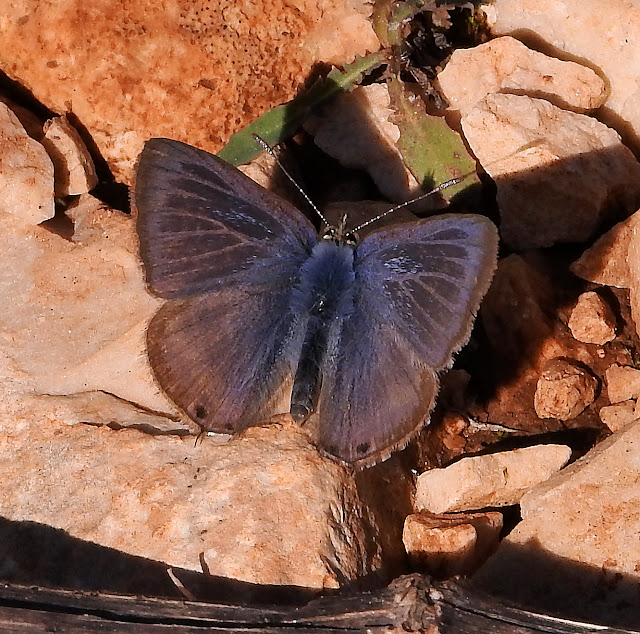
21-2-2022 PINET, VALENCIA - PEA BLUE BUTTERFLY (Lampides boeticus)


Sunday, 20 February 2022

4-6-2019 LINYANTI CAMP, BOTSWANA - GREATER BLUE EARED STARLING (Lamprotornis chalybaeus)


The Greater Blue-eared Starling is a dazzling, iridescent African bird known for its glossy blue-green feathers, distinct blue ear patch, and bright eyes, found in savannas and woodlands, feeding on fruits and insects, and forming large flocks with unique "squee-ar" calls, often nesting in tree cavities. 

Appearance & Identification
Color: Brilliant, metallic blue-green with purple-blue on the belly and a distinctive glossy blue ear-patch.
Eyes: Bright yellow, orange, or red, creating a striking contrast.
Size: About 22 cm (8.6 inches) long, with a short tail.
Juveniles: Duller with more brown, developing adult gloss and eye color as they mature. 

4-6-2019 LINYANTI, BOTSWANA - FORK TAILED DRONGO (Dicrurus adsimilis)


The fork-tailed drongo, also known as the common drongo or African drongo, is a member of the Dicruridae family. It is a small bird with a distinctive fork-shaped tail, red-brownish eyes, and an entirely black plumage that exhibits a blue-green iridescence in certain lights. Both sexes are similar in appearance, with the underside of the bird being uniformly black, contrasting with the glossy black-blue upper body.

When identifying the fork-tailed drongo, look for its robust black beak, red eyes, and the deeply forked black tail. Juveniles can be distinguished by their dark brown tone, less pronounced tail fork, and lack of glossy shine on the lower body. During flight, the darker remiges of the D. a. adsimilis subspecies are particularly noticeable.

The fork-tailed drongo inhabits wooded habitats, including woodlands and savannas, and is tolerant of arid climates. It can be found at elevations up to 2200 meters.

This species is widespread across Africa south of the Sahara, with four recognized subspecies varying in range and physical characteristics. It was once thought to range into Asia, but the Asian species is now classified as the black drongo (D. macrocercus).

4-6-2019 LINYANTI CAMP, BOTSWANA - RED LECHWE (MALE AND FEMALE) (Kobus leche ssp. leche)


The lechwe, red lechwe, or southern lechwe (Kobus leche) is an antelope found in wetlands of south-central Africa.
The lechwe is native to Botswana, Zambia, southeastern Democratic Republic of the Congo, northeastern Namibia, and eastern Angola, especially in the Okavango Delta, Kafue Flats, and Bangweulu Wetlands. The species is fairly common in zoos and wild animal farms.

Adult lechwe typically stand 90 to 100 cm (35 to 39 in) at the shoulder and generally weigh from 50 to 120 kg (110 to 260 lb), with males being larger than females. They are golden brown with white bellies. Males are darker in colour, but exact hue and amount of blackish on the front legs, chest and body varies depending on subspecies. The long, spiral horns are vaguely lyre-shaped and borne only by males. The hind legs are somewhat longer in proportion than in other antelopes to ease long-distance running on marshy soil.

4-6-2019 LINYANTI CAMP, BOTSWANA - WHITE FRONTED BEE-EATER (Merops bullockoides)


The White-fronted Bee-eater, known scientifically as Merops bullockoides, is a vibrant and slender bird adorned with a striking black mask and a white forehead. Its square tail and bright red throat patch are distinctive features. Measuring at 23 cm in length, the bird's upperparts are a lush green, while its underparts boast a warm cinnamon hue. Its call is a resonant, deep squeak that carries through the air.

To identify the White-fronted Bee-eater, look for its unique combination of colors: a black mask, white forehead, green upperparts, and cinnamon underparts. The square tail and bright red throat patch are also key identifiers. Listen for its deep squeaking call as a helpful auditory clue.


This species thrives in the open savannahs of sub-equatorial Africa, often found near gullies where their insect prey, particularly bees, are abundant.

The White-fronted Bee-eater is widely distributed across the savannah regions of sub-equatorial Africa, where it is a common sight in its preferred habitat.

The White-fronted Bee-eater exhibits a complex social structure, nesting in colonies that can average around 200 individuals. These colonies are not just for breeding but also serve as a communal space for roosting and socializing. The birds demonstrate cooperative breeding, with non-breeding individuals acting as helpers to their kin, significantly increasing the success rate of raising young.


The White-fronted Bee-eater is currently listed as Least Concern on the IUCN Red List, indicating that it is not at immediate risk of population decline or habitat loss at a global scale.

The diet of the White-fronted Bee-eater primarily consists of bees, but it also includes other flying insects, depending on seasonal availability. They employ two hunting strategies: making swift hawking flights from lower branches or gliding down from perches to hover momentarily before snatching their prey mid-flight.

20-2-2022 MONTE CORONA, VALENCIA - SARDINIAN WARBLER (FEMALE) (Sylvia melanocephala)


20-2-2022 MONTE CORONA, VALENCIA - HORSE CHESTNUT MOTH (Pachycnemia hippocastanaria)


20-2-2022 MONTE CORONA, VALENCIA - GREAT TIT


20-2-2022 MONTE CORONA, VALENCIA - BUFF TAILED BUMBLE BEE (Bombus terrestris)


20-2-2022 MONTE CORONA, VALENCIA - HORSE CHESTNUT MOTH (Pachycnemia hippocastanaria)