
Friday, 25 February 2022




Thursday, 24 February 2022


Wednesday, 23 February 2022


Tuesday, 22 February 2022
4-6-2019 LINYANTI CAMP, BOTSWANA - JAMESON'S FIREFINCH (Lagonosticta rhodopareia)
%2020.jpg)
Jameson's firefinch is a small, native African bird found in savannas and woodlands, known for the male's red plumage and the species' tendency to live in pairs or small flocks. Its diet consists mainly of grass seeds and small insects, and it is a host for the parasitic Village Indigobird, which lays its eggs in their nests.
Key facts
Classification: It belongs to the order Passeriformes and the family Estrildidae.
Appearance:
Size: Approximately
11cm long and weighs around 10g.
Male: Reddish plumage on the face, chest, and underparts; it has a blue-gray bill and black undertail coverts.
Female: More subdued brownish tones with a reddish rump, and the same blue-gray bill and black undertail coverts.
%2021.jpg)
Habitat: Found in eastern and southern Africa, including savannas, woodlands, and scrub, often near water or along forest edges.
Diet: Primarily forages on the ground for fallen grass seeds, but also eats small insects like ants and termites.
Behavior:
Usually seen in pairs or small groups.
Vocalizes with a short trill, according to eBird.
Breeding:
Nests are oval-shaped, made of dry grass, and lined with soft grass or feathers.
Lays 2–7 eggs, with a clutch size of 3–4 is more typical, and both parents incubate the eggs and feed the chicks.
Breeding often peaks during the summer months.
Conservation Status: Listed as Least Concern on the IUCN Red List.
Parasitism: The Village Indigobird is a brood parasite that lays its eggs in the Jameson's firefinch's nest, as noted by Wildlife Vagabond.


Monday, 21 February 2022
4-6-2019 LINYANTI CAMP, BOTSWANA - DOUBLE BANDED SANDGROUSE (Pterocles bicinctus)
%2020.jpg)
The double-banded sandgrouse (Pterocles bicinctus ) is a species of ground-living bird in the family Pteroclidae. It is found in arid parts of southern Africa.
A moderate sized bird with a plump body, the double-banded sandgrouse has a small pigeon-like head and long wings and tail. The general colour of the plumage is light brown with darker mottling and rows of whitish specks. The male is distinguished by having a conspicuous black and white band on its forehead and a chestnut throat area delineated by another black and white band. Both sexes have an area of bare yellow skin surrounding their eye and the male has an orange beak. The female is smaller and duller in colour. The juvenile resembles the female.
The double-banded sandgrouse is found in Angola, Botswana, Malawi, Mozambique, Namibia, South Africa, Zambia and Zimbabwe. It has a preference for short trampled grass beside roads and tracks, gravel patches, tussocky grassland and recently burned areas of scrub with green shoots starting to develop. It is also seen in areas of scanty vegetation beneath scattered Terminalia sericea and Burkea africana trees and in scrubby mopane woodland. It is less common than Burchell's sandgrouse (Pterocles burchelli ) and Namaqua sandgrouse (Pterocles namaqua ), both of which have an overlapping distribution in southern Africa.

6-4-2019 LINYANTI, BOTSWANA - ZAMBESI CRESTED BARBET (Trachyphonus vaillantii ssp. nobilis)

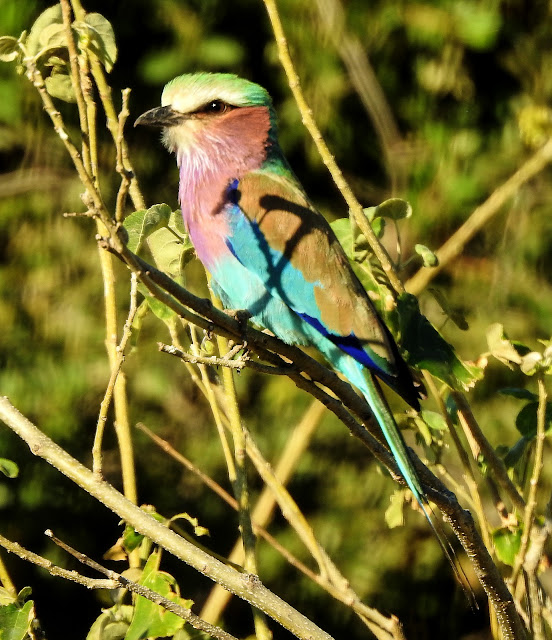
The crested barbet (Trachyphonus vaillantii) ('trachys'=rough, 'phone'=voice, sound') is a sub-Saharan bird in the Lybiidae family. Its specific name commemorates François Levaillant, a famed French naturalist.
With its thick bill and very colourful plumage the crested barbet is unmistakable. This small bird has a speckled yellow and red face with a small black crest. The belly is yellow with red speckles, wings are black with white specks and it has a broad black band on its neck. Yellow head and body with black and white feathers, red markings on end of body, its colour blends well in the bush. They have a distinct trill.
21-2-2022 PINET, VALENCIA - COMMON BRIMSTONE BUTTERFLY (Gonepteryx rhamni)

Gonepteryx cleopatra, the Cleopatra or Cleopatra butterfly, is a medium-sized butterfly of the family Pieridae.
Gonepteryx cleopatra is a medium-sized butterfly with a wingspan of about 50–70 mm (2.0–2.8 in). It is a sexually dimorphic species; the female has pale yellow or greenish wings, whereas the male is darker yellow with an orange patch on the forewing. Both sexes have a forewing apical hook and brown dots in the center of each wing, and the underside of wings is light greenish yellow. The greenish color, the shape and the pronounced venation on the hindwings give to these butterflies a good camouflage, making them resemble just leaves.



Subscribe to:
Comments (Atom)