This Blog contains Wildlife, Plants and Bird Photos from Walks, Safaris, Birding Trips and Vacations. Most of the pictures have been taken with my Nikon P900 and P950X cameras. Just click on any image for a larger picture. On the right column under the Blog Archive are the entries by date. Below that under Animal categories all the diffent species of Animals, Birds, Insects and Plants contained in the website are listed. Clicking on any entry will show all the entries for that species.
TOTAL PAGEVIEWS
TRANSLATE
Wednesday, 8 November 2023
8-11-2023 CRU DE LONGA, ALBUFERA - WHITE WAGTAIL (Motacilla alba)
The White wagtail is a slender bird with the characteristic long, constantly wagging tail of its genus. There are a number of other subspecies, some of which may have arisen because of partial geographical isolation, such as the resident British and Irish form, the pied wagtail M. a. yarrellii, which now also breeds in adjacent areas of the neighbouring European mainland. The Pied wagtail exchanges the grey colour of the nominate form with black (or very dark grey in females), but is otherwise identical in its behaviour. Other subspecies, the validity of some of which is questionable, differ in the colour of the wings, back, and head, or other features. Some races show sexual dimorphism during the breeding season. As many as six subspecies may be present in the wintering ground in India or Southeast Asia and here they can be difficult to distinguish.
8-11-2023 CRU DE LONGA, ALBUFERA - EUROPEAN STARLING (Sturnus vulgaris)
The common starling (Sturnus vulgaris), also known as the European starling in North America and simply as the starling in Great Britain and Ireland, is a medium-sized passerine bird in the starling family, Sturnidae. It is about 20 cm (8 in) long and has glossy black plumage with a metallic sheen, which is speckled with white at some times of year. The legs are pink and the bill is black in winter and yellow in summer; young birds have browner plumage than the adults. It is a noisy bird, especially in communal roosts and other gregarious situations, with an unmusical but varied song. Its gift for mimicry has been noted in literature including the Mabinogion and the works of Pliny the Elder and William Shakespeare.
The common starling has about 12 subspecies breeding in open habitats across its native range in temperate Europe and across the Palearctic to western Mongolia, and it has been introduced as an invasive species to Australia, New Zealand, Canada, the United States, Mexico, Argentina, South Africa and Fiji. This bird is resident in western and southern Europe and southwestern Asia, while northeastern populations migrate south and west in the winter within the breeding range and also further south to Iberia and North Africa. The common starling builds an untidy nest in a natural or artificial cavity in which four or five glossy, pale blue eggs are laid. These take two weeks to hatch and the young remain in the nest for another three weeks. There are normally one or two breeding attempts each year. This species is omnivorous, taking a wide range of invertebrates, as well as seeds and fruit. It is hunted by various mammals and birds of prey, and is host to a range of external and internal parasites.
Large flocks typical of this species can be beneficial to agriculture by controlling invertebrate pests; however, starlings can also be pests themselves when they feed on fruit and sprouting crops. Common starlings may also be a nuisance through the noise and mess caused by their large urban roosts. Introduced populations in particular have been subjected to a range of controls, including culling, but these have had limited success, except in preventing the colonisation of Western Australia.
The species has declined in numbers in parts of northern and western Europe since the 1980s due to fewer grassland invertebrates being available as food for growing chicks. Despite this, its huge global population is not thought to be declining significantly, so the common starling is classified as being of least concern by the International Union for Conservation of Nature.
Tuesday, 7 November 2023
7-11-2023 MONTE CORONA, VALENCIA - SEED BUG (Spilostethus pandurus)
Spilostethus pandurus is a species of "seed bugs" belonging to the family Lygaeidae, subfamily Lygaeinae.
The species was described in 1763 by Scopoli in his "Entomologica carniolica" with locus typicus from the area around Ljubljana. Scopoli does not mention the etymology of the species name but may have named it for the Panduri infantry unit of the Habsburg monarchy.
This species can be found in the Euro-mediterranean-Turaniaan Region, with a more southern distribution than Spilostethus saxatilis.
It is present in Albania, Austria, Bulgaria, Croatia, Cyprus, Czech Republic, France, Germany, Greece, Hungary, Italy, Israel, Malta, Portugal, Romania, Russia, Serbia, Slovakia, Slovenia, Spain, Switzerland, Turkey, Lebanon, in the Afrotropical realm and in the southern Asia to India and China.
7-11-2023 MONTE CORONA, VALENCIA - BLUE ROCK THRUSH (FEMALE) (Monticola solitarius)
Widespread throughout Southern Europe, North Africa and Southern Asia, the blue rock thrush is a large sized chat which is predominantly sedentary, although a partial migrant within specific narrow geographical areas.
Although named as a thrush this bird is actually a chat. The adult male of the nominate race has a dark blue body with darker brown coloured wings and tail. It is the same size as a starling and has a long thick spiky slate grey bill. From a distance the male can appear to be black although the head is a bright blue. The adult female is a dull browny blue grey on the upperparts extending from the forehead, across the crown and down the back. The face is pale and mottled with thin brown markings almost with the appearance of scales, which run down to the mid chest area. From the mid chest to the lower belly the body is pale with horizontal dark brown bars across the belly from flank to flank. Juveniles are similar to females but slighter darker with bolder underpart markings, although there is no blue colouration or shading on the plumage whatsoever. There are a total of five sub-species of blue rock thrush. The colour and patternation differences from the nominate of four of the sub-species are subtle, however the adult male of the sub-species Monticola solitarius philippensis is strikingly different, in that whilst the body of the bird is predominantly a bold blue, the breast, belly and undertail areas are a contrasting rufous to chestnut brown shade.
Monday, 6 November 2023
2-11-2023 MARCHUQUERA, VALENCIA - SPOTLESS STARLING (Sturnus unicolor)
The spotless starling (Sturnus unicolor) is a passerine bird in the starling family, Sturnidae. It is closely related to the common starling (S. vulgaris), but has a much more restricted range, confined to the Iberian Peninsula, Northwest Africa, southernmost France, and the islands of Sicily, Corsica and Sardinia. It is largely non-migratory.
Subsequent to the recent split of the genus Sturnus, this species and the common starling are the only species retained in the genus. Hybrids with the common starling are found occasionally where the breeding ranges overlap in southwestern France and northeastern Spain.
The adult spotless starling is very similar to the common starling, but marginally larger (21–23 cm length; 70–100 g weight), and has darker, oily-looking black plumage, slightly purple- or green-glossed in bright light, which is entirely spotless in spring and summer, and only with very small pale spots in winter plumage, formed by the pale tips of the feathers. It also differs in having conspicuously longer throat feathers (twice the length of those on common starlings, forming a shaggy "beard" which is particularly obvious when the bird is singing. Its legs are bright pink. In summer, the bill is yellow with a bluish base in males and a pinkish base in females; in winter, it is duller, often blackish. Young birds are dull brown, darker than young common starlings, and have a black bill and brown legs. Confusion with the common starling is particularly easy during the winter, when common starlings are abundant throughout the spotless starling's range, but also in summer where their breeding ranges overlap in northeastern Spain and the far southwest of France. It can also be confused with the common blackbird (Turdus merula), which differs most obviously in its longer tail and lack of plumage gloss.
Like the common starling, it walks rather than hops, and has a strong direct flight, looking triangular-winged and short-tailed. It is a noisy bird and a good mimic; its calls are similar to the common starling's, but louder.
The spotless starling uses a wide range of habitats and can be found in any reasonably open environment, from farmland and olive groves to human habitation. The highest population densities are in open grazed holm oak woods, and in urban habitats such as Gibraltar, where it is common. The population has grown in recent decades with a northward expansion in range, spreading to the whole of Spain (previously absent from the northeast) between 1950 and 1980, and colonising locally along the southern coast of mainland France since 1983. Like its more common relative, it is an omnivore, taking a wide variety of invertebrates, berries, and human-provided scraps. It is gregarious, forming sizeable flocks, often mixed with common starlings, of up to 100,000 in winter.
Like most starlings, it is a cavity-nesting species, breeding in tree holes, buildings and in cliff crevices. It typically lays three to five eggs.
5-11-2023 MARXCHUQUERA, VALENCIA - MEDITERRANEAN KATYDID (Phaneroptera nana)
Phaneroptera nana, common name southern sickle bush-cricket, is a species in the family Tettigoniidae and subfamily Phaneropterinae. It has become an invasive species in California where it may be called the Mediterranean katydid.
This bush cricket is native to mainland Europe, the Near East and North Africa. The Indo-Malayan species Phaneropera subcarinata, described by Bolívar, is morphologically similar to P. nana, and was classified under the P. nana name by Carl Brunner von Wattenwyl. As an invasive species, it has spread to the San Francisco Bay Area and may be widespread in the Los Angeles Basin, with records of its presence in California dating from at least 1952. In addition, it has been recorded in South America and hypothesized in the Annals of Carnegie Museum to have spread via shipping.
It mainly inhabits sunny and dry habitats, especially shrubs and low branches of trees.
7-11-2023 MONTE CORONA, VALENCIA - TURNIP MOTH (Agrotis segetum)
Agrotis segetum, sometimes known as the turnip moth, is a moth of the family Noctuidae. The species was first described by Michael Denis and Ignaz Schiffermüller in 1775. It is a common European species and it is found in Africa and across Eurasia except for the northernmost parts.
It is a cutworm in the genus Agrotis, which possibly is the genus that includes the largest number of species of cutworms.
It is usually known as the common cutworm in English. It is sometimes called the turnip moth in the United Kingdom.
In the British Isles, two broods are produced each year, the adults flying in May and June and again in August and September. It is known to migrate some distances. The species is nocturnal and is attracted to light and nectar-rich flowers. The species overwinters as a caterpillar.
Agrotis segetum is one of the most important species of noctuid moths whose larvae are called cutworms. The larvae are generally grey, sometimes tinged with purple. They attack the roots and lower stems of a huge range of plants (see list below) and can be a particularly serious pest of root vegetables and cereals. Attacking the lower stems often results in cutting down seedlings, which is why this species is classed as a cutworm.
Thursday, 2 November 2023
2-11-2023 MONTE CORONA, VALENCIA - JASMINE MOTH (Palpita vitrealis)
Palpita vitrealis, common name jasmine moth or white pearl, is a species of moth of the family Crambidae.
This species occurs worldwide, including Africa (Equatorial Guinea, Gambia, Kenya, Sierra Leone, South Africa), Asia, Australia and Europe. In Europe, it is mainly found in southern Europe, but may be found further north.
The wingspan of Palpita vitrealis can reach 27–31 mm. The body and the wings are translucent with a slight sheen. Eyes are large and reddish-brown. On the upper edge of the forewings is present a rather broad orange or brown border. The forewings also show two black spots in the middle. Legs are white and brown ringed.
These moths mainly fly from August till late October, depending on the location. They feed on nectar of various flowers, including ivy and buddleia. This species shows a migratory nature. The larvae are initially yellow, later becoming green. They can grow to a length of about 2 cms. They feed on the leaves of the host plants, mainly jasmine (Jasminum officinale), privet (Ligustrum species), Forsythia, Arbutus unedo and european olive (Olea europaea). In Africa the preferred host plants are Sida rhombifolia, Grewia, Helicteres isora, Schima noronhae and Randia scortechinii. The larvae are considered a pest of olive fields, as they attack the leaves and fruits. The final instar of the larvae spins some leaves together and form a silky cocoon to pupate.
2-11-2023 MONTE CORONA, VALENCIA - TAWNY COCKROACH (Ectobius pallidus)
Ectobius pallidus, the tawny cockroach, is a species of non-cosmopolitan cockroach in the family Ectobiidae. It occurs in southern England, Belgium, France, the Netherlands, Germany, Switzerland, Italy, Spain and Portugal; in North Africa: Algeria and Tunisia. It is now known to be introduced into North America.
2-11-2023 MONTE CORONA, VALENCIA - GIANT AFRICAN MANTIS (FEMALE) (Sphodromantis viridis)
Sphodromantis viridis is a species of praying mantis that is kept worldwide as a pet. Its common names include African mantis, giant African mantis, and bush mantis.
Sphodromantis viridis is popularly called the African mantis, but that common name is shared with not only other species in its genus (i.e. S. belachowski, S. centralis, S. gastrica, S. lineola, etc.), but also Miomantis caffra and others, as well.
Sphodromantis viridis is native to West Africa south of the Sahara Desert. It can also be found as an introduced species in areas outside its original range, including Israel and Spain.
Despite its scientific name (viridis is Latin for green this insect ranges in color from bright green to dull brown. Females can reach 10 cm (3.9 in) in length. Sexual dimorphism is typical of mantises; the male is much smaller. Females may also be distinguished from males as they have a six-segmented abdomen compared to an eight-segmented abdomen of the male.
As adults, both sexes have a distinctive white spot on their wings. They have a yellowish color on their inner fore leg distinguishable from the black eyespot and white dots of the European mantis Mantis religiosa with which it shares some range.
Wednesday, 1 November 2023
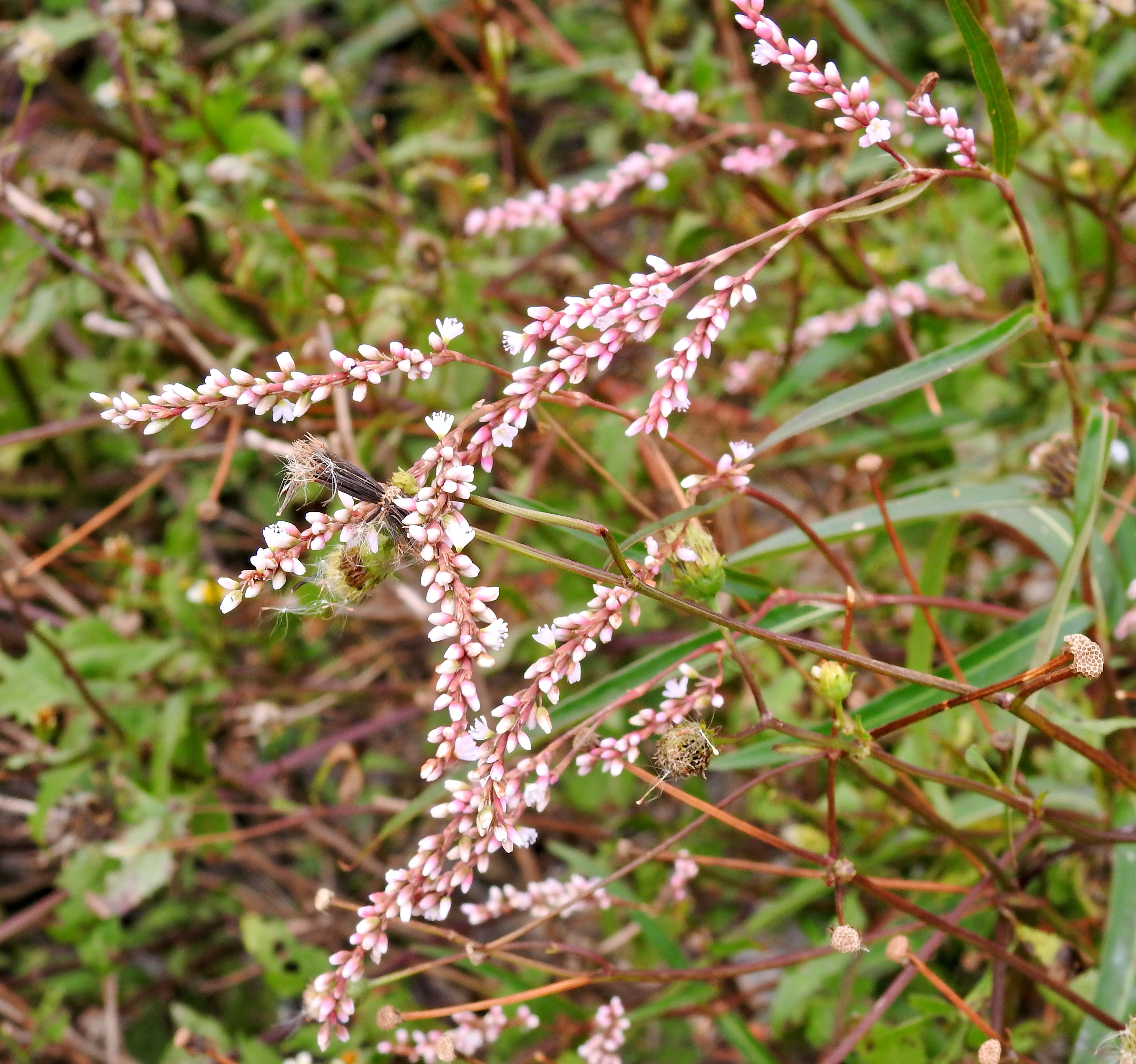
1-11-2023 ULLAL DE BALDOVI, VALENCIA - SLENDER KNOTWEED (Persicaria decipiens)
Persicaria decipiens, commonly known as slender knotweed, is a species of flowering plant native to Australia and Asia.
Persicaria decipiens is a trailing plant whose stems grow horizontally at first but become more vertical with time, reaching 30 cm (1 ft) high. Its narrow elliptic to lanceolate (spear-shaped) leaves are 5–12 cm (2–4.5 in) long and 0.5–1.3 cm (0.20–0.51 in) across. The slender pink flower spikes appear from November to June, with a peak in February. Cylindrical in shape, they are not stiff and tend to bend over. The plant tends to die back in winter and regenerate after water.[3]
Persicaria decipiens was among the plants collected by Joseph Banks and Daniel Solander on 5 May 1770 at Botany Bay during the first voyage of Captain James Cook. Prolific Scottish botanist Robert Brown described the species as Polygonum decipiens in his 1810 work Prodromus Florae Novae Hollandiae et Insulae Van Diemen. It was given its current name by Karen Wilson in 1988 as the broadly defined genus Polygonum was split into smaller genera. Common names include slender knotweed, willow weed and snake root.
P. decipiens is found in water and wet soil. It is found across Africa and the Mediterranean, through southwestern Asia, Malesia and all states of Australia, as well as Norfolk Island, New Zealand and New Caledonia. It has become naturalised in Madagascar.
1-11-2023 SOLLANA, VALENCIA - EURASIAN KESTREL (Falco tinnunculus)
Falco tinnunculus - Common Kestrel
1-11-2023 LAGUNA DE SILLA, VALENCIA - LITTLE EGRET (Egretta garzetta)
The breeding range of the western race (E. g. garzetta) includes southern Europe, the Middle East, much of Africa and southern Asia. Northern European populations are migratory, mostly travelling to Africa although some remain in southern Europe, while some Asian populations migrate to the Philippines. The eastern race, (E. g. nigripes), is resident in Indonesia and New Guinea, while E. g. immaculata inhabits Australia and New Zealand, but does not breed in the latter. During the late twentieth century, the range of the little egret expanded northwards in Europe and into the New World, where a breeding population was established on Barbados in 1994. The birds have since spread elsewhere in the Caribbean region and on the Atlantic coast of the United States.
The little egret's habitat varies widely, and includes the shores of lakes, rivers, canals, ponds, lagoons, marshes and flooded land, the bird preferring open locations to dense cover. On the coast it inhabits mangrove areas, swamps, mudflats, sandy beaches and reefs. Rice fields are an important habitat in Italy, and coastal and mangrove areas are important in Africa. The bird often moves about among cattle or other hoofed mammals.
1-11-2023 LAGUNA DE SILLA, VALENCIA - BLUETHROAT (MALE) (Luscinia svecica)
The bluethroat (Luscinia svecica) is a small passerine bird that was formerly classed as a member of the thrush family Turdidae, but is now more generally considered to be an Old World flycatcher, Muscicapidae. It, and similar small European species, are often called chats.
It is a migratory insectivorous species breeding in wet birch wood or bushy swamp in Europe and across the Palearctic with a foothold in western Alaska. It nests in tussocks or low in dense bushes. It winters in the Iberian Peninsular, the northern half of Africa, and in southern Asia (among others including the Indian subcontinent).
The bluethroat bird is similar in size to the European robin at 13–14 cm. It is plain brown above except for the distinctive black tail with red side patches. It has a strong white supercilium. Despite the distinctive appearance of the males, recent genetic studies show only limited variation between the forms, and confirm that this is a single species. Moults begins in July after breeding and are completed in 40–45 days, before the birds migrate.
The male has a varied and very imitative song. Its call is a typical chat chack noise.
Tuesday, 31 October 2023
1-11-2023 MONTE CORONA, VALENCIA - PUG MOTH (Eupithecia oxycedrata)
Eupithecia oxycedrata is a species of moth in the family Geometridae. It is found in Spain, southern Portugal, the Balearic Islands, southern France, Corsica, Sardinia, Sicily, Malta, Italy, Slovenia, Croatia, Bosnia and Herzegovina, Montenegro, North Macedonia, Bulgaria, Greece, Crete, western Romania and the Crimea. It is also found in North Africa, from Morocco to Tunisia, and in Turkey. The habitat consists of dry maquis, especially where junipers grow.
The wingspan is 16-19.5 mm. There are two generations per year, with adults on wing from early April to late June and again from early September to mid October.
The larvae feed on the needles and flowers of Juniperus oxycedrus.
Monday, 30 October 2023
30-10-2023 ADOR CAMPO, VALENCIA - EPAULET SKIMMER DRAGONFLY (MALE) (Orthetrum chrysostigma)
Very widespread and occurs virtually throughout Africa, including North Africa. It also occurs in parts of Southern Europe and the Middle East. In South Africa it occurs virtually throughout, but is scarce in the dry central regions.
The Epaulet Skimmer is a southern European and African dragonfly. A little similar to the Keeled Skimmer of the UK, it has a narrow elongated body with central raised "keel". Above is the attractive pale blue male with turquoise eyes, but the "epaulet" marking on the thorax that gives it its name is not often clear and darkens with age.
30-10-2023 ADOR CAMPO, VALENCIA - EPAULET SKIMMER DRAGONFLY (MALE AND FEMALE) (Orthetrum chrysostigma)
Orthetrum chrysostigma, the epaulet skimmer, is a species of dragonfly in the family Libellulidae. It is found in Algeria, Angola, Benin, Botswana, Burkina Faso, Cameroon, Central African Republic, Chad, the Democratic Republic of the Congo, Ivory Coast, Egypt, Equatorial Guinea, Ethiopia, Gambia, Ghana, Guinea, Kenya, Liberia, Libya, Malawi, Mali, Mauritania, Morocco, Mozambique, Namibia, Niger, Nigeria, Senegal, Sierra Leone, Somalia, South Africa, Sudan, Tanzania, Togo, Uganda, Zambia, Zimbabwe, and possibly Burundi as well as Canary Islands, Israel, and Portugal. It was recorded in the Maltese Islands in 2010. One was also spotted in Tel Aviv, Israel in August 2022.
Its natural habitats are subtropical or tropical moist lowland forests, dry savanna, moist savanna, subtropical or tropical dry shrubland, subtropical or tropical moist shrubland, rivers, intermittent rivers, shrub-dominated wetlands, swamps, freshwater lakes, intermittent freshwater lakes, freshwater marshes, intermittent freshwater marshes, and freshwater springs. The adults prey on various flying insects. The bodies of adult males are blue, and those of young and females are yellow and brown.
30-10-2023 ADOR CAMPO, VALENCIA - PLAIN TIGER BUTTERFLY (Danaus chrysippus)
Danaus chrysippus, also known as the plain tiger, African queen, or African monarch, is a medium-sized butterfly widespread in Asia, Australia and Africa. It belongs to the Danainae subfamily of the brush-footed butterfly family Nymphalidae. Danainae primarily consume plants in the genus Asclepias, more commonly called milkweed. Milkweed contains toxic compounds, cardenolides, which are often consumed and stored by many butterflies. Because of their emetic properties, the plain tiger is unpalatable to most predators. As a result, its coloration is widely mimicked by other species of butterflies. The plain tiger inhabits a wide variety of habitats, although it is less likely to thrive in jungle-like conditions and is most often found in drier, wide-open areas.
D. chrysippus encompasses three main subspecies: D. c. alcippus, D. c. chrysippus, and D. c. orientis. These subspecies are found concentrated in specific regions within the larger range of the entire species.
The plain tiger is believed to be one of the first butterflies depicted in art. A 3,500-year-old ancient Egyptian fresco in Luxor features the oldest known illustration of this species.
30-10-2023 ADOR CAMPO, VALENCIA - MEDITERRANEAN BROCADE MOTH CATERPILLAR (Spodoptera littoralis)
Larvae body length ranges from 40 to 45 mm. The larvae is usually hairless and varies in color. It has been noted that new born larvae has grayish or dark-green body color whereas the developed larvae has brownish or yellowish body color. Dark and light longitudinal bands along with two dark semi-circular spots on the back are noted characteristics of the larvae. The newly hatched larvae up to third-instar mainly feed on the lower side of the leaves but the later instar larvae feed on both sides. S. littoralis larvae in general are known to feed in the dark. It also has been observed that larvae up to their third and fourth-instar usually remain in their host plant but fifth and sixth-instar larvae leave the host plant during the day and climb back up at night.
The pupa is around 20 mm long and cylindrical in shape. Initially, the pupa is green colored with reddish abdomen but it turns reddish-brown within few hours. Pupation usually occurs 3–5 cm deep in the solid ground under soil. The duration of pupation is around 5–6 hours
30-10-2023 POTRIES, VALENCIA - GREY WAGTAIL (Motacilla cinerea)
The grey wagtail (Motacilla cinerea) is a member of the wagtail family, Motacillidae, measuring around 18–19 cm overall length. The species looks somewhat similar to the yellow wagtail but has the yellow on its underside restricted to the throat and vent. Breeding males have a black throat. The species is widely distributed, with several populations breeding in Eurosiberia and migrating to tropical regions in Asia and Africa. The species is always associated with running water when breeding, although they may use man-made structures near streams for the nest. Outside the breeding season, they may also be seen around lakes, coasts and other watery habitats. Like other wagtails, they frequently wag their tail and fly low with undulations and they have a sharp call that is often given in flight.
30-10-2023 ADOR CAMPO, VALENCIA - HORSESHOE WHIP SNAKE (Hemorrhois hippocrepis)
The horseshoe whip snake (Hemorrhois hippocrepis) is a species of snake in the family Colubridae . The species is native to southwestern Europe and northern Africa.
Adults of H. hippocrepis may attain a total length (including tail) of 1.5 m (5 feet). Its body is slender, and its head is wider than its neck. The eye is large, with a round pupil, and with a row of small scales below it. The smooth dorsal scales are arranged in 25-29 rows, and the ventrals number 220–258. Dorsally, it has a series of large spots which are either blackish or dark brown edged with black. There is a series of alternating smaller dark spots on each side. The lighter ground color between the spots may be yellowish, olive, or reddish.
The dark spots are closely spaced, giving the appearance of a dark snake with a light pattern resembling a chain or a series of X's. There is a light horseshoe-shaped mark on the neck and back of head.
H. hippocrepis is found in Algeria, Morocco and Tunisia in North Africa, and in southern and central Portugal, southern, eastern and central Spain, Gibraltar, southern Sardinia and Pantelleria Island in Europe. In the island locations, it may have been introduced. Since the early 2000s it has been reported from Balearic Islands of Mallorca, Ibiza and Formentera. It could have been introduced there by way of old olive trees imported from mainland Spain. The species is thriving there and becomes larger than on the mainland.
The natural habitats of H. hippocrepis are Mediterranean-type shrubby vegetation, rocky areas, rocky shores, sandy shores, arable land, pastureland, plantations, rural gardens, and urban areas.
H. hippocrepis is oviparous.
Sunday, 29 October 2023
29-10-2023 POTRIES, VALENCIA - CLOUDED YELLOW BUTTERFLY (Colias croceus)
The beautiful clouded yellow butterfly is a migratory large yellow butterfly species most often seen in the UK in late summer and autumn.
The clouded yellow butterfly (Colias croceus) is a migrant species in the UK. Unable to survive the winter here, each spring it flies north from its breeding areas near the Mediterranean. In some years large numbers reach our shores, in others it can be completely absent.
Being a long-distance migrant, the clouded yellow has a strong flight. This large yellow butterfly might get mistaken for one of our other yellow British butterfly species, such as the brimstone, or even a white. When the clouded yellow is in flight we get a glimpse of the orange-yellow upperwing with its broad black margin but at rest it invariably closes its wings so we can see only its underside. Underneath the clouded yellow is deep yellow with a pair of silvery spots in the centre of the hindwing and a dark spot in the centre of the forewing.
Although a migrant, the clouded yellow does breed in the UK during the summer. Early migrants arrive in May and June, their young combined with later migrants can boost numbers significantly during August and a further brood can be seen on the wing during September and October.
29-10-2023 POTRIES, VALENCIA - PAINTED LADY BUTTERFLY (Vanessa cardui)
The Painted Lady butterfly and other insects are part of a class of invertebrates within the phylum Euarthropoda, including arachnids, myriapods, and crustaceans. Arthropods have an exoskeleton, segmented bodies, and jointed appendages.
The Painted Lady butterflies are one of the brush-footed butterflies (family Nymphalidae), also called four-footed butterflies. They have a five to nine-centimeter wingspan and live for about two to four weeks.
Painted Lady butterflies are found on every continent in the world except Antarctica and Australia.
In the wild, the females lay about 500 eggs in their short 2-4-week lifespan. To put that in perspective, the best laying chicken breeds can only lay about 5-6 eggs per week. Ok, they’re fundamentally different species, but 500 butterfly eggs are still impressive for the lovely little lady.
During migration, the Painted Lady species travels a phenomenal 9,000-mile round trip from tropical Africa to the Arctic Circle! 1 Sorry North American Monarchs, that's almost double the distance of your significant migration.
We think of a cuticle as something on our fingers and toes, but that word refers to the skin (exoskeleton) on caterpillars. The exoskeleton is made of a biomaterial called chitin (fact #9 below explains the cool way chitin also affects butterfly wings). Chitin is one of the most important biopolymers in nature.2 It's the same biomaterial that lobsters, crabs, and other arthropods use in their hard exoskeletons. Strong hydrogen bonds between the chitin chains give chitin exceptional toughness, protecting the caterpillar’s soft insides until it goes through metamorphosis. Or in the case of the lobster, protecting its succulent flesh until it turns into our buttery, gourmet dinner! Being that tough means that chitin doesn't stretch with growth, so caterpillars and other arthropods periodically shed their exoskeletons, i.e., they molt.
The larval stage of the Painted Lady butterfly is about 5 to 10 days. The caterpillars will eat and eat and eat; after all, how else are they going to turn into gorge-ous butterflies? Caterpillars can consume 200X their birth weight in less than two weeks. They will increase their body mass by as much as 1,000 times or more during this stage. Imagine a seven-pound newborn child consuming 1400 pounds of formula in two weeks.3 As the caterpillar grows, its skin gets too tight, triggering a hormone (ecdysone) that regulates the molting process. A caterpillar changes its skin about four times before it's fully grown and ready to go into the chrysalis stage. And, no surprise, the voracious caterpillar doesn't just shed that skin; it digests and reabsorbs most of it. What an appetite!
Like spiders, caterpillars produce silk through a "spinneret." This tube-like structure is located on the lower side of the caterpillar's mouth. The caterpillar excretes liquid silk from its salivary glands then through the spinneret. When the liquid hits the air, it turns into a solid silk strand. Silk is one of the strongest natural fibers – it's said that pound for pound, silk is stronger than steel. Although, the spider's silk is stronger than not just steel, but also Kevlar! 4 If you have a butterfly habitat, you can observe them attach to the roof before forming a chrysalis. The caterpillar uses silk from its spinneret to secure itself and build its chrysalis.
Butterflies use complex structures called photonic crystals to scatter light and create that distinctive iridescent look.5 Scientists used powerful X-rays at the Advanced Photon Source at Argonne to get a unique look at the structure of the tiny crystals that make up butterflies' wings. The results show us how the wings get their iridescent, brilliant colors. "We also found tiny crystal irregularities that may enhance light-scattering properties, making the butterfly wings appear brighter." These "defects" grow as a result of the chirality —the left or right-handedness—of the chitin molecules from which butterfly wings are formed," said co-author Ian McNulty, an X-ray physicist with the Center for Nanoscale Materials at Argonne.
29-10-2023 PEGO MARJAL, ALICANTE - EUROPEAN STONECHAT (MALE) (Saxicola rubicola)
The European stonechat (Saxicola rubicola) is a small passerine bird that was formerly classed as a subspecies of the common stonechat. Long considered a member of the thrush family, Turdidae, genetic evidence has placed it and its relatives in the Old World flycatcher family, Muscicapidae.
The stonechat is 11.5–13 cm long and weighs 13–17 g, slightly smaller than the European robin. Both sexes have distinctively short wings, shorter than those of the more migratory whinchat and Siberian stonechat. The summer male has black upperparts, a black head, an orange throat and breast, and a white belly and vent. It also has a white half-collar on the sides of its neck, a small white scapular patch on the wings, and a very small white patch on the rump often streaked with black. The female has brown upperparts and head, and no white neck patches, rump or belly, these areas being streaked dark brown on paler brown, the only white being the scapular patch on the wings and even this often being buffy-white.
29-10-2023 CANAL LES FONTS OLIVA, VALENCIA - LITTLE EGRET (Egretta garzetta)
The little egret (Egretta garzetta) is a species of small heron in the family Ardeidae. The genus name comes from the Provençal French Aigrette, "egret", a diminutive of Aigron," heron". The species epithet garzetta is from the Italian name for this bird, garzetta or sgarzetta.
It is a white bird with a slender black beak, long black legs and, in the western race, yellow feet. As an aquatic bird, it feeds in shallow water and on land, consuming a variety of small creatures. It breeds colonially, often with other species of water birds, making a platform nest of sticks in a tree, bush or reed bed. A clutch of three to five bluish-green eggs is laid and incubated by both parents for about three weeks. The young fledge at about six weeks of age.
Its breeding distribution is in wetlands in warm temperate to tropical parts of Europe, Africa, Asia, and Australia. A successful colonist, its range has gradually expanded north, with stable and self-sustaining populations now present in the United Kingdom.
In warmer locations, most birds are permanent residents; northern populations, including many European birds, migrate to Africa and southern Asia to over-winter there. The birds may also wander north in late summer after the breeding season, and their tendency to disperse may have assisted in the recent expansion of the bird's range. At one time common in Western Europe, it was hunted extensively in the 19th century to provide plumes for the decoration of hats and became locally extinct in northwestern Europe and scarce in the south. Around 1950, conservation laws were introduced in southern Europe to protect the species and their numbers began to increase. By the beginning of the 21st century the bird was breeding again in France, the Netherlands, Ireland and Britain. Its range is continuing to expand westward, and the species has begun to colonise the New World; it was first seen in Barbados in 1954 and first bred there in 1994. The International Union for Conservation of Nature has assessed the bird's global conservation status as being of "least concern".


%201.jpg)


%201.jpg)
%202.jpg)
%202.jpg)


%201.jpg)
%202.jpg)
%203.jpg)
%204.jpg)


%202.jpg)
%203.jpg)
%201.jpg)
%201.jpg)


%201.jpg)
