TOTAL PAGEVIEWS

TRANSLATE

Saturday, 6 January 2024

31-12-2023 ATLANTIC BLV, GAMBIA - OLIVE NAPED WEAVER (Ploceus brachypterus)

The olive-naped weaver (Ploceus brachypterus) is a bird species in the family Ploceidae. It is found in West Africa from Senegal and Gambia to Cameroon.

The olive-naped weaver was formally described and illustrated in 1837 by the English naturalist William John Swainson. He did not specify the origin of his specimens but they probably came from Senegal. He placed the species in the genus Ploceus and coined the binomial name Ploceus brachypterus. The specific epithet is from Ancient Greek brakhupteros meaning "short-winged".

The olive-naped weaver was formerly considered to be a subspecies of the black-necked weaver (Ploceus nigricollis). The two species differ in plumage and in the colour of the iris, but a molecular study published in 2019 found that they are genetically very similar.


The olive-naped weaver is a medium-sized bird found in West Africa with an olive-green back and nape and a slender black mask through the eye. Males have a black throat and cinnamon-brown face, while females lack the throat patch and have a prominent yellow supercilium. They inhabit various wooded areas like savannas, forests, and mangroves, and usually live alone or in pairs. Their diet consists of seeds, fruits, and insects, and they are not highly social when breeding, typically nesting solitarily. 

Identification
Size: Medium-sized weaver bird.
Color: Olive-green back and nape; pale eyes.
Mask: Slender black mask that runs through the eye.
Male: Has a black throat and a cinnamon-brown blush around the face.
Female: Lacks the black throat patch; has a prominent yellow supercilium (eyebrow) and a longer eyestripe. 


Habitat and distribution
Range: Found in West Africa, from Senegal and Gambia to Cameroon.
Habitats: Woodland, thick scrub, moist savanna, gallery forest, forest clearings, farmbush, well-wooded gardens, and plantations. 

Diet
Primary food: Seeds and small fruits from trees and shrubs.
Other food: Insects, particularly in warmer months.
Foraging: Feeds on both winged insects and forages for fruit on the ground. 
Behavior and breeding

Social: Usually seen alone or in pairs.
Nesting: Unlike many other weavers, they are not highly social when breeding and typically nest solitarily, or only in small, loosely packed colonies.
Nests: Males build the nests to attract females, using plant fibers or twigs. They may reuse the same nesting site in consecutive seasons. 
Vocalizations
Typical weaver calls include "chet" notes and a "sizzling, radio static" song. 

31-12-2023 FAJARA, GAMBIA - VILLAGE INDIGOBIRD (Vidua chalybeata)

The village indigobird (Vidua chalybeata), also known as the steelblue widowfinch or (in U.S. aviculture) the Combassou finch, is a small songbird belonging to the family Viduidae. It is distinguishable from other indigobird species by bill and leg colours, the colour tinge of the male's breeding plumage, song, and to lesser extent, the nestling's plumage and mouth pattern. The bill colour can be red or white depending on the population, and there is some regional variation in the colour tone of the male's plumage.

It is a resident breeding bird in most of Africa south of the Sahara Desert. This indigobird is found in many open habitats including open woodland, scrub and cultivation, but, as its name implies, it is most readily seen near villages.

It is a brood parasite which lays its eggs in the nests of red-billed firefinches. Unlike the common cuckoo, it does not destroy the host's egg. Typically, 2-4 eggs are added to those already present. The eggs of both the host and the firefinch are white, although the indigobird's are slightly larger. The nestling indigobirds mimic the unique gape pattern of the fledglings of the host species.


31-12-2023 ATLANTIC BLV, GAMBIA - PIED CROW (Corvus albus)


 This species, Africa's most widespread member of the genus Corvus, occurs from sub-Saharan Africa, specifically Nigeria, Ghana, Senegal, Sudan, Somalia, Eritrea, Zambia, Botswana, Mozambique and Zimbabwe, south to the Cape of Good Hope and on the large island of Madagascar, the Comoros Islands, Aldabra, Assumption Island, Cosmoledo, Astove Island, Zanzibar, Pemba, and Fernando Po. It inhabits mainly open country with villages and towns nearby. It does not occur in the equatorial rainforest region. It is rarely seen very far from human habitation, though it is not as tied to the urban way of life as the house crow (Corvus splendens) of Asia, and may be encountered far from human habitation in Eritrea.

31-12-2023 ATLANTIC BLV, GAMBIA - VINACEOUS DOVE (Streptopelia vinacea)

The vinaceous dove (Streptopelia vinacea) is a bird species in the pigeon family Columbidae that widely resident across the Sahel and Sudan (region).

The vinaceous dove is a small, stocky pigeon, typically 25cm in length. Its back, wings, and tail are pale brown. When flying, it shows a blackish underwing. The head and the underparts are pale pinkish-grey, and it has a black hind-neck patch edged with white. The legs are red, with white in the tail. Sexes are similar, but juveniles are duller than adults. The call is a fast coo-cu-cu-coo.

The vinaceous dove is a common bird that is found in central and western African countries such as Senegal, Gambia, Burkina Faso, Benin, and Nigeria.

This species is abundant in scrub and savannah. It builds a stick nest in a tree, often an acacia, and lays two white eggs. Its flight is quick, with the regular beats and an occasional sharp flick of the wings is characteristic of pigeons in general. Vinaceous doves eat grass seeds, grains, and other vegetation. They are quite terrestrial, and usually forage on the ground. Unlike several other species in this genus, they are very gregarious and often feed in large group, frequently with other doves.


31-12-2023 NGALA LODGE, GAMBIA - YELLOW BILLED KITE (Milvus migrans ssp. parasitus)

The Yellow-billed Kite is found throughout much of sub-Saharan Africa, in nearly all types of habitats including forests, wetlands, savannas, and to a lesser extent, arid environments.

The yellow-billed kite is the Afrotropic counterpart of the black kite, of which it is most often considered a subspecies. However, DNA studies suggest that the yellow-billed kite differs significantly from black kites in the Eurasian clade, and should be considered as a separate, allopatric species.


They migrate annually to central-east Africa for winter. See how small their feet are? Although they appear large, they only hunt prey like rodents, frogs and insects, but will also spend much of the day on the wing scavenging. 

31-12-2023 BAKAU, GAMBIA - HOODED VULTURE (Necrosyrtes monachus)


 The hooded vulture (Necrosyrtes monachus) is an Old World vulture in the order Accipitriformes, which also includes eagles, kites, buzzards and hawks. It is the only member of the genus Necrosyrtes, which is sister to the larger Gyps genus, both of which are a part of the Aegypiinae subfamily of Old World vultures. It is native to sub-Saharan Africa, where it has a widespread distribution with populations in southern, East and West Africa. It is a scruffy-looking, small vulture with dark brown plumage, a long thin bill, bare crown, face and fore-neck, and a downy nape and hind-neck. Its face is usually a light red colour. It typically scavenges on carcasses of wildlife and domestic animals. Although it remains a common species with a stable population in the lower region of Casamance, some areas of The Gambia, and Guinea-Bissau, other regions such as Dakar, Senegal, show more than 85% losses in population over the last 50 years. Threats include poisoning, hunting, loss of habitat and collisions with electricity infrastructure, and the International Union for Conservation of Nature has rated its conservation status as "critically endangered" in their latest assessment (2022). The highest current regional density of hooded vultures is in the western region of The Gambia.


1-1-2024 BAKAU, GAMBIA - LONG TAILED GLOSSY STARLING (Lamprotornis caudatus)


The long-tailed glossy starling (Lamprotornis caudatus) is a member of the starling family of birds. It is a resident breeder in tropical Africa from Senegal east to Sudan.

This common passerine is typically found in open woodland and cultivation. The long-tailed glossy starling builds a nest in a hole. The normal clutch is two to four eggs.

This ubiquitous bird is gregarious and noisy, with a harsh grating call.

The adults of these 54 cm (21 in) long birds have metallic green upperparts, violet underparts and a 34 cm (13 in) long purple tail. The face is black with a yellow eye. The sexes are similar, but juveniles are duller, with a brownish tone to the plumage.


Friday, 5 January 2024

1-1-2024 NGALA LODGE, GAMBIA - SPECKLED PIGEON (Columba guinea)

Speckled Pigeon is endemic to Africa.

Adult has blue-grey upperparts, and maroon mantle with light purplish reflections. On the wings, inner wing-coverts and tertials are maroon, slightly marked with grey. Outer wing-coverts are grey. We can see large part of wings boldly tipped with numerous white triangles, becoming narrow white fringe on outer greater coverts. Flight feathers are dull grey-brown.

Back to rump is pale grey, ending into darker grey uppertail coverts. All feathers show pale grey tips. Tail Is dark grey with broad black terminal band.

Speckled Pigeon feeds mainly on seeds and cultivated grains. 

1-1-2024 NGALA LODGE, GAMBIA - RAINBOW AGAMA (Agama agama)

The Rainbow Agama or Red-headed Rock Agama is one of the most colorful reptiles. The species is distributed over most of Sub-Sahara Africa. Males are territorial and defend a relatively small patch of rock aggressively against any intruder. The conservation status of Agama agama, which is also often for sale and kept in private terrariums, is not yet defined by IUCN.


1-1-2024 NGALA LODGE, GAMBIA - YELLOW BILLED KITE (Milvus migrans ssp. parasitus)

The yellow-billed kite (Milvus aegyptius ) is the Afrotropic counterpart of the black kite (Milvus migrans ), of which it is most often considered a subspecies. However, recent DNA studies suggest that the yellow-billed kite differs significantly from black kites in the Eurasian clade, and should be considered as a separate, allopatric species.

There are two subspecies: M. a. parasitus, found throughout most of sub-Saharan Africa (including Madagascar), except for the Congo Basin (with intra-African migrations) and M. a. aegyptius of Egypt, south-west Arabia and the Horn of Africa (which disperses south during the non-breeding season).


2-1-2024 LAMIN RICE FIELDS, GAMBIA - GIANT KINGFISHER (Megaceryle maxima ssp maxima)


The Giant kingfisher is Africa’s largest species of kingfisher. It has a large crest and a big straight black beak. Most of its body is covered with black feathers that are tipped with white spots. A male has an orange breast and its belly is white with some black spots. A female’s breast is black and white spotted and the belly is orange, and the difference between them can be remembered by thinking of a male as wearing an orange shirt and a female wearing an orange skirt.

3-1-2024 BAKAU, GAMBIA - SPLENDID STARLING (Lamprotornis splendidus)


The splendid starling (Lamprotornis splendidus), also known as the splendid glossy-starling, is a species of starling in the family Sturnidae.

It is found in Angola, Benin, Botswana, Burundi, Cameroon, the Central African Republic, the Republic of the Congo, the Democratic Republic of the Congo, Equatorial Guinea, Ethiopia, Gabon, Gambia, Ghana, Guinea, Guinea-Bissau, Kenya, Liberia, Mali, Niger, Nigeria, Rwanda, São Tomé and Príncipe, Senegal, Sierra Leone, South Sudan, Tanzania, Togo, Uganda, and Zambia — and is introduced in Belgium. 

3-1-2024 BAKAU, GAMBIA - LAUGHING DOVE (Streptopelia senegalensis)

The laughing dove (Spilopelia senegalensis) is a small pigeon that is a resident breeder in Africa, the Middle East, South Asia, and Western Australia where it has established itself in the wild after being released from Perth Zoo in 1898. This small long-tailed dove is found in dry scrub and semi-desert habitats where pairs can often be seen feeding on the ground. It is closely related to the spotted dove (Spilopelia chinensis) which is distinguished by a white and black chequered necklace. Other names include laughing turtle dove, palm dove and Senegal dove while in Asia the name little brown dove is often used.

3-1-2024 BAKAU, GAMBIA - WESTERN GREY PLANTAIN EATER (Crinifer piscatore)


The western plantain-eater (Crinifer piscator), also known as the gray plantain-eater or western gray plantain-eater, is a large member of the turaco family, a group of large arboreal near-passerine birds restricted to Africa.

This species is a resident breeder in open woodland habitats in tropical west Africa. It lays two or three eggs in a tree platform nest.

These are common, noisy and conspicuous birds, despite lacking the brilliant colours of relatives such as the violet turaco. They are 50 cm long, including a long tail. Their plumage is mainly gray above spotted with brown. The head, erectile crest, neck and breast are brown streaked with silver. The underparts are whitish, heavily streaked with brown.

3-1-2024 BAKAU, GAMBIA - CORAL VINE (Antigonon leptopus)


 Antigonon leptopus is a species of perennial vine in the buckwheat family commonly known as coral vine or queen's wreath. This clambering vine is characterized by showy, usually pink flowers that can bloom throughout the year and large, heart-shaped leaves. A. leptopus is native to the Pacific and Atlantic coastal plains of Mexico, but also occurs as a roadside weed from Mexico south to Central America.  It is widely introduced and invasive throughout tropical regions of the world, including in the south and eastern United States, the West Indies, South America, and the Old World tropics of Asia and Africa. This species is utilized for its edible tubers and seeds, but also for its horticultural properties as an ornamental vine in warmer parts of the world.

2-1-2024 BAKAU, GAMBIA - WESTERN RED BILLED HORNBILL (Tockus kempi)

The western red-billed hornbill (Tockus kempi) is a species of hornbill in the family Bucerotidae. It is found from Senegal and Gambia to southern Mauritania and western Mali. There are five species of red-billed hornbills generally recognized now, but all five were once considered conspecific. Some authorities still categorize the group as Tockus erythrorhynchus with the remaining four as its subspecies.

Western red-billed hornbills are small hornbills in the genus Tockus. They have curved red beaks which are more orange on the lower beak and more bright red on the upper beak, with both ending with a dark orange colour. Their heads are greyish white and have black feathers along the back of their heads and neck. They have white plumage on their faces and large dark grey eye rings. Their sclera is dark brown and their pupils are black. Their wings are like all red-billed hornbills, with large and small circles of white feathers surrounded by black feathers on the exterior and white on the upper half of the interior and black on the lower half of the interior. They have long tail feathers that are black on the exterior and a greyish white on the interior.

2-1-2024 CALYPSO BAR, GAMBIA - BROAD BILLED ROLLER (Eurystomus glaucurus)

The broad-billed roller (Eurystomus glaucurus) is a member of the roller family of birds which breeds across tropical Africa and Madagascar in all but the driest regions. It is a wet season breeder, which migrates from the northern and southern areas of its range towards the moister equatorial belt in the dry season.

The broad-billed roller is 29–30 cm in length. It has a warm back and head, lilac foreneck and breast, with the rest of the plumage mainly brown. The broad bill is bright yellow. Sexes are similar, but the juvenile is a drabber version of the adult, with a pale breast. The broad-billed roller is striking in its strong direct flight, with the brilliant blues of the wings and tail contrasting with the brown back. The call of the broad-billed roller is a snarling k-k-k-k-k-r-r-r-r-r sound.

This is a species of open woodland with some tall trees, preferably near water. These rollers often perch prominently on trees, posts or overhead wires, like giant shrikes.

They are inactive for most of the day, apart from chasing intruders, but in late afternoon they hunt for the swarming ants and termites on which they feed, sometimes in groups of 100 or more rollers. They drink like swallows, dipping their bills into water in flight.


This bird nests in an unlined hole in a tree cavity, laying 2-3 eggs.

The Broad-billed Roller is monogamous unless its mate dies. In the event of a partner dying Eurystomus glaucurus will seek out a new mate

The nesting habit of Broad-billed Roller is to create the nest in a hole in a tree trunk. The bird lays eggs which are white in colour and number between 2 to 4

The preferred habitats for Broad-billed Roller are: forests and heavily treed regions

You will normally see the Broad-billed Roller by itself rather than in the company of birds of the same species.

3-1-2024 BAKAU, GAMBIA - HOODED VULTURE (Necrosyrtes monachus)

The hooded vulture, Necrosyrtes monachus, is one of the smallest of the Old World vultures. The species gets its common name from the cream-colored hood, formed from a patch of downy feathers, along the back of its neck to the crown of its head.

The small vulture is scruffy-looking and has a rather short, rounded tail. The male and female vultures appear similar, while females have longer eyelashes than males. Juveniles are similar in appearance to adults, only darker and plainer in color with a purple sheen.

The vulture’s face is usually pinkish-white in color, though it can flush red when agitated. It has dark brown plumage with a feathered nape and hind-neck. The hooded vulture’s long thin black bill leads into its bare face, crown, and foreneck.


Soaring above savannah and human settlements, the hooded vulture typically scavenges on carcasses from wildlife or domesticated animals. They also feed on grasshoppers, grubs, and locusts and congregate during the seasonal emergence of insects.

The hooded vulture feeds at low tide on mussels, lobsters, mollusks, and dead fish along the coast. When limited food is available, the species can go without food for several days by not excreting and in turn slowing down its metabolism. 

Thursday, 4 January 2024

3-1-2024 BAKAU, GAMBIA - PLAIN TIGER BUTTERFLY (Danaus chrysippus)


Clearly a relative of the well known monarch, D. plexippus, this species is slightly smaller. Rather more widespread but very scarce in coastal areas of the Mediterranean from Spain to Greece. It has a world wide distribution.

There is almost no variation recorded across its vast worldwide range. There are exceptions in a few places such as east Africa where additional forms are present and appear to be controlled by Mendelian genetics - why the effect is localised is not clear.

Mediterranean coasts from Spain, where it is most frequent, to Greece, but absent from large parts of the cost. North Africa in Morocco to Tunisia where it can be found well inland. Seemingly greatly reduced in the Canary Islands now. Flies at all times of the year, with a period of relative inactivity in winter.

A powerful species, roaming widely. Frequents hot dry places.

Wednesday, 3 January 2024

3-1-2024 BAKAU, GAMBIA - YELLOW BILLED KITE (Milvus migrans ssp. parasitus)


The yellow-billed kite is the Afrotropic counterpart of the black kite, of which it is most often considered a subspecies. However, DNA studies suggest that the yellow-billed kite differs significantly from black kites in the Eurasian clade, and should be considered as a separate, allopatric species. 

2-1-2024 CALYPSO BAR, GAMBIA - COMMON SANDPIPER (Actitis hypoleucos)


The common sandpiper (Actitis hypoleucos) is a small Palearctic wader. This bird and its American sister species, the spotted sandpiper (A. macularia), make up the genus Actitis. They are parapatric and replace each other geographically; stray birds of either species may settle down with breeders of the other and hybridize. Hybridization has also been reported between the common sandpiper and the green sandpiper, a basal species of the closely related shank genus Tringa.

The common sandpiper breeds across most of temperate and subtropical Europe and Asia, and migrates to Africa, southern Asia and Australia in winter. The eastern edge of its migration route passes by Palau in Micronesia, where hundreds of birds may gather for a stop-over. They depart the Palau region for their breeding quarters around the last week of April to the first week of May.

2-1-2024 CALYPSO BAR, GAMBIA - YELLOW CASQUED HORNBILL (Ceratogymna elata)


The yellow-casqued hornbill (Ceratogymna elata), also known as the yellow-casqued wattled hornbill, is found in the rainforest of coastal regions of West Africa, for example in Côte d'Ivoire. It is threatened by habitat loss.

The yellow-casqued hornbill is one of the largest birds of the West African forest, with adults weighing up to 2 kg (4.4 lb). They live mainly in the forest canopy, rarely feeding on the ground. They live in small family groups containing at least one adult male and female, with one or two immature birds, though they sometimes gather in larger flocks to exploit a major food supply such as an ant or termite nest.

The birds are occasionally preyed upon by crowned hawk-eagles, and they respond to the presence of an eagle (sometimes indicated by its characteristic shriek) by mobbing – approaching it and emitting calls. Since the eagles depend on surprise to make a catch, this frequently causes them to leave the area. Recent research (Rainey et al., 2004) has shown that the birds respond in the same way to the alarm calls that Diana monkeys, which live in the same areas, emit if they notice an eagle, and that they can distinguish the calls made by the monkeys in the presence of eagles from those they make in the presence of leopards, which prey on the monkeys but not on the hornbills.

2-1-2024 CALYPSO BAR, GAMBIA - PIED KINGFISHER (Ceryle rudis)


The pied kingfisher (Ceryle rudis) is a species of water kingfisher widely distributed across Africa and Asia. Originally described by Carl Linnaeus in 1758, it has five recognised subspecies. Its black and white plumage and crest, as well as its habit of hovering over clear lakes and rivers before diving for fish, make it distinctive. Males have a double band across the breast, while females have a single broken breast band. They are usually found in pairs or small family groups. When perched, they often bob their head and flick up their tail.


2-1-2024 LAMIN RICE FIELDS, GAMBIA - HAMERKOP (Scopus umbretta)


The hamerkop (Scopus umbretta) is a medium-sized wading bird. It is the only living species in the genus Scopus and the family Scopidae. The species and family was long thought to sit with the Ciconiiformes but is now placed with the Pelecaniformes, and its closest relatives are thought to be the pelicans and the shoebill. The shape of its head with a long bill and crest at the back is reminiscent of a hammer, which has given this species its name after the Afrikaans word for hammerhead. It is a medium-sized waterbird with brown plumage. It is found in Africa, Madagascar and Arabia, living in a wide variety of wetlands, including estuaries, lakesides, fish ponds, riverbanks, and rocky coasts. The hamerkop is a sedentary bird that often shows local movements.

The hamerkop takes a wide range of prey, mostly fish and amphibians, but shrimps, insects and rodents are taken too. Prey is usually hunted in shallow water, either by sight or touch, but the species is adaptable and will take any prey it can. The species is renowned for its enormous nests, several of which are built during the breeding season. Unusually for a wading bird the nest has an internal nesting chamber where the eggs are laid. Both parents incubate the eggs, and raise the chicks.

The species is not globally threatened and is locally abundant in Africa and Madagascar, and the International Union for Conservation of Nature (IUCN) has assessed it as being of least concern.


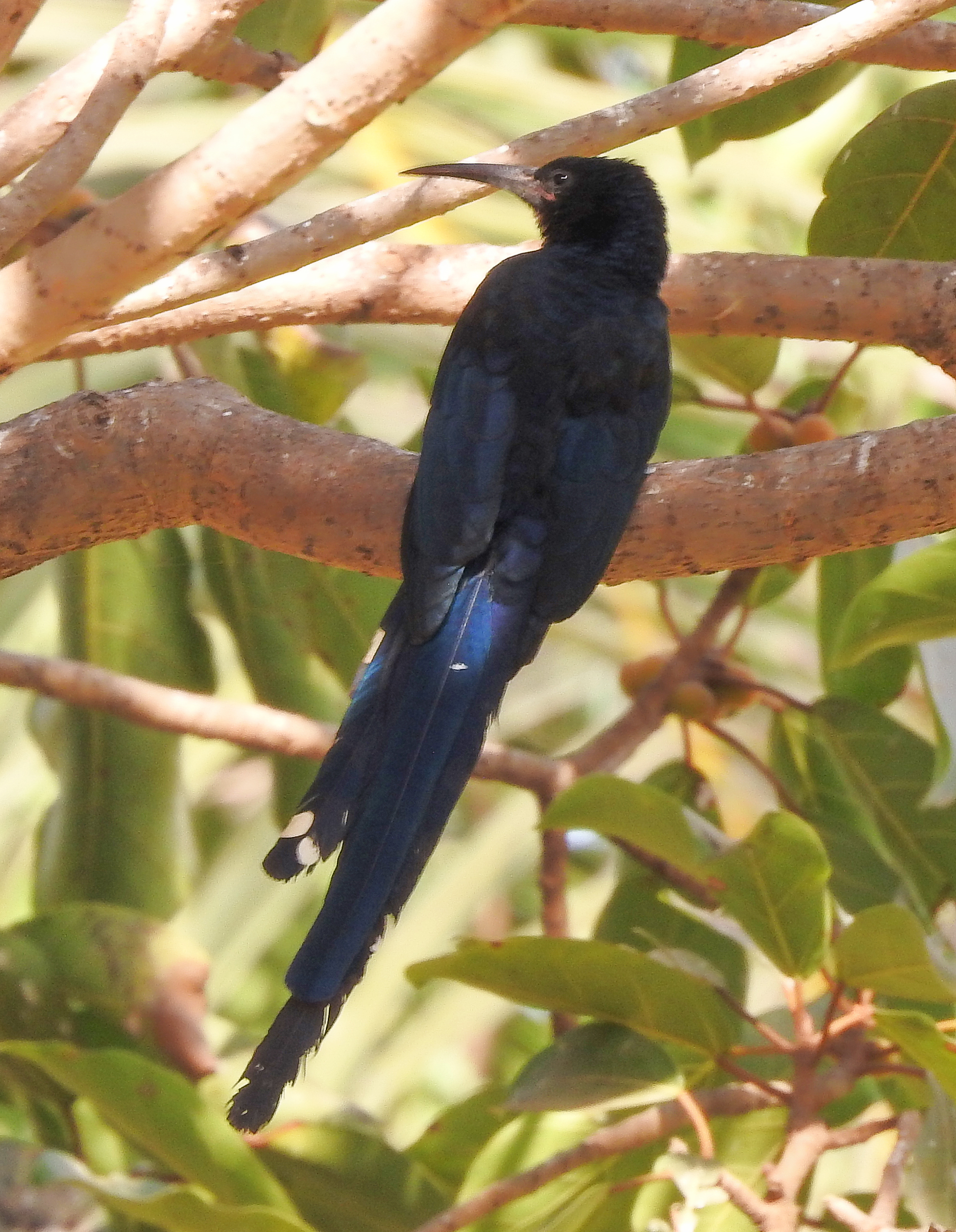
2-1-2024 LAMIN RICE FIELDS, GAMBIA - GREEN WOOD HOOPOE (Phoeniculus purpureus)


The green wood hoopoe (Phoeniculus purpureus) is a large, up to 44 cm (17 in) long tropical bird native to Africa. It is a member of the family Phoeniculidae, the wood hoopoes, and was formerly known as the red-billed wood hoopoe.

This abundant species is a metallic dark green, with a purple back and very long diamond-shaped purple tail. Distinctive white markings on the wings and white chevrons on the tail edges make it easily identifiable, as does its long, thin, curved red bill. Sexes are similar, but immatures have a black bill.

It advertises its presence with its loud kuk-uk-uk-uk-uk call and other vocalisations.


The green wood hoopoe is an insect-eating species. It feeds mainly on the ground, at termite mounds, or on tree trunks, and forms flocks outside the breeding season. Its specialised claws enable it to cling easily to the underside of branches while closely inspecting the bark for insects.

The green wood hoopoe is a cooperative breeder and common resident in the forests, woodlands and suburban gardens of most of sub-Saharan Africa. It is found in groups of up to a dozen or so birds with only one breeding pair. The breeding female lays two to four blue eggs in a natural tree hole or old barbet nest and incubates them for about 18 days. On hatching, she and the nestlings are fed by the rest of the group, even after they have fledged and left the nest hole. The group is fearless in defence of the nestlings against intruders. This species is parasitised by the greater and lesser honeyguide.