TOTAL PAGEVIEWS

TRANSLATE

Wednesday, 10 January 2024

27-12-2023 KOTU CREEK, GAMBIA - AFRICAN DARTER (Anhinga rufa)

The African darter (Anhinga rufa), sometimes called the snakebird, is a water bird of sub-Saharan Africa and Iraq.

The African darter is a member of the darter family, Anhingidae, and is closely related to American (Anhinga anhinga), Oriental (Anhinga melanogaster), and Australasian (Anhinga novaehollandiae) darters.

The African darter is 80 cm (31 in) long. Like other anhingas, it has a very long neck. The male is mainly glossy black with white streaking; females and immature birds are browner. The African darter differs in appearance from the American darter most recognisably by its thin white lateral neck stripe against a rufous background colour. The pointed bill prevents confusion with cormorants.

The African darter is found throughout sub-Saharan Africa wherever large bodies of water occur; overall the species remains widespread and common.

The only non-African subspecies, the Levant darter (Anhinga rufa chantrei), occurred at Lake Amik (Amik Gölü) in south-central Turkey, in the Hula Valley lake and marshes in northern Israel and in the Mesopotamian Marshes of the lower Euphrates and Tigris rivers in southern Iraq. The Turkish population disappeared during the 1930s and the Israeli population during the drainage of the Hula in the 1950s. In Khuzestan, 110 birds were counted in 1990, but the subspecies was feared extinct as a result of oil spills during the Gulf War and the drainage of the Mesopotamian Marshes that followed it. However, a small population was documented in the Hawizeh Marshes in 2007. The drainage of the marshes was interrupted and reversed after the Iraq War.


This species builds a stick nest in a tree and lays 3–6 eggs. It often nests with herons, egrets and cormorants.

It often swims with only the neck above water, hence the common name snakebird. This, too, is a habit shared with the other anhingas. It feeds on fish, which it catches by diving.

Unlike many other waterbirds the feathers of the African darter do not contain any oil and are therefore not waterproof. Because of this, the bird is less positively buoyant and its diving capabilities are enhanced. After diving for fish, the feathers can become waterlogged. In order to be able to fly and maintain heat insulation, it needs to dry its feathers. Thus the African darter is often seen sitting along the waterside spreading its wings and drying its feathers in the wind and the sun along with cormorants, which may share its habitat.

27-12-2023 KOTU CREEK, GAMBIA - REED (LONG TAILED) CORMORANT (Microcarbo africanus)

The reed cormorant (Microcarbo africanus), also known as the long-tailed cormorant, is a bird in the cormorant family Phalacrocoracidae. It breeds in much of Africa south of the Sahara, and Madagascar. It is resident but undertakes some seasonal movements.

This is a small cormorant, 50–55 cm (20–22 in) in overall length with a wingspan of 80–90 cm (31–35 in).[7] It is mainly black, glossed green, in the breeding season. The wing coverts are silvery. It has a longish tail, a short head crest and a red or yellow face patch. The bill is yellow.

The sexes are similar, but non-breeding adults and juveniles are browner, with a white belly. Some southern races retain the crest all year round.

This is a common and widespread species, and is not considered to be threatened. It breeds on freshwater wetlands or quiet coasts.

The reed cormorant can dive to considerable depths, but usually feeds in shallow water. It frequently brings prey to the surface. It takes a wide variety of fish. It prefers small slow-moving fish, and those with long and tapering shapes, such as mormyrids, catfishes, and cichlids. It will less frequently eat soles (which can be important in its diet locally), frogs, aquatic invertebrates, and small birds.

Two to four eggs are laid in a nest in a tree or on the ground, normally hidden from view by long grass.


Tuesday, 9 January 2024

27-12-2023 KOTU CREEK, GAMBIA - SPUR WINGED LAPWING (Vanellus spinosus)

The spur-winged lapwing or spur-winged plover (Vanellus spinosus) is a lapwing species, one of a group of largish waders in the family Charadriidae.

It is one of several species of wader supposed to be the "trochilus" bird said by Herodotus to have been involved in an unattested cleaning symbiosis with the Nile crocodile.

The spur-winged lapwing breeds around the eastern Mediterranean, and in a wide band from sub-Saharan west Africa to Arabia. The Greek and Turkish breeders are migratory, but other populations are resident. The species is declining in its northern range, but is abundant in much of tropical Africa, being seen at almost any wetland habitat in its range. The spur-winged lapwing is one of the species to which the Agreement on the Conservation of African-Eurasian Migratory Waterbirds applies.

In eastern and southern Africa the species has seen a range increase, entering Zambia for the first time in 1999 and spreading south and west.


These are conspicuous and unmistakable birds. They are medium-large waders with black crown, chest, foreneck stripe and tail. The face, the rest of the neck and belly are white and the wings and back are light brown. The bill and legs are black. Its striking appearance is supplemented by its noisy nature, with a loud did-he-do-it call. The bird's common name refers to a small claw or spur hidden in each of its wings.

This species has a preference for marshes and similar freshwater wetland habitats. The food of the spur-winged lapwing is insects and other invertebrates, which are picked from the ground.

It lays four blotchy yellowish eggs on a ground scrape. The spur-winged lapwing is known to sometimes use the wing-claws in an attack on animals and, rarely, people, who get too close to the birds' exposed offspring. 

27-12-2023 BRUFUT FOREST, GAMBIA - BROWN THROATED WATTLE EYE (Platysteira cyanea)

The adult brown-throated wattle-eye is a stout bird about 14 cm (5.5 in) long. The breeding male has glossy black upperparts, and white underparts with a neat black breast band. There is a strong white wingbar, and fleshy red wattles above the eye.

The females are grey-black above, and also have the white wing bar and red wattles. There is a small patch of white below the bill, and the throat and breast are maroon, separated from the white belly by the black breast band. Young males are washed-out, greyer versions of the female.

These active insect-eating birds are found in pairs or small groups. The ringing call of the brown-throated wattle-eye is a very characteristic six note doo-dd-dum-di-do-do.


27-12-2023 BUKAU, GAMBIA - LAUGHING DOVE (Streptopelia senegalensis)


Small, similar in size to European Turtle-Dove. Tail is strikingly long with white corners and a grey center, but is all white underneath. Its body is pastel shades of brown and pink with a spotted black collar. Usually associated with human-modified landscapes, such as plantations, gardens, and urban areas as long as some trees are present. The call is a repetitious “coo- coo coo ru” replicated 5–8 times.

The laughing dove (Spilopelia senegalensis) is a pigeon widespread in Africa, the Middle East, and South Asia. It was introduced to Perth in 1889 and has become established around Western Australia. Birds that land on ships may be introduced to new regions.

27-12-2023 NGALA LODGE, GAMBIA - WHITE CROWNED ROBIN CHAT

The white-crowned robin-chat (Cossypha albicapillus) is a species of bird in the family Muscicapidae. It is found in Benin, Burkina Faso, Cameroon, Central African Republic, Ivory Coast, Ethiopia, Gambia, Ghana, Guinea, Guinea-Bissau, Mali, Niger, Nigeria, Senegal, Sierra Leone, South Sudan, and Togo. Its natural habitats are dry savanna and subtropical or tropical moist shrubland.


9-1-2024 RIO SERPIS GANDIA, VALENCIA - BLACK REDSTART (FEMALE) (Phoenicurus ochruros)


The black redstart (Phoenicurus ochruros) is a small passerine bird in the genus Phoenicurus. Like its relatives, it was formerly classed as a member of the thrush family (Turdidae), but is now known to be an Old World flycatcher (Muscicapidae). Obsolete common names include Tithys redstart, blackstart (not to be confused with the species currently known as blackstart) and black redtail.

The black redstart is 13–14.5 cm (5.1–5.7 in) in length and 12–20 g (0.42–0.71 oz) in weight, similar to the common redstart. The adult male is overall dark grey to black on the upperparts and with a black breast; the lower rump and tail are orange-red, with the two central tail feathers dark red-brown. The belly and undertail are either blackish-grey (western subspecies; see Taxonomy and systematics, above) or orange-red (eastern subspecies); the wings are blackish-grey with pale fringes on the secondaries forming a whitish panel (western subspecies) or all blackish (eastern subspecies). The female is grey (western subspecies) to grey-brown (eastern subspecies) overall except for the orange-red lower rump and tail, greyer than the common redstart; at any age the grey axillaries and underwing coverts are also distinctive (in the Common Redstart these are buff to orange-red). There are two distinct forms in first calendar year males at least in western subspecies, with the first ('carei') being similar to females and the second ('paradoxus') approaching adult males but lacking the whitish wing panel that does only develop during post-breeding moult of wing feathers in the second calendar year. This second form is much rarer than the first.

9-1-2024 RIO SERPIS GANDIA, VALENCIA - WHITE WAGTAIL (Motacilla alba)

The white wagtail (Motacilla alba) is a small passerine bird in the family Motacillidae, which also includes pipits and longclaws. The species breeds in much of Europe and the Asian Palearctic and parts of North Africa. It has a toehold in Alaska as a scarce breeder. It is resident in the mildest parts of its range, but otherwise migrates to Africa. In Ireland and Great Britain, the darker subspecies, the pied wagtail or water wagtail (M. a. yarrellii) predominates; this is also called in Ireland willie wagtail, not to be confused with the Australian species Rhipidura leucophrys which bears the same common name. In total, there are between 9 and 11 subspecies of M. alba.

The white wagtail is an insectivorous bird of open country, often near habitation and water. It prefers bare areas for feeding, where it can see and pursue its prey. In urban areas it has adapted to foraging on paved areas such as car parks. It nests in crevices in stone walls and similar natural and human-made structures.

It is the national bird of Latvia and has featured on the stamps of several countries. Though it is 'of least concern', there are several threats against it, like being kept as pets and being used as food. 

Monday, 8 January 2024

28-12-2023 TENDABA, GAMBIA - GREEN MONKEY (Chlorocebus sabaeus)


The green monkey (Chlorocebus sabaeus), also known as the sabaeus monkey, is an Old World monkey with golden-green fur and pale hands and feet. The tip of the tail is golden yellow as are the backs of the thighs and cheek whiskers. It does not have a distinguishing band of fur on the brow, like other Chlorocebus species, and males have a pale blue scrotum. Some authorities consider this and all of the members of the genus Chlorocebus to be a single widespread species, C. aethiops.

The green monkey is a sexually dimorphic species, with males typically being slightly larger than females. Wild adult males weigh between 3.9 and 8.0 kg (8.6 and 17.6 lb) and measure between 420 and 600 mm (1.38 and 1.97 ft), while the females usually weigh between 3.4 and 5.3 kg (7.5 and 11.7 lb) and measure between 300 and 495 mm (0.984 and 1.624 ft).

8-1-2024 VILLALONGA TUNNELS, VALENCIA - GREY HERON (Ardea cinerea)


The grey heron (Ardea cinerea) is a long-legged wading bird of the heron family, Ardeidae, native throughout temperate Europe and Asia, and also parts of Africa. It is resident in much of its range, but some populations from the more northern parts migrate southwards in autumn. A bird of wetland areas, it can be seen around lakes, rivers, ponds, marshes and on the sea coast. It feeds mostly on aquatic creatures which it catches after standing stationary beside or in the water, or stalking its prey through the shallows.

Standing up to 1 metre (3 ft 3 in) tall, adults weigh from 1 to 2 kg (2 to 4 lb). They have a white head and neck with a broad black stripe that extends from the eye to the black crest. The body and wings are grey above and the underparts are greyish-white, with some black on the flanks. The long, sharply pointed beak is pinkish-yellow and the legs are brown.

The birds breed colonially in spring in heronries, usually building their nests high in trees. A clutch of usually three to five bluish-green eggs is laid. Both birds incubate the eggs for around 25 days, and then both feed the chicks, which fledge when 7-8 weeks old. Many juveniles do not survive their first winter, but if they do, they can expect to live for about 5 years. 

8-1-2024 VILLALONGA TUNNELS, VALENCIA - EURASIAN BLACKCAP (FEMALE) (Sylvia atricapilla)


The blackcap is a mainly grey warbler with distinct male and female plumages. The nominate subspecies is about 13 cm (5.1 in) long with a 7–8 cm (2.8–3.1 in) wing length. The weight is typically 16–25 g (0.56–0.88 oz), but can be up to 31 g (1.1 oz) for birds preparing to migrate. The adult male has olive-grey upperparts, other than a paler grey nape and a neat black cap on the head. The underparts are light grey, becoming silvery white on the chin, throat and upper breast. The tail is dark grey, with an olive tint to the outer edge of each feather. The bill and long legs are grey, and the iris is reddish brown. The female resembles the male, but has a reddish-brown cap and a slightly browner tone to the grey of the upperparts. Juveniles are similar to the female, but their upperparts have a slight rufous tinge, and the breast and flanks have a more olive tone; young males have a darker brown cap than their female counterparts. This species is unmistakable; other dark-headed Sylvia species, such Sardinian and Orphean warblers have extensive black on the head instead of a small cap. They are also larger and have white edges on the tail.

8-1-2024 VILLALONGA TUNNELS, VALENCIA - EURASIAN BLACKCAP (MALE) (Sylvia atricapilla)

The Eurasian blackcap (Sylvia atricapilla), usually known simply as the blackcap, is a common and widespread typical warbler. It has mainly olive-grey upperparts and pale grey underparts, and differences between the five subspecies are small. Both sexes have a neat coloured cap to the head, black in the male and reddish-brown in the female. The male's typical song is a rich musical warbling, often ending in a loud high-pitched crescendo, but a simpler song is given in some isolated areas, such as valleys in the Alps. The blackcap's closest relative is the garden warbler, which looks quite different but has a similar song.

The blackcap breeds in much of Europe, western Asia and northwestern Africa, and its preferred habitat is mature deciduous woodland. The male holds a territory when breeding, which is defended against garden warblers as well as other blackcaps. The nest is a neat cup, built low in brambles or scrub, and the clutch is typically 4–6 mainly buff eggs, which hatch in about 11 days. The chicks fledge in 11–12 days, but are cared for by both adults for some time after leaving the nest. The blackcap is a partial migrant; birds from the colder areas of its range winter in scrub or trees in northwestern Europe, around the Mediterranean and in tropical Africa. Some birds from Germany and western continental Europe have adapted to spending the winter in gardens in Great Britain and Ireland. Insects are the main food in the breeding season, but, for the rest of the year, blackcaps survive primarily on small fruit. Garden birds also eat bread, fat and peanuts in winter.

Despite extensive hunting in Mediterranean countries and the natural hazards of predation and disease, the blackcap has been extending its range for several decades, and is classified by the International Union for Conservation of Nature as least concern. Its rich and varied song has led to it being described as the "mock nightingale" and it has featured in literature, films and music. In Messiaen's opera Saint François d'Assise, the saint is represented by themes based on the blackcap's song.
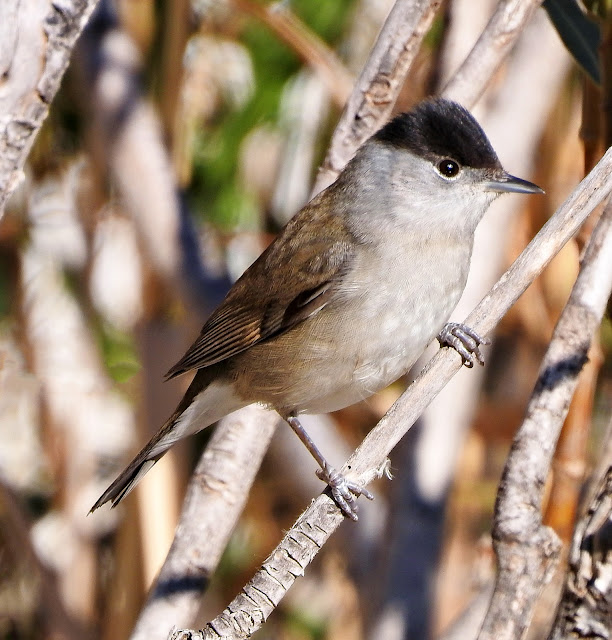

The blackcap is a mainly grey warbler with distinct male and female plumages. The nominate subspecies is about 13 cm (5.1 in) long with a 7–8 cm (2.8–3.1 in) wing length. The weight is typically 16–25 g (0.56–0.88 oz), but can be up to 31 g (1.1 oz) for birds preparing to migrate. The adult male has olive-grey upperparts, other than a paler grey nape and a neat black cap on the head. The underparts are light grey, becoming silvery white on the chin, throat and upper breast. The tail is dark grey, with an olive tint to the outer edge of each feather. The bill and long legs are grey, and the iris is reddish brown. The female resembles the male, but has a reddish-brown cap and a slightly browner tone to the grey of the upperparts. Juveniles are similar to the female, but their upperparts have a slight rufous tinge, and the breast and flanks have a more olive tone; young males have a darker brown cap than their female counterparts. This species is unmistakable; other dark-headed Sylvia species, such Sardinian and Orphean warblers have extensive black on the head instead of a small cap. They are also larger and have white edges on the tail.

Blackcaps have a complete moult in their breeding areas in August and September prior to migration. Some birds, typically those migrating the greatest distances, have a further partial moult between December and March. Juveniles replace their loosely structured body feathers with adult plumage, starting earlier, but taking longer to complete, than the adults. Blackcaps breeding in the north of the range have an earlier and shorter post-juvenile moult than those further south, and cross-breeding of captive birds shows that the timing is genetically controlled. 

Sunday, 7 January 2024

28-12-2023 TENDABA, GAMBIA - GAMBIAN EPAULETTED FRUIT BAT (Epomophorus gambianus)


The Gambian epauletted fruit bat (Epomophorus gambianus) is a species of megabat in the family Pteropodidae. It is found in Benin, Burkina Faso, Cameroon, Central African Republic, Chad, Democratic Republic of the Congo, Ivory Coast, Ethiopia, Gambia, Ghana, Guinea, Guinea-Bissau, Liberia, Mali, Niger, Nigeria, Senegal, Sierra Leone, South Sudan, Sudan, and Togo. Its natural habitats are subtropical or tropical dry forests and savanna.

Populations of epauletted fruit bats are threatened by pesticides on fruit, human disturbance and over-pooing in the past. However, the number one reason it may be threatened is habitat destruction.

Mostly found in Africa, these creatures have grayish-brown color fur with a white patch at the base of their ear in both males and females. These fruit bats are also very noisy creatures. In the context of mating behavior (see "Reproduction" below), adult males may hang from perches and perform a calling-display during which they utter a moderately loud bell like 'ping' at intervals of 1–3 seconds.

It is very easy to tell the male fruit bat from the female fruit bat. In comparison, males are usually larger than females. The males also have gland-like pouches in the skin of their shoulder, that is surrounded by light colored patches and/or tufts of fur. Thus, one of the reasons why they are named Gambian epauletted fruit bats, it produces the effect of epaulettes; a decorative or ornamental piece. The only way one would be able to see the epaulettes is when the male becomes stressed or sexually stimulated. Both males and females have small rounded ears, with a dog-like muzzle.

Their head and body length are usually 125–250 mm (5–10 in) and their wing span is about 508 mm (20 in) for the males. Mass ranges from 40 to 120 g (1.4 to 4.2 oz) and forearms are about 60–100 mm (2–4 in). This creature also has a tail that is hard to detect beneath the inter femoral membrane.

The species is known to hang off of evergreen trees during the day alone or spread out from one another and travel in packs of hundreds during the late hours of the night in the forest of Africa. 

29-12-2023 BAKAU, GAMBIA - HOODED VULTURE (Necrosyrtes monachus)


The hooded vulture, Necrosyrtes monachus, is one of the smallest of the Old World vultures. The species gets its common name from the cream-colored hood, formed from a patch of downy feathers, along the back of its neck to the crown of its head.

The small vulture is scruffy-looking and has a rather short, rounded tail. The male and female vultures appear similar, while females have longer eyelashes than males. Juveniles are similar in appearance to adults, only darker and plainer in color with a purple sheen.

The vulture’s face is usually pinkish-white in color, though it can flush red when agitated. It has dark brown plumage with a feathered nape and hind-neck. The hooded vulture’s long thin black bill leads into its bare face, crown, and foreneck.

29-12-2023 BAKAU, GAMBIA - WESTERN RED BILLED HORNBILL (Tockus kempi)

Fairly small, slim, long-tailed hornbill. Note the red bill, dark eye with a ring of black skin, and heavily spotted back. White patches on the wing and outer tail are conspicuous in flight. Found in savanna and woodland. Call is a series of clucks that starts with single notes, then becomes louder and more emphatic, with doubled notes. Similar to Northern Red-billed Hornbill, but separated by the black rather than pale bare skin around the eye.

The western red-billed hornbill is a species of hornbill in the family Bucerotidae. It is found from Senegal and Gambia to southern Mauritania and western Mali. There are five species of red-billed hornbills generally recognized now, but all five were once considered conspecific. Some authorities still categorize the group as Tockus erythrorhynchus with the remaining four as its subspecies.


29-12-2023 BAKAU, GAMBIA - GOLDEN TRUMPET (Allamanda cathartica)


 Allamanda cathartica, commonly called golden trumpet, common trumpetvine, and yellow allamanda, is a species of flowering plant of the genus Allamanda in the family Apocynaceae. It is native to Brazil. This plant is cited in Flora Brasiliensis by Carl Friedrich Philipp von Martius.

It does not twine, nor does it have tendrils or aerial roots. It can be pruned into a shrub form. If not pruned it can sprawl to a height of 20 feet.

The city of Canóvanas, Puerto Rico has adopted this species, known locally as canario amarillo, as its official flower.

29-12-2023 BAKAU, GAMBIA - YELLOW BILLED KITE (Milvus migrans ssp. parasitus)


As suggested by its name, the yellow-billed kite is easily recognized by its entirely yellow bill, unlike that of the black kite (which is present in Africa as a visitor during the North Hemisphere winter). However, immature yellow-billed kites resemble the black kites of the corresponding age.

They are found in almost all habitats, including parks in suburbia, but rare in the arid Namib and Karoo. They feed on a wide range of small vertebrates and insects, much of which is scavenged.

29-12-2023 BAKAU, GAMBIA - LAUGHING DOVE (Streptopelia senegalensis)

The laughing dove (Spilopelia senegalensis) is a small pigeon that is a resident breeder in Africa, the Middle East, South Asia, and Western Australia where it has established itself in the wild after being released from Perth Zoo in 1898. This small long-tailed dove is found in dry scrub and semi-desert habitats where pairs can often be seen feeding on the ground. It is closely related to the spotted dove (Spilopelia chinensis) which is distinguished by a white and black chequered necklace. Other names include laughing turtle dove, palm dove and Senegal dove while in Asia the name little brown dove is often used.

29-12-2023 BAKAU, GAMBIA - MOURNING COLLARED DOVE (Streptopelia decipiens)


The mourning collared dove or African mourning dove (Streptopelia decipiens) is a dove which is a widespread resident breeding bird in Africa south of the Sahara. Despite its name, it is not related to the North American mourning dove (Zenaida macroura). This species is common or abundant near water. They often mingle peacefully with other doves.


29-12-2023 BAKAU, GAMBIA - FIRESPIKE (Odontonema tubaeforme)


Odontonema tubaeforme is a plant in the family Acanthaceae native to Central America and naturalised as a garden escape in numerous other countries.

O. tubaeforme is an upright shrub up to 2 m or 3 m tall. Its elliptical, glossy leaves are 10 cm by 20 cm with a 2 cm petiole and arranged opposite each other on the stem. It has terminal spikes of waxy red to burgundy flowers, 30 mm long with 5 mm petals, and blooms in summer and autumn. It is grown as an annual frost-tender ornamental garden plant.

29-12-2023 BAKAU, GAMBIA - RED BILLED FIREFINCH (MALE) (Lagonosticta senegala)

The red-billed firefinch or Senegal firefinch (Lagonosticta senegala ) is a small seed-eating bird in the family Estrildidae. This is a resident breeding bird in most of Sub-Saharan Africa with an estimated global extent of occurrence of 10,000,000 km2. It was introduced to Egypt, but the population there has become extinct. It was also introduced to southern Algeria where it is currently expanding northward.

The red-billed firefinch is 10 cm (3.9 in) in length. The adult male has entirely scarlet plumage apart from brown wings. The bill is pink, and there is a yellow eye-ring. Females have uniformly brown upperparts and buff underparts. There is a small red patch in front of both eyes, with the bill also being pink.


 This widespread and abundant species is often found around human habitation, often with other species such as the red-cheeked cordon-bleu. Its soft queet-queet call is a familiar African sound. The song is a rising chick-pea-pea-pea.

The red-billed firefinch is a small gregarious bird which feeds mainly on grain and other seeds. It frequents open grassland and cultivation. The nest is a large domed grass structure with a side entrance, built low in a bush, wall or thatch into which three to six white eggs are laid. The nest of this species is parasitised by the village indigobird.

30-12-2023 NGALA LODGE, GAMBIA - BROWN BABBLER (Turdoides plebejus)


The brown babbler (Turdoides plebejus ) is a species of bird in the family Leiothrichidae. It is predominantly found in West Africa, but ranging from the Gambia to Kenya. The species is common across its range. The species is also known as the Sudan babbler.

The brown babbler is a medium-sized Turdoides babbler, measuring 22–25 centimetres (8.7–9.8 in) in length and weighs around 52–80 grams (1.8–2.8 oz). The plumage is grey-brown with a white-streaked throat and breast and a scaled head. The wings are bronze-brown, the bill black and the legs dusky or slaty black. The iris of the eyes are yellow. The sexes are alike, and juvenile birds are like the adults but with plainer and browner plumage and brown irises.

The brown babbler inhabits the broad band of the Sahel between the Sahara Desert and the tropical forests of Western Africa, from southern Mauritania, Senegal and the Gambia to southern Sudan, Uganda and western Kenya. The species lives in open savanna, wooded grasslands, riparian habitat in drier areas, degraded cultivation, farmlands, parks and gardens. The species is common across its range and readily lives in human modified habitat and is not considered threatened with extinction.

30-12-2023 BAKAU, GAMBIA - PIED CROW (Corvus albus)


Pied crows (Corvus albus) are widely distributed African birds. Extremely intelligent and opportunistic, they share the jackdaw’s love of shiny things. They also have a special flying ability, with broad wings that enable great powers of flight. They are curious, they are great mimics, and they use tools.

The Pied crow is about the size of the European carrion crow or a little larger but has a proportionately larger bill, slightly longer tail and wings, and longer legs. As its name suggests, its glossy black head and neck are interrupted by a large area of white feathering from the shoulders down to the lower breast. The tail, bill, and wings are black, too. The eyes are dark brown. The white plumage of immature birds is often mixed with black.

30-12-2023 NGALA LODGE, GAMBIA - HOODED VULTURE (Necrosyrtes monachus)

A small, mostly brown vulture with a small, naked, pink head covered with velvety white flufflike feathers. The slender, drooping, black beak and blue eye-ring are visible at close quarters and diagnostic when seen. Young birds have gray facial skin and brown fluff on the back of the neck. In flight, note rounded tail and silvery flight feathers. Rare and declining but widespread in open country, forest edge, and towns. While scavenging it is easily displaced from carcasses by larger and more aggressive vultures.

Although Hooded Vultures have relatively small home ranges, they are widely distributed across Africa. It occurs in Senegal, Mauritania, Guinea-Bissau, The Gambia, Niger and Nigeria in West Africa; in East Africa it is found in Chad, Sudan, South Sudan, Ethiopia and Somalia; in southern Africa it has been recorded in northern Namibia, Botswana, Zimbabwe, Mozambique and South Africa.


30-12-2023 BAKAU, GAMBIA - PIAPIAC (Ptilostomus afer)


The piapiac (Ptilostomus afer) is an African bird in the crow family, and is the only member of the genus Ptilostomus. It is most closely related to the Central Asian ground jays.

In size it is a little smaller and slimmer than the European magpie (Pica pica) though the bill is relatively thicker. It is 35–42 cm (14–17 in) in length and weighs 121–130 g (4.3–4.6 oz). The overall colouring is black with the feathers quite silky in texture and having a purplish gloss in good light. The base of the tail tends to be more brown in colour than the rest of the body. Unusual for a passerine it has 10 rather than 12 tail feathers. The nasal plumes are somewhat upturned on top of the bill but fully cover the nostrils. The bill itself is black in the adult but partly reddish-pink towards the base in juvenile specimens. The bird's legs and feet are black and the iris is variable, but tends towards violet, purple or mauve with a bluish-purple outer ring. The voice is usually described as a shrill squeaking often with the jackdaw-like overtones. There is also a croaking alarm call given in anger where the head bobs.

 The range of the species is the tropical equatorial region of central Africa from Senegal on the west coast, eastwards in a broad band to Sudan and southern Ethiopia. Within this range, its favoured habitat is towards more open country of cultivated land with fields and pasture and small associated towns and villages.