TOTAL PAGEVIEWS

TRANSLATE

Sunday, 20 April 2025

20-4-2025 MONTE CORONA, VALENCIA - WAVE MOTH (Idaea cervantaria)


Idaea, sometimes called Hyriogona (among other synonyms), is a large genus of geometer moths. It was erected by Georg Friedrich Treitschke in 1825. They are found nearly worldwide, with many native to the Mediterranean, the African savannas, and the deserts of western Asia.

As of 2013, there were about 680 species in the genus.

19-4-2025 MONTE CORONA, VALENCIA - COMMON GREEN LACEWING (Genus Chrysoperla)


Chrysoperla carnea, one of the species of common green lacewing,[1][2] is an insect in the Chrysopidae family. Although the adults feed on nectar, pollen and aphid honeydew, the larvae are active predators and feed on aphids and other small insects. It has been used in the biological control of insect pests on crops.

Chrysoperla carnea was originally considered to be a single species with a holarctic distribution but it has now been shown to be a complex of many cryptic, sibling subspecies. These are indistinguishable from each other morphologically but can be recognised by variations in the vibrational songs the insects use to communicate with each other, which they especially do during courtship.

The green lacewing eggs are oval and secured to the plant by long slender stalks. They are pale green when first laid but become gray later. The larvae are about one millimetre long when they first hatch. They are brown and resemble small alligators, crawling actively around in search of prey. They have a pair of pincer-like mandibles on their head with which they grasp their prey, sometimes lifting the victim off the leaf surface to prevent its escape. The larvae inject enzymes into the bodies of their victims which digest the internal organs, after which they suck out the liquidated body fluids.[citation needed] The larvae grow to about eight millimetres long before they spin circular cocoons and pupate.

Adult green lacewings are a pale green colour with long, threadlike antennae and glossy, golden, compound eyes. They have a delicate appearance and are from twelve to twenty millimetres long with large, membranous, pale green wings which they fold tent-wise above their abdomens. They are weak fliers and have a fluttery form of flight. They are often seen during the evenings and at night when they are attracted by lights. The high green sensitivity of the superposition eyes allows the green lacewings to recognize fresh green leaves that they use to find honey dew produced by aphids, a site for egglaying and a resting place.

17-4-2025 MONTE CORONA, VALENCIA - CURVED HORN MOTH (Symmoca signatella)


Symmoca signatella is a moth of the family Autostichidae. It is known from most of western Europe, but also Lithuania, Croatia, Greece and southern Russia. It has also been recorded from California in North America.

The wingspan is 12–15 mm. Adults are on wing in late summer and autumn.

The larvae feed on dried vegetable matter. They have been recorded feeding on dry leaves and plant debris on the stem and branches of Rosmarinus officinalis. The accumulation of debris was connected by light webbing.

23-3-2025 GAL OYA, SRI LANKA - PADDYFIELD PIPIT (Anthus rufulus)

The Paddyfield Pipit, or Oriental Pipit, is a rather large member of the pipit family, measuring around 15 cm in length. It is predominantly streaked grey-brown on its upper parts and pale on its underparts, with some breast streaking. Both sexes appear similar, with long legs, a lengthy tail, and a dark bill. The plumage does not vary significantly between seasons, but juveniles can be distinguished by their richer coloration below and more pronounced spotting on the breast.

Distinguishing the Paddyfield Pipit in winter can be challenging due to the presence of migratory pipit species. However, it is generally smaller and more compact than its relatives, with a shorter tail and a less powerful flight. Its call, a repetitive "chip-chip-chip," is distinct from the explosive "shreep" of Richard's Pipit and the nasal "pschreen" of Blyth's Pipit. The Paddyfield Pipit can be confused with the Tawny Pipit but has more streaking on the mantle and lacks the Tawny's black loreal stripe.

This species thrives in open environments, particularly in short grasslands and cultivated areas that offer patches of bare ground.

The Paddyfield Pipit is a resident breeder across the Indian Subcontinent, extending east to southern China, southern Thailand, and Indochina. Its range also includes the Philippines and parts of Indonesia.

The Paddyfield Pipit is known for its rapid movements on the ground. When disturbed, it takes flight briefly before settling back down. It breeds mainly during the dry season, possibly raising multiple broods. Its breeding behavior includes a fluttery flight display accompanied by a repeated note.

The bird's vocalizations are characterized by a "chip-chip-chip" call, which is notably different from the calls of similar pipit species in the region.

Nesting occurs on the ground, often under grass tufts or bushes. The nest is typically cup-shaped, though exposed nests may be domed. Clutches usually consist of three to four eggs with a greenish hue and brown specks.

The Paddyfield Pipit primarily feeds on small insects, but it will also consume larger beetles, tiny snails, and worms. It forages on the ground and may also catch insects in flight.

The Paddyfield Pipit is classified as Least Concern by the IUCN, indicating that it is not currently at significant risk of extinction.

23-3-2025 GAL OYA, SRI LANKA - ORIENTAL GARDEN LIZARD (Calotes versicolor)

The oriental garden lizard (Calotes versicolor), also called the eastern garden lizard, Indian garden lizard, common garden lizard, bloodsucker or changeable lizard, is an agamid lizard found widely distributed in Indo-Malaya. It has also been introduced in many other parts of the world.

Calotes versicolor is an insectivore, and the male gets a bright red throat in the breeding season. It measures over 10 cm (3.9 in) in length snout-to-vent. Total length including the tail is up to 37 cm (14.5 in). Two small groups of spines, perfectly separated from each other, above each tympanum. Dorsal crest moderately elevated on the neck and anterior part of the trunk, extending on to the root of the tail in large individuals, and gradually disappearing on the middle of the trunk in younger ones. No fold in front of the shoulder, but the scales behind the lower jaw are much smaller than the others; gular sac not developed. From thirty-nine to forty-three series of scales round the middle of the trunk. The hind foot (measured from the heel to the extremity of the fourth toe) is not much longer than the head in the adult, whilst it is considerably longer in the young. The coloration is very variable, sometimes uniform brownish or greyish-olive or yellowish. Generally broad brown bands across the back, interrupted by a yellowish lateral band. Black streaks radiate from the eye, and some of them are continued over the throat, running obliquely backwards, belly frequently with greyish longitudinal stripes, one along the median line being the most distinct; young and half-grown specimens have a dark, black-edged band across the inter-orbital region.


The ground-colour is generally a light brownish olive, but the lizard can change it to bright red, to black, and to a mixture of both. This change is sometimes confined to the head, at other times diffused over the whole body and tail. A common state in which it may be seen (as stated by T. C. Jerdon) is, seated on a hedge or bush, with the tail and limbs black, head and neck yellow picked out with red, and the rest of the body red. Jerdon and Blyth agree that these bright, changeable colours are peculiar to the male during the breeding-season, which falls in the months of May to early October.

Albert Guenther mentioned that Alexandre Henri Mouhot had collected in Siam one of those fine variations of colours, which, however, appear to be infinite. It has the usual cross streaks between the eyes and the radiating lines continent of India to China; it is very common in Ceylon, not extending into the temperate zone of the Himalayas. Ceylonese specimens are generally somewhat larger; one of them measured 16 inches, the tail taking 11 inches. It is found in hedges and trees; it is known in Ceylon under the name of "Bloodsucker", a designation the origin of which cannot be satisfactorily traced; in the opinion of Kelaart, the name was given to it from the occasional reddish hue of the throat and neck. "Roktochosha (রক্তচোষা)" is also a local name in the Bengali language, which also translates to "bloodsucker".

The female lays from five to sixteen soft oval eggs, about 5/8 of an inch long, in hollows of trees, or in holes in the soil which they have burrowed, afterward covering them up. The young appear in about eight or nine weeks. In a hot sunny day a solitary bloodsucker may be seen on a twig or on a wall, basking in the sun, with mouth wide open. After a shower of rain numbers of them are seen to come down on the ground and pick up the larva and small insects which fall from the trees during the showers. Changeable lizards escape danger by darting to the nearest tree. If the predator comes even closer, they will scale to the side of the tree facing away from the predator and very swiftly dart up the tree. The predator looks behind the tree only to see that the lizard is up in the branches.

23-3-2025 GAL OYA, SRI LANKA - ORANGE MIGRANT BUTTERFLY (Catopsilia scylla)


Catopsilia scylla, the orange migrant or orange emigrant, is a species of butterfly that lives in South East Asia and Australasia. Its larvae feed predominantly on plants of the genera Cassia and Senna.

Adults are approximately 60–65 millimetres (2.4–2.6 in) long. The males have white forewings edged in black, and cadmium-yellow hindwings, usually with black spots on the margins. Females are similar, but have an additional group of black spots on the forewing, which often merge to form a dark ring.

Catopsilia scylla has a wide distribution in South East Asia and Australasia. Its range stretches from Myanmar, Cambodia, Philippines, Thailand, and Vietnam, along the Malay Peninsula, across Java and Sumatra, and over northern Australia. It was recently discovered in Sri Lanka.

In Australia, C. scylla has been recorded on various species of Senna, including S. didymobotrya, S. leptoclada and S. surattensis. In Singapore, host plants include Senna obtusifolia, Cassia fistula, and especially Senna pallida.

The eggs are milky white and spindle shaped, and are usually laid singly on a leaf of the host plant. The eggs hatch after 1.5–2 days, and the caterpillars grow through five instars over 11–13 days, to reach a final length of 40 millimetres (1.6 in). The caterpillars are green and smooth, with a rounded head, and develops a series of black dots and a white lateral line on top of the plain green ground colour. Pupae are 26 mm (1.0 in) long, and are attached to the host plant in an upright position. After seven days, the adult emerges.

Saturday, 19 April 2025

23-3-2025 GAL OYA, SRI LANKA - COMMON JEZEBEL BUTTERFLY (Delias eucharis)

Delias eucharis, the common Jezebel, is a medium-sized pierid butterfly found in many areas of south and southeast Asia, especially in the non-arid regions of India, Bangladesh, Sri Lanka, Indonesia, Myanmar and Thailand. The common Jezebel is one of the most common of the approximately 225 described species in the genus Delias.

The wingspan of both males and females ranges from 6.5 to 8.5 cm.

The common Jezebel are nomadic in behaviour and are found in a variety of environment including, but not limited to, temperate hill forests, tropical rainforests, dry open woodlands, and beach hinterlands. They are generally found all over India, except in the desert tracts, and up to an altitude of 7,000 feet (2,100 m) in the hills. The butterfly may be found wherever there are trees, even in towns and cities, flying high among the trees and visiting flowers.

It is also commonly seen in gardens. The females can be seen flying amongst the trees in search of its food plants, while the males are more frequently observed visiting flowers for nectar. It rests with its wings closed exhibiting the brilliantly coloured underside.

The Jezebel often flies high up in the canopy and usually comes lower down only to feed on nectar in flowers. Due to this habit apparently, it has evolved a dull upperside and a brilliant underside so that birds below it recognise it immediately while in flight and at rest.

It has bright colouration to indicate the fact that it is unpalatable due to toxins accumulated by the larvae from the host plants.

Like other unpalatable butterflies the common Jezebel is mimicked by Prioneris sita, the painted sawtooth. The common Jezebel can be distinguished by the shape of the orange red spots on the hindwing. In the painted sawtooth these spots are very squarish whereas in the common Jezebel they are more arrow head shaped. The painted sawtooth also flies faster and will also mudpuddle.

The Jezebel breeds all year round.

23-3-2025 GAL OYA, SRI LANKA - INDIAN CORMORANT (Phalacrocorax fuscicollis)

The Indian cormorant or Indian shag (Phalacrocorax fuscicollis) is a member of the cormorant family. It is found mainly along the inland waters of the Indian Subcontinent but extending west to Sind and east to Thailand and Cambodia. It is a gregarious species that can be easily distinguished from the similar sized little cormorant by its blue eye, small head with a sloping forehead and a long narrow bill ending in a hooked tip.

This medium-sized bronze brown cormorant is scalloped in black on the upper plumage, lacks a crest and has a small and slightly peaked head with a long narrow bill that ends in a hooked tip. The eye is blue and bare yellow facial skin during the non-breeding season. Breeding birds have a short white ear tuft. In some plumages it has a white throat but the white is restricted below the gape unlike in the much larger great cormorant. Sexes are similar, but non-breeding adults and juveniles are browner.

This cormorant fishes gregariously in inland rivers or large wetlands of peninsular India and the northern part of Sri Lanka. It also occurs in estuaries and mangroves but not on the open coast. They breed very locally in mixed species breeding colonies. They extend north-east to Assam and eastward into Thailand, Burma and Cambodia.

The breeding season is July to February but depends on rainfall and water conditions. In northern India, they breed from July to February and in Sri Lanka, between November and February. The nest is a platform of twigs placed in the forks of partially submerged trees or of those growing on the islands. The nests are similar to those of other Indian cormorants, storks or waterbirds in dense colonies, often with several tiers of nests. The usual clutch is three to five eggs which are bluish green and with a chalky surface.

The Indian cormorant makes short dives to capture the fish and a group will often fish communally, forming a broad front to drive fish into a corner.

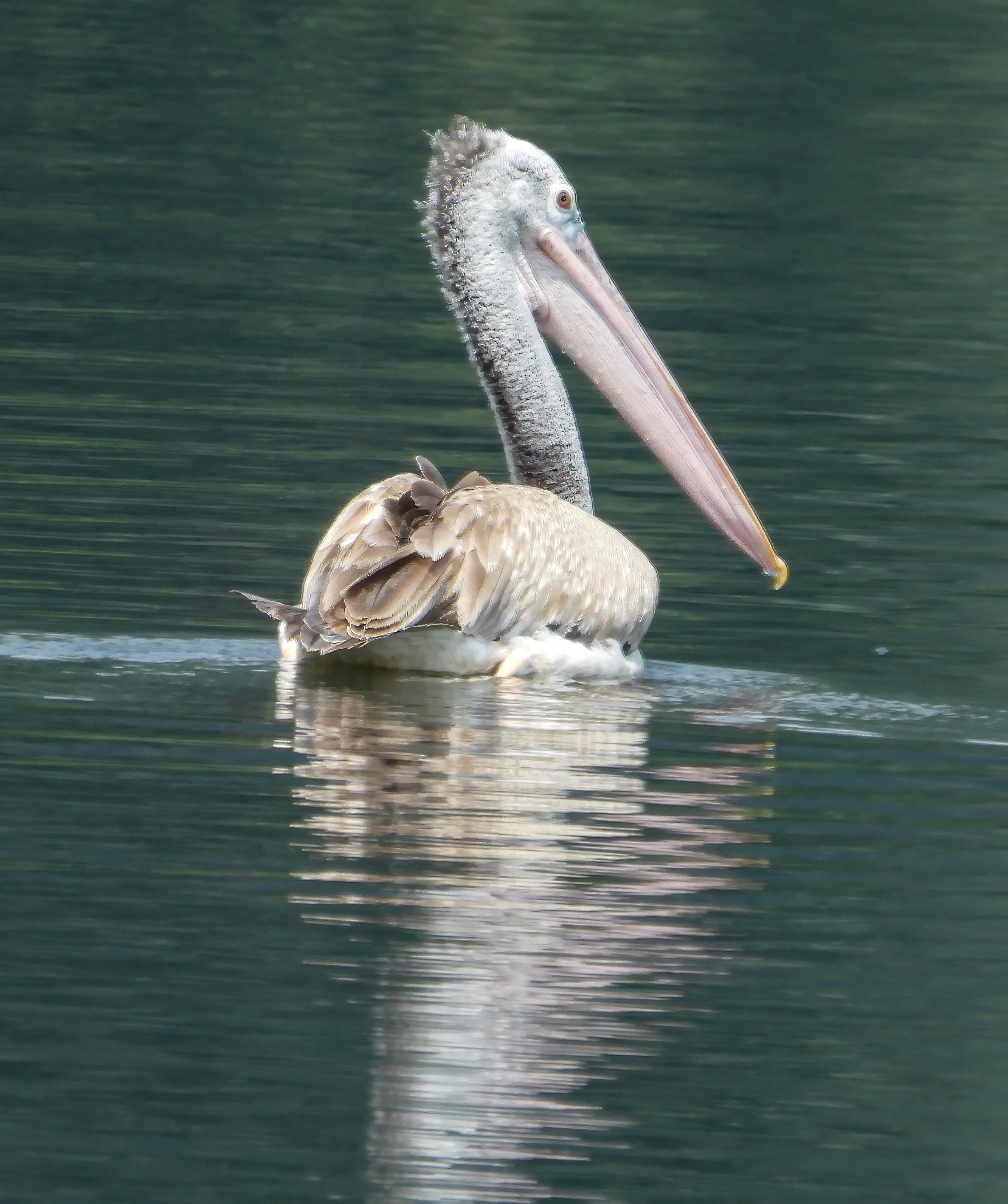
23-3-2025 GAL OYA, SRI LANKA - SPOT BILLED PELICAN (Pelecanus philippensis)

The Spot-billed Pelican, or Gray Pelican, is a member of the pelican family, distinguished by its size, which is smaller than other regional pelicans, and its distinctive plumage. It has a white body with a grey crest and a brownish tail. The feathers on the hind neck are curly, forming a greyish nape crest. The pouch is pink to purplish with large pale spots, and the upper mandible is similarly spotted. The bill's tip is yellow to orange, and the bird's overall length ranges from 125 to 152 cm, with a wingspan of 213 to 250 cm.

At a distance, the Spot-billed Pelican may be confused with other pelicans, but upon closer inspection, the spots on the upper mandible and the lack of bright colors set it apart. The greyer plumage and the rounder tail are also key identification features. The breeding plumage includes a dark base of the beak and a pink orbital patch.

This species favors large inland and coastal waters, particularly large lakes, where it can be found in shallow lowland freshwaters.

The Spot-billed Pelican breeds in southern Asia, from southern Iran across India to Indonesia. It is not migratory but may make local movements, with a wider distribution in the non-breeding season.

Spot-billed Pelicans are generally silent, but they can produce hisses, grunts, or bill snaps at their nests. They fish singly or in small flocks, often soaring on thermals during the day. They may forage at night and nest in colonies, often alongside other waterbirds.

The Spot-billed Pelican is typically silent, with vocalizations limited to the nesting period.

Breeding occurs in colonies, with nests made of twigs on low trees near wetlands. The breeding season varies, with courtship involving head movements and bill claps. Clutches usually consist of three to four chalky white eggs.

The Dalmatian Pelican is similar in flight but has darker tertials and inner secondaries, and a pale band along the greater coverts.

The Spot-billed Pelican catches fish in its bill pouch while swimming. It does not form large feeding flocks and may fish at night.

The Spot-billed Pelican is classified as Near Threatened due to habitat loss and human disturbance. However, populations in southern India are thought to be on the rise, and increased protection has led to a recovery in numbers.

23-3-2025 GAL OYA, SRI LANKA - COMMON EVENING BROWN BUTTERFLY (Melanitis leda)


Melanitis leda, the common evening brown, is a common species of butterfly found flying at dusk. The flight of this species is erratic. They are found in Africa, South Asia and South-east Asia extending to parts of Australia.

Underside varies in colour greatly. Antennae, head, thorax and abdomen in both seasonal forms brown or greyish brown: the antennae annulated with white, ochraceous at apex.

Resident butterflies are known to fight off visitors to the area during dusk hours. This chase behaviour is elicited even by pebbles thrown nearby.

The caterpillars feed on a wide variety of grasses including rice (Oryza sativa), bamboos, Andropogon, Rotboellia cochinchinensis, Brachiaria mutica, Cynodon, Imperata, and millets such as Oplismenus compositus, Panicum and Eleusine indica.

Adults feed mainly on nectar, and in rare cases visit rotting fruits.

23-3-2025 GAL OYA, SRI LANKA - SRI LANKA BRONZE SKINK (Eutropis madaraszi)

Eutropis madaraszi, also known commonly as the Sri Lanka bronze mabuya, the Sri Lanka bronze skink, or (ambiguously) the spotted skink, is a species of lizard in the family Scincidae. The species is endemic to the island of Sri Lanka.

The specific name, madaraszi, is in honor of Hungarian ornithologist Gyula Madarász of the Hungarian National Museum.


A widespread terrestrial skink, E. madaraszi has been reported from both wet and dry zones. Known localities include Colombo, as well as around Kala Wewa, and Madatugama.

The body of E. madaraszi is slender, with 32 midbody scale rows. The dorsum is brown, with a dark line along the flank. The venter is creamy and unpatterned.

E. madaraszi is found at elevations up to 800 m (2,600 ft), in rock crevices, under leaf litter or under logs, and seen basking at midday.

22-3-2025 WATER GARDENS LODGE, SIGIRIYA - WHITE THROATED KINGFISHER (Halcyon smyrnensis)


The White-throated Kingfisher, Halcyon smyrnensis, also known as the White-breasted Kingfisher, is a vibrant tree kingfisher. It boasts a striking blue back, wings, and tail, while its head, shoulders, flanks, and lower belly are a rich chestnut. The throat and breast are a contrasting white, and the large bill and legs are a vivid red. This robust bird measures 27–28 cm in length and exhibits a rapid and direct flight, revealing large white patches on its blue and black wings during flight. Both sexes appear similar, though juveniles present a more subdued version of the adult's plumage.

When identifying the White-throated Kingfisher, look for its bright blue upperparts and chestnut head and body. The white throat and breast are distinctive, as is the red bill and legs. In flight, the white wing patches are a key identification feature. Juveniles may be less colorful but retain the same general pattern.

This kingfisher is adaptable and can be found in a variety of open habitats, from plains with trees and wires to urban areas. It is also seen at elevations up to 7500 feet in the Himalayas.

The White-throated Kingfisher has a wide distribution across Asia, from the Sinai in the west, through the Indian subcontinent, to China and Indonesia. It is a resident species over much of its range, with some populations making short-distance movements.

22-3-2025 WATER GARDENS LODGE, SIGIRIYA - LITTLE EGRET (Egretta garzetta)

The Little Egret, Egretta garzetta, is a dainty heron adorned in pure white plumage. It is characterized by a slender black beak, long black legs, and, notably in the western race, yellow feet. This elegant bird is a sight to behold with its graceful neck and poised stance.

Adult Little Egrets measure between 55–65 cm in length with a wingspan of 88–106 cm, and weigh 350–550 g. Their plumage is predominantly white, though some may exhibit bluish-grey coloration. Breeding adults boast ornate nape plumes reaching about 150 mm, along with distinctive feathers on the breast and elongated scapulars. The bill and lores are black, with greenish-grey skin at the base of the lower mandible and around the eye, which houses a yellow iris. Legs are black with contrasting yellow feet, though juveniles may have greenish-black legs and duller feet. The subspecies E. g. nigripes is distinguished by yellow skin between the bill and eye, and blackish feet.

The Little Egret frequents a variety of wetland habitats, from the shores of lakes and rivers to marshes and coastal regions. It is often found in open environments, such as mangroves, swamps, mudflats, and sandy beaches, as well as human-altered landscapes like rice fields.

The species has a broad breeding distribution across warm temperate to tropical regions of Asia, Africa, Australia, and Europe. Northern populations are migratory, wintering in Africa and southern Asia, while others remain as permanent residents in warmer areas.

22-3-2025 WATER GARDENS LODGE, SIGIRIYA - GREY HERON (Ardea cinerea)


The Grey Heron (Ardea cinerea) is a statuesque wading bird belonging to the family Ardeidae. It is a familiar sight in both rural and urban settings, often seen standing stoically along the water's edge. An adult Grey Heron is a large bird, reaching up to 100 cm in height, with a wingspan between 155 to 195 cm. It weighs between 1 to 2 kg. The plumage is predominantly ashy-grey above, with a greyish-white underbelly and some black on the flanks. A striking feature is the white head and neck adorned with a broad black stripe that extends from the eye to the black crest. The beak is pinkish-yellow, long, and sharply pointed, while the legs are a brown hue.

When identifying the Grey Heron, look for the white head with the black supercilium and crest, the long grey neck, and the ashy-grey wings and back. The underparts are lighter, and the legs are long and brown. Juveniles can be distinguished by their duller grey neck and smaller crest. The beak is a useful indicator of age, being brighter in breeding adults.

Grey Herons are highly adaptable and can be found in a variety of watery habitats including lakes, rivers, ponds, marshes, and coastal environments. They require shallow waters for foraging or areas with shelving margins where they can wade.

Native to temperate Europe and Asia, as well as parts of Africa, the Grey Heron has a broad range. Northern populations may migrate southwards in autumn, while others remain resident year-round. Vagrant sightings have occurred in the Caribbean, Bermuda, and parts of North America.

Friday, 18 April 2025

22-3-2025 WATER GARDENS LODGE, SIGIRIYA - WHITE BREASTED WATERHEN (Amaurornis phoenicurus)

The White-breasted Waterhen, known scientifically as Amaurornis phoenicurus, presents a striking contrast in its plumage. The adult birds are adorned with dark grey upperparts and flanks, while their face, neck, and breast gleam in pure white. The lower belly and undertail boast a cinnamon hue or match the white of their upper body. Adapted for a life amidst dense vegetation, their bodies are laterally compressed, easing their movement through reeds. They possess long toes, a short tail, and are equipped with a yellow bill and legs. Both sexes are similar in appearance, though females are marginally smaller. The immature birds display a more subdued coloration, and the downy chicks are cloaked in black, a common trait among rails.

To identify the White-breasted Waterhen, look for the clean white face, breast, and belly that contrast with the dark slaty body. Their yellow bill and legs are also distinctive, as is their behavior of walking with a cocked, jerking tail.

These waterhens favor marshes as their breeding grounds, thriving in tropical Asia's wetlands.

The species is widely distributed across South and Southeast Asia, from Pakistan to Indonesia. They are commonly found in the plains but can also be encountered in higher elevations up to 1500 meters.

White-breasted Waterhens are often solitary or in pairs, foraging with deliberate steps along water bodies. They exhibit a unique tail-jerking motion as they walk and are known to probe the mud or shallow water with their bills, also visually seeking out food. They are crepuscular, being most active during dawn and dusk.

The species is vocal, especially during the breeding season, producing loud and repetitive croaking calls. The Andaman population, in particular, is known for its duck-like quack calls.

Breeding occurs mainly from June to October, varying by location. Nests are constructed on dry ground amidst marsh vegetation, where 6-7 eggs are laid. Both parents share incubation duties and chick rearing, with hatching occurring around 19 days.

Their diet consists of insects, small fish, aquatic invertebrates, and grains or seeds. They have been observed washing their prey in water before consumption and may occasionally feed in deeper waters like a moorhen.

The White-breasted Waterhen is classified as Least Concern by the IUCN, indicating a stable population across its extensive range.

22-3-2025 WATER GARDENS LODGE, SIGIRIYA - PIED PADDY SKIMMER DRAGONFLY (Neurothemis tullia)


Neurothemis tullia, the pied paddy skimmer, is a species of dragonfly found in south and south-east Asia. It appears in Bangladesh, China, Hong Kong, India, Malaysia (Peninsular Malaysia), Myanmar, Nepal, Sri Lanka, Taiwan, Thailand, Cambodia and Viet Nam.

It is a black dragonfly with a pale yellow mid-dorsal carina of thorax. Wings are hyaline for apical half and opaque steely blue-black for basal half which is bordered by a milky white patch towards the tip. 

Females differ remarkably from the males both in body-colouring and markings and in marking of the wings. Its body is greenish yellow with a bright yellow mid-dorsal carina of thorax. Base of wings are amber yellow followed by a blackish brown patch. Apices of all wings are broadly opaque blackish brown and the remaining halves are pale yellow.

It breeds in marshes, well vegetated ponds, lakes and rice fields. It perches very close to ground and its flight is very weak.

22-3-2025 WATER GARDENS LODGE, SIGIRIYA - INDIAN PEAFOWL (MALE) (Pavo cristatus)

The Indian peafowl, also known as the common peafowl or blue peafowl, is a species native to the Indian subcontinent. It is a bird of resplendent beauty, with the male, or peacock, showcasing a spectacular array of iridescent colors. The peacock's most striking feature is its fan-like crest of spatula-tipped wire-like feathers and the long train made up of elongated upper-tail covert feathers adorned with colorful eyespots. These feathers can be raised into a fan and quivered during courtship displays. Despite their size, peacocks are capable of flight. The female, or peahen, is more subdued in coloration, with a white face, iridescent green lower neck, and overall dull brown plumage.

The Indian peafowl is unmistakable within its range. The male has a metallic blue crown, a fan-shaped crest, and a spectacular train with eye-spot markings. The peahen is smaller, with a rufous-brown head, mottled upper body, and dark brown lower parts. The loud "pia-ow" or "may-awe" calls are distinctive and often indicate the presence of predators.

Indian peafowl are ground-dwelling birds that prefer open forest or land under cultivation. They are adaptable and can be found near water sources in both moist and dry-deciduous forests.

22-3-2025 GAL OYA, SRILANKA - PADDYFIELD PIPIT (Anthus rufulus)


The Paddyfield Pipit, or Oriental Pipit, is a rather large member of the pipit family, measuring around 15 cm in length. It is predominantly streaked grey-brown on its upper parts and pale on its underparts, with some breast streaking. Both sexes appear similar, with long legs, a lengthy tail, and a dark bill. The plumage does not vary significantly between seasons, but juveniles can be distinguished by their richer coloration below and more pronounced spotting on the breast.

Distinguishing the Paddyfield Pipit in winter can be challenging due to the presence of migratory pipit species. However, it is generally smaller and more compact than its relatives, with a shorter tail and a less powerful flight. Its call, a repetitive "chip-chip-chip," is distinct from the explosive "shreep" of Richard's Pipit and the nasal "pschreen" of Blyth's Pipit. The Paddyfield Pipit can be confused with the Tawny Pipit but has more streaking on the mantle and lacks the Tawny's black loreal stripe.

22-3-2025 GAL OYA, SRILANKA - WHITE BROWED BULBUL (Pycnonotus luteolus)

The White-browed Bulbul, known scientifically as Pycnonotus luteolus, is a small bird with a distinctive appearance. It measures approximately 20 cm in length and is adorned with olive-grey upperparts contrasted by whitish underparts. A striking feature is its pale supercilium, which gives the bird its name, accompanied by a white crescent below the eye. The eyestripe and moustachial stripe are dark, providing a sharp contrast. A touch of yellow graces the vent and chin, while the throat remains predominantly whitish. Both sexes share similar plumage, making them indistinguishable in the field.

When attempting to identify the White-browed Bulbul, look for the characteristic white eyebrow stripe and the yellowish vent. The bird's song, a rich and spluttering warble, is often a giveaway to its presence. It is known to perch atop a bush to vocalize before diving back into the vegetation, making visual identification challenging.

This species thrives in dense scrub habitats, preferring the security of thick vegetation. It is also commonly found in gardens and woodlands with ample shrubbery, where it can easily remain concealed.

The White-browed Bulbul is endemic to Sri Lanka and peninsular India. Its range extends from central and southern India to the island of Sri Lanka, with its northernmost boundary reaching across Gujarat, Madhya Pradesh, and western West Bengal.

White-browed Bulbuls are typically observed alone or in pairs, actively foraging within bushes for fruit, nectar, and insects. They exhibit a skulking behavior, often remaining hidden among the foliage.

The bird's vocalizations are a distinctive feature, with a song described as a rich, spluttering warble. It is more often heard than seen, using its voice to communicate within its dense habitat.

The breeding season for the White-browed Bulbul is quite extended, ranging from March to September, with possible variations in different regions. They may breed twice a year, with peaks in February and September. The nest is a loosely constructed cup of twigs, cobwebs, and hair, typically situated low in a thick bush. A typical clutch consists of two eggs.

These bulbuls forage for fruit, nectar, and insects within the shelter of bushes, displaying a preference for a varied diet.

The IUCN Red List has classified the White-browed Bulbul as Least Concern, indicating that the species does not currently face any significant threats to its survival.

22-3-2025 GAL OYA, SRILANKA - ASIAN GREEN BEE-EATER (Merops orientalis)

The Asian green bee-eater, known scientifically as Merops orientalis, is a captivating near passerine bird belonging to the bee-eater family. This slender and brightly colored avian species measures approximately 9 inches in length, with the elongated central tail-feathers contributing about 2 inches to its overall size. The plumage is predominantly bright green, with a blue tinge on the chin and throat, and a golden rufous touch on the crown and upper back. The flight feathers exhibit a rufous hue mixed with green and tipped with blackish. A distinctive black line runs in front of and behind the eye, while the iris is a striking crimson. The bill is black, and the legs are a dark grey, with feet that are weak and toes that are joined at the base.

To identify the Asian green bee-eater, look for the bright green plumage with blue and golden rufous accents. The sexes appear similar and cannot be visually distinguished. Juveniles lack the elongated tail feathers seen in adults. The bird's bill is black, and the legs are dark grey. The crimson iris is a notable feature that can aid in identification.

The Asian green bee-eater is found in a variety of habitats including grasslands, thin scrub, and forests, often at a considerable distance from water bodies. It prefers open country with bushes and can adapt to different environments from arid areas in Africa and Arabia to more diverse habitats in Asia.

This species is widely distributed across Asia, from coastal southern Iran, through the Indian subcontinent, to Vietnam. It is a resident bird but exhibits seasonal movements, often moving to drier regions during the rainy season and to warmer areas in winter. In some parts of Pakistan, they are known as summer visitors.

The Asian green bee-eater is known for its insectivorous diet, predominantly consuming bees, wasps, and ants captured in mid-air from open perches. It employs a unique method of removing stings and breaking the exoskeleton of its prey before consumption. Seasonal movements are observed in response to rainfall, but true migration is not well documented. These birds are often seen in small groups and may roost communally. They exhibit a tendency to sand-bathe more frequently than other bee-eater species and occasionally bathe in water.

The call of the Asian green bee-eater is a nasal trill, sounding like "tree-tree-tree-tree," typically emitted during flight.

Breeding season spans from March to June. The Asian green bee-eater often nests solitarily, constructing tunnels in sandy banks. The nest tunnel can extend up to 5 feet in length, with 3-5 glossy white, spherical eggs laid at the end of the tunnel. Both sexes participate in incubation, and the eggs hatch asynchronously after about 14 days. Chicks fledge in 3 to 4 weeks, showing a reduction in body weight during the fledging stage.

The Asian green bee-eater feeds on flying insects, with a preference for beetles and hymenopterans, while orthopterans seem to be avoided. Occasionally, they may consume crabs. They regurgitate indigestible parts of their prey as pellets.

22-3-2025 GAL OYA, SRILANKA - ASHY PRINIA (Prinia socialis)

The ashy prinia or ashy wren-warbler (Prinia socialis) is a small warbler in the family Cisticolidae. This prinia is a resident breeder in the Indian subcontinent, ranging across most of India, Nepal, Bangladesh, eastern Pakistan, Bhutan, Sri Lanka and western Myanmar. It is a common bird in urban gardens and farmland in many parts of India and its small size, distinctive colours and upright tail make it easy to identify. The northern populations have a rufous rump and back and have a distinct breeding and non-breeding plumage while other populations lack such variation.

These 13–14 cm long warblers have short rounded wings and a longish graduated cream tail tipped with black subterminal spots. The tail is usually held upright and the strong legs are used for clambering about and hopping on the ground. They have a short black bill. The crown is grey and the underparts are rufous in most plumages. In breeding plumage, adults of the northern population are ash grey above, with a black crown and cheek with no supercilium and coppery brown wings. In non-breeding season, this population has a short and narrow white supercilium and the tail is longer. They are found singly or in pairs in shrubbery and will often visit the ground.

22-3-2025 GAL OYA, SRILANKA - COMMON CROW BUTTERFLY (Euploea lewiniip)


Euploea core, also known as the common crow, is a common butterfly found in South Asia to Australia. In India it is also sometimes referred to as the common Indian crow, and in Australia as the Australian crow. It belongs to the crows and tigers subfamily Danainae (tribe Danaini).

E. core is a glossy-black, medium-sized 85–95 mm (3.3–3.7 in) butterfly with rows of white spots on the margins of its wings. E. core is a slow, steady flier. Due to its unpalatability it is usually observed gliding through the air with a minimum of effort. As caterpillars, this species sequesters toxins from its food plant which are passed on from larva to pupa to the adult. While feeding, it is a very bold butterfly, taking a long time at each bunch of flowers. It can also be found mud-puddling with others of its species and often in mixed groups. The males of this species visit plants like Crotalaria and Heliotropium to replenish pheromone stocks which are used to attract a female during courtship.

The common crow is the most common representative of its genus, Euploea. Like the tigers (genus Danaus), the crows are inedible and thus mimicked by other Indian butterflies (see Batesian mimicry). In addition, the Indian species of the genus Euploea show another kind of mimicry, Müllerian mimicry. Accordingly, this species has been studied in greater detail than other members of its genus in India.

Thursday, 17 April 2025

22-3-2025 MEGOLIA, SRILANKA - GREAT EGRET (Ardea alba)


The great egret, known scientifically as Ardea alba, is a majestic bird with a stately bearing and an impressive wingspan. This large egret is adorned with all-white plumage and can stand up to a meter tall. It is a cosmopolitan species, found across temperate and tropical regions worldwide.

To identify the great egret, look for its yellow bill and contrasting black legs and feet, which may vary slightly during the breeding season. During this time, the bill may darken, and the lower legs may lighten. The great egret also sports ornamental feathers on its back when in breeding plumage. Both sexes appear identical, and juveniles resemble nonbreeding adults. The great egret can be distinguished from the intermediate egret by the gape of its bill, which extends well beyond the back of the eye.

The great egret favors habitats close to water, such as large lakes with reed beds and other extensive wetlands. It nests in colonies, often at heights of 10 to 40 feet within trees.

22-3-2025 DAMBULLA, SRILANKA - SPUR THROATED GRASSHOPPER (subfamily Catantopinae)

Global Distribution is Nepal, Bhutan, China: Hainan, Vietnam, Đáo Côn So'n Island, Cù Lao Thu Island, Cambodia, Japan, Myanmar, Srilanka, Taiwan

Indian Distribution is Kerala, Manipur, Sikkim, Tamil Nadu


Diabolocatantops pinguis is a species of grasshoppers in the subfamily Catantopinae and tribe Catantopini. This species can be found in the Indian subcontinent, China and Indo-China. No subspecies are listed in the Catalogue of Life.

21-3-2025 WATER GARDENS, SIGIRIYA - GREY HEADED FISH EAGLE (Haliaeetus ichthyaetus)

The Grey-headed Fish Eagle (Icthyophaga ichthyaetus) is a robust raptor, cloaked in dark brown plumage with a contrasting pale grey head. Its underbelly is lighter, and it boasts white legs. The tail is white with a distinctive broad black subterminal band. This bird of prey exhibits sexual dimorphism, with females typically outweighing males.

Adults display a grey-brown back with a pale grey head and pale iris. The breast and neck are brown, while the wings are dark brown with blacker primaries. Juveniles are paler with brown heads and necks, greyer on the sides of the throat, and exhibit buff supercilia and whitish streaks. Their tails are marbled black and white with a broader dark subterminal band and a white tip.

Inhabiting lowland forests up to 1,500 meters above sea level, the Grey-headed Fish Eagle is found near water bodies such as rivers, lakes, lagoons, reservoirs, marshes, swamps, and coastal lagoons and estuaries. It is also known to frequent irrigation tanks in Sri Lanka.

This eagle's range extends from India and Southeast Asia to Malaysia, Western Indonesia, and the Philippines. It is generally uncommon, with varying local presence across its distribution.

A sedentary and often solitary bird, the Grey-headed Fish Eagle spends much time perched on bare branches overlooking water, swooping down occasionally to catch fish. Its flight appears heavy, with sharp wing-beats, and it rarely soars, likely due to its habitat.

Its vocal repertoire includes a gurgling "awh-awhr" and "chee-warr," an "ooo-wok," a nasally "uh-wuk," and a loud, high-pitched scream. These calls are typically emitted from a perch or in flight, becoming more vocal during the breeding season.

Breeding seasons vary across its range, with nests built high in trees near water. The clutch size ranges from 2 to 4 eggs, but typically only 2 white eggs are laid. Both parents share incubation and chick-rearing duties.

Specializing in piscivory, the Grey-headed Fish Eagle preys on live fish and scavenges for dead ones. It may also consume reptiles, birds, and small mammals. It hunts from perches or by quartering over water, using its recurved talons to snatch fish.

Listed as Near-Threatened, the Grey-headed Fish Eagle faces threats from habitat loss, deforestation, over-fishing, and pollution. Its population is estimated between 10,000–100,000 mature individuals, with a declining trend.