TOTAL PAGEVIEWS

TRANSLATE

Saturday, 26 April 2025

26-3-2025 YALA NAT PARK, SRI LANKA - LITTLE EGRET (Egretta garzetta)

The Little Egret, Egretta garzetta, is a dainty heron adorned in pure white plumage. It is characterized by a slender black beak, long black legs, and, notably in the western race, yellow feet. This elegant bird is a sight to behold with its graceful neck and poised stance.

Adult Little Egrets measure between 55–65 cm in length with a wingspan of 88–106 cm, and weigh 350–550 g. Their plumage is predominantly white, though some may exhibit bluish-grey coloration. Breeding adults boast ornate nape plumes reaching about 150 mm, along with distinctive feathers on the breast and elongated scapulars. The bill and lores are black, with greenish-grey skin at the base of the lower mandible and around the eye, which houses a yellow iris. Legs are black with contrasting yellow feet, though juveniles may have greenish-black legs and duller feet. The subspecies E. g. nigripes is distinguished by yellow skin between the bill and eye, and blackish feet.

The Little Egret frequents a variety of wetland habitats, from the shores of lakes and rivers to marshes and coastal regions. It is often found in open environments, such as mangroves, swamps, mudflats, and sandy beaches, as well as human-altered landscapes like rice fields.

The species has a broad breeding distribution across warm temperate to tropical regions of Asia, Africa, Australia, and Europe. Northern populations are migratory, wintering in Africa and southern Asia, while others remain as permanent residents in warmer areas.

23-4-2025 MONTE CORONA, VALENCIA - HALF EDGED WALL JUMPING SPIDER (Menemerus semilimbatus)

Menemerus semilimbatus is a spider in the family Salticidae.

Menemerus semilimbatus are about 6.5–8.4 millimetres (0.26–0.33 in) long, the male being slightly smaller than the female. These fairly big jumping spiders are dorso-ventrally flattened and are covered with short dense, grayish-white hairs, with hairy whitish palps and a white band on the side margins of the carapace, showing also a small white, triangular marking in the middle. The eyes are large and forward-facing. The legs are light brown with darker rings and patches, while the abdomen is dorsally yellowish or grayish, with a characteristic pattern of several bright V-shaped markings. The females show a notch at the posterior edge of the epigyne and two oval depressions in the anterior half.

Menemerus semilimbatus is a Mediterranean species widely distributed in Europe, southern Asia and in Africa. In the Americas, it has been reported in Argentina, Chile, Ecuador and USA.

These spiders are synanthropic living in gardens and inside and on the outside of houses. It is usually found on the walls of buildings where it stalks its prey.


25-4-2025 MONTE CORONA, VALENCIA - FALSE BLISTER BEETLE (Chrysanthia reitteri)

False blister beetles, sometimes known also as pollen feeding beetles, are unique in that adults of all the approximately 1,000 species in the world are obligate pollen feeders. They obtain their common name because many species cause blisters when pinched or squashed against the skin. Being pollen feeders, they are often common on flowers. They are also attracted to lights, and their numbers can be vast at night, especially on the Florida Keys. Oxycopis mcdonaldi (Arnett) causes skin blistering and makes itself a nuisance at resort areas where the beetles are attracted by night lights around swimming pools, tennis courts, and open air restaurants. Yet another species, Nacerdes melanura (L.), the wharf borer, is common around wood pilings where its larvae bore into and weaken the wood of docks and adjacent buildings.

26-3-2025 YALA NAT PARK, SRI LANKA - BLUE TAILED BEE-EATER (Merops philippinus)

The Blue-tailed Bee-eater, Merops philippinus, is a near passerine bird belonging to the family Meropidae. It is a slender bird with a rich palette of colors, predominantly green with a blue tail. The face features a narrow blue patch with a black eye stripe, and the throat is a mix of yellow and brown. Notably, the beak is black, and the three outer toes are fused at the base. Both sexes are similar in appearance, with a body length of 23–26 cm, including the elongated central tail feathers.

When identifying the Blue-tailed Bee-eater, look for the blue rather than green rump and tail, distinguishing it from the similar Blue-cheeked Bee-eater. The under-tail coverts are bluish, and the blue cheek patch is smaller. The chestnut on the throat and breast is darker and more extensive.

This species is typically found in open habitats near water bodies.

The Blue-tailed Bee-eater has a widespread distribution across South and Southeast Asia. It is migratory in many parts of its range, with breeding colonies often found in river valleys.

These birds are known for their colonial breeding habits, nesting in close proximity within vertical mudbanks or sloping land. They exhibit communal feeding and roosting behaviors and may have helpers assisting the breeding pair.

The Blue-tailed Bee-eater's call is a rolling chirping whistle, described as a "teerp," primarily heard during flight.

Breeding occurs from April to May in India, with nests tunneled into loamy sand banks. The species lays 5 to 7 near-spherical eggs, with both parents involved in care. They guard against brood parasitism and extra-pair copulation.

The Blue-cheeked Bee-eater is the most similar species within its range but can be differentiated by its drier habitat preference and distinct coloration differences.

The diet consists mainly of flying insects such as bees, wasps, and hornets, which are caught in the air from an open perch. The insects are beaten on the perch to kill them and break the exoskeleton.

The Blue-tailed Bee-eater is listed as Least Concern by the International Union for Conservation of Nature (IUCN), indicating a stable population.

26-3-2025 YALA NAT PARK, SRI LANKA - MUGGER CROCODILE (Crocodylus palustris)

The mugger crocodile (Crocodylus palustris) is a medium-sized broad-snouted crocodile, also known as mugger and marsh crocodile. It is native to freshwater habitats from south-eastern Iran to the Indian subcontinent, where it inhabits marshes, lakes, rivers and artificial ponds. It rarely reaches a body length of 5 m (16 ft 5 in) and is a powerful swimmer, but also walks on land in search of suitable waterbodies during the hot season. Both young and adult mugger crocodiles dig burrows to which they retreat when the ambient temperature drops below 5 °C (41 °F) or exceeds 38 °C (100 °F). Females dig holes in the sand as nesting sites and lay up to 46 eggs during the dry season. The sex of hatchlings depends on temperature during incubation. Both parents protect the young for up to one year. They feed on insects, and adults prey on fish, reptiles, birds and mammals.

The mugger crocodile evolved at least 4.19 million years ago and has been a symbol for the fructifying and destructive powers of the rivers since the Vedic period. It was first scientifically described in 1831 and is protected by law in Iran, India and Sri Lanka. Since 1982, it has been listed as Vulnerable on the IUCN Red List. Outside protected areas, it is threatened by conversion of natural habitats, gets entangled in fishing nets and is killed in human–wildlife conflict situations and in traffic accidents.

Friday, 25 April 2025

26-3-2025 YALA NAT PARK, SRI LANKA - PHEASANT TAILED JACANA (Hydrophasianus chirurgus)

The pheasant-tailed jacana, a member of the jacana family, is a distinctive bird with elongated toes and nails that allow it to gracefully traverse floating vegetation in shallow lakes. This species is notable for its seasonal plumage changes and is the only jacana known to undertake long migrations.

In breeding plumage, the pheasant-tailed jacana is easily recognized by its elongated central tail feathers, chocolate brown body, white face, and silky golden nape. The wings are predominantly white, with a black border visible in flight. Non-breeding plumage sees the bird in a more subdued brown with a dark eyestripe and a necklace-like pattern on a white front. Both sexes possess sharp white carpal spurs, with females typically larger than males.

The pheasant-tailed jacana favors shallow lakes rich in floating vegetation, which is essential for its foraging and breeding.

This species is widespread across tropical Asia, from Yemen to the Philippines. It exhibits migratory behavior in parts of its range, with northern populations moving southward during the non-breeding season.


The pheasant-tailed jacana is known for its foraging strategy, which includes both swimming and walking on aquatic vegetation. It is a polyandrous species, with females laying several clutches of eggs that are incubated and raised by different males within their harem.

The bird's vocalizations include a mewing call and a nasal tone among winter flocks. During the breeding season, males and females have distinct calls, with young birds emitting a low cheep.

Breeding occurs on floating vegetation during the rainy season. The female is polyandrous and may lay up to ten clutches, leaving the male to incubate the eggs and raise the young. The eggs are dark olive-brown with glossy black markings.

The pheasant-tailed jacana can be confused with the bronze-winged jacana, especially in immature birds. However, the presence of white wings and a black stripe on the neck helps distinguish the pheasant-tailed jacana.

Its diet primarily consists of insects, molluscs, and other invertebrates, which it picks from the water's surface or floating vegetation.

The pheasant-tailed jacana is currently listed as Least Concern on the IUCN Red List, indicating that it is not at immediate risk of population decline.

26-3-2025 YALA NAT PARK, SRI LANKA - ASIAN OPENBILL STORK (Anastomus oscitans)


The Asian openbill, a member of the stork family Ciconiidae, is a large wading bird recognized by its distinctive beak structure. The adult bird's beak features a notable gap between the arched upper mandible and the recurved lower mandible, a trait absent in the young. This species exhibits sexual dimorphism, with the males typically larger than the females. The plumage transitions from greyish during the non-breeding season to predominantly white in the breeding season, complemented by glossy black wings and tail with hints of green or purple iridescence.

To identify the Asian openbill, look for the unique gap in the adult's beak and its relatively small stature for a stork, standing at 68 cm in height. The bird's short legs range in color from pinkish to grey, turning reddish prior to breeding. In flight, the Asian openbill can be distinguished by its broad wings and neck outstretched, often mistaken for a white stork or Oriental stork from a distance.

Asian openbills frequent inland wetlands, avoiding river banks and tidal flats. They are adaptable, often seen foraging in crop fields, irrigation canals, and seasonal marshes.

This species is indigenous to the Indian subcontinent and Southeast Asia. It is a resident bird within its range but undertakes long-distance movements in response to climatic changes and food availability.

26-3-2025 YALA NAT PARK, SRI LANKA - SRI LANKAN SPOTTED DEER (JUVENILE) (Axis axis ssp. ceylonensis)


The Sri Lankan axis deer (Axis axis ceylonensis) or Ceylon spotted deer is a subspecies of axis deer (Axis axis) that inhabits only Sri Lanka. The name chital is not used in Sri Lanka. Its validity is disputed, and some maintain that the axis deer is monotypic (i.e., has no subspecies).

Sri Lankan axis deer are active primarily during early morning and again during the evening, but they are commonly observed near waterholes anytime. The Sri Lankan axis deer eats primarily grasses, but it also eats fallen fruits and leaves. The Sri Lankan axis deer graze closely with langur, peacock, wild buffalo, and sambar deer. They usually live in groups of between 10 and 60 animals, though herds may include up to 100 animals.

26-3-2025 YALA NAT PARK, SRI LANKA - SRI LANKAN CHITAL (SPOTTED DEER) (FEMALE) (Axis axis ssp. ceylonensis)

The Sri Lankan axis deer (Axis axis ceylonensis) or Ceylon spotted deer is a subspecies of axis deer (Axis axis) that inhabits only Sri Lanka. The name chital is not used in Sri Lanka. Its validity is disputed, and some maintain that the axis deer is monotypic (i.e., has no subspecies).

Sri Lankan axis deer are active primarily during early morning and again during the evening, but they are commonly observed near waterholes anytime. The Sri Lankan axis deer eats primarily grasses, but it also eats fallen fruits and leaves. The Sri Lankan axis deer graze closely with langur, peacock, wild buffalo, and sambar deer. They usually live in groups of between 10 and 60 animals, though herds may include up to 100 animals.

Axis deer are important prey for the Sri Lankan leopard. It is also prey for sloth bears, jackals, and crocodiles.

These deer inhabit lowland dry forests, savannas, and shrub lands. Very rarely, these deer inhabit dry mountain areas.

Unlike the mainland axis deer (Axis axis) which is plentiful, Sri Lankan axis deer populations are considered to be vulnerable.[citation needed] Threats include hunting for meat and deforestation. Historically, axis deer were found in very large numbers in the entire dry zone of Sri Lanka, but these numbers have been significantly reduced. Today several thousand of these deer are found in Sri Lanka. Sri Lankan axis deer are mainly found in protected areas in the dry zone, with a small number of herds living outside the protected forest areas. Large herds can be found only in protected areas.

They can be seen on the streets of Trincomalee. Particularly, they wander near the walls of Fort Fredrick.

26-3-2025 YALA NAT PARK, SRI LANKA - BENGAL MONITOR (Varanus bengalensis)


The Bengal monitor (Varanus bengalensis), also called the Indian monitor, is a species of monitor lizard distributed widely in the Indian subcontinent, as well as parts of Southeast Asia and West Asia.

Juveniles are patterned and more colourful

The Bengal monitor can reach 175 cm (69 in) with a snout-to-vent length (SVL) of 75 cm (30 in) and a tail of 100 cm (39 in). Males are generally larger than females. Heavy individuals may weigh nearly 7.2 kg (16 lb).

The populations of monitors in India and Sri Lanka differ in the scalation from those of Myanmar; these populations were once considered subspecies of the Bengal monitor, but are now considered two species within the V. bengalensis species complex. What was once the nominate subspecies, V. bengalensis, is found west of Myanmar, while the clouded monitor (V. nebulosus) is found to the east. Clouded monitors can be differentiated by the presence of a series of enlarged scales in the supraocular region. The number of ventral scales varies, decreasing from 108 in the west to 75 in the east (Java).

The species ranges from Iran to Java, among the most widely distributed of monitor lizards as they are eurytopic and adaptable to a range of habitats. It is found in river valleys in eastern Iran, Afghanistan, India, Nepal, Sri Lanka, Pakistan, Bangladesh and Burma. 

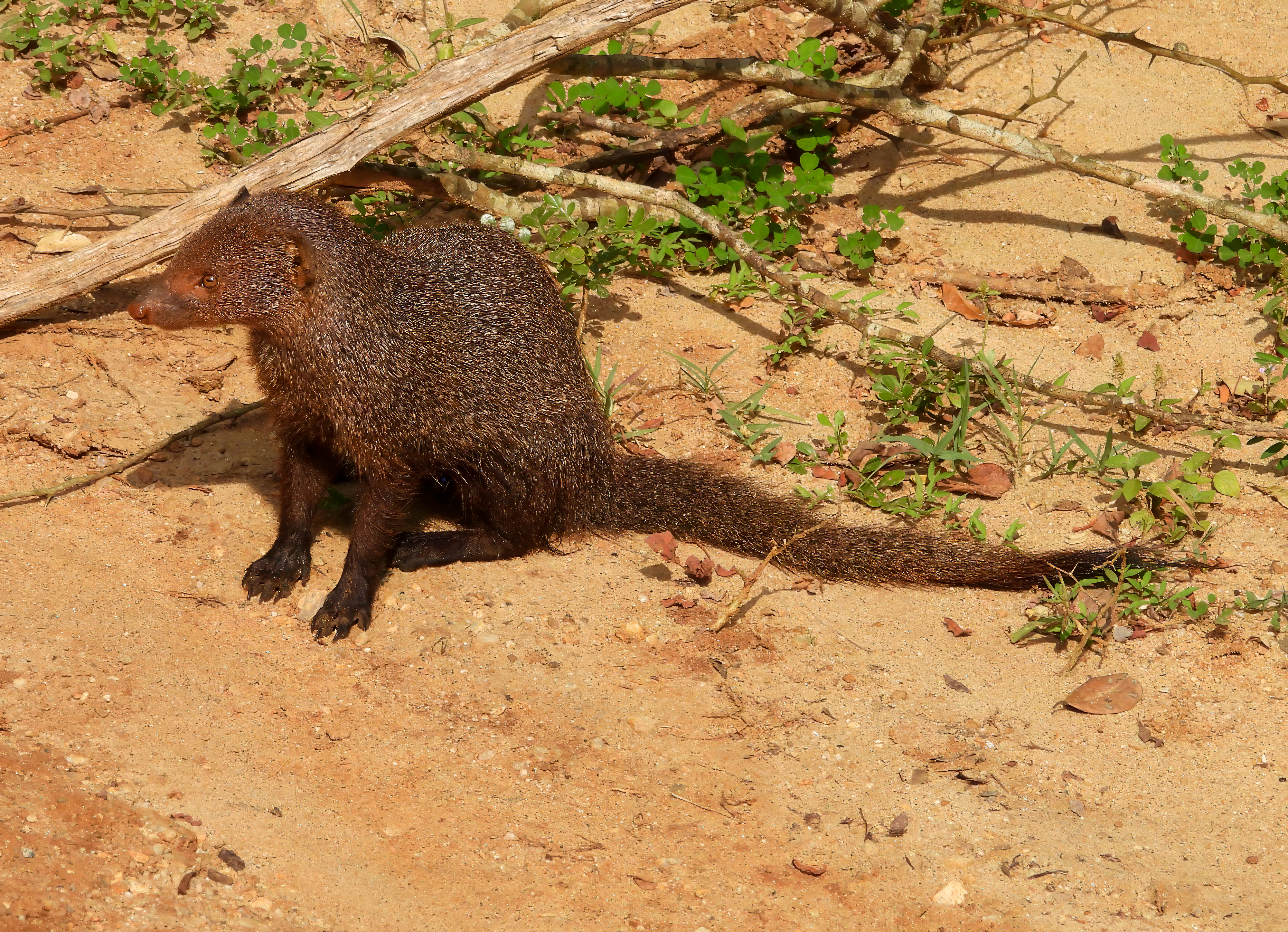
26-3-2025 YALA NAT PARK, SRI LANKA - RUDDY MONGOOSE (Urva smithii)

The ruddy mongoose (Urva smithii) is a mongoose species native to hill forests in India and Sri Lanka.

Its head to body length is 40–45 cm (16–18 in) with a 36 cm (14 in) long tail.[2]

The ruddy mongoose is mainly a forest-living animal and prefers more secluded areas. It has also been recorded in secluded paddy fields and in comparatively open fields.

Herpestes smithii was the scientific name proposed by John Edward Gray in 1837 for a zoological specimen in the collection of the British Museum Natural History. All Asian mongooses are now thought to belong in the genus Urva.

Subspecies:

U. s. smithii

U. s. thysanurus

U. s. zeylanius

The ruddy mongoose (Urva smithii) usually carries its black-tipped tail tip curved upward which is visible from a distance. Like other mongooses, it hunts by day and by night, and feeds on birds, rat snakes, land monitors, rodents and snails. Generally a solitary animal, rarely can be seen in pairs during mating season. However, mother and pup family groups consisting about five animals have been observed.

It is found in thick jungles, forest edges near paddy fields and tea estates. However, withdraw quickly in a crevice or underneath a rock shelf during human confrontation. When cornered, they fight fearlessly with loud and shrill cries.

In Sri Lanka this animal is usually regarded as an unlikable animal and a pest. The golden palm civet (Paradoxurus zeylonensis), altogether a different species endemic to Sri Lanka, is also called hotambuwa due to similar appearance and coloration.

25-4-2025 MONTE CORONA, VALENCIA - BLACK BURROWING BUG (Cydnus aterrimus)


Cydnus aterrimus is a species of burrowing bug in the family Cydnidae. It is found in the Caribbean, Europe and Northern Asia (excluding China), North America, and Southern Asia.

Host Plant is Euphorbia.

26-3-2025 YALA NAT PARK, SRI LANKA - MALABAR PIED HORNBILL (Anthracoceros coronatus)


The Malabar pied hornbill, known scientifically as Anthracoceros coronatus and colloquially as the lesser pied hornbill, is a striking bird with a predominantly black plumage. It measures approximately 65 cm in length and is notable for its large yellow bill topped with a sizeable casque, which is mostly black. The bird's underparts are white, including a distinct throat patch and the sides of its tail. The trailing edges of its wings also bear a white coloration. Males can be distinguished by their lack of white orbital skin, a feature present in females. Juvenile hornbills are recognizable by the absence of a casque and weigh around 1 kg.

When observing the Malabar pied hornbill, look for its contrasting black and white plumage and the impressive casque on its bill. The male's lack of white around the eyes and the bird's size are key identification markers.

This hornbill favours evergreen and moist deciduous forests and often establishes itself near human settlements. It thrives in the lush greenery where it can find ample food and nesting sites.

The Malabar pied hornbill is a common resident breeder in India and Sri Lanka. Its presence is noted across three main regions within the Indian subcontinent: Central and Eastern India, along the Western Ghats, and in Sri Lanka.

26-3-2025 YALA NAT PARK, SRI LANKA - ORANGE BREASTED GREEN PIGEON (Treron bicinctus)


The Orange-breasted Green Pigeon, Treron bicinctus, is a vibrant avian species found across the tropical regions of Asia, extending from the southern Himalayas through parts of the Indian Subcontinent to Southeast Asia. The males of this species are particularly striking with a pinkish and broader orange band across the upper breast, while females exhibit a bright yellow breast. Both sexes share a blue-grey nape, yellowish-green crown, bronzed uppertail coverts, and unmarked rufous undertail coverts.

When identifying the Orange-breasted Green Pigeon, look for the absence of maroon on the wing, which distinguishes it from similar green pigeons. The male lacks grey on the head and instead has a lilac band above the orange breast band. The undertail coverts are cinnamon, edged with yellow, and the tail is grey with a dark subterminal band. Females are yellow below without the bands seen in males, and their undertail coverts are a duller cinnamon with greenish spots. The central tail feathers are slaty grey, a helpful characteristic for differentiation from other species.

This species thrives in forests and is widely distributed in regions such as the Terai and lower Himalayas, the Western and Eastern Ghats, and Sri Lankan forests not far from the coast.

The Orange-breasted Green Pigeon is found across a broad range, including Burma, Thailand, the Malay Peninsula, Vietnam, Java, and Hainan. Some populations exhibit seasonal movements, and vagrants have been recorded in locations like Sind.

26-3-2025 YALA NAT PARK, SRI LANKA - YELLOW WATTLED LAPWING (Vanellus malabaricus)

The Yellow-wattled Lapwing, Vanellus malabaricus, is a distinctive bird endemic to the Indian Subcontinent. It is characterized by its dull grey-brown plumage, contrasting black cap, and striking yellow legs. A notable feature is the triangular yellow wattle at the base of its beak, which gives the species its name. These medium-sized waders exhibit a pale brown coloration with a white underbelly, separated by a narrow blackish line from the brown neck and upper breast.

When identifying the Yellow-wattled Lapwing, look for the black crown separated from the neck by a white band and the large yellow facial wattles. The chin and throat are black, and the tail features a subterminal black band. In flight, a white wingbar is visible on the inner half of the wing. The bill is yellow at the base, and they possess tiny yellow carpal spurs. The sexes appear similar, but males may have slightly longer wings and tarsi.

This species thrives in dry, stony, and open grassland or scrub habitats. They prefer drier environments compared to their cousin, the Red-wattled Lapwing.

The Yellow-wattled Lapwing is commonly found across India, with sightings in Pakistan, Nepal, Bangladesh, and Sri Lanka. They do not typically migrate but may move seasonally in response to rainfall patterns.

These lapwings are sedentary, though they may undertake long-distance movements triggered by the monsoons. They are ground birds, with nests consisting of a simple collection of tiny pebbles. The species is known for its sharp call and swift flight capabilities.

The call of the Yellow-wattled Lapwing is a sharp "tchee-it," which is often heard during their active periods.


Breeding occurs in the dry season, with a peak from March to May, just before the monsoons. Their territories are estimated to be around 2.7 acres, and they typically lay four eggs in a ground scrape. Remarkably, the eggs tend to hatch simultaneously, despite being laid days apart.

While there are no recognized subspecies, there is a size gradient with larger individuals found further north. Juveniles can be distinguished by their brown crowns.

Their diet consists mainly of beetles, termites, and other invertebrates, which they pick from the ground.

The IUCN Red List classifies the Yellow-wattled Lapwing as Least Concern, indicating a stable population without significant threats at present.

Thursday, 24 April 2025

26-3-2025 YALA NAT PARK, SRI LANKA - JERDON'S BUSH LARK (Plocealauda affinis)


The Jerdon's bush lark, known scientifically as Mirafra affinis, is a modestly adorned avian species belonging to the Alaudidae family. It is a bird that captures the essence of the South Asian landscapes, with its understated beauty and harmonious existence within its environment.

When attempting to identify Jerdon's bush lark, one should look for the distinctive arrowhead-like spots pointing upwards on its breast. This species is often confused with the Indian bush lark, but keen observers will note the Jerdon's bush lark's buffy lores, less white behind the ear coverts, and darker centers to the wing coverts and central tail feathers. The primary coverts display dark centers that are quite prominent, and the wing panels are a duller rufous compared to its relatives. The subspecies found in the southern Western Ghats, known as the race ceylonensis, is darker and more rufous on the underside and boasts a longer bill. Overall, the underparts of Jerdon's bush lark are paler and greyish-brown.

This adaptable bird can be found in a variety of open habitats, which include the perimeters of forests, rocky scrublands, meadows on scrubby hills, clearings within open-type forests, shrub-edged fallow croplands, and dense bamboo thickets, up to an elevation of 1500 meters.

The Jerdon's bush lark graces the landscapes of south-east India and Sri Lanka, with an estimated global extent of occurrence spanning 100,000 to 1,000,000 square kilometers.

26-3-2025 LEOPARD TRAILS LODGE, SRI LANKA - ORIENTAL MAGPIE ROBIN (Copsychus saularis)


The Oriental magpie-robin (Copsychus saularis) is a small, striking passerine bird, once grouped with thrushes but now classified among the Old World flycatchers. Males are characterized by their black upperparts, head, and throat, contrasted with a white shoulder patch and white underparts extending to the sides of their long tail. Females, on the other hand, display a more subdued greyish black above and greyish white below. Juveniles bear scaly brown upperparts. This species is known for its long tail, typically held upright, and its melodious song, which has made it a favored cagebird in the past.

The Oriental magpie-robin measures about 19 centimeters in length, including its distinctive long tail. The male's black and white plumage and the female's greyish tones are key identification features. The tail is often cocked upright when the bird is active on the ground, but it assumes a normal position during singing.

These birds are adaptable and can be found in a variety of habitats, from urban gardens to forests. They are often seen close to the ground, foraging in leaf-litter or perching conspicuously.

The Oriental magpie-robin is widespread across the Indian subcontinent and parts of Southeast Asia, including Nepal, Bangladesh, India, Sri Lanka, Pakistan, Indonesia, Thailand, China, Malaysia, and Singapore.

Magpie-robins are territorial, especially during the breeding season when males sing from high perches. They are known to be aggressive in defending their territory and may even respond to their own reflections. Their foraging behavior includes hopping along branches and rummaging through leaf-litter.

The Oriental magpie-robin is celebrated for its varied and melodious song, which includes imitations of other bird species. Calls range from territorial to distress signals, with a distinctive harsh mobbing call sounding like a hissing 'krshhh'.

Breeding season varies by region, with nests typically found in tree hollows or wall crevices. The female is primarily responsible for nest building and incubation, which lasts 8 to 14 days. Eggs are pale blue-green with brown speckles, and clutches usually consist of four to five eggs.

While there are no very similar species within its range, the Oriental magpie-robin can be confused with the Philippine magpie-robin (Copsychus mindanensis), which is now recognized as a separate species.

Primarily insectivorous, the Oriental magpie-robin's diet consists of insects and other invertebrates, though it may occasionally consume nectar, geckos, leeches, centipedes, and even small fish.

The IUCN lists the Oriental magpie-robin as Least Concern, but its populations are declining in some areas due to habitat loss, competition from other species, and trapping for the pet trade. They are protected by law in some regions.

The Oriental magpie-robin holds cultural significance in various countries. It is the national bird of Bangladesh, known locally as the doyel or doel, and is a symbol of pride, appearing on currency and in public squares. In Sri Lanka, it is called Polkichcha, and in southern Thailand, it is known as Binlha, often featured in local songs.

26-3-2025 LEOPARD TRAILS LODGE, SRI LANKA - INDIAN ROBIN (Copsychus fulicatus)

The Indian robin, Copsychus fulicatus, is a small passerine bird that is part of the Muscicapidae family. Exhibiting sexual dimorphism, the males are distinguished by their striking black plumage with a white shoulder patch, while the females are more subdued in coloration, with brownish-grey feathers. The species is known for its long tail, which is characteristically held upright, revealing the chestnut undertail coverts.

Males of the Indian robin can be identified by their black bodies and the white shoulder patch, which can vary in visibility. The northern subspecies have brownish upper plumage, which becomes progressively blacker as one moves southward. Females lack the white shoulder stripe and are greyish below. Juveniles resemble females but have a mottled throat.

The Indian robin favors open scrub areas, often found in stony, grassy, and scrub forest habitats. It tends to avoid dense forests and regions with high rainfall.

This bird is widespread across the Indian subcontinent, with its range extending through Bangladesh, Bhutan, India, Nepal, Pakistan, and Sri Lanka. It is a resident species, showing no migratory behavior.

The Indian robin is often seen running along the ground or perching on low thorny shrubs and rocks. Males are territorial and can be quite aggressive during the breeding season, engaging in displays and even attacking their own reflections.

26-3-2025 LEOPARD TRAILS LODGE, SRI LANKA - PIED PADDY SKIMMER DRAGONFLY (Neurothemis tullia)

Neurothemis tullia, the pied paddy skimmer, is a species of dragonfly found in south and south-east Asia. It appears in Bangladesh, China, Hong Kong, India, Malaysia (Peninsular Malaysia), Myanmar, Nepal, Sri Lanka, Taiwan, Thailand, Cambodia and Viet Nam.


It is a black dragonfly with a pale yellow mid-dorsal carina of thorax. Wings are hyaline for apical half and opaque steely blue-black for basal half which is bordered by a milky white patch towards the tip. Females differ remarkably from the males both in body-colouring and markings and in marking of the wings. Its body is greenish yellow with a bright yellow mid-dorsal carina of thorax. Base of wings are amber yellow followed by a blackish brown patch. Apices of all wings are broadly opaque blackish brown and the remaining halves are pale yellow.

It breeds in marshes, well vegetated ponds, lakes and rice fields. It perches very close to ground and its flight is very weak

26-3-2025 LEOPARD TRAILS LODGE, SRI LANKA - LITTLE CORMORANT (Microcarbo niger)


The Little Cormorant, Microcarbo niger, is a dainty member of the cormorant family, measuring about 50 centimeters in length. In its breeding attire, it boasts a sleek, all-black plumage adorned with white spots and delicate filoplumes on its face, and a modest crest on the back of its head. The non-breeding or juvenile birds display a more subdued brownish plumage, with a small, distinct white patch on the throat.

Distinguishable from the slightly larger Indian Cormorant by its shorter beak and absence of a peaked head, the Little Cormorant has dark eyes and facial skin. Males and females appear similar, though males are generally larger. A rare silvery-grey plumage has been noted in some individuals.

The Little Cormorant frequents a variety of freshwater bodies, from diminutive village ponds to expansive lakes, and occasionally coastal estuaries.

This species is widely distributed across the Indian Subcontinent, extending east to Java. It is absent from the Himalayas, though vagrants have been spotted in Ladakh.

Often seen perched on waterside rocks with wings outstretched, the Little Cormorant forages alone or in small groups. It dives underwater, propelled by webbed feet, to catch fish, which are sometimes stolen by other birds when brought to the surface.

26-3-2025 LEOPARD TRAILS LODGE, SRI LANKA - COMMON GRASS YELLOW BUTTERFLY (Eurema hecabe)


Eurema hecabe, the common grass yellow, is a small pierid butterfly species found in Asia, Africa and Australia. They are found flying close to the ground and are found in open grass and scrub habitats. It is simply known as "the grass yellow" in parts of its range; the general term otherwise refers to the entire genus Eurema.

The common grass yellow exhibits seasonal polyphenism. The lepidopteran has a darker summer morph, triggered by a long day exceeding 13 hours in duration, while the shorter diurnal period of 12 hours or less induces a fairer morph in the post-monsoon period.

26-3-2025 LEOPARD TRAILS LODGE, SRI LANKA - CREEPING BURHEAD (Echinodorus cordifolius)

Echinodorus cordifolius, the spade-leaf sword or creeping burhead, is a species of aquatic plants in the Alismatales. It is native to Mexico, the West Indies, Central America, South America (as far south as Paraguay) and the southeastern United States (Texas to Florida and as far north as Iowa).[1][2]

Found in marshes, swamps, ditches and ponds. Blooms in the late summer to early fall.

Herbs, perennial, stout, to 100 cm; rhizomes present. Leaves emersed, submersed leaves mostly absent; petiole 5--6-ridged, 17.5--45 cm; blade with translucent markings distinct lines, ovate to elliptic, 6.5--32 ´ 2.5--19.1 cm, base truncate to cordate. Inflorescences racemes, of 3--9 whorls, each 3--15-flowered, decumbent to arching, to 62 ´ 8--18 cm, often proliferating; peduncles terete, 35–56 cm; rachis triangular; bracts distinct, subulate, 10–21 mm, coarse, margins coarse; pedicels erect to ascending, 2.1--7.5 cm. Flowers to 25 mm wide; sepals spreading, 10–12-veined, veins papillate; petals not clawed; stamens 22; anthers versatile; pistils 200–250. Fruits oblanceolate, plump, 3--4-ribbed, abaxially 1-keeled, 2--3.5 ´ 0.9--1.5 mm; glands 3--4; beak terminal,1--1.3 mm. 2n = 22.[4]

Echinodorus cordifolius is very easily recognized, as it is the only species with arching to decumbent inflorescences. In addition, it is the only one with papillate veins on the sepals.

Easily cultivated in neutral to soft water and tropical to sub-tropical temperatures. Rich substrate and good light. Common in the cultivated aquarium trade.

26-3-2025 LEOPARD TRAILS LODGE, SRI LANKA - LITTLE BLUE MARSH HAWK DRAGONFLY (FEMALE) (Brachydiplax sobrina)


Brachydiplax sobrina is a species of dragonfly in the family Libellulidae. It is native to Bangladesh, India, Myanmar, Nepal, Sri Lanka, and Thailand.

It is a small dragonfly with dark-brown eyes. Its thorax is yellowish-brown, with black metallic markings. All marks are obscured by bluish-white pruinescence in adults. Abdomen is black on dorsum, marked with broad yellow spots on the sides in sub-adults and tenerals. All the marks are obscured by blue pruinescence in adults. Female is similar to the teneral male.

It breeds in marshes, ditches, and ponds.

26-3-2025 LEOPARD TRAILS LODGE, SRI LANKA - PLAIN PRINIA (prinia inornata)


The Plain Prinia, or Prinia inornata, known also as the plain wren-warbler or white-browed wren-warbler, is a diminutive bird of the Cisticolidae family. Measuring 13–14 cm in length, these warblers possess short, rounded wings, a relatively long tail, sturdy legs, and a succinct black bill. The breeding plumage of adults is characterized by a grey-brown upper body, a conspicuous short white supercilium, and rufous fringes on the closed wings, while the underparts are of a whitish-buff hue. Both sexes exhibit identical plumage.

In the non-breeding season, the Plain Prinia's upperparts transition to a warmer brown, and the underparts take on a more pronounced buff color. The tail elongates during this period. Geographic variations exist among the subspecies, with differences in plumage shade. Notably, the endemic Sri Lankan race maintains its summer plumage and shorter tail throughout the year.


The Plain Prinia is a bird that favors wet lowland grasslands, open woodlands, and scrub areas. It can also be found in gardens, adapting to human-altered landscapes.

This resident breeder's range extends from Pakistan and India to South China and Southeast Asia. It was once considered conspecific with the Tawny-flanked Prinia, which is found in Africa south of the Sahara, but they are now generally recognized as separate species.

The Plain Prinia is a skulking bird, often remaining hidden within its preferred habitats. It constructs its nest within a shrub or amidst tall grasses, where it lays a clutch of three to six eggs. This contrasts with the Tawny-flanked Prinia, which prefers to nest in herbage and typically lays two to four eggs.

LEOPARD TRAILS LODGE, SRI LANKA - ORIENTAL DARTER (Anhinga melanogaster)


The Oriental darter, Anhinga melanogaster, is a water bird of tropical South Asia and Southeast Asia. It is characterized by its long and slender neck, which is reminiscent of a snake, hence its colloquial name "snakebird." The bird's plumage is predominantly black with silvery streaks on the wing coverts and tertials. The underparts are blackish brown, and a pale line over the eye and throat, along with a line running along the sides of the neck, gives it a striped appearance.

Adult Oriental darters can be identified by their white iris with a yellow ring, a dark tip on the upper mandible, and yellowish lower mandible. The legs and webbing on the foot are yellow in immatures and non-breeding birds, while breeding birds have darker grey tarsi and toes with yellow webbing. In flight, the bird's long and slender neck, wide wings, and wedge-shaped tail make it distinctive.

The Oriental darter is typically found in freshwater lakes and streams, where it can be seen foraging alone with its body submerged and neck moving jerkily above the water.

This species is native to tropical regions of South Asia and Southeast Asia.

The Oriental darter hunts by submerging its body in water and darting its neck forward with rapid force to stab fish underwater. It then brings the fish to the surface, tossing it before swallowing head first. The bird is often seen perched on a rock or branch with wings held open to dry, as its feathers are wettable like those of cormorants. It may soar on thermals or alternate flapping and gliding in flight.