TOTAL PAGEVIEWS

TRANSLATE

Friday, 23 November 2018

20-4-2018 OKAVANGO DELTA, BOTSWANA - CHOBE BUSHBUCK (FEMALE) (Tragelaphus sylvaticus ssp. ornatus)


The Chobe bushbuck is a medium-sized antelope and is the smallest of the spiral-horned species of antelope. The horns are short, spiraled and sharply pointed. It is strongly built with a hunched back, large ears and a bushy tail. The Chobe bushbuck is reddish-brown with white vertical stripes on its side and white spots on the shoulders, hindquarters and face. There is considerable local and individual variation in its patterns of spots and stripes. 

The buck has a white dorsal crest. It is a nocturnal browser, very shy and barks when alarmed or disturbed. It is a very territorial animal. It is seen singly or in pairs. The female is smaller than the buck, does not have horns and its markings are less conspicuous.


The bushbuck is found in dense thick bush in low elevations as well as in mountains near a permanent supply of water.

It is found in Eastern Angola, northeastern Namibia including the Caprivi strip, northern Botswana, Zambia, southeastern Congo (Zaire), Malawi, northern and western Mozambique, Zimbabwe except in the Limpopo drainage.

The smallest of the spiral-horned antelopes, the bushbuck is the most widely distributed ungulate on the African continent; occurring from as far west as southern Mauritania and Senegal, east across the Sahel to Ethiopia and Somalia and south in all countries to South Africa. Bushbuck are singularly unusual in their ubiquity.

Throughout their extensive distributional range, they inhabit, and appear to be adapted, to a wide variety of ecotypes including rainforest, wooded savanna, semi-arid to arid savanna, sub-desert, fynbos and montane forest. Bushbuck are dependent only on the cover offered by forests, dense bush and thickets (Dorst and Dandelot, 1970). They are usually found in the vicinity of permanent water but are able to subsist on dew in waterless areas (Kingdon 1997).

20-4-2018 OKAVANGO DELTA, BOTSWANA - AFRICAN SAVANNA ELEPHANT (Loxodonta Africana)


The African bush elephant has grey skin with scanty hairs. Its large ears cover the whole shoulder and can grow as large as 2 m × 1.5 m (6 ft 7 in × 4 ft 11 in). Its large ears help to reduce body heat; flapping them creates air currents and exposes large blood vessels on the inner sides to increase heat loss during hot weather. The African bush elephant's ears are pointed and triangular-shaped. Its occipital plane slopes forward. Its back is shaped markedly concave. Its sturdy tusks are curved out and point forward. The trunk is a prehensile extension of the upper lip and nose. Short tactile hair grows on the trunk, which has two finger-like processes on the tip. This highly sensitive organ is innervated primarily by the trigeminal nerve and is thought to be manipulated by about 40,000-60,000 muscles. Because of this muscular structure, the trunk is so strong that elephants can use it for lifting about 3% of their own body weight. They use it for smelling, touching, feeding, drinking, dusting, sound production, loading, defending, and attacking. Both sexes have tusks, which erupt when they are 1-3 years old and grow throughout life. Tusks grow from deciduous teeth known as tushes that develop in the upper jaw and consist of a crown, root, and pulpal cavity, which are completely formed soon after birth. Tushes reach a length of 5 cm (2.0 in). The tusks of males grow faster than the tusks of females.

20-4-2018 OKAVANGO DELTA, BOTSWANA - BENNETT'S WOODPECKER (Campethera bennettii)


The Bennett's woodpecker, a species of bird in the Picidae family, is a striking figure in the woodlands and bushes of Africa. This bird, approximately 24 cm in length and weighing between 61 to 84 grams, is adorned with a palette of colors that include brown, yellow, white, and pale yellow. The male is particularly distinctive with its red forehead, crown, and nape, while the female sports a black forehead with white spots and brown or blackish-brown ear coverts and throat.

To identify the Bennett's woodpecker, look for the male's vibrant red head and the female's spotted black forehead. Both sexes have red eyes, a grey beak, and legs that are either bluish-green or grey-green. The underparts are pale yellow with dark spots on the breast and flanks. Juveniles have a black forehead and crown with darker upperparts. The subspecies C. b. capricorni is slightly larger with deeper colored underparts and fewer spots.

Bennett's woodpecker favors woodlands and bushes, including miombo, Baikiaea, Acacia, and mopane woodlands, which provide ample foraging opportunities and nesting sites.

22-4-2018 OKAVANGO DELTA, BOTSWANA - BLACK COLLARED BARBET ( Lybius corquatus)


The Black-collared Barbet, Lybius torquatus, is a plump and vividly marked bird, native to the diverse landscapes of sub-Saharan Africa. It is easily recognized by its robust size, typically ranging from 20 to 25 centimeters in length, and its large head adorned with a heavy, bristle-fringed bill characteristic of its genus. The species is named for its striking black collar and head, which contrast with the fiery red plumage surrounding its eyes and beak. Notably, the Black-collared Barbet exhibits morphological variability, with some individuals replacing the red head with a black one. Despite this variation, the species is sexually monomorphic, showing no discernible difference between males and females in either morphology or behavior.

When identifying the Black-collared Barbet, look for the distinctive black collar and head, as well as the intense red coloration around the eyes and beak. The bird's larger size sets it apart from other barbets. Its plumage may vary, with some individuals displaying a black head instead of the typical red. Both sexes appear identical, making sex differentiation in the field a challenge.


The Black-collared Barbet thrives in a variety of habitats across sub-Saharan Africa, including woodlands and savannas, where it can be found inspecting trees and utilizing nest holes for roosting.

This species has a wide range across sub-Saharan Africa, from Angola to Kenya, and southward to South Africa, encompassing countries such as Botswana, Burundi, the Democratic Republic of the Congo, Eswatini, Lesotho, Malawi, Mozambique, Namibia, Rwanda, Tanzania, Uganda, Zambia, and Zimbabwe.

The Black-collared Barbet is a gregarious bird, often seen acting in unison with others of its kind to repel intruders. They are known to roost together in groups, sometimes numbering up to 15 individuals in a single nest hole. Their flight is characterized by a direct path and a loud whirring of wings.

The vocal repertoire of the Black-collared Barbet is dominated by its antiphonal duets, often described as "too-puddly" or "too-doodle" calls. These duets are synchronized, with one bird singing a note followed by its partner, creating a seamless auditory experience. The birds engage in a greeting ceremony that includes wing-flicking and bowing to each other. In addition to its duets, the barbet produces a variety of calls, including a snarling warning and a loud buzzing.


The breeding season for the Black-collared Barbet occurs from December to February, during which time they may engage in more elaborate wing and flight displays as part of their mating rituals.

While the Black-collared Barbet is distinctive in its appearance, it may be confused with other barbet species. However, its larger size, intense coloration, and unique duetting behavior are key differentiators.

The diet of the Black-collared Barbet is predominantly frugivorous, with a preference for a variety of fruits and vegetables. They are known to visit plantations in search of food, consuming fruits whole and later regurgitating the seeds. Although less frequently, they may also feed on insects, centipedes, lizards, frogs, and geckos.

Thursday, 22 November 2018

22-11-2018 MONTE CORONA , VALENCIA - LEAF BEETLE (Genus Timarcha)


Timarcha is a genus of leaf beetles in the family Chrysomelidae, with more than 100 described species in three subgenera. The most widely known species is T. tenebricosa, the bloody-nosed beetle. All species are black, wingless organisms. Timarcha are herbivorous species, living mostly on plants belonging to Rubiaceae and Plumbaginaceae, although a few can feed on Brassicaceae and Rosaceae. Timarcha is the only member of the tribe Timarchini.

21-4-2018 ULLAL DE BOLDOVI , VALENCIA - BLACK JACK (Bidens pilosa)


Bidens pilosa is an annual species of herbaceous flowering plant in the daisy family Asteraceae. Its many common names include hitch hikers, black-jack, beggarticks, farmer's friends and Spanish needle, but most commonly referred to as cobblers pegs. It is native to the Americas but is widely distributed as an introduced species in other regions including Eurasia, Africa, Australia, South America and the Pacific Islands, and is classified as an invasive species in some regions of the world.

Bidens pilosa is a branched annual forb of gracile habit, growing up to 1.8 meters tall. It grows aggressively on disturbed land and often becomes weedy. The leaves are all oppositely arranged and range from simple to pinnate in form, the upper leaves with three to five dentate, ovate-to-lanceolate leaflets. The petioles are slightly winged.

The plant may flower at any time of the year, but mainly in summer and autumn in temperate regions. The flowers are small heads borne on relatively long peduncles. The heads consist of about four or five broad white ray florets (ligules), surrounding many tubular yellow disc florets without ligules that develop into barbed fruits.

The fruits are slightly curved, stiff, rough black rods, tetragonal in cross section, about 1 cm long, typically with two to three stiff, heavily barbed awns at their distal ends.

21-11-2018 ALBUFERA, VALENCIA - WHITE WAGTAIL (Motacilla alba)


The White Wagtail (Motacilla alba) is a small, elegant passerine bird, a member of the family Motacillidae, which includes pipits and longclaws. This slender bird measures between 16.5 to 19 cm in length, with East Asian subspecies reaching up to 21 cm. It is characterized by its long, constantly wagging tail, a behavior that has become synonymous with the genus. Weighing an average of 25 g, the White Wagtail can live up to 12 years in the wild.

Adult White Wagtails exhibit a distinctive plumage with a combination of grey, black, and white. The bird's upper parts are generally grey, with a white face, belly, and breast. Males during the breeding season may show a darker back, and the species is known for its sharp, brisk call and more melodious song during courtship.

The White Wagtail is commonly found in open country, often in close proximity to human habitation and water sources. It shows a preference for bare areas which facilitate the sighting and pursuit of prey. This bird has adapted well to urban environments, utilizing paved areas such as parking lots for foraging.


This species has a vast breeding range across Europe, the Asian Palearctic, parts of North Africa, and has a presence in Alaska. It is a migratory bird, with populations moving to Africa and parts of Asia during the winter. In Great Britain and Ireland, the darker subspecies known as the Pied Wagtail is more prevalent.

The White Wagtail is known for its perpetual tail wagging, a behavior that remains somewhat enigmatic but is thought to be a signal of vigilance to predators. It is a monogamous bird that defends its breeding territory with determination.

The call of the White Wagtail is a sharp "chisick," softer than that of the Pied Wagtail. Its song is more structured and is used by males to attract females rather than to mark territory.

White Wagtails are monogamous breeders, with both sexes contributing to nest building. The nest is often placed in crevices or holes near water or in human-made structures. The species lays three to eight cream-colored, speckled eggs, which both parents incubate. Chicks fledge after 12 to 15 days and continue to be fed for a week thereafter.

The Pied Wagtail, particularly the subspecies M. a. yarrellii, is similar but has a darker back and is found in Great Britain and Ireland. Other subspecies vary in wing, back, and head coloration.

The diet of the White Wagtail primarily consists of insects and small invertebrates, including beetles, dragonflies, flies, and crustaceans. It continues to feed on insects even in winter, unlike many other insectivorous birds in temperate climates.

Wednesday, 21 November 2018

21-11-2018 ALBUFERA, VALENCIA - NORTHERN LAPWING (Vanellus vanellus)


The Northern Lapwing, known scientifically as Vanellus vanellus, is a distinctive bird with a notable crest on its head. It measures 28–33 cm in length, with a wingspan of 67–87 cm and a body mass ranging from 128–330 g. The species exhibits sexual dimorphism; males have a pronounced crest and a stark black crown, throat, and breast, which contrasts sharply with their white face. Females and juveniles have shorter crests and less defined head markings, but their overall plumage is similar to that of the males, with a black and white coloration and a greenish tint on the back.

When identifying the Northern Lapwing, look for its rounded wings, short legs, and the characteristic crest that adorns its head. The male's long crest and contrasting black and white facial patterns are particularly striking during the breeding season. In flight, the species can be recognized by its slow wingbeats and the rounded shape of its wings.

The Northern Lapwing is a ground-nesting bird that favors open landscapes such as cultivated fields, grasslands, and wetlands. It is adaptable and can be found in a variety of temperate environments across Eurosiberia.


This bird is a widespread resident throughout temperate regions of Eurosiberia. It is highly migratory, wintering in regions as far south as North Africa and parts of Asia. Western European populations are more sedentary, while vagrants have been known to appear in North America following storms.

The Northern Lapwing is known for its acrobatic display flights, accompanied by a cacophony of calls during the breeding season. It migrates predominantly during the day, often in large flocks. The species is fiercely protective of its nest and young, boldly confronting any potential threats. In winter, it gathers in massive flocks on open land, and it is known to feed nocturnally when the moon is bright.

The Northern Lapwing is quite vocal, especially in the breeding season. Its contact call is a loud "pee-wit," which is also the origin of one of its common names. Males perform a display flight while emitting a wheezy "pee-wit, wit wit, eeze wit," and they may also produce squeaking or mewing sounds.


Breeding takes place on the ground in a simple scrape. The species typically lays 3–4 eggs, which are zealously defended against all intruders. The Northern Lapwing's breeding strategy includes feigning injury to distract predators from its nest.

The Northern Lapwing can be confused with other lapwing species, but its unique crest and the coloration of the male during the breeding season are distinguishing features.

Its diet consists primarily of insects and other small invertebrates. The Northern Lapwing often feeds in mixed flocks with Golden Plovers and Black-headed Gulls, the latter of which may steal food but also offer some protection against predators.

21-11-2018 ALBUFERA, VALENCIA - MEADOW PIPIT (Anthus pratensis)


The Meadow Pipit, Anthus pratensis, is a small, unassuming bird of the passerine family. It measures between 14.5 to 15 cm in length and weighs a mere 15 to 22 grams. Its plumage is predominantly brown above and buff below, with darker streaks adorning most of its body. The tail is brown with narrow white edges, and it stands on pale pinkish-yellow legs. A distinctive feature is its notably long hind claw, surpassing the length of its other hind toes.

When identifying the Meadow Pipit, look for its streaked appearance and listen for its weak "tsi-tsi" call. In flight, observe its song, which is a simple, repetitive tune that increases in pace towards the end. The bird's small size and long hind claw are also key identification markers.

The Meadow Pipit favors open spaces such as pastures, bogs, and moorlands. It can also be found in low-intensity agricultural areas and, during winter, in saltmarshes and occasionally open woodlands.

This species breeds across the Palearctic, from Greenland and Iceland to the Ural Mountains, and south to central France and Romania. An isolated population resides in the Caucasus Mountains. While migratory over most of its range, wintering in southern Europe, North Africa, and southwestern Asia, it remains resident year-round in western Europe.


The Meadow Pipit is a terrestrial bird, feeding on the ground and using elevated perches to scan for predators. It is known to move to the coast or lowlands during winter, even in areas where it is considered resident.

The call of the Meadow Pipit is a soft "tsi-tsi." Its song, delivered during a short song flight, is a simple melody that quickens as it progresses.

Nests are well-concealed on the ground in dense vegetation. Clutches typically contain two to seven eggs, which hatch after 11 to 15 days. Fledging occurs 10 to 14 days post-hatching, and the species often raises two broods per year. The Meadow Pipit is a frequent host for the cuckoo's parasitic breeding strategy.

The Meadow Pipit can be confused with the Red-throated Pipit, which has more pronounced streaking and an orange-red throat in summer, and the Tree Pipit, which is larger, less streaked, and has stronger facial markings and a shorter hind claw.

Its diet consists mainly of insects and other invertebrates, favoring prey less than 5 mm in length. During winter, it also consumes seeds from grasses, sedges, rushes, heather, and crowberry berries.

The Meadow Pipit is classified as Least Concern by the IUCN. However, there has been a noted decline in populations, particularly in French farmland, where numbers have dropped by 68% over the past 17 years.

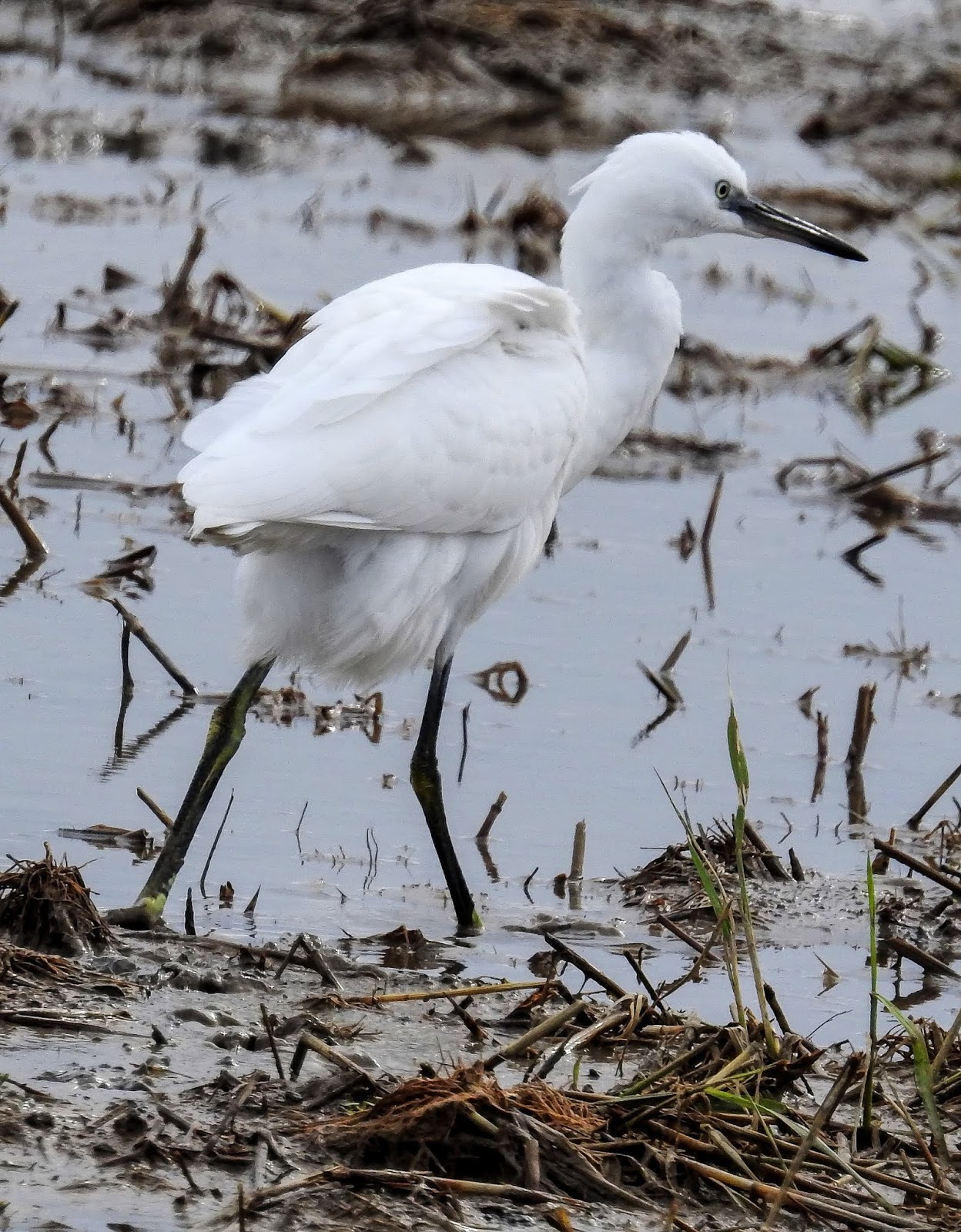
21-4-2018 ALBUFERA, VALENCIA - LITTLE EGRET (Egretta garzetta)


The Little Egret is a small, all-white egret, similar in shape but half the size of a Grey Heron.

Little Egrets are elegant, snow-white wading birds with long legs and a long S-shaped neck. Their straight, dagger-like bill is black, and their eyes are yellow. These birds have black legs with characteristic yellow feet, although this feature is often hidden under the water.

Female Little Egrets are smaller than their male counterparts but otherwise similar. In the breeding season, both sexes develop long paired plumes on the nape of the neck and long feathers on the breast and shoulders.

Juveniles appear similar to non-breeding adults but have dull greenish bills and legs and lack yellow feet.

Little Egrets in the UK are most likely to be confused with another all-white species, the Great White Egret (Ardea alba). However, that species is much taller and larger, with a yellow bill and yellow upper legs.

The Little Egret may appear large in flight or when standing tall with a fully extended neck, but they can look dramatically smaller when hunched at rest.

21-4-2018 ALBUFERA, VALENCIA - GREAT EGRET (Ardea alba)


The great egret, known scientifically as Ardea alba, is a majestic bird with a stately bearing and an impressive wingspan. This large egret is adorned with all-white plumage and can stand up to a meter tall. It is a cosmopolitan species, found across temperate and tropical regions worldwide.

To identify the great egret, look for its yellow bill and contrasting black legs and feet, which may vary slightly during the breeding season. During this time, the bill may darken, and the lower legs may lighten. The great egret also sports ornamental feathers on its back when in breeding plumage. Both sexes appear identical, and juveniles resemble nonbreeding adults. The great egret can be distinguished from the intermediate egret by the gape of its bill, which extends well beyond the back of the eye.

The great egret favors habitats close to water, such as large lakes with reed beds and other extensive wetlands. It nests in colonies, often at heights of 10 to 40 feet within trees.

This bird has a vast range, occurring worldwide in suitable habitats. It is particularly common across the Sun Belt of the United States and throughout the Neotropics.

The great egret is known for its slow, graceful flight with its neck retracted, a characteristic of herons and bitterns. It walks with its neck extended and wings held close. Generally silent, it may emit a low, hoarse croak when disturbed and a louder croaking at breeding colonies.


The great egret's vocalizations include a low croak when disturbed and various croaking and squawking sounds during the breeding season.

Breeding begins at 2-3 years of age with monogamous pairings. The male initiates nest building to attract a female. The nest is a sizable structure of sticks, lined with plant material. The species lays up to six bluish-green eggs, with both parents sharing incubation duties over 23-26 days. The young are fed by regurgitation and can fly within 6-7 weeks.

The great egret's diet consists of fish, frogs, small mammals, reptiles, crustaceans, and insects. It typically forages in shallow water, standing still or slowly stalking its prey before impaling it with its sharp bill.

The great egret is listed as Least Concern by the IUCN. It has recovered from historical threats such as plume hunting and has adapted well to human presence. It is partially migratory, with some populations moving south during colder winters. The species is a symbol of conservation success and represents the National Audubon Society.

21-11-2018 ALBUFERA, VALENCIA - EURASIAN GREAT CORMORANT (Phalacrocorax carbo)


The great cormorant (Phalacrocorax carbo), a robust seabird, is cloaked in predominantly black plumage. It is a member of the cormorant family, with a widespread distribution. The species exhibits considerable size variation across its range, with males generally larger than females. Notable features include a longish tail and a distinctive yellow throat-patch. During the breeding season, adults boast white patches on their thighs and throat.

To identify the great cormorant, look for its large size, heavy build, and thick bill. It lacks a crest and its plumage does not have a green tinge, distinguishing it from the common shag. In North America, it is bulkier than the double-crested cormorant and has less yellow on the throat and bill. The white thigh patches are a key identifier.

Great cormorants are found in a variety of aquatic environments including seas, estuaries, freshwater lakes, and rivers. They often nest in colonies close to these water bodies.

This species has a broad distribution, breeding across the Old World, Australia, and the Atlantic coast of North America. Northern populations tend to migrate southward in winter, seeking coasts rich in fish.

Great cormorants are generally silent but may emit guttural noises at breeding colonies. They are known for their wing-drying posture, often seen with wings outstretched to dry after diving.

21-11-2018 ALBUFERA, VALENCIA - CATTLE EGRET (Bubulcus ibis)


The Cattle Egret, a member of the heron family Ardeidae, is a small white bird recognized for its association with grazing animals. It exhibits a stout build, with a wingspan ranging from 88 to 96 cm, and a body length between 46 to 56 cm. The species is relatively light, weighing between 270 to 512 grams. It is characterized by a short, thick neck, a robust bill, and a somewhat hunched posture.

Outside the breeding season, the adult Cattle Egret has predominantly white plumage, a yellow bill, and greyish-yellow legs. Come breeding time, the western variety develops striking orange-buff plumes on the back, breast, and crown, while the bill, legs, and irises turn a vivid red. The eastern variety differs slightly with buff coloration extending to the cheeks and throat during breeding, and the plumes taking on a more golden hue. Both sexes are similar in appearance, though males are marginally larger with longer breeding plumes.


Cattle Egrets are adaptable birds that exploit a variety of drier and open habitats more than other heron species. Their preferred environments include seasonally inundated grasslands, pastures, farmlands, wetlands, and rice paddies.

Originally native to parts of Asia, Africa, and Europe, the Cattle Egret has seen a significant expansion in its distribution, colonizing much of the rest of the world over the last century. It is now found in the tropics, subtropics, and warm-temperate zones globally.


Cattle Egrets are often seen in the company of cattle or other large mammals, benefiting from the insects and small vertebrates these animals disturb. They are known for their migratory behavior, with some populations moving seasonally, while others disperse post-breeding.

At breeding colonies, the Cattle Egret emits a soft, guttural "rick-rack" call but is generally quiet outside this setting.


Breeding occurs in colonies, often near water and in the company of other wading birds. The nest is a platform of sticks in trees or shrubs. Both parents are involved in nest construction and incubation, which lasts about 23 days. Chicks are born with some down and are dependent on their parents for warmth and food.


The Cattle Egret can be confused with other white egrets, but its shorter neck, more robust build, and behavior around livestock help distinguish it.


The diet is varied, primarily consisting of insects like grasshoppers, crickets, and flies. They also consume spiders, frogs, small reptiles, and occasionally bird eggs and chicks. They are known to forage in fields, often near grazing animals, and have been observed following farm machinery to catch disturbed prey.

The Cattle Egret is classified as Least Concern by the IUCN, with an extensive range and a large, stable population. Its successful colonization of new areas has led to it being considered an invasive species in some regions, though it has not yet been noted to have significant negative impacts.

21-11-2018 ALBUFERA, VALENCIA - BLACK HEADED GULL (Chroicocephalus ridibundus)


Fairly small gull, common and widespread across Eurasia. All plumages have big white blaze on leading edge of wing. Breeding adult has dark brown (not black) hood, red bill and legs; nonbreeding and immature have dark ear spot on white head, dark tip to red bill. Juvenile has mottled brownish back, which molts to pale gray by winter. Can be found in essentially any wet habitat, from duck ponds and farm fields to wild wetlands and seacoasts. Locally occurs in flocks of hundreds, sometimes thousands. 

Rare but regular vagrant to North America, especially in the northeast, where usually seen singly among flocks of Bonaparte’s or Ring-billed Gulls. Compared to nonbreeding Bonaparte’s, note Black-headed’s red bill, dark red legs, and more extensive black in underwings.

21-11-2018 ALBUFERA, VALENCIA - BLACK CROWNED NIGHT HERON (JUVENILE) (Nycticorax nycticorax)


The Black-crowned Night Heron, scientifically known as Nycticorax nycticorax, is a medium-sized heron with a global presence, spanning parts of Europe, Asia, and the Americas. It is distinguished by its black crown and back, contrasting with a white or grey body, red eyes, and short yellow legs. Notably, it deviates from the typical heron silhouette, appearing more robust with shorter bills, legs, and necks compared to its egret and day heron relatives.

Adults boast a striking black crown and back, with the rest of their plumage primarily white or grey. Their eyes are a vivid red, and they stand on short yellow legs. During social interactions, such as greeting or courtship, they display two or three elongated white plumes that extend from the back of their heads. Males and females are similar in appearance, though males may be marginally larger. Juveniles, on the other hand, are cloaked in a dull grey-brown with pale spots and streaks, and their eyes are a more subdued orange with less vibrant legs.

These herons favor fresh and salt-water wetlands as their breeding grounds, which are found across their vast range.


The Black-crowned Night Heron breeds across various regions: from Eurasia to Africa, the Indonesian Archipelago, North and South America, and even the remote Falkland Islands. While migratory in the northern extremes, it is generally a resident species, with North American populations wintering in warmer climes from Mexico to the West Indies.

Known for their ambush hunting tactics, these herons stand motionless at the water's edge, striking at prey primarily during the night or early morning. They exhibit a diverse diet, consuming fish, amphibians, insects, and more. They are also one of the few heron species to use tools, such as bait, to fish. By day, they rest in trees or shrubbery, and outside of breeding season, some subspecies display more sociable tendencies.


The Black-crowned Night Heron is a vocal species within its colonies, often heard making a "quok" or "woc" sound.

Colonial nesters, they construct platforms of sticks in trees or on the ground in protected areas. Clutch sizes range from three to eight eggs.

Their diet is varied, including small fish, crustaceans, insects, small mammals, and even refuse. They have been observed using bait to attract fish, a rare behavior for birds.

The IUCN lists the Black-crowned Night Heron as Least Concern, indicating a stable population across its extensive range.

Tuesday, 20 November 2018

20-4-2018 OKAVANGO DELTA, BOTSWANA - STRIPED KINGFISHER (Halcyon chelicuti)


The Striped Kingfisher, known scientifically as Halcyon chelicuti, is a member of the tree kingfisher subfamily. It is a small, robust bird, with a general length ranging from 16 to 18 cm. The upper parts of the adult are predominantly greyish brown, while the lower back, secondary flight feathers, and tail boast a striking metallic blue, which is particularly visible in flight. The underparts are off-white, with varying degrees of buff and brown streaking across the subspecies.

When perched, the Striped Kingfisher may appear rather inconspicuous, but its flight reveals a white patch at the base of the primary flight feathers and a black border along the wing linings. Males can be identified by a black bar at the base of the primaries. The head is streaked dark brown, with a buffy grey or brownish background depending on the sex. A black line runs through the eyes and around the back of the neck, sitting above a white collar. The bill is blackish above and reddish-orange below, with the lower mandible being dull red in juveniles.


The Striped Kingfisher favors woodlands, thorn scrub, dry bush, and open savannas, but it tends to avoid densely forested areas, intensive farmlands, and extreme deserts.

This species is found throughout Sub-Saharan Africa, with two subspecies: H. c. chelicuti occupying most of the range, and H. c. eremogiton residing in the northern desert regions from central Mali to eastern Sudan.


Highly territorial, the Striped Kingfisher defends an area that may encompass up to three hectares and contain around 100 tall trees. It is known to chase away intruders, including other kingfishers, shrikes, doves, and rollers. The bird surveys its territory from a treetop, singing from before dawn until after midday.

The call of the Striped Kingfisher is a high-pitched, piercing "cheer-cherrrrrr" or a far-carrying "KEW, kerrrrrrrrr," with the latter featuring a descending trill. This call is often part of a dusk display involving wing-opening.


The diet primarily consists of grasshoppers, other large insects, and occasionally small lizards, snakes, and rodents. The Striped Kingfisher hunts from a perch, swooping down to capture prey, which is then beaten before being swallowed.

With an extensive range estimated at 13 million square kilometers and a large population, the Striped Kingfisher is classified as Least Concern on the IUCN Red List. There is no indication of significant population decline to warrant a higher threat category.

20-11-2018 MONTE CORONA, VALENCIA - GREEN HUNTSMEN SPIDER (Micrommata ligurina)


Micrommata ligurina is a species of huntsman spider. It was first described by Carl Ludwig Koch in 1845.

In the females of Micrommata ligurina the body length can reach 9–14 millimetres (0.35–0.55 in), while in the males it is about 6–9 millimetres (0.24–0.35 in).[4] The carapace is long and narrow and the abdomen is elongate. The cephalothorax and the long legs of the females are bright green, with a lighter green abdomen showing an almost indistinct median band.

This spider is very similar to the green huntsman spider (Micrommata virescens), but the females have a black dot on the carapace. Moreover the adult males of M. ligurina have a dark brown median band on abdomen with whitish or gray sides.

The eight eyes are arranged in two rows and surrounded by white hairs. Adults can be found in late winter and in early spring.

Micrommata ligurina occurs from the Mediterranean Basin to Central Asia. The range of this species includes Bulgaria, Croatia, France, Great Britain, Greece, Italy, Macedonia, Malta, Portugal, Romania and Spain.

These huntsman spiders live on herbaceous vegetation.

20-11-2018 ALCOY, VALENCIA - DUNNOCK (Prunella modularis)


The dunnock (Prunella modularis) is a small passerine, or perching bird, found throughout temperate Europe and into Asian Russia. Dunnocks have also been successfully introduced into New Zealand. It is by far the most widespread member of the accentor family; most other accentors are limited to mountain habitats. Other common names of the dunnock include: hedge accentor, hedge sparrow or hedge warbler.


Dunnocks are native to large areas of Eurasia, inhabiting much of Europe including Lebanon, northern Iran, and the Caucasus. They are the only commonly found accentor in lowland areas; all the others inhabit upland areas.Dunnocks were successfully introduced into New Zealand during the 19th century, and are now widely distributed around the country and some offshore islands. Favoured habitats include woodlands, shrubs, gardens, and hedgerows where they typically feed on the ground, often seeking out detritivores as food.


Dunnocks exhibit a variety of mating systems, with females often engaging in polyandry. Males attempt to ensure paternity by pecking at the female's cloaca to stimulate the ejection of rival sperm. The species is known for its quick copulation, which can occur more than 100 times a day. Parental care is generally proportional to mating success, with both males and females commonly seen provisioning at a single nest.

The dunnock's streaked back and drab coloration may lead to confusion with the house sparrow, but its distinctive behavior and calls can aid in proper identification.

Dunnocks primarily feed on the ground, often targeting detritivores as a food source.

Monday, 19 November 2018

20-4-2018 OKAVANGO DELTA, BOTSWANA - SOUTHERN AFRICAN GIRAFFE (Giraffa giraffa ssp. giraffa)


The South African giraffe or Cape giraffe (Giraffa giraffa or Giraffa camelopardalis giraffa) is a species or subspecies of giraffe found in South Africa, Namibia, Botswana, Zimbabwe, Eswatini and Mozambique. It has rounded or blotched spots, some with star-like extensions on a light tan background, running down to the hooves.

In 2016, the population was estimated at 31,500 individuals in the wild.

The IUCN currently recognizes only one species of giraffe with nine subspecies. The Cape giraffe, along with the whole species, were first known by the binomen Camelopardalis giraffa as described by German naturalist Johann Christian Daniel von Schreber in his publication Die Säugethiere in Abbildungen nach der Natur mit Beschreibungen (The Mammals Illustrated from Nature with Descriptions) during his travel in the Cape of Good Hope in 1784. Dutch naturalist Pieter Boddaert also described it under the binomial name Giraffa giraffa whilst also identifying the nominate specimen of said species under the ternary name Giraffa camelopardalis giraffa in 1785.

The South African giraffe has dark, somewhat rounded patches "with some fine projections" on a tawny background colour. The spots extend down the legs and get smaller. The median lump of males is less developed.

22-4-2018 OKAVANGO DELTA, BOTSWANA - SADDLE BILLED STORK (Ephippiorhynchus senegalensis)


The Saddle-billed Stork, known scientifically as Ephippiorhynchus senegalensis, is a magnificent and large wading bird belonging to the stork family, Ciconiidae. It stands tall, reaching heights of 145 to 150 cm (4 ft 9 in to 4 ft 11 in), with a wingspan stretching an impressive 2.4 to 2.7 m (7 ft 10 in to 8 ft 10 in). The male of the species is typically larger and heavier than the female, with weights ranging from 5.1 to 7.52 kg (11.2 to 16.6 lb).

Distinguishing between the sexes is straightforward; the female boasts golden yellow irises, while the male has brown irises complemented by dangling yellow wattles. Both sexes share a striking plumage, with iridescent black covering the head, neck, back, wings, and tail, and the rest of the body along with primary flight feathers being white. The juvenile birds wear a more subdued brownish-grey attire. The stork's bill is a vivid red adorned with a black band and a distinctive yellow frontal shield, the namesake "saddle." Their legs and feet are black with pink hocks, and a bare red patch of skin can be found on the chest, which intensifies in color during the breeding season.

19-4-2018 OKAVANGO DELTA, BOTSWANA - SOUTHERN GREY HEADED KINGFISHER (Halcyon leucocephala ssp pallidiventris)


The Southern Grey-headed Kingfisher, Halcyon leucocephala, presents a striking figure with its pale grey head, black mantle, and a vivid blue rump. Its wings and tail share this blue brilliance, while the chestnut underparts add a warm contrast. The beak, long and sharp, is a notable red. This bird averages 21 cm in length, a size that allows it to maneuver with agility in its preferred habitats.

When identifying the Grey-headed Kingfisher, look for the combination of its grey head and chestnut belly, which distinguishes it from similar species. The subspecies H. l. pallidiventris has a darker grey head and paler chestnut underparts. The bird's bright blue rump, wings, and tail are also key identification features.

This kingfisher favors woodlands, scrub, and cultivated areas, and can be found at altitudes up to 2,200 meters. It is often seen near water, though it does not rely on aquatic environments.


The Southern Grey-headed Kingfisher, Halcyon leucocephala, presents a striking figure with its pale grey head, black mantle, and a vivid blue rump. Its wings and tail share this blue brilliance, while the chestnut underparts add a warm contrast. The beak, long and sharp, is a notable red. This bird averages 21 cm in length, a size that allows it to maneuver with agility in its preferred habitats.

When identifying the Grey-headed Kingfisher, look for the combination of its grey head and chestnut belly, which distinguishes it from similar species. The subspecies H. l. pallidiventris has a darker grey head and paler chestnut underparts. The bird's bright blue rump, wings, and tail are also key identification features.

This kingfisher favors woodlands, scrub, and cultivated areas, and can be found at altitudes up to 2,200 meters. It is often seen near water, though it does not rely on aquatic environments.

The species is widely distributed across tropical and semi-tropical regions of Africa and the Arabian Peninsula, from the Cape Verde Islands and Mauritania to Ethiopia, Somalia, southern Arabia, and southward to South Africa.


The Grey-headed Kingfisher is typically solitary or found in pairs. It is known for perching motionless on a branch for extended periods, keenly observing the ground for insects or small lizards before striking. It is protective of its nesting sites, often dive-bombing potential threats such as monitor lizards.

The song of the Grey-headed Kingfisher is a series of notes that ascend, descend, and then ascend again, growing increasingly strident. Its warning call is a sharp "tchk, tchk, tchk, tchk."

This kingfisher nests in holes within steep riverbanks and exhibits aggressive behavior in defending its nest.

The Grey-headed Kingfisher may be confused with the Brown-hooded Kingfisher due to its similar size and coloration, but the latter has a red and black bill. It also resembles the Woodland Kingfisher, which lacks the chestnut belly and has more extensive cyan feathers on the back.

It primarily feeds on insects and small lizards, which it hunts by watching from a perch before diving down to capture its prey.

The Grey-headed Kingfisher is currently listed as Least Concern on the IUCN Red List, indicating that it is not at immediate risk of widespread decline.