TOTAL PAGEVIEWS

TRANSLATE

Tuesday, 22 February 2022

4-6-2019 LINYANTI CAMP, BOTSWANA - JAMESON'S FIREFINCH (Lagonosticta rhodopareia)


Jameson's firefinch is a small, native African bird found in savannas and woodlands, known for the male's red plumage and the species' tendency to live in pairs or small flocks. Its diet consists mainly of grass seeds and small insects, and it is a host for the parasitic Village Indigobird, which lays its eggs in their nests. 
Key facts
Classification: It belongs to the order Passeriformes and the family Estrildidae.

Appearance:
Size: Approximately 
 11cm long and weighs around 10g.

Male: Reddish plumage on the face, chest, and underparts; it has a blue-gray bill and black undertail coverts.

Female: More subdued brownish tones with a reddish rump, and the same blue-gray bill and black undertail coverts.


Habitat: Found in eastern and southern Africa, including savannas, woodlands, and scrub, often near water or along forest edges.

Diet: Primarily forages on the ground for fallen grass seeds, but also eats small insects like ants and termites.

Behavior:
Usually seen in pairs or small groups.
Vocalizes with a short trill, according to eBird.

Breeding:
Nests are oval-shaped, made of dry grass, and lined with soft grass or feathers.
Lays 2–7 eggs, with a clutch size of 3–4 is more typical, and both parents incubate the eggs and feed the chicks.
Breeding often peaks during the summer months.

Conservation Status: Listed as Least Concern on the IUCN Red List.
Parasitism: The Village Indigobird is a brood parasite that lays its eggs in the Jameson's firefinch's nest, as noted by Wildlife Vagabond. 

22-2-2022 XERACO STATION, VALENCIA - EUROPEAN SERIN (Serinus serinus)


Monday, 21 February 2022

4-6-2019 LINYANTI CAMP, BOTSWANA - DOUBLE BANDED SANDGROUSE (Pterocles bicinctus)


The double-banded sandgrouse (Pterocles bicinctus ) is a species of ground-living bird in the family Pteroclidae. It is found in arid parts of southern Africa.

A moderate sized bird with a plump body, the double-banded sandgrouse has a small pigeon-like head and long wings and tail. The general colour of the plumage is light brown with darker mottling and rows of whitish specks. The male is distinguished by having a conspicuous black and white band on its forehead and a chestnut throat area delineated by another black and white band. Both sexes have an area of bare yellow skin surrounding their eye and the male has an orange beak. The female is smaller and duller in colour. The juvenile resembles the female.

The double-banded sandgrouse is found in Angola, Botswana, Malawi, Mozambique, Namibia, South Africa, Zambia and Zimbabwe. It has a preference for short trampled grass beside roads and tracks, gravel patches, tussocky grassland and recently burned areas of scrub with green shoots starting to develop. It is also seen in areas of scanty vegetation beneath scattered Terminalia sericea and Burkea africana trees and in scrubby mopane woodland. It is less common than Burchell's sandgrouse (Pterocles burchelli ) and Namaqua sandgrouse (Pterocles namaqua ), both of which have an overlapping distribution in southern Africa.

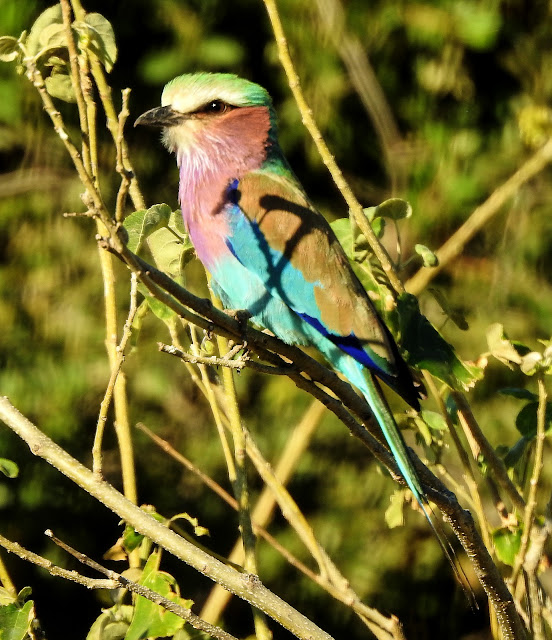
6-4-2019 LINYANTI, BOTSWANA - LILAC BREASTED ROLLER (Coracias caudatus)


4-6-2019 LINYANTI CAMP, BOTSWANA - BURCHELL'S STARLING (Lamprotornis australis)


6-4-2019 LINYANTI, BOTSWANA - ZAMBESI CRESTED BARBET (Trachyphonus vaillantii ssp. nobilis)


The crested barbet (Trachyphonus vaillantii) ('trachys'=rough, 'phone'=voice, sound') is a sub-Saharan bird in the Lybiidae family. Its specific name commemorates François Levaillant, a famed French naturalist.

With its thick bill and very colourful plumage the crested barbet is unmistakable. This small bird has a speckled yellow and red face with a small black crest. The belly is yellow with red speckles, wings are black with white specks and it has a broad black band on its neck. Yellow head and body with black and white feathers, red markings on end of body, its colour blends well in the bush. They have a distinct trill.

21-2-2022 PINET, VALENCIA - COMMON BRIMSTONE BUTTERFLY (Gonepteryx rhamni)


Gonepteryx cleopatra, the Cleopatra or Cleopatra butterfly, is a medium-sized butterfly of the family Pieridae.
Gonepteryx cleopatra is a medium-sized butterfly with a wingspan of about 50–70 mm (2.0–2.8 in). It is a sexually dimorphic species; the female has pale yellow or greenish wings, whereas the male is darker yellow with an orange patch on the forewing. Both sexes have a forewing apical hook and brown dots in the center of each wing, and the underside of wings is light greenish yellow. The greenish color, the shape and the pronounced venation on the hindwings give to these butterflies a good camouflage, making them resemble just leaves.

21-2-2022 PINET, VALENCIA - SNAKE MILLIPEDE (Ommatoiulus rutilans)


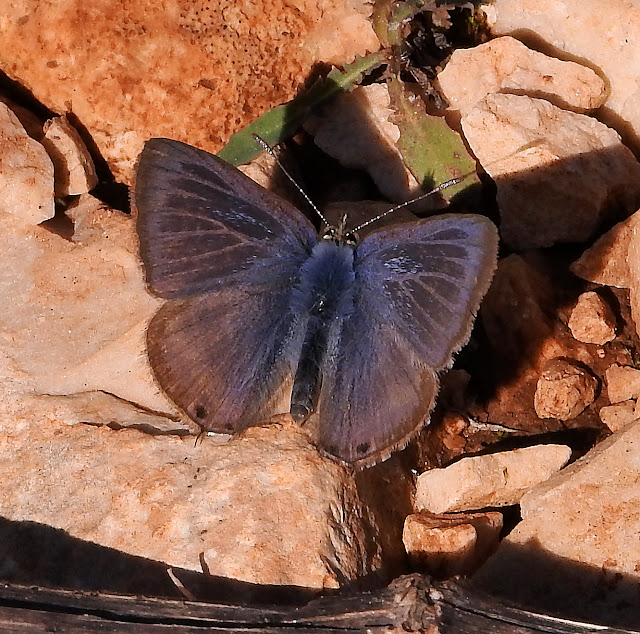
21-2-2022 PINET, VALENCIA - PEA BLUE BUTTERFLY (Lampides boeticus)


Sunday, 20 February 2022

4-6-2019 LINYANTI CAMP, BOTSWANA - GREATER BLUE EARED STARLING (Lamprotornis chalybaeus)


4-6-2019 LINYANTI, BOTSWANA - FORK TAILED DRONGO (Dicrurus adsimilis)


4-6-2019 LINYANTI CAMP, BOTSWANA - RED LECHWE (MALE AND FEMALE) (Kobus leche ssp. leche)


4-6-2019 LINYANTI CAMP, BOTSWANA - WHITE FRONTED BEE-EATER (Merops bullockoides)


20-2-2022 MONTE CORONA, VALENCIA - SARDINIAN WARBLER (FEMALE) (Sylvia melanocephala)


20-2-2022 MONTE CORONA, VALENCIA - HORSE CHESTNUT MOTH (Pachycnemia hippocastanaria)


20-2-2022 MONTE CORONA, VALENCIA - GREAT TIT


20-2-2022 MONTE CORONA, VALENCIA - BUFF TAILED BUMBLE BEE (Bombus terrestris)


20-2-2022 MONTE CORONA, VALENCIA - HORSE CHESTNUT MOTH (Pachycnemia hippocastanaria)


4-6-2019 LINYANTI CAMP, BOTSWANA - COMMON SLENDER MONGOOSE (Herpestes sanguineus)


The common slender mongoose (Herpestes sanguineus), also known as the black-tipped mongoose or the black-tailed mongoose, is a very common mongoose species native to sub-Saharan Africa.

As the name suggests, the common slender mongoose has a lithe body of 27.5–40 cm (10.8–15.7 in) and a long tail of 23–33 cm (9.1–13.0 in). Males weigh 640–715 g (22.6–25.2 oz), while the smaller females weigh 460–575 g (16.2–20.3 oz).

The color of their fur varies widely between subspecies, from a dark reddish-brown to an orange red, grey, or even golden yellow, but these mongooses can be distinguished from other mongooses due to the prominent black or red tip on their tails. They also have silkier fur than the other African members of their family.

The common slender mongoose occurs throughout sub-Saharan Africa, where it is most common in the savannah and semiarid plains, but rarely recorded in densely forested areas and deserts.


The common slender mongoose generally lives either alone or in pairs. It is primarily diurnal, although it is sometimes active on warm, moonlit nights. It doesn't seem to be territorial, but will nevertheless maintain stable home ranges that are often shared with members of related species. Indeed, the common slender mongoose and these other species may even den together, as most of their relatives are nocturnal. Dens may be found anywhere sheltered from the elements: in crevices between rocks, in hollow logs, and the like.

A male's range includes the ranges of several females, and scent cues inform him when the female is in heat. The gestation period is believed to be 60 to 70 days, and most pregnancies result in one to three young. The male does not help care for them. Unusually, for a solitary species, in the Kalahari Desert the males are philopatric whereas the females disperse.

The common slender mongoose is primarily carnivorous, though it is an opportunistic omnivore. Insects make up the bulk of its diet, but lizards, rodents, snakes, birds, amphibians, and the occasional fruit are eaten when available. It will also eat carrion and eggs. As befits the popular image of mongooses, the slender mongoose is capable of killing and subsequently eating venomous snakes, but such snakes do not constitute a significant portion of its diet.

Common slender mongooses are more adept at climbing trees than other mongooses, often hunting birds there. White browed-sparrow weavers, crimson breasted shrikes, and glossy starlings are considered common prey.

4-6-2019 LINYANTI CAMP, BOTSWANA - AFRICAN HAWK EAGLE (Aquila spilogaster)


The African hawk-eagle (Aquila spilogaster) is a large bird of prey. Like all eagles, it belongs to the family Accipitridae. This species’ feathered legs mark it as a member of the Aquilinae subfamily. The African hawk-eagle breeds in tropical Sub-Saharan Africa. It is a bird of assorted woodland, including both savanna and hilly areas but the tend to occur in woodland that is typically dry. The species tends to be rare in areas where their preferred habitat type is absent. This species builds a stick nest of around 1 m (3.3 ft) across in a large tree. The clutch is generally one or two eggs. The African hawk-eagle is powerfully built and hunts small to medium sized mammals and birds predominantly, occasionally taking reptiles and other prey as well. The call is a shrill kluu-kluu-kluu. The African hawk-eagle is considered a fairly stable species and a species of Least Concern per the IUCN.

The African hawk-eagle is uncommonly aggressive and bold predator. Their primary hunting tool is their powerful feet. In general, their sneaky foraging techniques recall a huge Accipiter. In terms of agility and hunting prowess, especially in terms of their short-distance flight after prey, they are also somewhat reminiscent of an Accipiter. Mostly the African hawk-eagle engages in still-hunting, wherein they scan from prey from an inconspicuous perch for a long period. When prey is spotted, the hawk-eagle engages in a low level dash from their perch in cover. They often uses cover to cloak their approach almost up the point where they strike. While it has been claimed that their flight is “silent”, it would presumably be more correct to say that the hunting hawk-eagle engages in minimal flapping flight so as to not alert prey to their approach. Often, the hawk-eagles wait near prey-concentrated areas, such as waterholes and among riparian trees for birds to come to drink or by clearings that birds frequently cross. African hawk-eagles may too quarter above the ground and seize any prey they surprise. They are capable of sometimes taking birds on the wing but usually prefer to catch them on the ground and may force avian prey intercepted in the air back to the ground. Often terrestrial birds are taken right around the moment they alight. In some instances, prey may be chased, even on foot, into thickets. African hawk-eagles have seldom been recording engaging a stoop from soaring flight to capture prey. Pairs of African hawk-eagles often hunt together and in these circumstances seem to engage in deliberate cooperation, one distracting, the other striking. They share this tendency for hunting in pairs with their sister species, the Bonelli's eagle, which has been implied to engage in tandem hunts possibly for sociosexual pairing reasons rather than for obtaining larger or more difficult prey, as is typically assumed of tandem-hunting raptors. One tandem hunting pair of African hawk-eagles appeared to remarkably make use of a mesh fence to drive guineafowl into in a cunning strategy to prevent their escape. Yet another pair of African hawk-eagles appears to derive much of its prey by regularly and opportunistically perching in a tree holding a fruit bat colony.


4-6-2019 LINYANTI, BOTSWANA - COMMON BULBUL (Pycnonotus barbatus)


The common bulbul (Pycnonotus barbatus) is a member of the bulbul family of passerine birds. It is found in north-eastern, northern, western and central Africa.

The bill is fairly short and thin, with a slightly downwards curving upper mandible. The bill, legs, and feet are black and the eye is dark brown with a dark eye-ring, which is not readily visible. It is about 18 cm in length, with a long tail. It has a dark brown head and upperparts. Sexes are similar in plumage.

It is a common resident breeder in much of Africa, and it has recently been found breeding in southern Spain at Tarifa. It is found in woodland, coastal bush, forest edges, riverine bush, montane scrub, and in mixed farming habitats. It is also found in exotic thickets, gardens, and parks.


The common bulbul is usually seen in pairs or small groups. It is a conspicuous bird, which tends to sit at the top of a bush. As with other bulbuls they are active and noisy birds. The flight is bouncing and woodpecker-like. The call is a loud doctor-quick doctor-quick be-quick be-quick.
This species nests throughout the year in the moist tropics, elsewhere it is a more seasonal breeder with a peak in breeding coinciding with the onset of the rainy season. The nest is fairly rigid, thick-walled and cup-shaped. It is usually situated inside the leafy foliage of a small tree or shrub.

Two or three eggs are a typical clutch. Like other bulbuls, it is parasitised by the Jacobin cuckoo.

This species eats fruit, nectar, seeds and insects.


The Common Bulbul (Pycnonotus barbatus) is a widespread, adaptable African bird known for its bold, noisy nature, diverse omnivorous diet (fruits, insects, nectar), and distinctive dark-hooded look with pale underparts, often found in gardens and woodlands; they are vocal, territorial, and comfortable near humans, often mobbing predators and nesting in bushes. 

Key Facts:
Appearance: Brownish-grey body, dark brown head with a slightly crested look, black bill, legs, and eye; some subspecies have yellow undertail coverts.
Size: Medium-sized, about 18-20 cm long with a long tail, similar in plumage for both sexes.
Habitat: Highly adaptable, living in woodlands, savannahs, gardens, parks, and urban areas across much of Africa.


Diet: Opportunistic omnivores, eating fruits, berries, seeds, flowers, insects, and sometimes small vertebrates, even scavenging human food.
Behavior: Very vocal, often the first to sing; lives in pairs or family groups, bold around humans, and participates in mobbing predators like snakes.
Nesting: Builds cup-shaped nests in trees or bushes, lays 2-3 eggs, with both parents caring for young.
Vocalization: Known for loud, musical calls, including whistles, warbles, and chirps, with a call often described as "doctor-quick".
Status: Widespread and abundant, not considered globally threatened.