This Blog contains Wildlife, Plants and Bird Photos from Walks, Safaris, Birding Trips and Vacations. Most of the pictures have been taken with my Nikon P900 and P950X cameras. Just click on any image for a larger picture. On the right column under the Blog Archive are the entries by date. Below that under Animal categories all the diffent species of Animals, Birds, Insects and Plants contained in the website are listed. Clicking on any entry will show all the entries for that species.
TOTAL PAGEVIEWS
TRANSLATE
Wednesday, 19 June 2019
19-6-2019 RACO DE OLLA, VALENCIA - BLACK TAILED SKIMMER DRAGONFLY (Orthetrum cancellatum)
The black-tailed skimmer (Orthetrum cancellatum) is a dragonfly belonging to the family Libellulidae.
This species is widespread in Europe and Asia. It is found throughout European continent including the Mediterranean islands but is absent in the north of Britain and the northern half of Fennoscandia. This is one of the most common European species and it is still increasing its range northwards. To the east, the range extends over central Asia to Kashmir, Mongolia to the northern parts of China and Arunachal Pradesh in India.
It is present in Albania, Austria, Azerbaijan, Belarus, Belgium, Bosnia and Herzegovina, Bulgaria, China, Croatia, Cyprus, Czech Republic, Denmark, Estonia, Finland, France (Corsica, and mainland), Georgia, Germany, Greece, Hungary, India, Ireland, Italy, Kazakhstan, Kyrgyzstan, Latvia, Lithuania, Luxembourg, Malta, Moldova, Mongolia, Montenegro, Netherlands, North Macedonia, Norway, Poland, Portugal, Romania, Russia, Serbia, Slovakia, Slovenia, Spain, Sweden, Switzerland, Tajikistan, Turkey (Turkey-in-Europe), Turkmenistan, Ukraine, Uzbekistan and in part of United Kingdom.
The black-tailed skimmer is abundant throughout its range and is one of the most commonly seen dragonflies in Europe. It holds a stable population and has no known major threats.
This species has expanded its range, assisted by the creation of gravel pits which give it the extensive open unvegetated areas it prefers. It was first recorded in Great Britain in Essex in 1934. It is decreasing rapidly in the Maltese Islands.
This dragonfly is found at any open water with bare patches along the shore where the patrolling males frequently rest in the sun. It also inhabits near slow-flowing waters. It favors lakes, slow rivers, ponds and sometimes marshy area, without dense riparian vegetation. Females are less bold and not encountered as regularly. Adults prefer to perch on bare ground and rocks.
19-6-2019 RACO DE OLLA, VALENCIA - COMMON TERN (Sterna hirundo)
The Common Tern, Sterna hirundo, is a slender seabird with a circumpolar distribution, breeding in temperate and subarctic regions of Europe, Asia, and North America. It is a migratory species, wintering in coastal tropical and subtropical regions. Adults display light grey upperparts, white to very light grey underparts, and a black cap. Their legs are orange-red, and they possess a narrow pointed bill, which varies in color between subspecies.
To identify the Common Tern, look for its pale grey upper wings, which develop a dark feather shaft as the season progresses, creating a grey wedge. The rump and tail are white, and the tail extends no further than the folded wingtips when the bird is standing. The bill is mostly red with a black tip or entirely black, depending on the subspecies. In non-breeding adults, the forehead and underparts become white, and the bill turns black.
Common Terns are found nesting on flat, poorly vegetated surfaces close to water, such as beaches, islands, and artificial substrates like floating rafts. They adapt to a variety of habitats, from the taiga to tropical shores, and avoid excessively rainy, windy, or icy areas.
This species has a wide breeding range, encompassing Europe, North Africa, Asia, and North America. It migrates to winter along the coasts of Central and South America, Africa, and southern Asia, with some populations remaining partially migratory in the Caribbean.
Common Terns are agile flyers, capable of rapid turns, hovering, and vertical take-off. They are known for their powerful, direct flight and can fly at speeds averaging 30 km/h, increasing during migration. They breed in colonies, often alongside other seabird species, and exhibit strong territorial behavior.
The Common Tern has a distinctive alarm call, a KEE-yah, and a repertoire of other vocalizations used for communication within the colony and with their chicks. Parents and chicks recognize each other's calls, aiding in maintaining family bonds.
Breeding involves aerial courtship displays and ground rituals. Nests are shallow scrapes, sometimes lined with debris. Clutch size is typically three eggs, camouflaged with blotchy patterns. Both sexes incubate, and chicks fledge in 22–28 days. Adults are defensive of their nest and young, often harassing intruders.
The Common Tern can be confused with the Arctic Tern, Roseate Tern, and Forster's Tern, but differences in plumage details, leg and bill color, and vocalizations aid in distinguishing them.
The diet consists mainly of fish, which they catch by plunge-diving, but may also include molluscs, crustaceans, and large insects. They forage up to 15 km from the breeding colony and may follow schools of fish or predatory fish to locate prey.
The Common Tern is classified as Least Concern, with a large population and extensive breeding range. However, threats such as habitat loss, pollution, and disturbance have led to declines in some areas, particularly in North America. Conservation efforts include habitat management and protection from human disturbance.
19-6-2019 CREU DE LONGA, VALENCIA - BLACK WINGED STILT (Himantopus himantopus)
The Black-winged Stilt, Himantopus himantopus, is a slender wader known for its strikingly long, pink legs and contrasting black-and-white plumage. This elegant bird is a member of the avocet and stilt family, Recurvirostridae.
Adult Black-winged Stilts measure 33–36 cm in length. They possess a long, thin black bill and display a distinctive black and white coloration. The head and neck are predominantly white, with variable black markings depending on the sex and subspecies. Males typically have a glossy or greenish sheen on their black backs, while females exhibit a more brownish tinge. During flight, their long legs trail behind, and their wingbeats are steady.
These birds favor marshes, shallow lakes, and ponds as their breeding grounds. They are also known to inhabit coastal areas during migration and in the winter months.
The Black-winged Stilt has a wide range, extending across Europe, Asia, and Africa. Some populations migrate to coastal regions in winter, while others in milder climates may remain resident or engage in short-range movements.
Black-winged Stilts are often seen foraging in shallow waters, gracefully picking insects and crustaceans from the surface. They are known to nest in small groups, sometimes alongside avocets, and exhibit a variety of courtship behaviors, including intricate displays and duets.
The flight call of the Black-winged Stilt is a sharp and clear kleek, typically heard during its aerial maneuvers.
Nests are simple bare spots on the ground near water. These birds are communal nesters and may breed in loose colonies. They have been known to breed as far north as Britain, with recent successful breeding events recorded in Southern and Northern England.
The Black-winged Stilt can be confused with other stilt species, such as the Black-necked Stilt (H. mexicanus) in the Americas, the White-backed Stilt (H. melanurus), and the Pied Stilt (H. leucocephalus) in Australasia and New Zealand.
Their diet consists mainly of insects and crustaceans, which they deftly pick from the water's surface or from wet sand.
The IUCN lists the Black-winged Stilt as Least Concern, indicating a stable global population. However, they are protected under the Agreement on the Conservation of African-Eurasian Migratory Waterbirds, highlighting the importance of international cooperation in their conservation.
19-6-2019 ALBUFERA, VALENCIA - AUDOUIN'S GULL (Ichthyaetus audouinii)
The Audouin's gull, Ichthyaetus audouinii, presents itself as a large gull species, predominantly inhabiting the Mediterranean, the western coast of Saharan Africa, and the Iberian Peninsula. Its name pays homage to the French naturalist Jean Victoire Audouin. Resembling a small European herring gull, the adult Audouin's gull is distinguished by its short, stubby red bill and the unique "string of pearls" white wing primary tips. The legs of this bird are a subtle grey-green, and it takes a full four years for the gull to don its adult plumage.
When observing the Audouin's gull, one should note the red bill and the distinctive pattern of white spots along the wingtips, which contrast with the larger "mirrors" seen in other gull species. These features are key to distinguishing it from its relatives.
This gull favors coastal and pelagic environments, strictly adhering to regions where it can pursue its specialized diet.
The Audouin's gull is found in the Mediterranean, along the western Saharan African coast, and on the Iberian Peninsula. It breeds on small islands, either colonially or in solitude.
Once considered one of the world's rarest gulls, the Audouin's gull has established new colonies but remains a rare sight with a population of around 10,000 pairs. This bird is not known to wander far from its breeding grounds, though occasional records exist of it appearing as far afield as the Netherlands, England, and even Trinidad.
Tuesday, 18 June 2019
7-6-2019 MOREMI CAMP, BOTSWANA - PLAINS ZEBRA (Equus quagga)
The plains zebra (Equus quagga, formerly Equus burchellii) is the most common and geographically widespread species of zebra. Its range is fragmented, but spans much of southern and eastern Africa south of the Sahara. Six or seven subspecies have been recognised, including the quagga which was thought to be a separate species. More recent research supports variations in zebra populations being clines rather than subspecies.
Plains zebras are intermediate in size between the larger Grévy's zebra and the smaller mountain zebra and tend to have broader stripes than both. Great variation in coat patterns exists between clines and individuals. The plains zebra's habitat is generally, but not exclusively, treeless grasslands and savanna woodlands, both tropical and temperate. They generally avoid desert, dense rainforest and permanent wetlands. Zebras are preyed upon by lions and spotted hyenas, Nile crocodiles and, to a lesser extent, leopards, cheetahs and African wild dogs.
Plains zebras are a highly social species, forming harems with a single stallion, several mares and their recent offspring; bachelor groups also form. Groups may come together to form herds. The animals keep watch for predators; they bark or snort when they see a predator and the harem stallion attacks predators to defend his harem.
The plains zebra remains common in game reserves, but is threatened by human activities, such as hunting for its meat and hide, as well as competition with livestock and encroachment by farming on much of its habitat. The loss of open grasslands due to woody plant encroachment increases predation risk and therewith habitat. Plains zebra are listed as near threatened by the IUCN as of 2016. The species population is stable and not endangered, though populations in most countries have declined sharply.
7-6-2019 MOREMI CAMP, BOTSWANA - KALAHARI FORK TAILED DRONGO (Dicrurus adsimilis ssp. apivorus)
The fork-tailed drongo, also known as the common drongo or African drongo, is a member of the Dicruridae family. It is a small bird with a distinctive fork-shaped tail, red-brownish eyes, and an entirely black plumage that exhibits a blue-green iridescence in certain lights. Both sexes are similar in appearance, with the underside of the bird being uniformly black, contrasting with the glossy black-blue upper body.
When identifying the fork-tailed drongo, look for its robust black beak, red eyes, and the deeply forked black tail. Juveniles can be distinguished by their dark brown tone, less pronounced tail fork, and lack of glossy shine on the lower body. During flight, the darker remiges of the D. a. adsimilis subspecies are particularly noticeable.
The fork-tailed drongo inhabits wooded habitats, including woodlands and savannas, and is tolerant of arid climates. It can be found at elevations up to 2200 meters.
This species is widespread across Africa south of the Sahara, with four recognized subspecies varying in range and physical characteristics. It was once thought to range into Asia, but the Asian species is now classified as the black drongo (D. macrocercus).
7-6-2019 MOREMI CAMP, BOTSWANA - COPPERY TAILED COUCAL (Centropus cupreicaudus)
The coppery-tailed coucal (Centropus cupreicaudus) is a species of cuckoo in the family Cuculidae. It is found in Angola, Botswana, the Democratic Republic of the Congo, Malawi, Namibia, Tanzania, Zambia, and Zimbabwe. It was first described by the German ornithologist Anton Reichenow in 1896.
An adult coppery-tailed coucal is about 48 cm (19 in) long and has a curved beak and long, broad tail. Males are slightly smaller than females. The coppery-tailed coucal's plumage is similar to that of the Senegal coucal (Centropus senegalensis). It has a black head and upperparts, white or cream-coloured underparts, a brown rump with a coppery-sheen and a blackish-brown tail. Immature birds have pale streaks on the head and their flight feathers are barred. The call of the coppery-tailed coucal consists of deep, bubbling notes.
The coppery-tailed coucal is native to parts of south central Africa. Its range stretches from Angola in the west to southwestern Tanzania, northern Botswana and the Caprivi Strip in Namibia. Its typical habitat is swampland and dense vegetation near rivers, but it is also found on inundated floodplains and near seasonal lakes. The total size of its range is around 1,750,000 square kilometres (680,000 sq mi).
7-6-2019 MOREMI CAMP, BOTSWANA - COMMON IMPALA (MALE) (Aepyceros melampus ssp. melampus)
The impala or rooibok (Aepyceros melampus, lit. 'black-footed high-horn' in Ancient Greek) is a medium-sized antelope found in eastern and southern Africa. The only extant member of the genus Aepyceros, and tribe Aepycerotini, it was first described to Europeans by German zoologist Hinrich Lichtenstein in 1812.
Two subspecies are recognised—the grassland-dwelling common impala (sometimes referred to as the Kenyan impala), and the larger and darker black-faced impala, which lives in slightly more arid, scrubland environments. The impala reaches 70–92 cm (28–36 in) at the shoulder and weighs 40–76 kg (88–168 lb). It features a glossy, reddish brown coat. The male's slender, lyre-shaped horns are 45–92 cm (18–36 in) long.
7-6-2019 MOREMI CAMP, BOTSWANA - BLACK WINGED STILT (Himantopus himantopus)
The black-winged stilt is a black and white wading bird with incredibly long legs. They live in a variety of wetlands, from marshes to coastal lagoons. They wade through the water, plucking insects from the surface.
The Black-winged stilt (Himantopus himantopus) is one of the most fascinating waders seen on the banks of the many water-bodies in our country. Proportionately the longest legged of the waders, with the exception of the flamingo, the tall, lanky, slender-necked, Blackwinged stilt presents a stark visual contrast. Its black wings and white neck and underparts give it the distinctive look of a formally dressed dinner guest! The bright red legs and red iris provide an added dash of colour. In winter both sexes are fairly similar in appearance with dabs of greyish-brown on their heads and necks. The sooty-brown wings of the female are, however, duller than those of the male, which have an added metallic, blue-green sheen. With the onset of summer the adult male sports darker spots on his head extending down to his neck.
Members of the genus Himantopus, are a very variable species, (upto eight are recognised) of which the Black-winged is one. They have an extremely broad breeding range, from temperate to tropical climates and from rain forests to deserts, spreading over Eurasia, Africa, Australia and the Americas. Most members of this family are, however, nomadic, moving as conditions change, with a few northern hemisphere populations migrating over short distances.
The Black-winged stilt is both a resident and a visitor in India. Every winter it makes its way south in small flocks and settles on the edges of marshes, lakes, rivers and tidal areas all over the Indian peninsula. In summer these flocks move northwards again, to nest in the lakes and rivers of northern India, north-west Pakistan and Afghanistan.
A masterpiece of evolution, the Black-winged stilt fits perfectly into a special eco-niche in the shallows which few other waders have managed to exploit as successfully. This eco-niche consists of reasonably clear water, rich in aquatic life, ranging in depth from four to twelve inches. At this depth its long wading legs give the stilt an edge over most other waders like sandpipers and the diminutive stints, allowing them to explore comparatively deeper areas thereby reducing competition, by providing a wider feeding zone. Interestingly, in this feeding zone, most ducks too find themselves `out of their depth' as the area is too shallow for them to `upend' easily. This small, specific area is, therefore, almost exclusively the preserve of the stilt.
The stilt's legs dangle gracefully under its body in flight. Interestingly, the bird lowers or raises them as the need arises, using them to adjust its air-speed and also as a `rudder'.
The stilt's remarkable legs, almost ten inches long, are usually stretched neatly out behind the bird when flying, though for short hops they merely dangle about. Much to my amusement I discovered that the bird, despite the awkward length of its legs is still able to scratch its head with one foot outstretched over a wing. While flying the stilt must use a fairly rapid wing-beat and interestingly, it adjusts its air-speed by raising or lowering its legs, which are also used as rudders of sorts. To land, the bird glides gracefully downwards, wings held horizontally, and pushes its legs forward at the very last moment to come to a running or hopping halt. While observing flocks of stilts, their acrobatic techniques provide considerable entertainment. I have occasionally seen a bird drop its legs in the air, hover above the ground like an aircraft and then descend vertically on both feet. No less fascinating is the manner in which the delicate wader moves along the shoreline. It proceeds through the water with a jerky, high-stepping gait, lifting each leg well out of the water by bending its knee at right angles, before placing the foot gingerly down again in front.
7-6-2019 MOREMI CAMP, BOTSWANA - BLACK CRAKE (Zapornia flavirostra)
The Black Crake, known scientifically as Zapornia flavirostra, is a rather striking waterbird from the rail and crake family, Rallidae. Adults typically measure between 19 to 23 centimeters in length, featuring a short tail and notably long toes. The plumage is predominantly black, with a subtle brown olive hue on the wings and upperparts that is often imperceptible in natural light. The bird's eye is a vivid red, complemented by a yellow bill—aptly reflected in its binomial name—and legs and feet of a reddish hue, which may appear duller outside of the breeding season.
Both sexes of the Black Crake are similar in appearance, though males are marginally larger and most exhibit a hooked upper mandible—a feature less common in females. Juveniles display brown upperparts with a dark grey head and underparts, and their bill is a greenish yellow. Their legs and feet are a muted red. The downy chicks are uniformly black, a common trait among rails.
The Black Crake favors freshwater marshes teeming with vegetation, which provides essential cover. Unlike many of its rail relatives, this species is often observed in the open, thanks to its less secretive nature.
This bird is widespread across sub-Saharan Africa, save for regions that are particularly arid. It is known to undertake seasonal movements in response to drought conditions.
The Black Crake is diurnal and exhibits a certain boldness, often feeding in close proximity to humans. It is a common to abundant species that has adapted well to human-altered landscapes, such as areas affected by deforestation. Notably, the species is seldom hunted due to the unpalatable nature of its flesh.
The primary vocalization of the Black Crake is a duet commencing with a throaty chattering "krrrok-kraaaa," followed by a dove-like cooing "coo-crr-COO."
During the breeding season, the Black Crake becomes fiercely territorial and aggressive, even towards birds of similar size. Both sexes contribute to constructing a deep, neat bowl-shaped nest from wetland plants, which may be situated in marsh vegetation, on the ground, or occasionally elevated in a bush. The clutch typically consists of two to six eggs, which are cream or white with brown or chestnut spots. Incubation, lasting 13 to 19 days, is a shared duty, sometimes aided by offspring from previous broods. The precocial chicks venture from the nest within a few days of hatching and are fed by their parents and helpers for several weeks thereafter, achieving flight by 5 to 6 weeks of age and independence at 6 to 12 weeks.
The Black Crake's diet is varied, including invertebrates, small fish, frogs, seeds, bird eggs, and it will scavenge on carcasses. It forages on the ground or climbs reeds to capture prey, including flying insects. A peculiar behavior is observed when it perches on hippopotamuses and warthogs to remove parasites.
The Black Crake is currently classified as Least Concern on the IUCN Red List, indicating that it does not face any immediate threat of extinction.
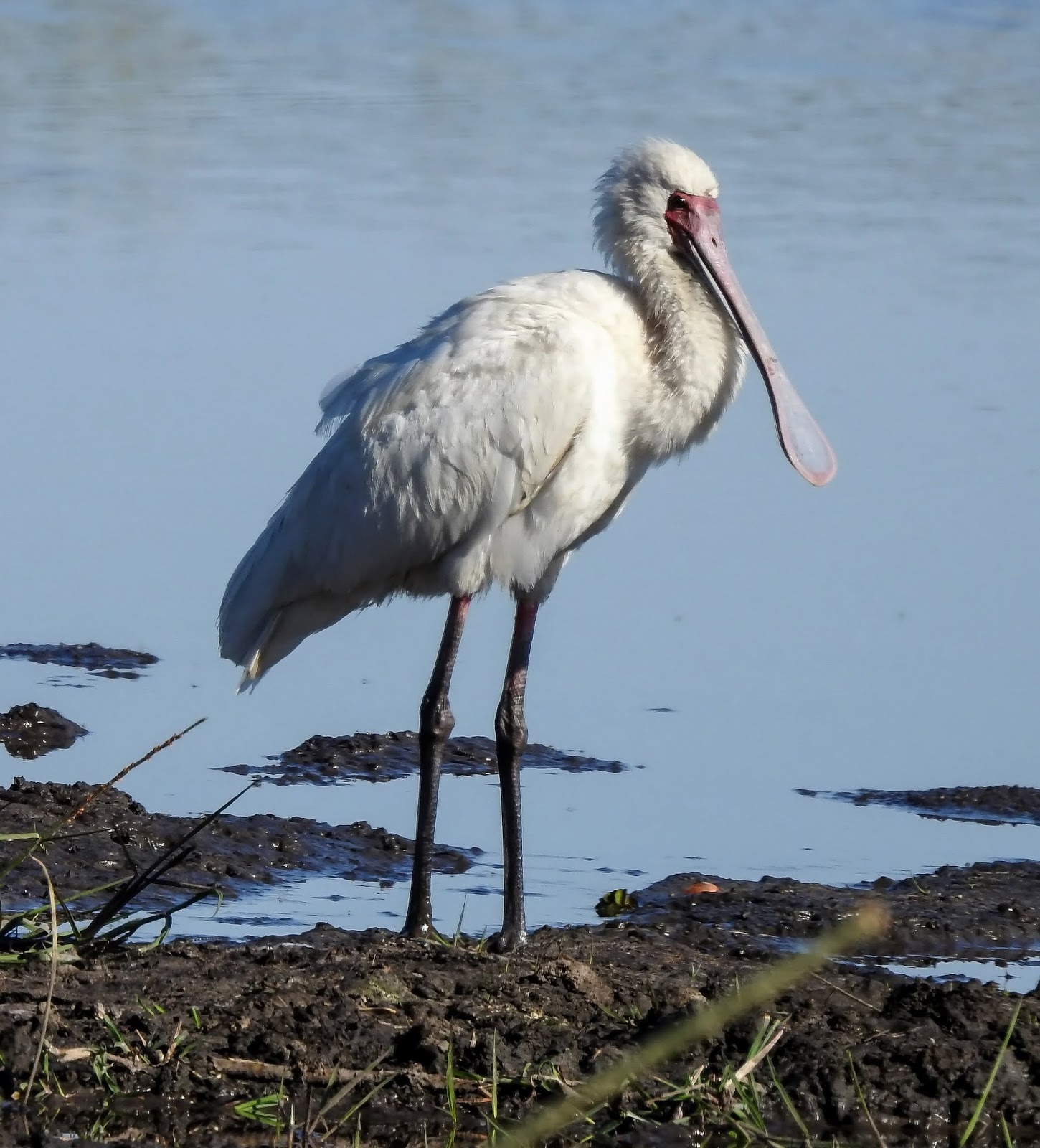
7-6-2019 MOREMI CAMP, BOTSWANA - AFRICAN SPOONBILL (Platalea alba)
The African spoonbill, Platalea alba, is a striking wading bird belonging to the ibis and spoonbill family, Threskiornithidae. This species is characterized by its long legs, which facilitate wading through marshy wetlands, and its distinctive long grey spatulate bill, which is used to sift through shallow waters for food. Adult birds are predominantly white with red legs and a red face, while immature birds can be identified by their yellow bills and the absence of red on their faces.
When identifying the African spoonbill, look for a large, all-white bird with a unique spoon-shaped bill. During flight, unlike herons, spoonbills keep their necks outstretched. Breeding adults will exhibit more vibrant red coloration on their legs and face, and their bill will be grey. Juveniles can be distinguished by their paler bill color and lack of red facial markings.
The African spoonbill is found in marshy wetlands that have open shallow water. It prefers environments where it can wade and forage for food, such as in reedbeds or along the edges of bodies of water.
This bird has a widespread presence across Africa and Madagascar, with sightings reported in countries including Botswana, Kenya, Mozambique, Namibia, South Africa, and Zimbabwe.
African spoonbills are known for their methodical feeding technique, swinging their open bills side-to-side in the water to catch prey. They are sociable birds, often nesting in colonies, but they typically do not share these colonies with storks or herons. Their long legs and thin, pointed toes are perfectly adapted for navigating through varying water depths.
The African spoonbill is generally silent, but it may make soft grunting noises during the breeding season.
Breeding season for the African spoonbill occurs in the winter and extends into spring. During this time, males display more pronounced plumage and brighter colors. Nests are constructed from sticks and reeds in trees above water and lined with leaves. Females lay three to five eggs, primarily in April or May. Both parents share the responsibility of incubating the eggs for up to 29 days. After hatching, the chicks are cared for by both parents for approximately 20 to 30 days, becoming ready to fly four weeks post-fledging.
The African spoonbill can be confused with the common spoonbill; however, it lacks the crest found on the latter. Additionally, the common spoonbill has a yellowish bill, whereas the African spoonbill's bill is grey.
The diet of the African spoonbill includes a variety of fish, molluscs, amphibians, crustaceans, insects, and larvae. Its specialized bill allows it to efficiently sift through water to capture these prey items.
The African Spoonbill's diet consists mainly of fish and aquatic invertebrates such as crustaceans or shellfishes, insects, larvae, and mollusks.
The African Spoonbill begins to breed in the winter. The breeding period starts in the winter and lasts throughout the spring. It usually breeds in colonies from late March through September. The female may lay 3-5 eggs during the month of April or May.
This bird's eggs are usually spotted with colored dots of red, brown, or blue. It lays its eggs mostly in a nest platform of sticks or reeds in a tree near water, but its nest can also be found in swamp reeds, among rocks, marsh plants, or cliffs. These nests are either near the ground or in trees over water.
The inside of the nest is often lined with leaves. The egg undergoes incubation for up to 29 days by both parents. After hatching the young are cared for by both parents for 20-30 days. Soon after. They begin to fly after another four weeks.
The African Spoonbill is usually a shy and alert bird. It is usually found singly, but can also be encountered in pairs or in groups. It is usually silent, except for an occasional grunt when alarmed. This bird travels by flight. It flies with its neck and legs extended, while flapping its wings steadily in the air.
18-6-2019 OLIVA, VALENCIA - WAVED UMBER MOTH (Menophra abruptaria)
Menophra abruptaria, the waved umber, is a moth of the family Geometridae. The species was first described by Carl Peter Thunberg in 1792. It is found in south-western North Africa, southern Europe and Anatolia; in the north, it is found from England to Switzerland, south-western Germany, Bangladesh . The wingspan is 36–42 mm. Adults are on wing from April to June. Normally, there is one generation per year, although there can be a partial second generation in summer.
The larvae feed on Ligustrum ovalifolium and Syringa vulgaris.
A distinctive species, occurring reasonably commonly in the south of England and Wales, becoming scarcer into the northernmost English counties.
It inhabits woodland, parks and gardens, and flies in a single generation from April into June.
The larvae feed on garden privet (Ligustrum ovalifolium) and lilac (Syringa vulgaris).
18-6-2019 MONTE CORONA, VALENCIA - TROPICAL TENT SPIDER (Cyrtophora citricola)
Cyrtophora citricola, also known as the tropical tent-web spider, is an orb-weaver spider in the family Araneidae. It is found in Asia, Africa, Australia, Costa Rica, Hispaniola, Colombia, and Southern Europe and in 2000, it was discovered in Florida. C. citricola differs from many of its close relatives due its ability to live in a wide variety of environments. In North America and South America, the spider has caused extensive damage to agricultural operations.
C. citricola is in the orb web spider family, but its orb webs are considered atypical. They have a thick silk strand barrier above the orb and a thinner barrier below the orb. This gives the webs a horizontal mesh-like appearance. The spider has developed distinct and specific prey-capturing techniques using its unconventional webs. The prey flies into the upper mesh layer of the web and is deflected into the orb web. The spider then collects and stores the prey in its web. The difference in C. citricola's web silk stems from physiological variations in its spinning apparatuses, as compared to other closely related species. Its webs are non-adhesive and do not require daily respinning.
18-6-2019 OLIVA, VALENCIA - MELODIOUS WARBLER (Hippolais polyglotta)
The Melodious Warbler, known scientifically as Hippolais polyglotta, is a medium-sized member of the Old World warbler family. It measures between 12 to 13 centimeters in length, presenting a plain brown back and wings, with a more yellowish hue on the underparts. This bird is distinguished by its strong and pointed bill, as well as its brown legs. Both sexes appear identical, a common trait among warblers, while juveniles exhibit a paler belly.
When identifying the Melodious Warbler, look for its brown upper parts which are less green than those of its eastern counterpart, the Icterine Warbler. The underparts are a distinct yellowish color. Its song is a delightful babble, less varied than the Icterine's but more fluent and sustained, without mimicked sounds. Listen also for a rattling "trrrr", similar to a House Sparrow, a soft "tuk", and a chattering "chret-chet".
This species thrives in open woodlands adorned with bushes. It is also found in forest edges, thickets, riverside vegetation, orchards, and gardens, which provide ample foraging opportunities and nesting sites.
The Melodious Warbler is a migratory bird, breeding in the warmth of southwest Europe and northwest Africa, and seeking winter refuge in the sub-Saharan regions of Africa. Its breeding territories span from the Iberian Peninsula to Germany and Italy, and in North Africa, it is found from Western Sahara to Tunisia.
The Melodious Warbler exhibits typical warbler behavior, being mainly insectivorous. It is known for its pleasant and melodious song, which it uses to communicate and establish territory during the breeding season.
Song & Calls
The warbler's song is a charming and melodious babble, more consistent and smooth than that of the Icterine Warbler but with less variety and no mimicry. Its calls include a rattling "trrrr", a subdued "tuk", and a chattering "chret-chet".
During the breeding season, the Melodious Warbler lays a clutch of three to five eggs. The nest is artfully constructed from fine grasses, stems, soft twigs, flakes of bark, and lichen, typically situated in a tree or bush.
The Melodious Warbler can be confused with the Icterine Warbler, but it can be distinguished by its browner upper parts and yellower underparts, as well as its song and calls.
Insects form the mainstay of the Melodious Warbler's diet, but it will also consume other small food items, including berries, to supplement its nutrition.
The International Union for Conservation of Nature (IUCN) has classified the Melodious Warbler as "Least Concern", indicating a stable population across its wide range.
Subscribe to:
Comments (Atom)


%2020.jpg)


%2020.jpg)
%2021.jpg)


%2020.jpg)
%2021.jpg)
%2020.jpg)
%2020.jpg)
%2021.jpg)
%2022.jpg)