TOTAL PAGEVIEWS

TRANSLATE

Saturday, 29 June 2019

20-5-2019 BUMI HILLS, ZIMBABWE - LITTLE BEE-EATER (Merops pasillas)


The little bee-eater (Merops pusillus) is a bird species in the bee-eater family, Meropidae. They are found in Sub-Saharan Africa. They should not be confused with the little green bee-eater (Merops orientalis). Migration is limited to seasonal movements depending on rainfall patterns.

Members of this species, like other bee-eaters, are rich and brightly coloured slender birds. They have green upper parts, yellow throats, black gorgets, and rich brown upper breasts fading to buffish ochre on the belly. Their wings are green and brown. Their beaks and legs are black. They reach a length of 15–17 cm, which makes them the smallest African bee-eater. Sexes are alike. Often silent, their call is a soft "seep".


These are abundant and tame birds, familiar throughout their range. There have been estimated to be between 60 and 80 million little bee-eaters. They breed in open country with bushes, preferably near water. Just as the name suggests, bee-eaters predominantly eat insects, especially bees, wasps and hornets, who are caught in the air by sorties from an open perch. This species often hunts from low perches, maybe only a metre or less high. Before eating their meal, a bee-eater removes the stinger by repeatedly hitting the insect on a hard surface.

Unlike most bee-eaters, these are solitary nesters, making a tunnel in sandy banks, or sometimes in the entrance to an Aardvark den. They lay 4 to 6 spherical white eggs. Both the male and the female take care of the eggs. These birds roost communally, lined up on a tree branch.


This is an abundant and tame bird, familiar throughout its range of Sub-Sahara Africa. There have been estimated to be between 60-80 million little bee-eaters. It breeds in open country with bushes, preferably near water. Just as the name suggests, bee-eaters predominantly eat insects, especially bees, wasps and hornets, which are caught in the air by sorties from an open perch.


This is the world’s smallest bee-eater at a length of 16 cm. The little bee-eater is bright green on top with orange or buff underparts, including the outer flight feathers. A black gorget (collar) separates the orange or buff breast from a yellow throat.
The tail is orange or buff, with a green center. Like all bee-eaters, the little bee-eater has a black eye stripe, with turquoise spot above the eye.

The little bee-eater hunts flying insects, whilst in flight. Once they catch an insect, they will return to a perch, to kill the insect and remove its sting, by repeatedly hitting the insect against the branch. The little bee-eater prefers insects such as bees and wasps.

A tunnel is dug by both the male and female little bee-eater, normally in a vertical sandy bank or an aardvark hole. This tunnel can be as deep as 130 cm. They do not line the nest cavity and the 2 to 6 eggs are laid directly on the sand. The eggs are incubated by both sexes for around 20 days.
This bee-eater is parasitized by the Greater Honeyguide (Indicator indicator).

The little bee-eater will roost communally at night, with the birds huddled together on a single perch. They often use the same perch repeatedly when hunting, taking short flights to catch their prey then returning back to the same perch.

The little bee-eater is found in a woodland environment, near water. This is a common resident in the north-eastern areas of South Africa.

Friday, 28 June 2019

20-5-2019 BUMI HILLS, ZIMBABWE - LILAC BREASTED ROLLER (Coracias caudatus)


19-5-2019 BUMI HILLS, ZIMBABWE - KITTLITZ'S PLOVER (Charadrius pecuarius)


The Kittlitz's plover, named after Heinrich von Kittlitz, is a diminutive shorebird, tipping the scales at a modest 35-40 grams. This species is adorned with a black bill, dark brown eyes encased in black eyelids, and legs that may shift in hue from black to greenish or grey. During the breeding season, the male is distinguished by a white forehead and a series of bands on the forecrown, while the female's plumage is similar but with a narrower black band. The non-breeding plumage sees little change, save for a paler underbelly and a browner eye stripe.

Adults boast a wing length of 100–110 mm, a bill length of 15–23 mm, and a tarsus length of 26–33 mm. Juveniles resemble adults but lack the black facial markings and have brown upperparts with a buff-colored hindneck collar.

Kittlitz's plover is partial to open habitats near water, such as lakes, lagoons, rivers, tidal mudflats, and inland saltmarshes. It breeds in areas with short vegetation and is strictly terrestrial in its activities.


This species is widespread across sub-Saharan Africa, Madagascar, and the Nile Delta. It is common in South Africa but less so in arid regions like Botswana and Namibia. In Madagascar, it is both a breeding resident and intra-island migrant.

Kittlitz's plover is sociable outside of the breeding season, forming small flocks. It is known for its flexible breeding system and shorter pair bonds, often being polygamous. The species is territorial during breeding, with both parents defending their ground vigorously.

A repertoire of calls includes 'pipip', 'towhit', 'tit-peep', and others, used variably as alarm calls, during courtship, or when feigning injury. The young emit a 'peep' to communicate.


Breeding occurs throughout the year with varying peak seasons. The nest is a simple ground scrape, lined with natural materials, and the clutch typically consists of 1-3 eggs. Both parents share incubation duties, which last 21–27 days.

The Madagascar plover (Charadrius thoracicus) is a distinct species that does not interbreed with Kittlitz's plover.

Kittlitz's plover forages in a run-stop-search manner, feeding on insects, spiders, small crustaceans, and molluscs. It can be aggressive towards other birds when foraging, especially in the winter months before breeding.

The IUCN lists Kittlitz's plover as Least Concern. It is abundant in Africa and locally common in Madagascar, with a wide range. Threats include habitat loss due to wetland degradation and diseases such as avian malaria and botulism.

20-5-2019 BUMI HILLS, ZIMBABWE - KITTLITZ'S PLOVER (JUVENILE) (Charadrius pecuarius)


The Kittlitz's plover, named after Heinrich von Kittlitz, is a diminutive shorebird, tipping the scales at a modest 35-40 grams. This species is adorned with a black bill, dark brown eyes encased in black eyelids, and legs that may shift in hue from black to greenish or grey. During the breeding season, the male is distinguished by a white forehead and a series of bands on the forecrown, while the female's plumage is similar but with a narrower black band. The non-breeding plumage sees little change, save for a paler underbelly and a browner eye stripe.

Adults boast a wing length of 100–110 mm, a bill length of 15–23 mm, and a tarsus length of 26–33 mm. Juveniles resemble adults but lack the black facial markings and have brown upperparts with a buff-colored hindneck collar.

20-5-2019 BUMI HILLS, ZIMBABWE - GUINEAFOWL BUTTERFLY (Hamanumida daedalus)


The genus Hamanumida comprises of a single species – daedalus, which is popularly known as the Guineafowl due to its colour and pattern which resembles that of the guineafowl bird.

Hamanumida daedalus is widespread across Africa including Madagascar. It also occurs in the Arab states.

This is a grassland / savannah species found at altitudes between sea level and about 800m. It is associated mainly with dry, rocky grassland where there are scattered bushes and trees, but also rapidly colonises abandoned agricultural land.

The primary larval foodplant is Combretum, but Terminalia and Tectona (teak) are also used.

The butterflies are normally seen singly or in two’s and three’s. Males will mud-puddle at the edges of fords and small streams, but both sexes are more commonly seen aggregating at the top of hills where courtship and copulation take place. They fly very low over the ground, and frequently settle to bask on bare ground or on rocks or boulders. At all times they remain very alert, taking flight at the slightest disturbance.


Hamanumida daedalus, the guineafowl butterfly, is a butterfly of the family Nymphalidae and only member of the genus Hamanumida.

Range
It is found in the Afrotropical realm (Natal, Eswatini, Transvaal, Mozambique, Zimbabwe, Botswana, tropical Africa (dry lowland areas) and southwest Arabia).


Description
The wingspan is 55–65 mm for males and 60–78 mm for females. Adults are on wing year-round, with peaks in midwinter and summer.

Food plants
The larvae feed on Combretum and Terminalia species.

20-5-2019 BUMI HILLS, ZIMBABWE - CRESTED FRANCOLIN (Dendroperdix sephaena)


The crested francolin, known scientifically as Ortygornis sephaena, is a distinguished member of the Phasianidae family. This bird is adorned with a notable crest, which gives it its common name.

When attempting to identify the crested francolin, look for its characteristic crest and the overall brown plumage with intricate patterns that provide excellent camouflage in its natural habitat.

The crested francolin is a bird of southern Africa, where it frequents a variety of habitats, adapting well to its surroundings.

This species is widely distributed across southern Africa, indicating a healthy and stable population in this region.

20-5-2019 BUMI HILLS, ZIMBABWE - WHITE BROWED SPARROW WEAVER (Plocepasser mahili)


20-5-2019 BUMI HILLS, ZIMBABWE - SOUTHERN BUSHBUCK (MALE) (Tragelaphus scriptus)


The Cape bushbuck (Tragelaphus sylvaticus), also known as imbabala, is a common, medium-sized bushland-dwelling, and a widespread species of antelope in sub-Saharan Africa. It is found in a wide range of habitats, such as rain forests, montane forests, forest-savanna mosaic, savanna, bushveld, and woodland. It stands around 90 cm (35 in) at the shoulder and weigh from 45 to 80 kg (99 to 176 lb). They are generally solitary, territorial browsers.

Cape bushbucks stand around 90 cm (35 in) at the shoulder and weigh from 60 to 80 kg (130 to 180 lb) in males and 25 to 60 kg (55 to 132 lb)in females. They have a light brown coat, with up to seven white stripes and white splotches on the sides. The white patches are usually geometrically shaped and on the most mobile parts of their bodies, such as the ears, chin, tail, legs, and necks. The muzzles are also white. Horns, found only on the males, can reach over half a metre and have a single twist. At 10 months old, young males sprout horns that are particularly twisted and at maturity form the first loop of a spiral.


The Cape bushbuck has on average less striping and more uniform colouration than populations in West Africa. Cape bushbuck occur from the Cape in South Africa to Angola and Zambia and up the eastern part of Africa to Ethiopia and Somalia, according to one interpretation. Other interpretations restrict the taxon to Southern Africa sensu stricto or consider them sensu lato to occur in the above range except eastern Sudan, Ethiopia, and Somalia. The first Latin name that can be attributed to the Cape bushbuck was Antilope sylvatica after Sparrman (1780), described from the Cape Colony.

Bushbuck browse on trees, shrubs, and forbs; they rarely if ever eat grasses. Studies of free-ranging bushbuck in various parts of southeastern Africa using DNA metabarcoding show that bushbuck frequently forage on acacias (Senegalia, Vachellia) and other legumes, along with mallows (Grewia, Hibiscus), bushwillows (Combretum), buckthorns (Berchemia, Ziziphus) and various other plants. Bushbuck are active throughout the day, but tend to be nocturnal near human habitations.


Bushbuck are solitary animals, but are not aggressively antisocial, and individuals sometimes forage in close proximity. Bushbuck live within a "home" area, which is usually around 50,000 m2 (540,000 sq ft) on the savannah and much larger in the forest, that they will not normally leave. These areas usually overlap other bushbuck home areas.

Some game farmers in southern Africa discovered that the bushbuck may compete with the closely related, larger nyala when they tried to introduce the two species to the same area. However, the two species are often found in close proximity in natural communities (e.g., in Gorongosa National Park, Mozambique).

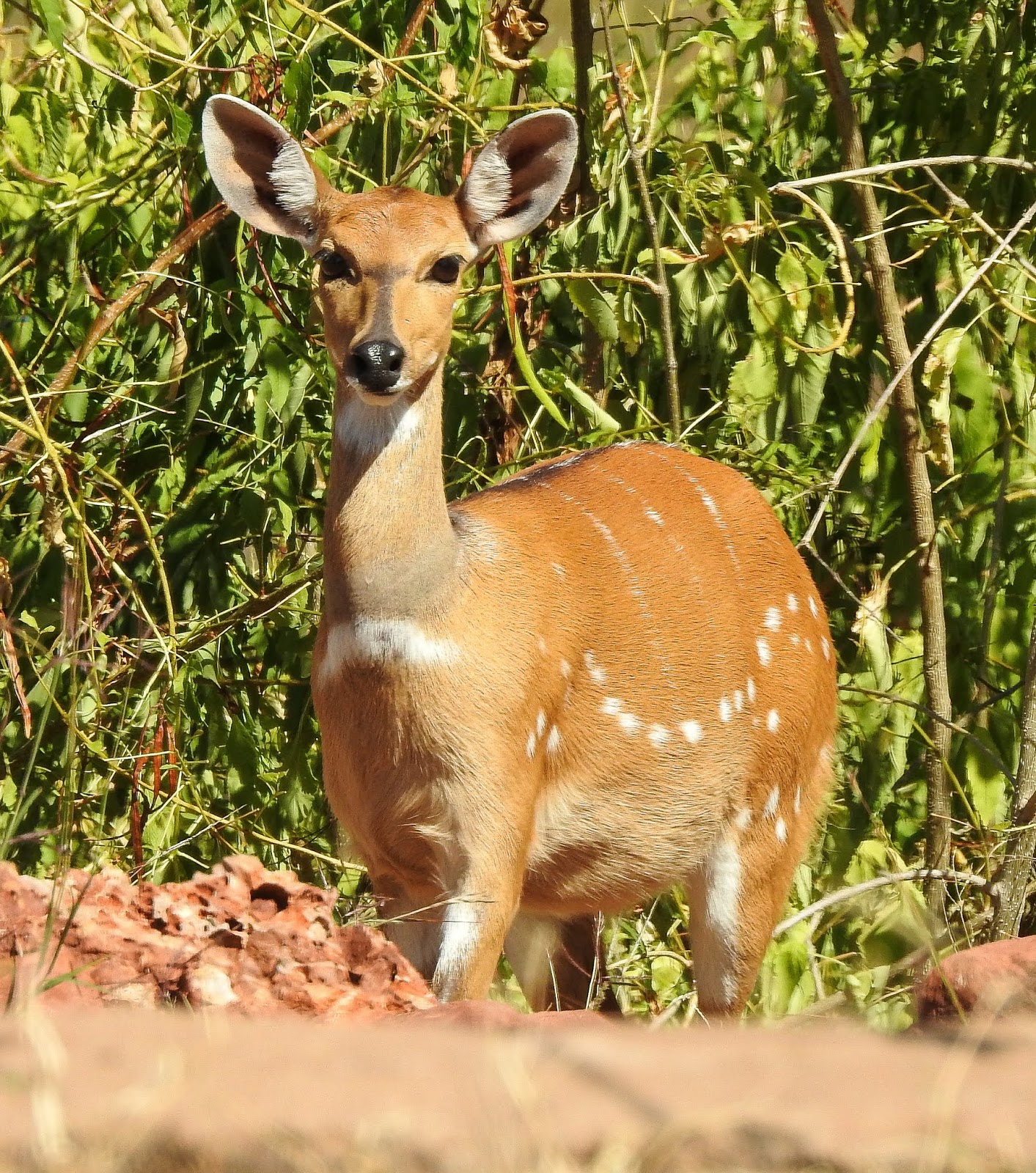
21-5-2019 BUMI HILLS, ZIMBABWE - SOUTHERN BUSHBUCK (FEMALE) (Tragelaphus scriptus)


The bushbuck (Tragelaphus scriptus ) is a common and a widespread species of antelope in Sub-Saharan Africa. Bushbuck are found in a wide range of habitats, such as rain forests, montane forests, forest-savanna mosaic, savanna, bushveld and woodland. Bushbuck stand about 90 centimetres (35 in) at the shoulder and weigh from 45 to 80 kilograms (99 to 176 lb). They are generally solitary, territorial browsers.

The bushbuck is a widespread species of antelope in Sub-Saharan Africa. These animals have a light brown coat, with up to seven white stripes and white splotches on the sides. The white patches are usually geometrically shaped and on the most mobile parts of their body such as the ears, chin, tail, legs, and neck. 


The muzzle is also white and horns are found only on the males.Cape bushbucks stand around 90 cm (35 in) at the shoulder and weigh from 60 to 80 kg (130 to 180 lb) in males and 25 to 60 kg (55 to 132 lb)in females. They have a light brown coat, with up to seven white stripes and white splotches on the sides. The white patches are usually geometrically shaped and on the most mobile parts of their bodies, such as the ears, chin, tail, legs, and necks. The muzzles are also white. Horns, found only on the males, can reach over half a metre and have a single twist. At 10 months old, young males sprout horns that are particularly twisted and at maturity form the first loop of a spiral.

28-6-2019 MARCHUQUERA, VALENCIA - PAINTED LADY BUTTERFLY (Vanessa cardui)


28-6-2019 MARCHUQUERA, VALENCIA - EURASIAN TREE SPARROW (MALE) (Passer montanus)


The Eurasian tree sparrow (Passer montanus) is a charming passerine bird, easily recognized by its rich chestnut crown and nape, and a distinctive black patch on each pure white cheek. Both sexes are similarly adorned, and the juveniles mirror the adults, albeit with slightly duller hues. This species is somewhat smaller than the closely related house sparrow, and its size is approximately 12.5–14 cm in length, with a wingspan of about 21 cm.

To identify the Eurasian tree sparrow, look for the kidney-shaped black ear patch on each white cheek, the black chin and throat, and the light brown upperparts streaked with black. The wings bear two narrow white bars, and the legs are pale brown. The bill is lead-blue in summer, darkening almost to black in winter. Unlike the house sparrow, there is no sexual dimorphism in plumage, making both males and females equally easy to identify.

In Europe, the Eurasian tree sparrow is typically found in lightly wooded open countryside, while in eastern Asia, it is more common in urban settings. It prefers nesting in natural cavities, holes in buildings, or even the abandoned nests of other large birds. This species is not typically found in mountainous regions, despite its scientific name suggesting otherwise.

26-6-2019 BONAIRE, VALENCIA - EURASIAN MAGPIE (Pica pica)


The Eurasian magpie, or common magpie (Pica pica), is a striking bird that graces the northern reaches of the Eurasian continent. It is a member of the crow family, known as corvids, and is part of the "monochrome" magpie group within the Holarctic radiation. The bird is easily recognized by its black and white plumage and long, iridescent tail.
Adult Eurasian magpies measure 44–46 cm in length, with over half of this being the tail. They have a wingspan of 52–62 cm. The head, neck, and breast are glossy black with a metallic sheen of green and violet, while the belly and scapulars are pure white. The wings are black with green or purple gloss, and the primaries have white inner webs. The tail is black with green and reddish-purple gloss. Both sexes have similar plumage, though females are slightly smaller. 

The Eurasian magpie favors open countryside with scattered trees, avoiding dense forests and treeless areas. It adapts well to suburban environments, including parks and gardens, and can be found in city centers.
This magpie's range spans temperate Eurasia from the western edges of Portugal and Spain to the eastern limits of the Kamchatka Peninsula.

The Eurasian magpie is known for its intelligence, comparable to that of great apes. It is monogamous, with pairs often remaining together across seasons. They are sedentary, though northern populations may move south in severe weather.


The magpie's call is a distinctive "chac-chac" or a repetitive "chac-chac-chac-chac." Young birds emit a similar call and a high-pitched "Uik Uik," which can resemble a small dog's bark.

Magpies typically breed after their first year. They build large, domed nests in tall trees, laying clutches of five to six pale blue-green eggs, which are incubated for 21–22 days. The chicks are altricial and fledge at around 27 days, with parental care continuing for several weeks.

The Eurasian magpie can be confused with the North American black-billed magpie (Pica hudsonia), though they are now considered separate species.

Omnivorous, the Eurasian magpie's diet includes young birds, eggs, small mammals, insects, carrion, acorns, grain, and other plant matter.

With an extensive range and stable population trends in Europe, the Eurasian magpie is classified by the IUCN as Least Concern. Estimates suggest a total population of 46 to 228 million individuals globally.

20-5-2019 BUMI HILLS, ZIMBABWE - SOUTHERN RED BILLED HORNBILL (Tockus rufirostris)


20-5-2019 BUMI HILLS, ZIMBABWE - BLACK CROWNED TCHAGRA (Tchagra senegalus)

20-5-2019 BUMI HILLS, ZIMBABWE - SAVANNAH ELEPHANT (Loxodonta Africana)


20-5-2019 BUMI HILLS, ZIMBABWE - SOUTHERN RED BILLED HORNBILL (Tockus rufirostris)


The Southern red-billed hornbill, Tockus rufirostris, is a distinguished member of the Bucerotidae family, gracing the savannas and drier bushlands of southern Africa with its presence. This bird is characterized by its striking red bill and the streaks of blackish plumage that extend from its ear coverts down the side of its neck.

Upon observing this species, one will note the sexual dimorphism where males are generally larger with slightly longer bills. The male's lower mandible may exhibit varying degrees of black pigmentation. Both sexes boast a yellow iris surrounded by pale orbital skin, ranging from pink to greyish hues. The throat is a pristine white, and the wing coverts are adorned with conspicuous spots.


The Southern red-billed hornbill is a native inhabitant of the savannas and dryer bushlands, thriving in these open environments where it can forage and nest.

This hornbill's range extends from Malawi and Zambia to southern Angola, northeastern Namibia, Botswana, Zimbabwe, eastern Eswatini, and northern South Africa, including Transvaal and northern KZN province. It is also found in the upper Zambezi valley of Mozambique, though it is mostly absent from the eastern lowlands.

A notable behavior of the Southern red-billed hornbill is its unique call, an accelerating series of notes that culminates in a crescendo of double notes. Unlike its congeners, this species does not engage in wing-raising displays.


The vocal repertoire of this hornbill includes a distinctive call that starts with a series of "kuk kuk kuk" notes and ends with a flourish of double notes, "kuk-we kuk-we."

The Southern red-billed hornbill can be confused with other red-billed hornbills, but it can be distinguished by its unique combination of yellow iris, pale orbital skin, and the pattern of blackish streaking on the neck.

The conservation status of the Southern red-billed hornbill is not explicitly mentioned, but given its wide distribution, it may not currently be of significant conservation concern. However, like all wildlife, it would benefit from ongoing habitat protection and monitoring.

Thursday, 27 June 2019

20-5-2019 BUMI HILLS, ZIMBABWE - AFRICAN CORMORANT (Microcarbo africanus ssp. africanus)


It is a small cormorant reaching between 50 and 55 cm in length and a wingspan of 85 cm. It is mainly black, bright green when breeding. The wing coverts are silvery. It has a fairly long tail, a short crest on its head, and a red or yellow facial patch. The beak is yellow.

Both sexes are similar, but non-breeding adults and juveniles are browner, with a white belly. Some southern breeds retain the crest throughout the year.

26-6-2019 BONAIRE, VALENCIA - COMMON HOUSE MARTIN (Delichon urbicum)


The Western House Martin (Delichon urbicum), sometimes known as the Common House Martin, is a migratory passerine bird belonging to the swallow family. It is characterized by a blue head and upperparts, a distinctive white rump, and pure white underparts. This species exhibits sexual dimorphism, with both sexes appearing similar, and juveniles displaying a sooty black coloration with white-tipped wing coverts and quills.

Adults measure approximately 13 cm in length, with a wingspan ranging from 26 to 29 cm and an average weight of 18.3 grams. They possess brown eyes, a small black bill, and pink toes and exposed leg parts. The white rump and underparts are particularly noticeable in flight, aiding in distinguishing them from other swallows.

The Western House Martin favors open country with low vegetation, such as pastures, meadows, and farmland, often near water. It is also found in urban areas and can nest in city centers if air quality permits.


This bird breeds across Europe, North Africa, and the Palearctic, migrating to sub-Saharan Africa and tropical Asia for the winter. It is a broad-front migrant, traveling during daylight and feeding on insects in flight.

The Western House Martin is a social bird, often breeding colonially with nests built in close proximity. It is known for its aerial agility, which it uses to evade predators such as the Eurasian Hobby.

The male's song is a soft twitter of melodious chirps, while the contact call is a hard "chirrrp." The alarm call is a shrill "tseep."

Nests are constructed from mud pellets under eaves or similar overhangs on buildings, usually in colonies. The species is known to produce two broods per year, with four to five white eggs per brood. Juveniles fledge after 22 to 32 days and are fed by parents for about a week thereafter.

20-5-2019 BUMI HILLS, ZIMBABWE - SOUTHERN GREATER KUDU (MALE) (Tragelaphus Strepsiceros)


The greater kudu (Tragelaphus strepsiceros) is a large woodland antelope, found throughout eastern and southern Africa. Despite occupying such widespread territory, they are sparsely populated in most areas due to declining habitat, deforestation, and poaching. The greater kudu is one of two species commonly known as kudu, the other being the lesser kudu, T. imberbis.

Kudu (/kuːduː/ koo-DOO), or koodoo, is the Khoikhoi name for this antelope. Trag- (Greek) denotes a goat and elaphos (Greek) a deer. Strepho (Greek) means 'twist', and strepsis is 'twisting'. Keras (Greek) refers to the horn of the animal.

Greater kudus have a narrow body with long legs, and their coats can range from brown/bluish grey to reddish brown. They possess between 4 and 12 vertical white stripes along their torso. The head tends to be darker in colour than the rest of the body, and exhibits a small white chevron which runs between the eyes. Greater kudu bulls tend to be much larger than the cows, and vocalize much more, utilizing low grunts, clucks, humming, and gasping. The bulls also have beards running along their throats, and large horns with two and a half twists, which, were they to be straightened, would reach an average length of 120 cm (47 in), with the record being 187.64 cm (73.87 in). They diverge slightly as they slant back from the head. The horns do not begin to grow until the bull is between the ages of 6–12 months. The horns form the first spiral rotation at around 2 years of age, and not reaching the full two and a half rotations until they are 6 years old; occasionally they may even have 3 full turns.

The greater kudu is one of the largest species of antelope, being slightly smaller than the bongo. Bulls weigh 190–270 kg (420–600 lb), with a maximum of 315 kg (694 lb), and stand up to 160 cm (63 in) tall at the shoulder. The ears of the greater kudu are large and round. Cows weigh 120–210 kg (260–460 lb) and stand as little as 100 cm (39 in) tall at the shoulder; they are hornless, without a beard or nose markings. The head-and-body length is 185–245 cm (6.07–8.04 ft), to which the tail may add a further 30–55 cm (12–22 in).

20-5-2019 BUMI HILLS, ZIMBABWE - SOUTHERN GREATER KUDU (FEMALE) (Tragelaphus Strepsiceros)


The Greater kudu (Tragelaphus strepsiceros) is a woodland antelope found in Africa. Despite occupying such widespread territory, Greater kudus are sparsely populated in most areas due to declining habitat, deforestation, and poaching.

Greater kudus have a narrow body with long legs, and their coats can range from brown/bluish-grey to reddish-brown. They possess between 4 and 12 vertical white stripes along their torso. The head is usually darker in color than the rest of the body and exhibits a small white v-shaped mark that runs between the eyes. Bulls tend to be much larger than cows, and vocalize much more; they also have beards running along their throats and large horns with two and a half twists.

The range of Greater kudu extends from the east in Ethiopia, Tanzania, Eritrea, and Kenya into the south where they are found in Zambia, Angola, Namibia, Botswana, Zimbabwe, and South Africa. Other regions where they occur are the Central African Republic, Chad, the Democratic Republic of the Congo, Djibouti, Malawi, Mozambique, Somalia, Swaziland, and Uganda. These antelopes live in mixed scrub woodlands and bush on abandoned fields and degraded pastures, mopane bush, and acacia in lowlands, hills, and mountains. They will occasionally venture onto plains only if there is a large abundance of bushes but normally avoid such open areas to avoid becoming an easy target for their predators.

20-5-2019 BUMI HILLS, ZIMBABWE - WESTERN GREY HERON (Ardea cinerea ssp. cinerea)


The term "western grey heron" is a variation of Grey Heron (Ardea cinerea), a large, long-legged wading bird found in wetlands across much of Europe, Asia, and Africa. It has grey upperparts, a white head with black stripes leading to a crest, and a yellowish-pink bill. Known for its calm foraging behavior, it hunts by standing still and striking quickly at fish, amphibians, and small mammals. 


Appearance

Plumage: Ashy-grey on the back and wings, with a greyish-white underside.
Head: White with a black stripe running from above the eye to the back of the head, where it forms a crest.
Neck: Light colored with dark streaks on the front.
Bill: Long, strong, and yellowish-pink, becoming brighter in the breeding season.
Legs: Long and brownish.

Size: Stands about 1 meter tall with a wingspan of around 1.75 meters. 
Behavior and diet
Foraging: Stalks or stands motionless in the water, waiting for prey to come close.


Diet: Primarily fish, but also eats amphibians, small mammals, reptiles, and insects.

Hunting: Strikes at prey with its long beak like a harpoon.

Flight: Folds its neck into an "S" shape while flying. 

Habitat and distribution

Habitat: Found in various wetlands, including rivers, lakes, ponds, and coastlines. It nests in colonies called heronries, often in trees near water.
Distribution: Its range includes Europe, Asia, and Africa. In some western populations, such as in parts of southern Africa, the population is increasing due to factors like irrigation and reservoirs. 

Calls

Main call: A harsh, croaking "fraaank".
Other noises: A variety of guttural and raucous sounds are made, especially at breeding colonies. 

27-6-2019 MONTE CORONA, VALENCIA - PAINTED LADY BUTTERFLY (Vanessa cardui)