TOTAL PAGEVIEWS

TRANSLATE

Friday, 15 September 2017

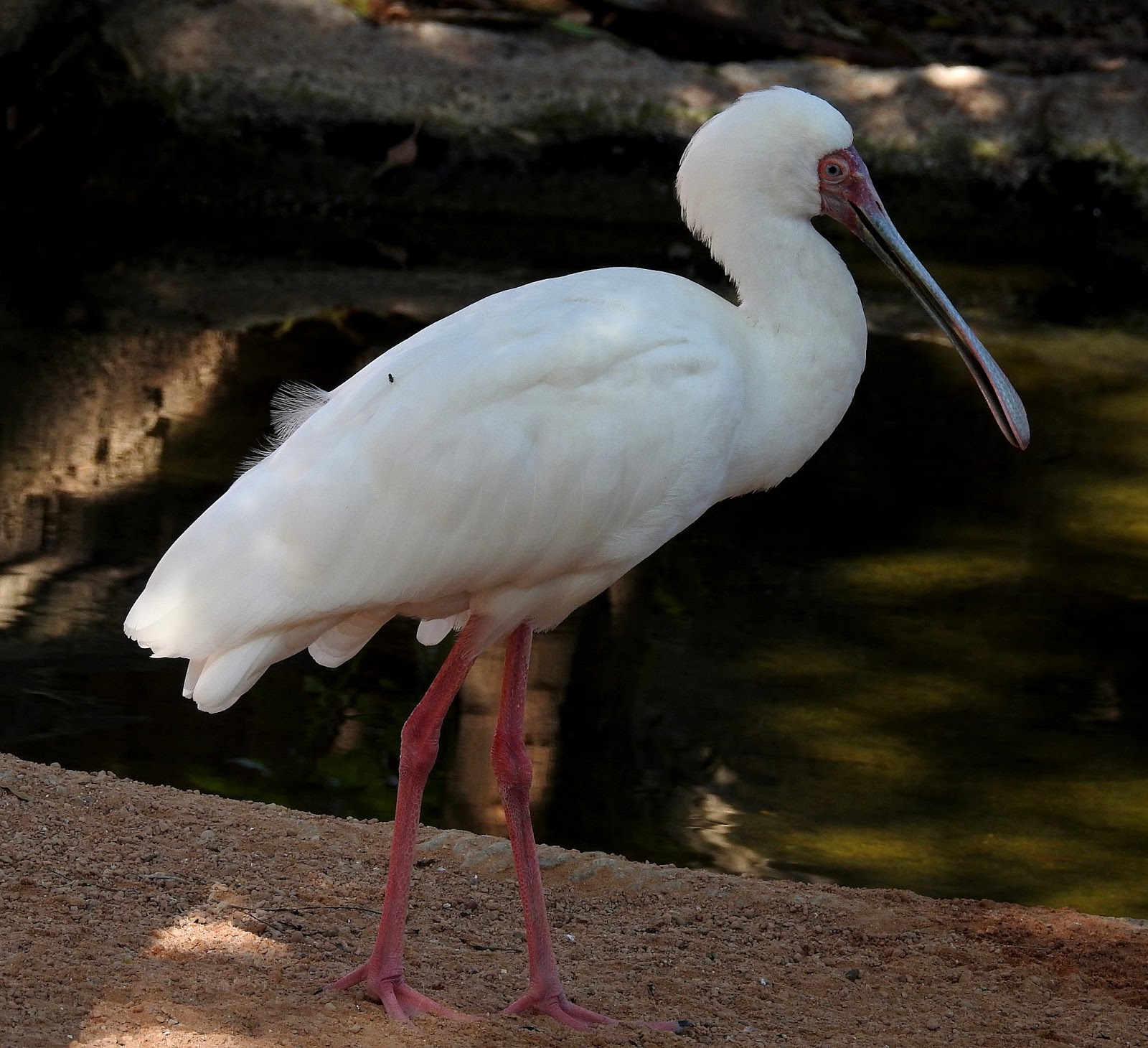
13-9-2017 BIOPARC, VALENCIA - AFRICAN SPOONBILL (Platalea alba)


The African spoonbill, Platalea alba, is a striking wading bird belonging to the ibis and spoonbill family, Threskiornithidae. This species is characterized by its long legs, which facilitate wading through marshy wetlands, and its distinctive long grey spatulate bill, which is used to sift through shallow waters for food. Adult birds are predominantly white with red legs and a red face, while immature birds can be identified by their yellow bills and the absence of red on their faces.

When identifying the African spoonbill, look for a large, all-white bird with a unique spoon-shaped bill. During flight, unlike herons, spoonbills keep their necks outstretched. Breeding adults will exhibit more vibrant red coloration on their legs and face, and their bill will be grey. Juveniles can be distinguished by their paler bill color and lack of red facial markings.


The African spoonbill is found in marshy wetlands that have open shallow water. It prefers environments where it can wade and forage for food, such as in reedbeds or along the edges of bodies of water.

This bird has a widespread presence across Africa and Madagascar, with sightings reported in countries including Botswana, Kenya, Mozambique, Namibia, South Africa, and Zimbabwe.


African spoonbills are known for their methodical feeding technique, swinging their open bills side-to-side in the water to catch prey. They are sociable birds, often nesting in colonies, but they typically do not share these colonies with storks or herons. Their long legs and thin, pointed toes are perfectly adapted for navigating through varying water depths.

The African spoonbill is generally silent, but it may make soft grunting noises during the breeding season.

Breeding season for the African spoonbill occurs in the winter and extends into spring. During this time, males display more pronounced plumage and brighter colors. Nests are constructed from sticks and reeds in trees above water and lined with leaves. Females lay three to five eggs, primarily in April or May. Both parents share the responsibility of incubating the eggs for up to 29 days. After hatching, the chicks are cared for by both parents for approximately 20 to 30 days, becoming ready to fly four weeks post-fledging.

The African spoonbill can be confused with the common spoonbill; however, it lacks the crest found on the latter. Additionally, the common spoonbill has a yellowish bill, whereas the African spoonbill's bill is grey.


The diet of the African spoonbill includes a variety of fish, molluscs, amphibians, crustaceans, insects, and larvae. Its specialized bill allows it to efficiently sift through water to capture these prey items.

The IUCN Red List classifies the African spoonbill as Least Concern, indicating that the species currently faces no significant threats to its survival. It is also protected under the Agreement on the Conservation of African-Eurasian Migratory Waterbirds (AEWA).

13-9-2017 BIOPARC, VALENCIA - WHITE HEADED VULTURE (Trigonoceps occipitalis)


The White-headed Vulture, Trigonoceps occipitalis, presents a striking figure in the African skies. This medium-sized vulture, measuring 72–85 centimeters in length with a wingspan of 207–230 centimeters, is notable for its distinctive plumage. The females, slightly larger than the males, weigh an average of 4.7 kilograms, while the males tip the scales at less than 4 kilograms. The species exhibits reversed sexual dimorphism, a unique trait among its African counterparts.

This vulture is easily recognized by its contrasting black and white plumage. A white crest adorns its head, and the featherless regions of its face are a pale hue. Its beak is tinged pink, and the dark brown upper parts complement the black tail feathers. From below, the white feathers on its lower parts and legs are unmistakable. Each individual can be identified by a unique pattern in their median wing coverts.

The White-headed Vulture is adapted to mixed, dry woodlands at lower altitudes, avoiding human settlements. It thrives in thorny Acacia-dominated landscapes and can be found at elevations up to 4,000 meters in Ethiopia and around 3,000 meters in Kenya.

This vulture's range extends across sub-Saharan Africa, from Senegal and Gambia in the west, east to Somalia, and south to South Africa and Eswatini. It is a resident species, with populations concentrated in protected areas such as the Kruger National Park.


The White-headed Vulture is a solitary bird, often seen alone or in pairs, and is known to be territorial and long-lived. It builds nests predominantly in acacias or baobabs, laying a single egg post-rainy season. This species is also an opportunistic predator, occasionally hunting small mammals and reptiles.

During copulation, the White-headed Vulture emits a deep, squeak-like sound, longer than a grunt, which is considered unusual among vultures.

Breeding pairs are loyal to their territory and exhibit subtle copulation behavior. The average productivity from a study of 73 pairs was 0.69 chicks per pair.

The White-headed Vulture is unique in its appearance and can be distinguished from other vultures by its coloration and size.

Primarily a scavenger, this vulture is often the first to arrive at a carcass due to its habit of flying lower than other species. It may also hunt live prey, such as mongooses, lizards, squirrels, and hares.

The White-headed Vulture is currently classified as Critically Endangered. Its populations have been in decline since the 1940s due to habitat loss, reduced food availability, and poisoning. The species is highly sensitive to land-use changes and is now largely restricted to protected areas.

13-9-2017 BIOPARC, VALENCIA - ABDIM'S STORK (Ciconia abdimii)


The Abdim's stork, known scientifically as Ciconia abdimii and colloquially as the white-bellied stork, is a modestly sized member of the stork family, Ciconiidae. It is distinguished by its black plumage, contrasted with white underparts, and notable for being the smallest stork species. The legs are grey, with red knees and feet, and the bill is also grey. During the breeding season, one can observe red skin in front of the eye and blue skin near the bill, adding a splash of color to this otherwise monochromatic bird. An adult typically measures 73 cm in length and tips the scales at just over 1 kg.


When identifying the Abdim's stork, look for its black and white coloration, red knees, and the distinctive facial skin color changes during the breeding season. Its small size compared to other storks is also a key characteristic.

This stork favors open habitats across Sub-Saharan Africa, avoiding forests, dense woodlands, and deserts. It is also present in Yemen.


The Abdim's stork is a widespread resident from the Sahel down to South Africa. It breeds in the northern half of its range during the wet season and migrates to eastern and southern Africa for the rest of the year. There have been instances of this species in Florida, U.S., although these are likely due to escapes or deliberate releases, with no evidence of a breeding population.

Abdim's storks are colonial breeders, nesting in trees, on cliffs, or rooftops. They are migratory, moving seasonally between breeding and non-breeding areas.


The diet of the Abdim's stork is primarily insectivorous, with a preference for locusts, caterpillars, and other large insects. However, it is also known to consume small reptiles, amphibians, mice, crabs, and eggs.

During the breeding season, the female lays two to three eggs. The male is slightly larger than the female, which is a common trait among storks.

The Abdim's stork is currently evaluated as Least Concern on the IUCN Red List of Threatened Species. It is the focus of several breeding programs, notably in the United States and Europe, to ensure its continued survival in zoos and aviaries.

13-9-2017 BIOPARC, VALENCIA - MARABOU STORK (Leptoptilos crumenifer)


The Marabou Stork, Leptoptilos crumenifer, is a formidable presence in the avian world, with its massive stature and striking appearance. It stands tall at approximately 152 centimeters and can weigh up to 9 kilograms. Its wingspan is a sight to behold, stretching up to 3.7 meters, rivaling even the Andean condor in breadth. The marabou is adorned with a black back, contrasting white underparts, and a distinctive bare head and neck. Its bill is robust, and it sports a pink gular sac at its throat, a neck ruff, and white legs. Both sexes appear similar, though the female is typically smaller, and juveniles are browner with a less pronounced bill.


To identify the Marabou Stork, look for its large size, bare head, and neck, along with its black back and white underparts. The bird's enormous bill and pink throat sac are also key characteristics. When in flight, note that unlike most storks, the Marabou Stork flies with its neck retracted, resembling a heron.

The Marabou Stork is native to sub-Saharan Africa, where it can be found in a variety of habitats, both wet and arid. It often resides near human habitation, particularly around landfill sites.


This species is widespread across sub-Saharan Africa, from Senegal to Ethiopia, and down to South Africa. It is a common sight in both urban and less populated areas, depending on the region.

The Marabou Stork is known for its gregarious nature, often seen in groups. It is a colonial breeder, particularly during the dry season when food is more abundant. The bird has a reputation for being ill-tempered and is not particularly vocal, though it engages in bill-rattling courtship displays. The throat sac plays a role in producing sounds during this time.


The Marabou Stork is relatively quiet compared to other birds, but it does engage in bill-rattling as part of its courtship ritual.

Breeding occurs in colonies during the dry season. The female lays two to three eggs in a stick nest, with the eggs hatching after 30 days. Young Marabou Storks reach sexual maturity at 4 years, and the species can live up to 43 years in captivity and 25 years in the wild.


The Marabou Stork is an opportunistic feeder, primarily scavenging on carrion, scraps, and faeces. It is known to consume a wide range of animal matter, including fish, frogs, insects, small mammals, and reptiles. During the breeding season, it focuses on small, live prey to feed its nestlings. The bird often follows vultures to feed on carcasses and may become dependent on human garbage, consuming almost anything it can swallow.

The Marabou Stork is currently listed as Least Concern on the IUCN Red List, indicating that it is not at immediate risk of population decline.

The Marabou Stork can be confused with other large storks, such as the adjutants (Leptoptilos spp.), but can be distinguished by its unique bare head, neck, and pink throat sac.

Adult Marabou Storks face few natural predators and enjoy a high annual survival rate. However, they can fall prey to ambush by lions. They are also susceptible to various endoparasites, which can impact their health and longevity.

13-9-2017 BIOPARC, VALENCIA - RUPPELL'S VULTURE (Gyps rueppelli)


Rüppell's vulture (Gyps rueppelli) is a large bird and its name comes from the 19th-century German zoologist and explorer Eduard Rüppell. It is native to the Sahel region and East Africa and its current population is decreasing due to loss of habitat, incidental poisoning, and other factors. Rüppell's vulture is considered to be the highest-flying bird, with confirmed evidence of a flight at an altitude of 11,300 m (37,000 ft) above sea level.


Both sexes of this species look alike: mottled brown or black overall with a whitish-brown underbelly and thin, dirty-white fluff covering the head and neck. The base of the neck has a white collar, the eye is yellow or amber, and the crop patch is deep brown. The head does not have feathers. This is an adaptation that occurred because of the Rüppell vulture's tendency to stick its head inside of its prey when eating. Without the adaptation, feeding would become extremely messy.


Rüppell's vultures are diurnal and very social birds, roosting, nesting, and feeding in large flocks. Like most vultures, they are silent, except when at their nesting ground or foraging around a carcass. They spend much of their time flying, gliding with wings held level, or using slow, powerful wing beats. They often fly at great altitudes, using strong winds or thermals for more efficient soaring. These vultures locate food by sight only, and once they see a carcass they swoop down, land a little way off, and then bound forward with wings spread and their long neck outstretched. Fights with other vultures are common as the birds struggle to get their meal, their necks often turning deep red from aggression as they hiss, grunt, and chatter at their opponent.


The Rüppell’s vulture inhabits the Sahel region in central Africa (Mali, Niger, Nigeria, Sudan, Chad, and others), living in sub-Saharan grassland and woodland. It often roots and breeds around cliffs and gorges.


Rüppell’s vultures are monogamous and form strong lifelong pair bonds. In vulture courtship, a pair will circle close together near cliffs. Pairs perch next to each other for a long time and together form colonies of as many as 1,000 breeding pairs. They build their large nests out of sticks and line them with grass and leaves. Females often steal sticks from other nests for the males to arrange. Depending upon the nesting site’s location, it may be used year on year or just once. Both parents take part in incubation, brooding, and feeding the chicks. A single egg is laid each year. Incubation is for 55 days. When the chick hatches, both its parents will feed it and look after it until it is about 150 days old when it fledges. After fledging a chick remains dependent on its parents, reaching independence when the next breeding season comes. Until then, they learn how to seek and compete for food.


This formerly abundant species has suffered a rapid decline over much of its range, especially in West Africa, and is now mostly confined to protected areas. Despite being less studied than other vultures, it is known that these declines are due to the impact of agriculture on their habitat, persecution, and large-scale incidental poisoning. In West Africa, these birds have been greatly used in black magic practices.


The IUCN Red List reports the Rüppell’s vulture total population size as 22,000 mature individuals, with perhaps about 30,000 individuals at the beginning of the 1990s. Specific populations have been estimated in these areas: 3,000 pairs in Tanzania; 2,000 pairs in Kenya; 2,000 pairs in Ethiopia; 2,000 pairs in Sudan and 2,000 pairs in West Africa. Overall, currently, Rüppell’s vultures are classified as Critically Endangered (CR) and their numbers today are decreasing.


The Ruppell's vulture is the highest-flying bird. Reportedly, a jet flying over the Ivory Coast at an altitude of 35,433 feet (10,800 meters) hit one! The Ruppell's vulture gets on the wing about two hours after sunrise and spends its entire day aloft.

Very social birds. Usually nest in loose colonies of up to 100 pairs, but have been seen in colonies up to 1,000 pairs. Colonies are found in open, arid areas. Prefers open areas, since they hunt for carcasses using sight, not smell.

Huge vulture, slightly smaller than Eurasian Griffon. Adults have dark-bodied with pale feather tips on body and shoulders, giving them a scaled appearance; also note pale bill and eye. Juveniles are dark with a characteristic pale bar on the leading edge of the underwings and have a black bill and dark eyes. Nests on cliffs and is generally silent except when squabbling at carcasses. Often encountered foraging over grasslands and soaring along cliffs and ridgelines. 

Thursday, 14 September 2017

13-9-2017 BIOPARC, VALENCIA - SOUTHERN GROUND HORNBILL (Bucorvus leadbeateri)


The Southern Ground Hornbill (Bucorvus leadbeateri), formerly known as Bucorvus cafer, is a remarkable bird, the largest in the hornbill order and found exclusively within Africa. This majestic creature, with a length ranging from 90 to 129 cm and a wingspan of 1.2 to 1.8 meters, is a sight to behold. The males, larger than the females, can weigh between 3.5 to 6.2 kilograms, while females range from 2.2 to 4.6 kilograms. They are predominantly black with striking red patches of bare skin on the face and throat, which serve to keep dust from their eyes while foraging. In flight, the white tips of their wings are distinctly visible. The beak is robust, black, and slightly curved, with a casque more pronounced in males. Females are identified by their violet-blue throat skin, while juveniles have a paler, greyish patch instead of the vibrant red.


To identify the Southern Ground Hornbill, look for its large size, black plumage, and the vivid red or violet-blue skin on the throat. The male's throat is a pure red, while the female's is deep violet-blue. Juveniles can be recognized by their duller grey throat patch. In flight, the white primary feathers are a key distinguishing feature.

The Southern Ground Hornbill is found in woodlands and savannas, requiring a habitat with large trees for nesting and short grass for foraging.


This species ranges from Kenya to South Africa, with its presence also noted in northern Namibia and Angola to southern Zimbabwe and Burundi.

Living in groups of 5 to 10, these birds are apex predators and play a crucial ecological role. They forage on the ground, hunting a variety of prey from insects to small mammals. They are known for their loud, chorus-like calls that can be heard over great distances, serving as a means of maintaining their territory.

The Southern Ground Hornbill's calls are a distinctive aspect of their behavior, used for communication and territorial purposes. These calls can be heard up to 3 kilometers away.

Breeding pairs are assisted by at least two other birds, and experience as helpers is essential for successful rearing of young. They reach sexual maturity around 4-6 years of age and start breeding at about 10 years. Nesting typically occurs in high tree cavities or cliff face rock holes. They lay one to three eggs, but only one chick is usually reared to fledging.


The Abyssinian Ground Hornbill (B. abyssinicus) is similar but can be distinguished by its size and range.

Southern Ground Hornbills are carnivorous, feeding on reptiles, frogs, snails, insects, and mammals up to the size of hares. They forage on the ground and rarely drink water.

The IUCN lists the Southern Ground Hornbill as Vulnerable globally, with an Endangered status in South Africa, Lesotho, Namibia, and Eswatini. Their numbers are declining due to habitat destruction, persecution, and other factors. Conservation efforts include habitat preservation and captive breeding programs.

13-9-2017 BIOPARC, VALENCIA - CAPE PORCUPINE (Hystrix africaeaustralis)


The Cape porcupine (Hystrix africaeaustralis ) or South African porcupine, is a species of Old World porcupine native to central and southern Africa.

The Cape porcupine is a large terrestrial rodent native to central and southern Africa. It is the largest rodent in Africa and also the world's largest porcupine. It is a heavily built animal, with a stocky body, short limbs, and an inconspicuous tail. The body is covered in long spines up to 50 cm (20 in) in length, interspersed with thicker, sharply pointed, defense quills up to 30 cm (12 in) long, and with bristly, blackish, or brownish fur. The spines on the tail are hollow and used to make a rattling sound to scare away predators. An erectile crest of long, bristly hairs runs from the top of the porcupine's head down to its shoulders. The spines and quills cover the back and flanks of the animal and continuing onto the tail. The quills have multiple bands of black and white along their length, and grow from regularly spaced grooves along the animal's body; each groove holding five to eight quills. The remainder of the animal, including the undersides, is covered with dark hair.


Cape porcupines are found across the whole of southern and central Africa, to southern Kenya, Uganda, and Congo at the northern edge of their range. They live in a wide range of habitats, preferring rocky crevices and caves for shelter. They are only marginally present in dense forests and the driest of deserts and are not found in swampland.

Cape porcupines are nocturnal animals, typically living as mated pairs of adults, caring for their young together. Each pair may inhabit up to 6 burrows, jointly defending their shared territory, although they typically forage singly. Both sexes scent mark their territory, although males do so more frequently, and may play a more active role in its defense. Cape porcupines are shy creatures and when attacked, their main defense mechanism is to freeze. However, if cornered, they turn vicious and charge to stab their attacker with their quills. Otherwise, porcupines may retreat into their burrow, exposing only their quills and making it hard to dislodge.


Cape porcupines are herbivores and eat mostly plant material: fruits, roots, tubers, bulbs, and bark. They may sometimes gnaw on carrion and bones.

Cape porcupines are monogamous animals that form pairs. They mate throughout the year, although births are usually most common during the rainy season, between August and March. Females typically give birth only once each year. Gestation lasts around 94 days and results in the birth of a litter of 1-3 young. Newborn pups weigh 300 to 440 grams (11 to 16 oz); they are born well-developed, with their eyes open, and initially have soft quills. Although they are born with their incisor teeth fully erupted, the remaining teeth begin to appear at 14 days. The pups are weaned at around 100 days of age, and grow rapidly for the first 20 weeks, reaching the full adult size, and reproductive maturity, at the end of their first year.

13-9-2017 BIOPARC, VALENCIA - VERREAUX'S EAGLE OWL (Bubo lacteus)


The Verreaux's eagle-owl (Ketupa lactea), also known as the milky eagle owl or giant eagle owl, is a formidable presence in the avian world. As the largest owl found in Africa and the most massive in the tropics, it commands attention with its impressive stature. This species can reach up to 66 cm (26 in) in total length, with females typically out-sizing males. Its plumage is primarily a soft grey, with fine brownish vermiculations on the underside and more solid light brown with white spots on the shoulder. The facial disc is paler, often whitish, with stark black borders. However, its most distinctive feature is the bright pink eyelids, unique among owl species.

When observing Verreaux's eagle-owl, look for its large size, grey plumage, and the striking pink eyelids that are visible when the bird is at rest. The ear tufts are relatively small and may not be noticeable at a distance. The eyes are a deep brown, contrasting with the paler facial disc. In flight, its large wingspan is evident, which can reach nearly 164 cm (5 ft 5 in) in females.


Verreaux's eagle-owl favors dry, wooded savanna environments, often bordering semi-arid regions. It can also be found in riverine forests adjacent to savannas and in small, semi-open woodlands. This species is adaptable to various elevations, from sea level to mountainous areas up to 3,000 m (9,800 ft), though it is generally scarce in rocky terrains.

This eagle-owl is widespread across sub-Saharan Africa, with the highest densities in eastern and southern Africa. It is less common in the dense rainforests of west and central Africa, with a sporadic presence in transitional zones between the Sahara and rainforests.

Nocturnal by nature, Verreaux's eagle-owls spend their days roosting in trees, often on large horizontal branches. They are known to roost lightly, awakening quickly to defend themselves if necessary. Family groups, including offspring from previous years, may roost and preen together. Each pair defends a large territory, which can be up to 7,000 ha (17,000 acres) in size.


The call of the Verreaux's eagle-owl is the deepest among owls, with the male's song resembling a series of deep "gwok" sounds. The female's call is similar but higher-pitched. Their vocalizations can carry for considerable distances, facilitating communication between mates and territorial defense.

Verreaux's eagle-owls are monogamous and likely mate for life. They typically use large stick nests built by other birds, often on top of hamerkop nests or those constructed by large raptors. The female usually lays two white eggs, with the older chick often outcompeting the younger for food. Fledglings leave the nest before they can fly competently and remain dependent on their parents for several months.

The Shelley's eagle-owl (Ketupa shelleyi) is similar in size but has a darker, sooty coloration and prefers deep forests. The Cape eagle-owl (Bubo capensis) is smaller and has different plumage and eye color.

Verreaux's eagle-owl is an opportunistic predator with a diet that includes mammals, birds, reptiles, amphibians, and insects. It is known to be the only routine predator of hedgehogs in Africa, skillfully removing their prickly skins before consumption.

The IUCN lists Verreaux's eagle-owl as Least Concern due to its wide range and adaptability to habitat alterations. However, it occurs at low densities, and regional declines have been reported due to habitat destruction, persecution, and the effects of pesticides.

13-9-2017 BIOPARC, VALENCIA - GOLDEN BREASTED STARLING (Lamprotornis regius)


The golden-breasted starling (Lamprotornis regius ), also known as royal starling, is a medium-sized passerine in the starling family.

Lamprotornis regius can reach a body length of about 35 cm (14 in). The adult has a metallic green head and upper back, bright golden yellow breast and belly, dark bill and legs, white iris and metallic violet blue on wings, back, neck and its long tail feathers. Both sexes are similar. The young are duller than the adult.

The golden-breasted starling has a very large range. It is distributed in Northeastern Africa, from Somalia, Ethiopia, Kenya and northern Tanzania. These birds inhabit the grassland, savannah, the thickets of acacias, dry-thorn forests and shrubland.


The golden-breasted starling is a social animal, living in groups of three to twelve individuals. Adults can be found from January to June and from August to November, with a peak in January.

The golden-breasted starling molts once a year, after the breeding season. These birds are monogamous. The female usually lays between three and five pale green eggs with red speckles. It nests in tree holes, usually in tree holes that woodpeckers have left. The nest is made from leaves, roots and other vegetation. Entire family groups cooperate in raising young by gathering food and nesting materials.

Widespread throughout its habitat range, the population trend of the golden-breasted starling appears to be stable. The species is evaluated as being of least concern on the IUCN Red List of Threatened Species.


A slim, gorgeous long-tailed starling of dry country. Iridescent green, purple, and blue decorate the upperparts, and the belly is yellow. There is a dark mask and a pale eye. The flight is weak, with the long, thin tail flapping behind. Found in dry woodland, thorn savanna, and thorn scrub, usually in small flocks. Generally shy, but can become tame in some lodges and picnic areas.

Golden-breasted starlings are found throughout eastern Africa, including Somalia, Ethiopia, Kenya and Tanzania.
They prefer arid or semi-arid climates, and are usually found in savannas and shrublands. Although their population trend is stable, they are facing a threat from overcollection for the pet trade.

13-9-2017 BIOPARC, VALENCIA - ABDIM'S STORK (Ciconia abdimii)


The Abdim's stork, known scientifically as Ciconia abdimii and colloquially as the white-bellied stork, is a modestly sized member of the stork family, Ciconiidae. It is distinguished by its black plumage, contrasted with white underparts, and notable for being the smallest stork species. The legs are grey, with red knees and feet, and the bill is also grey. During the breeding season, one can observe red skin in front of the eye and blue skin near the bill, adding a splash of color to this otherwise monochromatic bird. An adult typically measures 73 cm in length and tips the scales at just over 1 kg.

When identifying the Abdim's stork, look for its black and white coloration, red knees, and the distinctive facial skin color changes during the breeding season. Its small size compared to other storks is also a key characteristic.


This stork favors open habitats across Sub-Saharan Africa, avoiding forests, dense woodlands, and deserts. It is also present in Yemen.

The Abdim's stork is a widespread resident from the Sahel down to South Africa. It breeds in the northern half of its range during the wet season and migrates to eastern and southern Africa for the rest of the year. There have been instances of this species in Florida, U.S., although these are likely due to escapes or deliberate releases, with no evidence of a breeding population.

Abdim's storks are colonial breeders, nesting in trees, on cliffs, or rooftops. They are migratory, moving seasonally between breeding and non-breeding areas.


The diet of the Abdim's stork is primarily insectivorous, with a preference for locusts, caterpillars, and other large insects. However, it is also known to consume small reptiles, amphibians, mice, crabs, and eggs.

During the breeding season, the female lays two to three eggs. The male is slightly larger than the female, which is a common trait among storks.

The Abdim's stork is currently evaluated as Least Concern on the IUCN Red List of Threatened Species. It is the focus of several breeding programs, notably in the United States and Europe, to ensure its continued survival in zoos and aviaries.

13-9-2017 BIOPARC, VALENCIA - SPECKLED PIGEON (Columba guinea)


The Speckled Pigeon, known scientifically as Columba guinea, is a robust avian resident of Africa, south of the Sahara. This species is often seen in open habitats and is recognized by its rufous back and wings, which are adorned with a multitude of white speckles. The pigeon's head is a subtle grey, accented with striking red patches encircling the eyes, while the neck displays a brownish hue interlaced with white streaks. The legs of this bird are a vivid red, adding a dash of color to its otherwise muted blue-grey plumage. Both sexes appear similar, with the immature birds presenting a browner plumage and lacking the distinctive red eye patches.

When identifying the Speckled Pigeon, look for its large size, measuring at 41 cm in length. The white speckles on the rufous wings are a key feature, along with the red eye patches in adults. The bird's flight is characterized by quick, regular beats interspersed with occasional sharp flicks of the wings, typical of pigeons.


This pigeon favors open habitats and is commonly found in proximity to human settlements and cultivated lands.

The Speckled Pigeon boasts a widespread presence across much of Africa, though its distribution does exhibit significant gaps. It is a resident breeder in the region, ensuring its regular sighting throughout the year.

The Speckled Pigeon is a sociable bird, often gathering in large flocks where food sources such as grain or groundnuts are abundant. It has adapted well to human environments, frequently seen around habitation and cultivation.

The vocalization of the Speckled Pigeon is a resonant and unmistakable "doo-doo-doo," which can be heard echoing across its habitat.


Breeding pairs construct large stick nests on protected rocky outcrops, and within urban settings, they may nest atop covered pergola pillars or under deep eaves on flat roofs. The pigeon lays a clutch of two white eggs.

The diet of the Speckled Pigeon is primarily vegetable matter. It is known to feed in large numbers in areas where grains and groundnuts are readily available.

The Speckled Pigeon is currently listed as Least Concern on the IUCN Red List, indicating that it does not face any significant threats to its population at this time.

13-9-2017 BIOPARC, VALENCIA - EURASIAN BLACKBIRD (FEMALE) (Turdus merula)


The Common blackbird (Turdus merula) is a species of true thrush. It is also called the Eurasian blackbird (especially in North America, to distinguish it from the unrelated New World blackbirds), or simply the blackbird where this does not lead to confusion with a similar-looking local species. This common and conspicuous species has given rise to a number of literary and cultural references, frequently related to its song.

The adult male has glossy black plumage, blackish-brown legs, a yellow eye ring, and an orange-yellow bill. The bill darkens somewhat in winter. The adult female is sooty-brown with a dull yellowish-brownish bill, a brownish-white throat, and some weak mottling on the breast. The juvenile is similar to the female but has pale spots on the upperparts, and the very young juvenile also has a speckled breast. Young birds vary in the shade of brown, with darker birds presumably males. The first-year male resembles the adult male but has a dark bill and weaker eye ring, and its folded wing is brown, rather than black like the body plumage.
Common blackbirds breed in Europe, North Africa, India, and southern China. Populations in the north and east migrate to winter in Egypt and the west and southeast of Asia. Depending on latitude, Common blackbirds may be resident, partially migratory, or fully migratory. These birds live in very varied habitats, including mountainous regions and big city centers, where they inhabit open forests and forest edges, woodlands, cultivated areas, gardens, and parks if the cover is dense enough for hiding.

Tuesday, 12 September 2017

9-9-2017 MONTE CORONA, VALENCIA - COMMON DARTER DRAGONFLY (FEMALE) (Sympetrum striolatum)


The common darter (Sympetrum striolatum) is a dragonfly of the family Libellulidae native to Eurasia. It is one of the most common dragonflies in Europe, occurring in a wide variety of water bodies, though with a preference for breeding in still water such as ponds and lakes. In the south of its range adults are on the wing all year round.

Eggs are not laid, but broadcast from the air: the male holds the female in tandem and swings her down and forward over water. At the furthest point of the arc the female releases some of her eggs to fall on the water.


Sympetrum species are not easy to tell apart and in most areas more than one Sympetrum species will occur. Females and teneral individuals have light yellow thorax and abdomen. Males turn red as they mature. Females darken with age, becoming a dark chocolate brown, and sometimes develop a blue colouration to the bottom of the abdomen. The wings also develop a brown tinge with age. In all cases the legs have a cream or yellow stripe on a black background - this is a diagnostic feature of this species. The pterostigma of the females can be red, blue, pale blue or brown.

Adults can be seen on the wing all year round in southern Europe but in northern regions they occur from June to November.


This small dragonfly is seen in a wide variety of habitats, including lakes, ponds, canals and slow-flowing rivers. They are ambush predators, waiting on a prominent perch - such as a leaf or the top of a gate, until prey fly past, whereupon they will fly after it. They are territorial on breeding waters, often attempting to chase much bigger dragonflies away such as southern hawkers. This habit of repeatedly returning to a sunny spot allows you to easily predict where they are going to land, which is why it is one of the easiest dragonflies to photograph.

In suitable hunting areas away from water, however, they are not territorial: large numbers may assemble - groups of several hundred in a single field have been recorded - and lines of insects can be seen along the top of field gates.

Monday, 11 September 2017

11-9-2017 VILLALONGA RESERVOIR, VALENCIA - LITTLE EGRET (Egretta garzetta)


The Little Egret, Egretta garzetta, is a dainty heron adorned in pure white plumage. It is characterized by a slender black beak, long black legs, and, notably in the western race, yellow feet. This elegant bird is a sight to behold with its graceful neck and poised stance.

Adult Little Egrets measure between 55–65 cm in length with a wingspan of 88–106 cm, and weigh 350–550 g. Their plumage is predominantly white, though some may exhibit bluish-grey coloration. Breeding adults boast ornate nape plumes reaching about 150 mm, along with distinctive feathers on the breast and elongated scapulars. The bill and lores are black, with greenish-grey skin at the base of the lower mandible and around the eye, which houses a yellow iris. Legs are black with contrasting yellow feet, though juveniles may have greenish-black legs and duller feet. The subspecies E. g. nigripes is distinguished by yellow skin between the bill and eye, and blackish feet.


The Little Egret frequents a variety of wetland habitats, from the shores of lakes and rivers to marshes and coastal regions. It is often found in open environments, such as mangroves, swamps, mudflats, and sandy beaches, as well as human-altered landscapes like rice fields.

The species has a broad breeding distribution across warm temperate to tropical regions of Asia, Africa, Australia, and Europe. Northern populations are migratory, wintering in Africa and southern Asia, while others remain as permanent residents in warmer areas.


Little Egrets are social yet territorial when feeding. They exhibit a range of foraging behaviors, from active chasing to patient ambush. Their movements are often in response to the presence of other animals, which may stir up prey.

The Little Egret's vocalizations include croaking and bubbling sounds at breeding colonies and a harsh alarm call when disturbed. These calls are similar to those of the Black-crowned Night Heron and the Cattle Egret.

Breeding colonies are often mixed with other water birds. Nests are platforms of sticks located in trees, shrubs, or reed beds. Clutches typically consist of three to five bluish-green eggs, incubated by both parents for about three weeks. The young fledge at approximately six weeks old.

The Little Egret can be confused with other white egrets, particularly the Snowy Egret, which shares some of its New World range. However, the Little Egret is larger and has more varied foraging strategies.


The diet is diverse, including fish, amphibians, small reptiles, mammals, birds, crustaceans, molluscs, insects, spiders, and worms. The Little Egret employs various hunting techniques, both in water and on land, to capture its prey.

The Little Egret is classified as "Least Concern" by the IUCN. Conservation measures in the 20th century have allowed populations to recover in Europe, and the species has been expanding its range. It is now successfully colonizing new areas, including the New World.