TOTAL PAGEVIEWS

TRANSLATE

Wednesday, 24 November 2021

3-6-2019 LINYANTI CAMP, BOTSWANA - RED EYED DOVE (Streptopelia semitorquata)


The red-eyed dove (Streptopelia semitorquata ) is a dove that is a widespread and common in Sub-Saharan Africa. It has been listed as Least Concern on the IUCN Red List since 2004.

The red-eyed dove is a largish, stocky pigeon, typically 30 cm (12 inches) in length. Its back, wings and tail are pale brown. When flying, it shows blackish flight feathers. The head and underparts are dark vinous-pink, shading to pale grey on the face. There is a black hind neck patch edged with white. The legs and a patch of bare skin around the eye are red. The call is a loud doo-doo-du-du.

Sexes are similar, but juveniles are duller than adults, and have scalloping on the body feathers.

Red-eyed doves eat grass seeds, grains and other vegetation. They often forage on the ground.

3-6-2019 LINYANTI CAMP, BOTSWANA - MARTIAL EAGLE (Polemaetus bellicosus)


The Martial Eagle (Polemaetus bellicosus), a formidable raptor, reigns over the sub-Saharan skies. This solitary species, the sole member of its genus, is distinguished by its impressive size and power. With feathered tarsi characteristic of the booted eagle subfamily, it is one of the largest of its kind. The Martial Eagle is an apex predator, soaring high to stoop upon a diverse array of prey, from mammals to reptiles.

Adult Martial Eagles exhibit a dark brown plumage on their upperparts, head, and upper chest, with occasional lighter feather edges. Their underparts are white, marked with sparse blackish-brown spots. In flight, their long broad wings and short tail give them a distinctive silhouette. Juveniles are paler with a greyish mottled appearance and take up to seven years to acquire their adult plumage.


The Martial Eagle favors wooded belts within open savanna landscapes, avoiding dense forests and arid deserts. It is often found perched in an upright position in large trees, surveying its territory.

This eagle's range spans across sub-Saharan Africa, with higher densities in southern and parts of east Africa. It is more sporadic in west Africa, with notable populations in protected areas such as South Africa's Kruger National Park.

Martial Eagles spend a significant portion of their day aloft, soaring at great heights. They are solitary outside of the breeding season and exhibit a preference for less disturbed areas, likely due to the abundance of prey and aversion to human activity.

The Martial Eagle is not a frequent vocalizer, but it does emit a low mellow whistle as a contact call and a louder, trilling call during territorial displays.


Breeding occurs at various times across their range, with nests built high in large trees. They lay usually one egg, with the female performing most of the incubation. Fledglings remain dependent on their parents for several months post-fledging.

The Black-chested Snake Eagle may be confused with the Martial Eagle but is significantly smaller with different coloring and flight patterns. Juvenile Martial Eagles may be mistaken for juvenile Crowned Eagles but differ in wing and tail proportions.

Martial Eagles are opportunistic predators, with a diet comprising mammals, birds, and reptiles. They are known for hunting from a high soar, using their keen eyesight to spot prey from several kilometers away.

The Martial Eagle is currently classified as Endangered by the IUCN, with populations declining due to factors such as persecution, habitat destruction, and collisions with power lines. Conservation efforts focus on education and the expansion of protected areas.

3-6-2019 LINYANTI CAMP, BOTSWANA - AFRICAN OPENBILL (Anastomus lamelligerus)


The African Openbill (Anastomus lamelligerus ) is a species of stork from the family Ciconiidae. It is widely distributed in Sub-Saharan Africa and western regions of Madagascar. This species is considered common to locally abundant across its range, although it has a patchy distribution. Some experts consider there to be two sub-species, A. l. lamelligerus distributed on the main continent and A. l. madagascariensis living on the island of Madagascar. Scientists make the difference between the two sub-species due to the more pronounced longitudinal ridges on the bills of adult A. l. madagascariensis.The Asian Openbill (Anastomus oscitans ) distributed in Asia is the African Openbill’s closest relative. The two species share the same notably large bill of a peculiar shape that gives them their name.

The African Openbill is a stork measuring 80-94 cm and weighing 1-1.3 kg. The species does not exhibit any major sexual dimorphism, although the males are slightly larger than the females and have a longer and heavier bill. The adult bill is betwen 135-196 mm in length, brownish in color and has a gap between the upper aend lower mandible. This gap is non-existent in juvenile birds and develops as the bird ages. It is because the two mandibles of the beak only meet at the tip and not in the middle that this stork genus received the name of “openbill”.


The adult plumage is overall black with iridescent green feathers on their backs, coverts and abdomens. The juvenile plumage is usually less vibrant and browner in color with the feathers of the underparts having pale tips. The legs and feet are black. The eyes are grey with grey lores and no distinct coloration of the eye-ring.

These storks are smaller in stature than most of the other species in their family which allows them to be much more agile in the air. This agility can be observed during their descents from high altitudes as they often perform steep dives and remarkable acrobatic manoeuvres. During their migration flights, the African openbill storks will use sustained flapping flight with an average wing flap rate of 200-210 flaps/minute. They will also often soar on the thermals when commuting to and from distant feeding areas. This allows them to travel long distances to obtain food without expending too much energy. In flight, these birds have their necks and head extended and their long, broad wings are spread out and perfect for soaring and gliding on the air currents.

3-6-2019 LINYANTI CAMP, BOTSWANA - WHITE FACED WHISTLING DUCK (Dendrocygna viduata)


The white-faced whistling duck (Dendrocygna viduata) is a whistling duck that breeds in sub-Saharan Africa and much of South America.

This species is gregarious, and at favoured sites, the flocks of a thousand or more birds arriving at dawn are an impressive sight. As the name implies, these are noisy birds with a clear three-note whistling call.

The white-faced whistling duck was formally described by the Swedish naturalist Carl Linnaeus in 1766 in the twelfth edition of his Systema Naturae under the binomial name Anas viduata. He specified the type locality as Cartagena in Colombia. The white-faced whistling duck is now one of eight species placed in the genus Dendrocygna that was introduced in 1837 by the English naturalist William Swainson. The species is considered as monotypic: no subspecies are recognised. The genus name combines the Ancient Greek dendron meaning "tree" with the genus name Cygnus Bechstein, 1803, meaning "swan" in Latin. The specific epithet viduata is Latin meaning "widowed" or "in mourning".

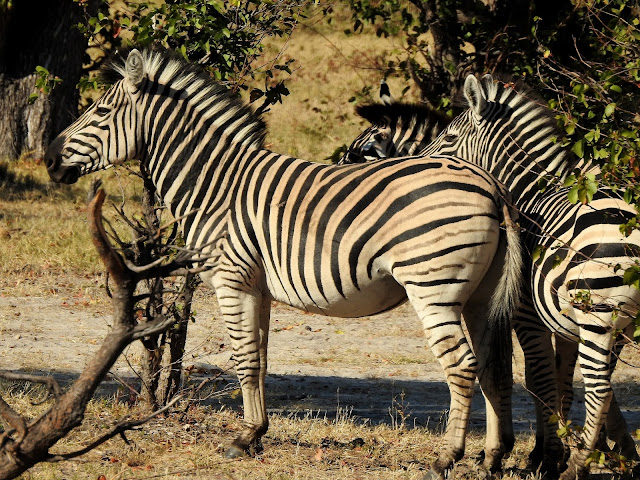
3-6-2019 LINYANTI CAMP, BOTSWANA - CHAPMAN'S ZEBRA (Equus quagga ssp. chapmani)


3-6-2019 LINYANTI CAMP, BOTSWANA - HELMETED GUINEA FOWL (Numida meleagris)


This is a gregarious species, forming flocks outside the breeding season typically of about 25 birds that also roost communally. Guineafowl are particularly well-suited to consuming massive quantities of ticks, which might otherwise spread Lyme disease. These birds are terrestrial, and prone to run rather than fly when alarmed. Like most gallinaceous birds, they have a short-lived, explosive flight and rely on gliding to cover extended distances. Helmeted guineafowl can walk 10 km and more in a day. Their bodies are well-suited for running and they are remarkably successful in maintaining dynamic stability over rough terrain at speed. They make loud harsh calls when disturbed.


Their diet consists of a variety of animal and plant foods. During the nonbreeding season, N. meleagris consumes corns, tubers, and seeds, particularly of agricultural weeds, as well as various agricultural crop spillage. During the breeding season, more than 80% of their diet may be invertebrates, particularly arthropods such as beetles. Guineafowl are equipped with strong claws and scratch in loose soil for food much like domestic chickens, although they seldom uproot growing plants in so doing. As with all of the Numididae, they have no spurs. They may live for up to 12 years in the wild.


Males often show aggression towards each other, and partake in aggressive fighting, which may leave other males bloodied and otherwise injured. They attempt to make themselves look more fearsome by raising their wings upwards from their sides and bristling their feathers across the length of their bodies, and they may also rush towards their opponent with a gaping beak. The nest is a well-hidden, generally unlined scrape, and a clutch is normally some 6 to 12 eggs, which the female incubates for 26 to 28 days. Nests containing larger numbers of eggs are generally believed to be the result of more than one hen using the nest; eggs are large, and an incubating bird could not realistically cover significantly more than a normal clutch.


Tuesday, 23 November 2021

22-11-2021 VILLALONGA, VALENCIA - HOUSE SPARROW (MALE) (Passer domesticus)


22-11-2021 VILLALONGA, VALENCIA - HOUSE SPARROW (FEMALE) (Passer domesticus)


23-11-2021 MONTE CORONA, VALENCIA - STINK BUG (Acrosternum heegeri)


23-11-2021 MONTE CORONA, VALENCIA - RUSTY DOT PEARL MOTH (Udea ferrugalis)


23-11-2021 MONTE CORONA, VALENCIA - COMMON HAIRY FIELD SPIDER (Neoscona subfusca)

https://www.inaturalist.org/taxa/320611-Neoscona-subfusca


23-11-2021 MONTE CORONA, VALENCIA - BLACK REDSTART (MALE) (Phoenicurus ochruros)


Monday, 22 November 2021

6-6-2019 MOREMI CAMP, BOTSWANA -BLACK HERON (Egretta ardesiaca)


The black heron is a medium-sized wading bird known for its striking black plumage and unique "canopy feeding" behavior, where it uses its wings to create shade to attract fish. It primarily inhabits wetlands across Africa, south of the Sahara, and other regions like Madagascar, nesting in colonies and feeding on fish, insects, and crustaceans. During breeding season, adults develop long, wispy plumes on their heads. 

Appearance
Size: Approximately 42.5 to 66 cm (16.7 to 26.0 in) long, with a weight between 270 and 390 g (9.5–13.8 oz).
Plumage: Dark grey to black overall, with a slaty or bluish sheen.
Beak: Black.
Legs and Feet: Black legs, with yellow feet in adults.
Breeding Plumage: Adults grow long, black, shaggy crests on their heads. 

Thursday, 18 November 2021

17-11-2021 RACO DE OLLA, VALENCIA - BLACK WINGED STILT (Himantopus himantopus)


15-11-2021 LORCA, VALENCIA - EUROPEAN WOOD MOUSE (Apodemus sylvaticus)


The wood mouse (Apodemus sylvaticus) is a murid rodent native to Europe and northwestern Africa. It is closely related to the yellow-necked mouse (Apodemus flavicollis) but differs in that it has no band of yellow fur around the neck, has slightly smaller ears, and is usually slightly smaller overall: around 90 mm (3.54 in) in length and 23 g in weight.ope and is a very common and widespread species, is commensal with people and is sometimes considered a pest. Other common names are long-tailed field mouse, field mouse, common field mouse, and European wood mouse. This species is a known potential carrier of the Dobrava sequence of hantavirus which affects humans and may pose serious risks to human health.


Wood mice inhabit forests, grasslands, and cultivated fields, tending to seek out more wooded areas in winter. Almost entirely nocturnal and terrestrial, wood mice burrow extensively, build nests of plants and live in buildings during harsh seasons. It is one of the most intensively studied species in the genus. In Europe, it ranges north to Scandinavia and east to Ukraine. The wood mouse is also found in northwestern Africa and on many Mediterranean islands.

Wood mice are primarily seed eaters, particularly seeds of trees such as oak, beech, ash, lime, hawthorn, and sycamore. If seeds are plentiful on the ground, they carry them back to their nests/burrows for storage. They may eat small invertebrates such as snails and insects, particularly in late spring and early summer when seeds are least available. Later in the season they will eat berries, fruits, fungi and roots. In winter, they may prey on hibernating bats, but this is still debatable.

Wood mice are mainly active during the dark, probably having evolved so to avoid predation, employing several anti-predatory strategies, though breeding females may be more active in daylight in order to collect sufficient food. While foraging, wood mice pick up and distribute visually conspicuous objects, such as leaves and twigs, which they then use as landmarks during exploration. If a wood mouse is caught by its tail, it can quickly shed the end of it, which may never regrow. Despite its name, it prefers hedgerows to woodland. During the colder months, wood mice do not hibernate; however, during severe winter seasons they can fall into a torpid state, a decrease in physiological activity.