This Blog contains Wildlife, Plants and Bird Photos from Walks, Safaris, Birding Trips and Vacations. Most of the pictures have been taken with my Nikon P900 and P950X cameras. Just click on any image for a larger picture. On the right column under the Blog Archive are the entries by date. Below that under Animal categories all the diffent species of Animals, Birds, Insects and Plants contained in the website are listed. Clicking on any entry will show all the entries for that species.
TOTAL PAGEVIEWS
TRANSLATE
Sunday, 16 February 2020
12-2-2020 BIOPARC, VALENCIA - ABDIM'S STORK (Ciconia abdimii)
12-2-2020 BIOPARC, VALENCIA - HELMETED GUINEA FOWL (Numida meleagris)
The helmeted guineafowl is a large, 53 to 58 cm (21 to 23 in) bird with a round body and small head. They weigh about 1.3 kg (2.9 lb). The body plumage is gray-black speckled with white. Like other guineafowl, this species has an unfeathered head, which in this species is decorated with a dull yellow or reddish bony knob, and bare skin with red, blue, or black hues. The wings are short and rounded, and the tail is likewise short. Various subspecies are proposed, differences in appearance being mostly a large variation in shape, size, and colour of the casque and facial wattles.
12-2-2020 BIOPARC, VALENCIA - SADDLE BILLED STORK (Ephippiorhynchus senegalensis)
12-2-2020 BIOPARC, VALENCIA - GREY CROWNED CRANE (Balearica regulorum)
17-2-2020 MONTE CORONA, VALENCIA - GARDEN CARPET MOTH (Xanthorhoe fluctuata)
12-2-2020 BIOPARC, VALENCIA - CAPE TEAL (Anas capensis)
Like many southern ducks, the sexes are similar. It is very pale and mainly grey, with a browner back and pink on the bill (young birds lack the pink). This is a generally quiet species, except during mating displays. The breeding male has a clear whistle, whereas the female has a feeble "quack". The Cape teal cannot be confused with any other duck in its range.
This species is essentially non-migratory, although it moves opportunistically with the rains. It is a thinly distributed but widespread duck, rarely seen in large groups except the moulting flocks, which may number up to 2000.
The Cape teal feeds on aquatic plants and small creatures (invertebrates, crustaceans and amphibians) obtained by dabbling. The nest is on the ground under vegetation and near water.
The Cape teal is one of the species to which the Agreement on the Conservation of African-Eurasian Migratory Waterbirds (AEWA) applies.
15-2-2020 MONTE CORONA, VALENCIA - SPECKLED WOOD BUTTERFLY (Pararge aegeria)
The speckled wood (Pararge aegeria) is a butterfly found in and on the borders of woodland areas throughout much of the Palearctic realm. The species is subdivided into multiple subspecies, including Pararge aegeria aegeria, Pararge aegeria tircis, Pararge aegeria oblita, and Pararge aegeria insula. The color of this butterfly varies between subspecies. The existence of these subspecies is due to variation in morphology down a gradient corresponding to a geographic cline.
The background of the wings ranges from brown to orange, and the spots are either pale yellow, white, cream, or a tawny orange. The speckled wood feeds on a variety of grass species. The males of this species exhibit two types of mate locating behaviors: territorial defense and patrolling. The proportion of males exhibiting these two strategies changes based on ecological conditions. The monandrous female must choose which type of male can help her reproduce successfully. Her decision is heavily influenced by environmental conditions.
15-2-2020 MONTE CORONA, VALENCIA - GREAT TIT (Parus major)
15-2-2020 MONTE CORONA, VALENCIA - SEVEN SPOTTED LADYBIRD (Coccinella septempunctata)
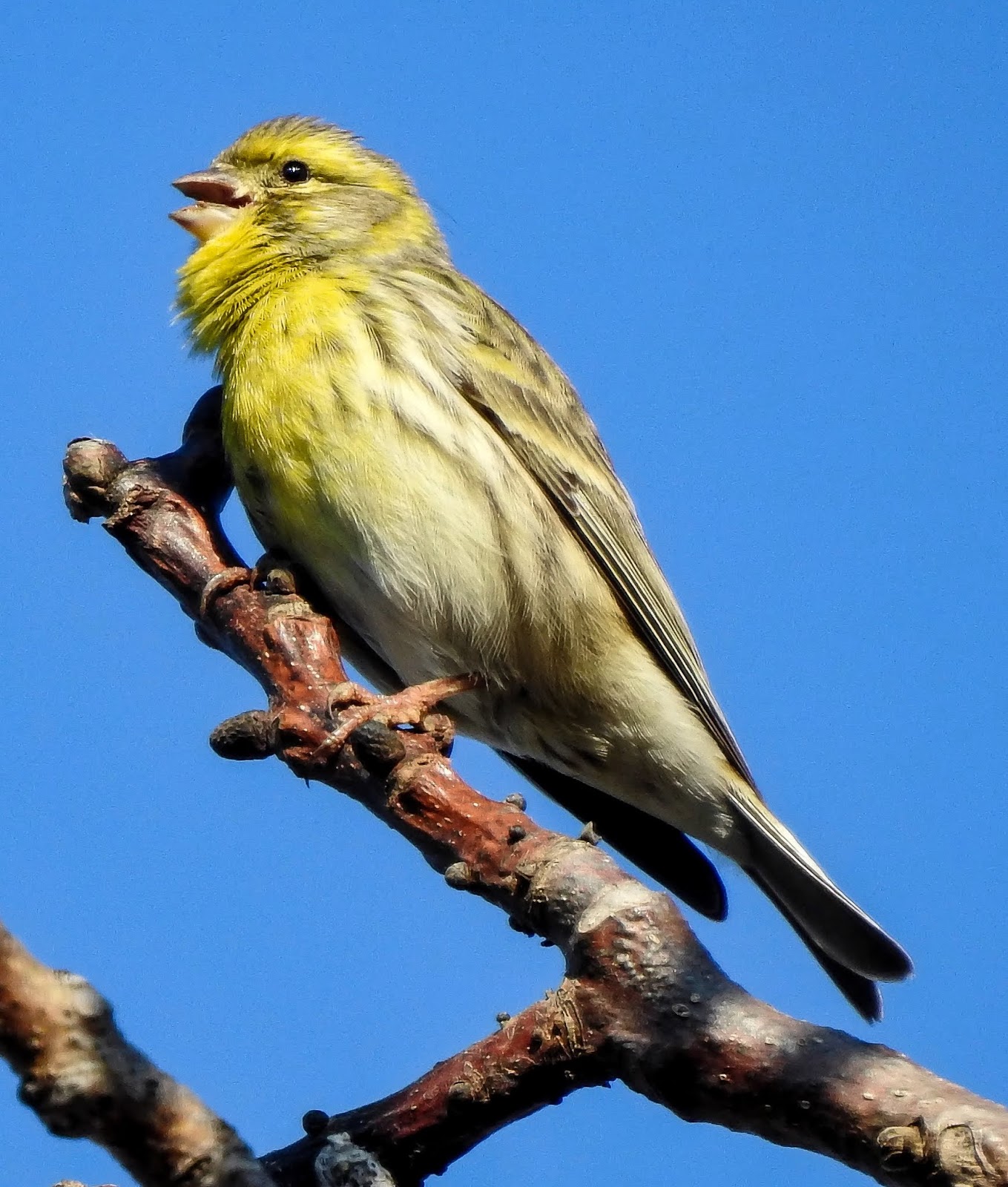
16-2-2020 RAFELCOFER, VALENCIA - EUROPEAN SERIN (MALE) (Serinus serinus)
When attempting to identify the European serin, look for the male's radiant yellow face and breast, which stand out against the greenish backdrop of its feathers. The male also boasts yellow wing bars and yellow tail sides, which can be quite helpful in distinguishing it from similar species. Both sexes share a buzzing trill of a song that resonates through their Mediterranean habitats.
Outside of the breeding season, the European serin is a sociable creature, forming flocks that may sometimes mingle with other finch species. It is an active and often conspicuous bird, its presence easily announced by its distinctive trill.
The European serin weaves its nest within the shelter of a shrub or tree, where it lays a clutch of 3 to 5 eggs. The chosen breeding habitats are often areas of open woodland and cultivation, with a preference for some conifers.
The diet of the European serin is predominantly seeds, but it does not shy away from including insects during the breeding season, providing essential protein for its young.
16-2-2020 VILLALONGA RIO SERPIS, VALENCIA - OCEAN BLUE MORNING GLORY (Ipomoea indica)
16-2-2020 RIO SERPIS VILLALONGA, VALENCIA - WESTERN CATTLE EGRET (Bubulcus ibis ssp. ibis)
16-2-2020 RAFELCOFER, VALENCIA - EUROPEAN GOLDFINCH (Carduelis carduelis)
16-2-2020 POTRIES, VALENCIA - SONG THRUSH (Turdus philomelos)
The song thrush breeds in most of Europe (although not in the greater part of Iberia, lowland Italy or southern Greece), and across Ukraine and Russia almost to Lake Baikal. It reaches to 75°N in Norway, but only to about 60°N in Siberia. Birds from Scandinavia, Eastern Europe and Russia winter around the Mediterranean, North Africa and the Middle East, but only some of the birds in the milder west of the breeding range leave their breeding areas. The song thrush has been sighted in North America as a rare vagrant, with records from Quebec in Canada, Greenland, as well as in Alaska, California, and Washington in the United States. It has also been sighted in various Atlantic islands and West Africa. In South America, there is a record of a song thrush from Colombia.
In Great Britain song thrushes are commonly found where there are trees and bushes. Such areas include parks, gardens, coniferous and deciduous woodland and hedgerows.
In intensively farmed areas where agricultural practices appear to have made cropped land unsuitable, gardens are an important breeding habitat. In one English study, only 3.5% of territories were found in farmland, whereas gardens held 71.5% of the territories, despite that habitat making up only 2% of the total area. The remaining nests were in woodlands (1% of total area).
The winter habitat is similar to that used for breeding, except that high ground and other exposed localities are avoided; however, the island subspecies T. p. hebridensis will frequent the seashore in winter.
In intensively farmed areas where agricultural practices appear to have made cropped land unsuitable, gardens are an important breeding habitat. In one English study, only 3.5% of territories were found in farmland, whereas gardens held 71.5% of the territories, despite that habitat making up only 2% of the total area. The remaining nests were in woodlands (1% of total area).
The winter habitat is similar to that used for breeding, except that high ground and other exposed localities are avoided; however, the island subspecies T. p. hebridensis will frequent the seashore in winter.
The song thrush is not usually gregarious, although several birds may roost together in winter or be loosely associated in suitable feeding habitats, perhaps with other thrushes such as the blackbird, fieldfare, redwing and dark-throated thrush. Unlike the more nomadic fieldfare and redwing, the song thrush tends to return regularly to the same wintering areas.


%2019.jpg)
%2020.jpg)


%2020.jpg)


%2020.jpg)
%2021.jpg)
%2020-topaz-upscale-1.7x.jpg)


%2020.jpg)
%2021.jpg)


