TOTAL PAGEVIEWS

TRANSLATE

Friday, 18 September 2020

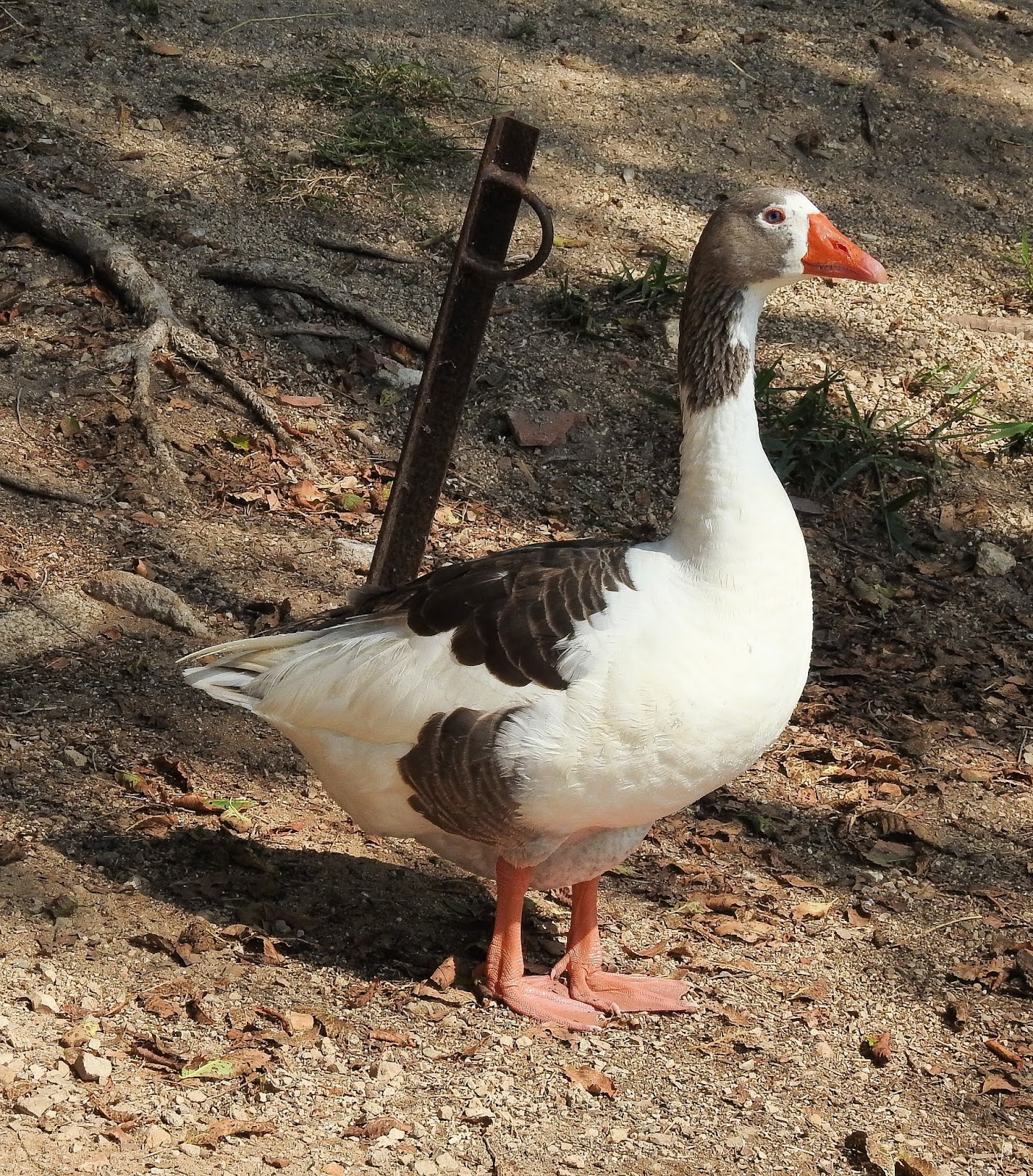
16-9-2020 L'ESTANY CULLERA, VALENCIA - MUSKOVY DUCK (JUVENILE) (Cairina moschata)


The Muscovy or Barbary is the domestic form of the wild Muscovy duck, Cairina moschata. There are a number of local or regional breeds, and drakes of these are commonly cross-bred with mallard-derived domestic ducks to produce the hybrids called mulards.

The Muscovy had been domesticated by various indigenous peoples of the Americas well before the arrival of Christopher Columbus in 1492.


Domestic Muscovy ducks (Cairina moschata) are unique, silent, perching waterfowl, often identified by red, fleshy caruncles around their eyes and beak. Originally from Central/South America, they are not descended from Mallards, unlike other domestic ducks. They are excellent for pest control, quiet (hissing rather than quacking), and, unlike most ducks, prefer to nest in trees. 


Domestic Muscovy drakes weigh some 4.5–6.3 kg. The duck is much smaller, typically about half the size of the drake, with a weight of 2.3–3.2 kg.[3]: 466 

Recognised colour varieties include five solid colours – black, blue, chocolate, lavender and white[3]: 465  – and eight 'magpie' colours, in which the whole back from the tail to the shoulders and the underside from below the tail to the breast is coloured black, blue, chocolate or lavender, the remainder being white. In the standard magpie colourings the crown of the head is also coloured; in the white-headed magpie colours the head is white.


The Muscovy is commonly reared for meat.

In commercial production, it is often cross-bred – either naturally or by artificial insemination – with a mallard-derived domestic duck to produce the hybrid known as a mulard.. In France – where 35 million mulards were reared in 2007 – the duck is usually a Rouen or Pekin; in Taiwan, local breeds such as the Tsaiya or Kaiya (Tsaiya x Pekin cross) are used.  These hatch in about four weeks and grow rapidly like a mallard-type duck, but to about the size and weight of the Muscovy. 


The inverse cross – domestic drake with Muscovy duck – is also possible, but infrequent. In France the mulard is reared both for its meat and for its liver; ducks are used principally to produce magret de canard, while drakes – which are better able to withstand the gavage or force-feeding employed – are reared for foie gras de canard. In countries such as China, Taiwan and Vietnam, mulards are reared mainly for their meat, which is less fatty than that of the Pekin.

Smart Foragers: Known for their intelligence, they are excellent pest controllers. They actively hunt mosquitoes, flies, slugs, and even mice. 


Key Facts About Domestic Muscovy Ducks:

Appearance & Size: They possess a "scaly" leg look, with long, sharp claws for gripping branches. Males (drakes) are much larger, weighing 
 kg (
 lbs), while females are roughly half that size (
 kg). Common colors include black, white, blue, and chocolate.

Vocalizations & Temperament: They are considered quiet, with males producing low hisses and females producing a soft trilling sound. They are generally friendly but can be territorial during breeding season.


Behavior & Ecology: They do not need a large water source for swimming, as their oil glands are underdeveloped compared to other ducks. They are excellent flyers and often prefer to roost in trees at night.

Diet & Utility: Muscovies are foragers that eat insects, snails, and larvae, making them excellent, natural pest control.

Tree Perchers: Unlike most ducks, Muscovies have strong claws on their webbed feet, allowing them to perch in trees and roost off the ground. 
Behavior & Intelligence

"Quackless" Ducks: They are remarkably quiet. Drakes produce a low, breathy hiss, while females make a soft, musical trill or "pip" sound.
Communication: They express excitement or friendliness by wagging their tails like dogs and raising a small crest of feathers on their heads.


Breeding: They are highly broody and known as excellent mothers. They lay large clutches of eggs (8-21) with a long incubation period of 35 days.

Lifespan: With proper care, domesticated Muscovy ducks can live for 15 to 20 years.

Meat Production: They are highly valued for their meat, which is known to be leaner ( fat-free) than other duck breeds. 


Key Physical Characteristics

Distinctive Faces: They are easily recognized by red, fleshy facial growths called caruncles. These develop as they age and are more prominent in males.

Size Difference: Males (drakes) are significantly larger than females, often weighing 10–15 lbs (4.5–6.8 kg), while females typically weigh 5–8 lbs (2.3–3.6 kg).
Color Variety: While wild Muscovies are mostly black with white wing patches, domestic varieties come in many colors, including white, chocolate, blue, and lavender.


Breeding & Lifespan
Long Incubation: Muscovy eggs take 35 days to hatch, which is a full week longer than mallard-derived ducks.

Mothers: Females are highly dedicated mothers and can raise multiple clutches (8–20 eggs each) per year.

Lifespan: In a domestic setting, they typically live 8 to 12 years, but can reach up to 20 years with proper care. 

Economic & Culinary Use

Lean Meat: They are primarily raised for their highly lean, red meat (98% fat-free), which is often compared to the taste of roast beef or veal rather than traditional greasy duck.

Sterile Hybrids: When bred with mallard-type ducks (like Pekins), they produce sterile offspring called "Mulards" or "mules," which are popular for commercial meat production. 

16-9-2020 L'ESTANY CULLERA, VALENCIA - MUSKOVY DUCK (JUVENILE)


The Muscovy or Barbary is the domestic form of the wild Muscovy duck, Cairina moschata. There are a number of local or regional breeds, and drakes of these are commonly cross-bred with mallard-derived domestic ducks to produce the hybrids called mulards.

The Muscovy had been domesticated by various indigenous peoples of the Americas well before the arrival of Christopher Columbus in 1492.


Domestic Muscovy ducks (Cairina moschata) are unique, silent, perching waterfowl, often identified by red, fleshy caruncles around their eyes and beak. Originally from Central/South America, they are not descended from Mallards, unlike other domestic ducks. They are excellent for pest control, quiet (hissing rather than quacking), and, unlike most ducks, prefer to nest in trees. 


Domestic Muscovy drakes weigh some 4.5–6.3 kg. The duck is much smaller, typically about half the size of the drake, with a weight of 2.3–3.2 kg.[3]: 466 

Recognised colour varieties include five solid colours – black, blue, chocolate, lavender and white[3]: 465  – and eight 'magpie' colours, in which the whole back from the tail to the shoulders and the underside from below the tail to the breast is coloured black, blue, chocolate or lavender, the remainder being white. In the standard magpie colourings the crown of the head is also coloured; in the white-headed magpie colours the head is white.

16-9-2020 L'ESTANY CULLERA, VALENCIA - MUSKOVY DUCK (JUVENILE) (Cairina moschata)

Thursday, 17 September 2020

8-9-2019 MONTE CORONA, VALENCIA - GEOMETER MOTH (Charissa mucidaria)


Charissa mucidaria, commonly known as the coppery taupe, is a species of geometer moth in the family Geometridae. It is native to the western Palaearctic region, particularly southern Europe and North Africa. 
Here are the key facts about this species:
The moth, also called the coppery taupe, has a scientific name of Charissa mucidaria and belongs to the Geometridae family. It is typically yellow-tan to greyish-brown with a wingspan between 20–30 mm. 

Native to Southern Europe and North Africa, it is often found in rocky habitats. Adults fly from March to May and again from July to September and are active at night. The larvae, known as "inchworms," feed on plants like Sedum and Rumex. 
Synonyms for the species include Charissa lusitanica and Charissa ochracearia. The species is included in biodiversity studies. 

17-9-2020 MONTE CORONA, VALENCIA - SMALL BLOOD VEIN MOTH (Scopula imitaria)


Scopula imitaria, the small blood-vein, is a moth of the family Geometridae. It was first described by Jacob Hübner in 1799 and it is found throughout Europe and in North Africa.
The wingspan is 12–26 mm. (1st generation); the next generation is typically much smaller and reaches no more than 18 mm. The forewing leading edge (costa) forms an acute angle with the outer edge forming a sharp point. The hindwings also come to a sharp angle in the middle of the outer edge (a "tail"). 

The pattern and colouring are variable. The wings are reddish, yellowish or orange to light brown. The lines and marginal line are almost always clear, but fine. The median crossline is clearly developed and inclined slightly diagonally to the inner and outer crossline. It is slightly curved and very weakly wavy and often accompanied by a distal facing shadow. The interior and exterior crosslines are slightly wavy (more clearly than the median line). The hindwings have the pattern, however they often lack the inner crossline. The outer cross line shows a pointed bulge outwards, which follows the "tail" of the perimeter. Discal flecks are only sometimes present or weak, They are more pronounced on the hindwing. The discal fleck of the hindwings sits on the outside of the medium line or in the "shadow". On the forewing it is basal to the median line.

16-9-2020 L'ESTANY CULLERA, VALENCIA - GREYLAG GOOSE (Anser anser)


The Greylag Goose (Anser anser) is a large and robust member of the waterfowl family Anatidae, easily recognized by its mottled and barred grey and white plumage. It boasts an orange beak, pink legs, and a sizeable stature, measuring between 74 and 91 centimeters in length and weighing an average of 3.3 kilograms. This species is the progenitor of most domestic goose breeds and exhibits a wide distribution across Europe and Asia.

Adult Greylag Geese have a rotund body, a thick and long neck, and a large head and bill. Their legs and feet are pink, and their bill is orange or pink with a white or brown nail. The wingspan ranges from 147 to 180 centimeters. Males are typically larger than females, and the eastern subspecies rubirostris is larger than the nominate subspecies. The plumage is greyish brown with a darker head and paler underparts, with black spotting that varies among individuals. Juveniles can be identified by their lack of black speckling and greyish legs.

Greylag Geese breed in a variety of wetland habitats, including moorlands, marshes, lakes, and coastal islands. They prefer areas with dense vegetation for cover. In winter, they occupy semi-aquatic habitats such as estuaries, marshes, flooded fields, and agricultural lands.


The Greylag Goose has a Palearctic distribution, with the western subspecies breeding from Iceland to central Europe and the eastern subspecies from Romania to northeastern China. Northern populations often migrate southwards to spend the winter in warmer regions, while many populations are resident year-round.

Greylag Geese are known for their lifelong monogamous pair bonds. They are gregarious and form flocks, which provides safety in numbers. Family groups stay together, migrating southwards in autumn and separating the following year. They are herbivorous, feeding mainly on grasses, and can cause damage to agricultural crops.

The call of the Greylag Goose is a loud cackling, similar to that of domestic geese. They use various calls for different situations and can recognize individual geese by voice. Flocks produce a sound reminiscent of baying hounds.

Greylag Geese mate for life and nest on the ground among vegetation. They lay a clutch of three to five eggs, which the female incubates. Both parents defend and rear the young, who are precocial and leave the nest shortly after hatching..

16-9-2020 RACO DE OLLA, VALENCIA - PIED AVOCET (Recurvirostra avosetta)


The pied avocet, Recurvirostra avosetta, presents a striking silhouette with its bold black and white plumage. This large wader, belonging to the avocet and stilt family, Recurvirostridae, is adorned with a distinctive black cap and black markings on its wings and back, contrasting sharply against its otherwise white body. The species is noted for its elegant, upturned bill and elongated, bluish legs, which add to its graceful demeanor.

Adult pied avocets measure approximately 16.5–17.75 inches in length, with a wingspan stretching around 30–31.5 inches. Their long legs and upturned bills, measuring about 2.95–3.35 inches and 3–4 inches respectively, are key features for identification. Both sexes appear similar, while juveniles can be distinguished by their more greyish and sepia tones.


These birds favor shallow lakes with brackish water and exposed mudflats, which provide ideal foraging and breeding grounds.

The pied avocet breeds across temperate Europe and extends across the Palearctic to Central Asia and the Russian Far East. It is a migratory species, with most individuals wintering in Africa or southern Asia. Some, however, remain in the milder parts of their range during winter, such as southern Spain and southern England.

Pied avocets forage in shallow waters or on mudflats, often employing a unique side-to-side scything motion with their bills to capture prey. They primarily consume crustaceans and insects. During the breeding season, they nest on open ground, often forming small groups and sometimes associating with other wader species. Their nests are typically lined scrapes or mounds of vegetation, where they lay three to five eggs.

16-9-2020 RACO DE OLLA, VALENCIA - RUFF (Calidris pugnax)

16-9-2020 RACO DE OLLA, VALENCIA - GREATER FLAMINGO (Phoenicopterus roseus)


The greater flamingo, Phoenicopterus roseus, stands as the most widespread and largest member of the flamingo family. This majestic bird is adorned with pinkish-white plumage, save for the red wing coverts and contrasting black primary and secondary flight feathers. The bill is a striking pink with a black tip, and the legs are a uniform pink, completing the iconic look of this species.

Adult greater flamingos can be identified by their height, ranging from 110 to 150 cm, and their weight between 2 and 4 kg. The largest males can reach up to 187 cm tall and weigh 4.5 kg. Observers should note the distinctive coloration, with the majority of the body being pinkish-white, red wing coverts, and black flight feathers. The pink bill with a black tip and entirely pink legs are also key identification features. The call of the greater flamingo is reminiscent of a goose-like honking.

Greater flamingos favor mudflats and shallow coastal lagoons with saline water, where they can be seen stirring the mud with their feet in search of food.

This species is common in the Old World, with a range that includes Northern and Sub-Saharan Africa, the Indian Subcontinent, the Middle East, the Levant, and Southern Europe. Notably, they are found in coastal regions and along water bodies such as the Nile River, the Persian Gulf, the Gulf of Aden, the Red Sea, and the Mediterranean.

16-9-2020 RACO DE OLLA, VALENCIA - MALLARD (MALE) (Anas platyrhynchos)

16-9-2020 RACO DE OLLA, VALENCIA - MALLARD (FEMALE) (Anas platyrhynchos)

16-9-2020 EMBARCADERO CATAROJA, VALENCIA - EURASIAN COLLARED DOVE (Streptopelia decaocto)

The Eurasian collared dove, also known as the collared dove or Turkish dove (Streptopelia decaocto), is a bird of modest size, presenting a grey-buff to pinkish-grey plumage that is slightly darker above than below. It is recognized by its distinctive black half-collar edged with white on its nape, from which it derives its name. The species exhibits a blue-grey underwing patch and a tail that is grey-buff above, with dark grey and white-tipped feathers below. The sexes appear similar, with juveniles displaying a less developed collar and a brown iris.

To identify the Eurasian collared dove, look for its medium size, slimmer and longer-tailed body compared to a rock pigeon, and a shorter stature than the wood pigeon. The red legs, black bill, and red iris surrounded by a small area of bare skin, which may appear white or yellow, are key features. The bird's song, a three-part cooing "goo-GOO-goo," and a harsh screeching call are also distinctive identifiers.

16-9-2020 ESTANY CULLERA, VALENCIA - EURASIAN COOT (Fulica atra)


The Eurasian coot, Fulica atra, also known as the common coot or Australian coot, is a distinctive waterbird with a slaty-black body, a glossy black head, and a striking white bill topped with a white frontal shield. This bird is a member of the Rallidae family, which includes rails and crakes. Both sexes exhibit similar plumage, making them indistinguishable in the field.

Adult Eurasian coots measure 36–38 cm in length with a wingspan of 70–80 cm. Males are slightly heavier than females, weighing around 890 g compared to the females' 750 g. The species is characterized by its white bill and frontal shield, which contrast sharply with its all-black body. Juveniles are paler with a whitish breast and lack the facial shield, which develops fully by one year of age.


The Eurasian coot is found on freshwater lakes and ponds and has adapted well to urban environments, often seen in city parks and gardens with water bodies.

This bird has a broad range across the Old World, including Europe, Asia, Australia, New Zealand, and parts of North Africa. It is a resident in milder regions but migrates south and west from much of Asia during winter.

The Eurasian coot is less secretive than many rails, often visible on open water or grasslands. It is territorial and aggressive during the breeding season, with both parents defending their territory. In non-breeding seasons, coots may form large flocks. They are reluctant flyers, preferring to run across water surfaces, and are known for bobbing their heads while swimming.

This species is known for its noisy demeanor, producing a variety of crackling, explosive, or trumpeting calls, which are often heard at night.


Coots build bulky, sometimes floating nests, concealed in vegetation or in the open. Both sexes construct the nest, with the male gathering materials. Clutches typically contain 6-10 buff-colored eggs speckled with black or dark brown. Both parents incubate the eggs, which hatch after 21-24 days. Chicks are precocial and nidifugous, with distinctive orange-red tips on their down.

Omnivorous in nature, the Eurasian coot consumes small live prey, including other birds' eggs, as well as algae, vegetation, seeds, and fruit. It employs various feeding techniques, both on land and in water.

The Eurasian coot is classified as Least Concern by the IUCN and is protected under the Agreement on the Conservation of African-Eurasian Migratory Waterbirds (AEWA).

16-9-2020 ULLAL DE BALDOVI, VALENCIA - LITTLE GREBE 11

16-9-2020 EL PALMAR, VALENCIA - RED SWAMP CRAYFISH (Procambarus clarkii)


Procambarus clarkii, known variously as the red swamp crayfish, Louisiana crawfish or mudbug, is a species of cambarid crayfish native to freshwater bodies of northern Mexico, and southern and southeastern United States, but also introduced elsewhere (both in North America and other continents), where it is often an invasive pest.

P. clarkii is typically dark red, with long claws and head, small or no spines on the sides of its carapace just below the head, and rows of bright red bumps on the front and side of the first leg.

In Europe, P. clarkii is included since 2016 in the list of Invasive Alien Species of Union concern (the Union list). This implies that this species cannot be imported, bred, transported, commercialized, or intentionally released into the environment in the whole of the European Union.


The native range of P. clarkii is from northern Mexico and far southeastern New Mexico, through the Gulf States to the Florida Panhandle, as well as inland north through the Mississippi Basin to southern Illinois. It has also been introduced, sometimes deliberately, outside its natural range to countries in Asia, Africa, Europe and elsewhere in the Americas. In northern Europe, the populations are self-maintaining but not expanding, while in southern Europe, P. clarkii is multiplying and actively colonizing new territories at the expense of the native crayfish, Astacus astacus and Austropotamobius spp. Individuals are reported to be able to cross many miles of relatively dry ground, especially in wet seasons, although the aquarium trade and anglers may have hastened the spread in some areas (anglers using P. clarkii as fishing bait are thought to have introduced it to the state of Washington). Attempts have also been made to use P. clarkii as a biological control organism, to reduce levels of the snails involved in the lifecycle of schistosomiasis, leading to the dispersal of P. clarkii in, for instance, Kenya.

16-9-2020 EL PALMAR, VALENCIA - WESTERN CATTLE EGRET (Bubulcus ibis ssp. ibis)

The western cattle egret (Bubulcus ibis) is a species of heron (family Ardeidae) found in the tropics, subtropics and warm temperate zones. Most taxonomic authorities lump this species and the eastern cattle egret together (called the cattle egret), but some (including the International Ornithologists' Union) separate them. Despite the similarities in plumage to the egrets of the genus Egretta, it is more closely related to the herons of Ardea. Originally native to parts of Asia, Africa and Europe, it has undergone a rapid expansion in its distribution and successfully colonised much of the rest of the world in the last century.

It is a white bird adorned with buff plumes in the breeding season. It nests in colonies, usually near bodies of water and often with other wading birds. The nest is a platform of sticks in trees or shrubs. Western cattle egrets exploit drier and open habitats more than other heron species. Their feeding habitats include seasonally inundated grasslands, pastures, farmlands, wetlands and rice paddies. They often accompany cattle or other large mammals, catching insect and small vertebrate prey disturbed by these animals. Some populations of the cattle egret are migratory and others show post-breeding dispersal.

16-9-2020 EL PALMAR, VALENCIA - WESTERN YELLOW WAGTAIL (FEMALE) (Motacilla flava)

Tuesday, 15 September 2020

16-9-2020 MONTE CORONA, VALENCIA - ROSY TABBY MOTH (Endotricha flammealis)

14-9-2020 MONTE CORONA, VALENCIA - CATALONIA WALL LIZARD (Podarcis liolepis)


Podarcis liolepis, the Columbretes wall lizard or Catalan wall lizard, is very similar to the other lizards in the genus Podarcis. This species was formerly described as a subspecies of the Iberian wall lizard, but has now been elevated to species status. These are slender lizards with long tails, narrow tapered heads and long thin toes, and stout legs. Colours are variable, although generally grey-brown. Often very subtle spots and stripes along the back and flanks can be seen and these can be more distinguished in the female. The underside is a much lighter cream or beige with sometimes a reddish tint. Adults grow 15–20 cm in length from the nose to tip of the tail. Body length can be a little as one third of the total body length, the tail making up the other two thirds.

Monday, 14 September 2020

15-9-2020 EL HONDO, MURCIA - EURASIAN DOTTERAL (Charadrius morinellus)


The Eurasian Dotterel (Eudromias morinellus) is a regular migrant at the El Hondo Natural Park (Parque Natural de El Fondo) in Alicante, Spain, often appearing during autumn migration.

Key Details for El Hondo:

Migration Timing: Autumn is the primary time to spot them, with records often in September.Recent Sightings: Sightings have been documented in September 2025, with birds seen near the Visitor Centre.

Habitat: They are often found in the drier, open field areas and salt-affected terrains surrounding the core wetlands of the reserve.Behavior: They can be quite tame, allowing for close observation, but are often inconspicuous, sometimes requiring patience to locate.El Hondo is a key location for this species in Eastern Spain, which is considered a notable rarity to see regularly, according to the BirdForum Opus. The area is managed as a mix of salty and freshwater lagoons, offering diverse habitats for both breeding and migratory birds.

14-9-2020 MONTE CORONA, VALENCIA - MEDITERRANEAN KATYDID (Phaneroptera nana)


Phaneroptera nana, common name southern sickle bush-cricket, is a species in the family Tettigoniidae and subfamily Phaneropterinae. It has become an invasive species in California where it may be called the Mediterranean katydid.

This bush cricket is native to mainland Europe, the Near East and North Africa. The Indo-Malayan species Phaneropera subcarinata, described by Bolívar, is morphologically similar to P. nana, and was classified under the P. nana name by Carl Brunner von Wattenwyl. As an invasive species, it has spread to the San Francisco Bay Area and may be widespread in the Los Angeles Basin, with records of its presence in California dating from at least 1952. In addition, it has been recorded in South America and hypothesized in the Annals of Carnegie Museum to have spread via shipping.

It mainly inhabits sunny and dry habitats, especially shrubs and low branches of trees.

13-9-2020 MONTE CORONA, VALENCIA - MEDITERRANEAN MANTIS (MALE) (Iris oratoria)

14-9-2020 MONTE CORONA, VALENCIA - GEOMETER MOTH (Charissa mucidaria)


Charissa mucidaria, the coppery taupe, is a moth of the family Geometridae. It was described by Jacob Hübner in 1799. It is found in southern Europe and North Africa (including Morocco).

The wingspan is 20–30 mm. Adults are on wing from March to May and again from July to September.

The larvae feed on Sedum, Anagallis, Polygonum and Rumex species.