TOTAL PAGEVIEWS

TRANSLATE

Sunday, 4 December 2016

20-11-2016 PYAY, MYANMAR - PEACOCK PANSY BUTTERFLY (Junonia almana)


Junonia almana, the peacock pansy, is a species of nymphalid butterfly found in Cambodia and South Asia. It exists in two distinct adult forms, which differ chiefly in the patterns on the underside of the wings; the dry-season form has few markings, while the wet-season form has additional eyespots and lines. It is listed as Least Concern in the IUCN Red List.

The adult butterfly has a wingspan of 54–62 mm (2.1–2.4 in), and exhibits seasonal polyphenism.

J. almana is found in India, Sri Lanka and South East Asia, and eastwards to China and Japan.


It has a cylindrical body with distinct color bands or patterns, which change as it grows and molts. Pupal After reaching sufficient size, the larva forms a chrysalis. Within this protective casing, peacock pansy undergoes drastic transformation, with tissue breakdown and reorganization.

Junonia almana completes its life cycle in 24.40 ± 1.14 days (eggs 3, larvae, 15 – 16, pupa 5 – 7 days).

The adults will nectar from a variety of flowers but they really seem to enjoy Lantana.


Above, the wings are rich yellowish brown with darker brown edges at both termen and costal margins. On each of the forewings, there are four distinct costal bars, the outermost three of which are filled with darker shadings. There is a prominent ``peacock'' eye-spot in space 2 near the tornal area, and a lesser one in space 5. On each hindwing, a much larger and more prominent eye-spot is featured in spaces 5-6 near the apex. The termens of both fore- and hindwings are marked by two series of marginal striae. Underneath, the wings are duller and the costal bars are filled with paler shadings instead. Compared to those on the upperside, the ocelli are smaller and on the hindwing, there is an additional ocellus in space 2, and the spot in spaces 5-6 appears to be a conjoined pair. Each of the fore- and hindwings has a dark stripe traversing from the costa to the dorsum. The stripes appear to be continuous across the two wings. The stripe on the hindwing is outlined by a broad pale band on the inner edge.


This species is rather common across multiple habitats in Singapore, with ubiquitous presence in open areas in the nature reserves as well as urban and suburban areas. It flies in the usual gliding manner of the Junonia spp. and typically several individuals can be seen together in one location. Under sunny condition, they have a habit of opening their wings wide to sunbathe while resting on a perch.

The eggs of the Peacock Pansy are laid singly on leaves or shoots of the host plant and rather frequently, on plants of other species in the vicinity of the host plant. The greenish egg is somewhat globular in shape but with a blunt top. Eleven to thirteen raised whitish ridges run from the top to the base of the egg. Each egg has a diameter of about 0.75mm.

20-11-2016 PYAY, MYANMAR - GREY PANSY BUTTERFLY (Junonia atlites)


Junonia atlites, the grey pansy, is a species of nymphalid butterfly found in South Asia.

J. atlites is found in Bangladesh, India, southern China, Cambodia, Indochina, the Malay Peninsula, western and central Indonesia, and the Philippines.

Upperside of both sexes pale lavender brown, apical half of wings paler. Forewing: cell with, three transverse, short, sinuous black bands, the outermost defining the discocellulars; a similar short, somewhat broader band beyond the apex of the cell; two transverse discal dusky black fasciae, the inner highly sinuous and outward, angulate above vein 4, the outer straighter, somewhat lunular, bordered by a series of whitish ovals with dusky or black centers. The black-centered spots in the ovals in interspaces 2, 5, and 6 margined posteriorly with rich ocherous yellow. 


Beyond this series of ovals is a lunular, narrow, transverse dark band, followed by sinuous subterminal and terminal broad dark lines. Apex of wing slightly fuliginous. Hindwing: a short slender black loop from veins 6 to 4 at apex of cell-area; two discal sinuous transverse dark, fasciae in continuation of those on the forewing: followed by a series of dark-centered ovals in interspaces 2–6, the ovals in interspaces 2, 5, and 6 with the dark centers inwardly broadly bordered with ochreous yellow; postdiscal, subterminal and terminal dark lunular lines as on the forewing. 

Underside lilacine white markings as on the upperside but very delicate, slender and somewhat obsolescent. In the dry-season forms of the males the rows of oval ocelli are only indicated by the yellow-centered ovals. The most prominent marking is the inner discal fascia crossing the wings; this is much less sinuous than on the upperside and not angulated on the forewing. In the females the markings are all heavier and more distinct, the space between the various transverse fasciae tinged with ocherous.

28-11-2016 JURONG, SINGAPORE - MASKED LAPWING (Vanellus miles)


The Masked lapwing (Vanellus miles ) is a large, common, and conspicuous bird. It spends most of its time on the ground and has several distinctive calls. It is common in Australian fields and open land, and is known for its defensive swooping behavior during the nesting season. The species is also known as the Masked plover and often called the Spur-winged plover or just plover in its native range.

The Masked lapwing is the largest representative of the family Charadriidae. It has a conspicuous yellow spur on the carpal joint of each wing. The subspecies from northern Australia and New Guinea (V. m. miles ) have an all-white neck and large yellow wattles with the male having a distinctive mask and larger wattles. The subspecies found in the southern and eastern states of Australia and in New Zealand (V. m. novaehollandiae ), and often locally called the Spur-winged plover, has a black neck-stripe and smaller wattles. (Note that the northern hemisphere Spur-winged plover is a different bird.)

Masked lapwings are native to the northern and eastern parts of Australia, New Zealand, and New Guinea. These birds don’t migrate and prefer to live on the edges of wetlands, and in other moist, open environments. However, they are adaptable and can often be found in surprisingly arid areas, pasturelands, and urban areas.

12-11-2016 MINGUN, MYANMAR - CADDISFLIES (Genus Dipseudopsis)


Dipseudopsidae is a family of caddisflies in the order Trichoptera. There are about 6 genera and at least 110 described species in Dipseudopsidae.

The type genus for Dipseudopsidae is Dipseudopsis F. Walker, 1852. The oldest fossils are of the extant genus Phylocentropus, from the Barremian aged Lebanese amber.

11-11-2016 MANDALAY, MYANMAR - IRRAWADDY SQUIRREL (Callosciurus pygerythrus)


Callosciurus pygerythrus (Irrawaddy Squirrel or Hoary-bellied Squirrel) is a relatively small squirrel which inhabits parts of northwestern Southeast Asia, and beyond. It is named after the Irrawaddy River, which runs through the heart of Myanmar. The term 'hoary' means 'greyish white.

It is an adaptable species which can thrive in a variety of forest types including deciduous broadleaved woodland, coniferous evergreen forest, secondary growth and mixed agricultural areas. Population densities are higher in disturbed forest, when compared with intact forest (IUCN: Duckworth, 2016).

Its diet includes a wide range of vegetation including seeds, flowers, fruits, bark and lichen, as well as insects and probably occasional small vertebrates.


There is some variation in fur colour between different populations, but the upperparts are reddish-brown to greyish-brown, and somewhat grizzled, and the underparts variable. Pale patches may be present on the hips. Francis (2001) summarizes a wide range of colour variation in Myanmar, although many such variations might be difficult to identify in the field.

The species is closely-related to Callosciurus inornatus (Inornate Squirrel), which occurs in parts of Laos and Vietnam (Oshida et al, 2021). 

Callosciurus pygerythrus is known to occur in Bangladesh, northeast India, Nepal and Myanmar (mainly west of the Irrawaddy River). It ranges from lowlands to lower montane regions at around 1500 metres.

The Irrawaddy squirrel (Callosciurus pygerythrus) or hoary-bellied Himalayan squirrel is a species of rodent in the family Sciuridae.


Irrawaddy squirrels vary in fur color, some squirrels being greyish-brown and reddish-brown, with some squirrels being grizzled. Some squirrels have dark tips of their tails, and pale hip patches. Its head to body length is about 20 centimeters, and its tail length is about 20 centimeters as well. Irrawaddy squirrels weigh approximately 45 grams.

It is native to Bangladesh, China, India, Myanmar, and Nepal. Most squirrels that live in Myanmar live west of the Irrawaddy River. Irrawaddy squirrels can live in a number of types of forests, including deciduous broad-leaved woodland, coniferous evergreen forests, mixed agricultural areas, and secondary growth forests. They can live in lowlands and lower mountainous regions, at around 1500 meters. It is threatened by habitat loss.

Irrawaddy squirrels mainly eat nuts, seeds, fruits, bark, lichen, and various types of vegetation, however some squirrels may eat insects and small vertebrates.

11-11-2016 MANDALAY, MYANMAR - LIME BUTTERFLY (Papilio demoleus ssp. malayanus)


Papilio demoleus is a common and widespread swallowtail butterfly. The butterfly is also known as the lime butterfly, lemon butterfly, lime swallowtail, and chequered swallowtail. These common names refer to their host plants, which are usually citrus species such as the cultivated lime. Unlike most swallowtail butterflies, it does not have a prominent tail. When the adult stage is taken into consideration, the lime swallowtail is the shortest-lived butterfly, with male adults dying after four days and females after a week. The butterfly is native to Asia and Australia, and can be considered an invasive pest in other parts of the world. The butterfly has spread to Hispaniola island (Dominican Republic) in the Western Hemisphere, and to Mahé, Seychelles.


The butterfly is tailless and has a wingspan 80–100 mm.  Above, the background colour is black. A broad, irregular yellow band is found on the wings above, which is broken in the case of the forewing. Besides this, the butterfly has a large number of irregular spots on the wing. The upper hindwing has a red tornal spot with blue edging around it.

As the caterpillar ages, its hunger for leaf tissue continues to grow.


P. demoleus is perhaps the most widely distributed swallowtail in the world. The butterfly can be found in:

Syria, Israel, Iraq, Oman, United Arab Emirates, Kuwait, Qatar, Iran, western and possibly eastern Afghanistan, the South Asian Subcontinent (India including the Andamans, Bangladesh, western Pakistan, Sri Lanka, Nepal), Myanmar, Thailand, the Philippines, Cambodia, Vietnam, southern China (including Hainan, Guangdong province), Taiwan, Japan (rare strays), Malaysia, Singapore, Indonesia (Kalimantan, Sumatra, Sula, Talaud, Flores, Alor and Sumba), Papua New Guinea, Australia (including Lord Howe Island), Solomon Islands, Hawaii, and possibly other Pacific Ocean islands.

The Southeast Asian subspecies Papilio demoleus malayanus recently established an abundant non-native population on Mahé in Seychelles This species was probably accidentally introduced to Mahé a few years ago (first records in November 2016). Further dispersal events of Papilio demoleus within Seychelles to other granitic islands of the archipelago, e.g. Praslin and La Digue, are expected.


Formerly absent from Borneo, it is now one of the commonest papilionids in Sabah and Sarawak in Malaysian Borneo, Kalimantan (Indonesian Borneo), and Brunei.

In recent years, the butterfly has spread to Hispaniola island (Dominican Republic) in the Western Hemisphere, and subsequently to Jamaica, and Puerto Rico. The Dominican population originated from Southeast Asia but how the butterfly reached there is not known.

The widespread range of P. demoleus indicates the butterfly's tolerance and adaptation to diverse habitats. It is found in savannahs, fallow lands, gardens, evergreen and semi-evergreen forests, and shows a preference for streams and riverbeds. In India, it is mostly found in the plains, but can be found on the hills of peninsular India and up to 7,000 feet (2,100 m) in the Himalayas. It is common in urban gardens and may also be encountered in wooded country. The butterfly is also a very successful invader, its spread appearing to be due to its strong flight, increase in urbanisation and agricultural land use that opens up new areas for dispersal, and greater availability of food plants.

8-11-2016 MANDALAY, MYANMAR - CHANGEABLE LIZARD (Calotes versicolor)


The Oriental garden lizard (Calotes versicolor) is an agamid lizard found in indo-Malaya. It has also been introduced in many other parts of the world. The Oriental garden lizard is an insectivore and the male gets a bright red throat in the breeding season.

The coloration of this lizard is very variable, sometimes uniform brownish or greyish-olive or yellowish. There are usually broad brown bands across the back, interrupted by a yellowish lateral band. Black streaks radiate from the eye, and some of them are continued over the throat, running obliquely backward, belly frequently with greyish longitudinal stripes, one along the median line being the most distinct; young and half-grown specimens have a dark, black-edged band across the inter-orbital region. During the breeding season, the male's head and shoulders turns bright orange to crimson and his throat black. Males also turn red-headed after a successful battle with rivals. Both males and females have a crest from the head to nearly the tail, hence their other common name, "crested tree lizard".


Oriental garden lizards occur in SE Iran, Afghanistan, Bangladesh, Bhutan, Cambodia, China (South) (Yunnan, Guangdong, Guangxi, Hong Kong, Hainan Island), India (including the Andaman Islands), Indonesia (Sumatra), Malaysia (Western), Maldives, Mauritius (Reunion, Rodrigues), Myanmar, Nepal, Pakistan, Philippines, Sri Lanka (Ceylon), Thailand, Vietnam (including Pulo Condore Island). These lizards are found in a wide range of habitats and appear to adapt well to humans. They are commonly found among the undergrowth in open habitats including highly urban areas.


Oriental garden lizards spend most of their time in low shrubs and tree trunks trying to stay undetected. They are solitary and diurnal; on a hot sunny day may often be seen on a twig or on a wall, basking in the sun, with mouth wide open. After a shower of rain numbers of these lizards may come down on the ground and pick up the larva and small insects that fall from the trees during the showers. Oriental garden lizards have teeth that are designed for gripping prey and not tearing it up. So they swallow their catch whole after it is stunned by shaking it about.


Population size
Unknown
Life Span
5 years
Length
37
cminch

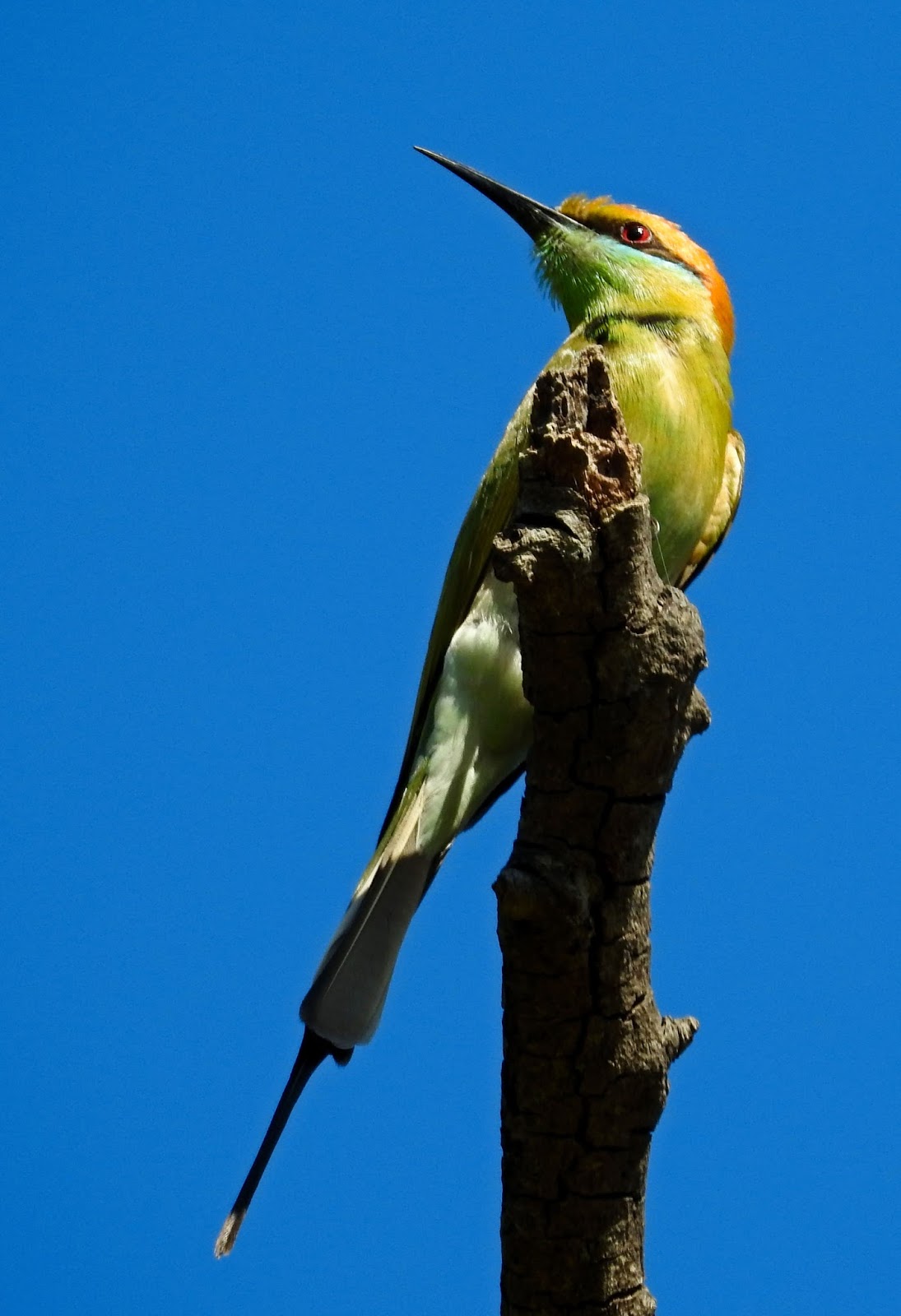
18-11-2016 MAGWE, MYANMAR - ASIAN GREEN BEE-EATER (Merops orientalis)


The Asian green bee-eater (Merops orientalis) is a brightly-colored bird in the bee-eater family. It performs some seasonal movements and is found widely distributed across Asia. Populations in Africa and the Arabian Peninsula that were formerly assigned to this species (under the name green bee-eater) are now considered distinct species: the African green bee-eater and the Arabian green bee-eater. Asian green bee-eaters are mainly insect eaters and prefer to live quite far from water.


Like other bee-eaters, this species is a richly colored, slender bird. The males and the females are not visually distinguishable. The entire plumage is bright green and tinged with blue, especially on the chin and throat. The crown and upper back are tinged with golden rufous. The flight feathers are rufous washed with green and tipped with blackish. A fine black line runs in front of and behind the eye. The iris is crimson and the bill is black while the legs are dark grey. The feet are weak with the three toes joined at the base. Southeast Asian birds have rufous crown and face, and green underparts. The wings are green and the beak is black. The elongated tail feathers are absent in juveniles.

The Asian green bee-eater’s vast range stretches from Mauritania in West Africa, to sub-Saharan Africa, as well as the Middle East and India as far in the north as Nepal; in Southeast Asia, it is found in central China, Thailand, and Vietnam. This species frequents wooded areas where there are scattered trees and bushes, keeping near streams and shores, but also occurs in arid areas that have acacia and date palms, and in dunes, near cultivated areas and big gardens. It likes bare and sandy soils. Asian green bee-eaters are not known to perform migrations but they make seasonal movements in response to rainfall.


Asian green bee-eaters are fairly gregarious birds, with 30-300 individuals roosting next to each other on a branch, and as many as 20 gathering to dust bathe together, this activity is believed to help remove excess oil from the feathers and dislodge harmful parasites. Flocks sleep together at roosts, high in trees. Except for at nighttime, they perch fairly low. They forage either alone or with a group of 15 to 20 birds. These elegant birds usually hunt low to the ground, making short swoops before returning to their perch. They sometimes perch on the backs of cattle or grazing antelope and make sallies into vegetation close to the ground to catch insects. Before eating their prey, they remove any dirt by striking the insect several times against a hard surface. These birds make soft trilling calls, ‘trree-trree-trree’, or short, sharp alarm calls that sound like ‘ti-ic’ or ‘ti-ti-ti’.


Asian green bee-eaters are thought to be monogamous breeders, which means that a male will mate with only one female and a female will mate with only one male. The breeding season ranges from March to June or sometimes July to August, depending on the range. These birds are solitary nesters in Arabia and Africa, whereas small colonies are found in India, with larger colonies (10 to 30 breeding pairs) in Myanmar and Pakistan. These birds nest in burrows that are dug by both males and females into the flat ground or a gentle slope in Africa, while in Asia it is often on a low shore. The burrow measures one to two meters in length, with the nest chamber of around 15 cm at its end. 4-8 white eggs are laid in the chamber and incubation is 18 to 22 days, mainly carried out by the female. The young stay in the nest for 22 to 31 days while being fed by both their parents. 

18-11-2016 MAGWE, MYANMAR - LITTLE RINGED PLOVER (Charadrius dubius)


The little ringed plover (Charadrius dubius ) is a small plover. The genus name Charadrius is a Late Latin word for a yellowish bird mentioned in the fourth-century Vulgate. It derives from Ancient Greek kharadrios a bird found in river valleys (kharadra, "ravine"). The specific dubius is Latin for doubtful, since Sonnerat, writing in 1776, thought this bird might be just a variant of common ringed plover.

Their breeding habitat is open gravel areas near freshwater, including gravel pits, islands and river edges across the Palearctic including northwestern Africa. They nest on the ground on stones with little or no plant growth. Both males and females take turns incubating the eggs.

They are migratory and winter in Africa. These birds forage for food on muddy areas, usually by sight. They eat insects and worms.

2-12-2016 BARCELONA - MONK PARAKEET (Myiopsitta monachus)


The Monk parakeet (Myiopsitta monachus) is a small species of true parrot in the family Psittacidae. It is native to the temperate to subtropical areas of Argentina and the surrounding countries in South America. Self-sustaining feral populations occur in many places, mainly in North America and Europe; there they live in urban areas and pose a risk to crops and even native bird species.

The Monk parakeet has bright-green upperparts. The forehead and breast are pale gray with darker scalloping and the rest of the underparts are very light-green to yellow. The remiges are dark blue, and the tail is long and tapering. The bill is orange in color.


Monk parakeets are found in Argentina and the surrounding countries in South America. Self-sustaining feral populations have been recorded in several U.S. states and various regions of Europe. They live in semi-arid savannas, and woodlands and are well-adapted to urban areas.

Monk parakeets are highly gregarious birds that live and nest in colonies. They are diurnal and spend most of the day foraging and preening each other. To get their food these energetic birds climb among branches using their beaks or may drop to the ground to pick seeds or fallen berries. At dusk, they come back to their communal roost site to sleep. Monk parakeets are very noisy. Their call is a loud and throaty 'chape(-yee)' or 'quak quaki quak-wi quarr' and they also use 'skveet' screeches.


Monk parakeets are monogamous and form strong long-lasting pair bonds. They breed between October and February. These birds build a stick nest, in a tree or on a man-made structure, rather than using a hole in a tree. They often breed colonially, building a single large nest with separate entrances for each pair. Females lay 5 to 12 white eggs which usually hatch in about 24 days. The chicks are altricial; they hatch blind and are covered in yellowish down. Both parents feed their young until they are ready to leave the nest which usually occurs at 40-50 days after hatching. Reproductive maturity is reached when young birds are 2 years old.


Population size
20 Mlnlnn
Life Span
20-30 years
Weight
90-120
goz
g oz 
Length
29
cminch
cm inch 
Wingspan
48
cminch
cm inch 

3-12-2016 MONTE CORONA, ADOR - EUROPEAN ROBIN (Erithacus rubecula)


Population size
130-201 Mlnlnn
Life Span
1-19 years
Weight
16-22
goz
g oz 
Length
12.5-14
cminch
cm inch 
Wingspan
20-22
cminch


The European robin (Erithacus rubecula) is a small insectivorous passerine bird. The term robin is also applied to some birds in other families with red or orange breasts. These include the American robin (Turdus migratorius ), a thrush, and the Australasian robins of the family Petroicidae.

The male and female European robins are similar in coloration, with an orange breast and face lined with grey, brown upperparts, and a whitish belly. The bill and eyes are black. Juveniles are spotted brown and white in coloration, with patches of orange gradually appearing.

European robins occur in Eurasia east to Western Siberia, south to Algeria, and on the Atlantic islands as far west as the Central Group of the Azores and Madeira. Irish and British robins are largely resident but a small minority, usually female, migrate to southern Europe during winter, a few as far as Spain. Scandinavian and Russian robins migrate to Britain and western Europe to escape the harsher winters. European robins prefer spruce woods in northern Europe, contrasting with their preference for parks and gardens in Ireland and Great Britain. These may also be found in grasslands, shrubby vegetation, hedgerows with some tall trees, orchards, and farmlands.

Saturday, 3 December 2016

28-11-2016 JURONG, SINGAPORE - LUZON BLEEDING HEART DOVE (Gallicolumba luzonica) COURTESY VALERIE FISHER


The Luzon bleeding-heart (Gallicolumba luzonica ) is one of a number of species of ground dove in the genus Gallicolumba that are called "bleeding-hearts". The native name in Tagalog is punay. It is also known as paloma de punalada 'stabbed pigeon'. The Luzon Bleeding-heart is the species in which the "blood" feature is most pronounced, with the reddish hue extending down the belly, furthering the illusion of blood having run down the bird's breast.

The genus Gallicolumba has a number of species known as "bleeding-hearts", ground doves that get this name due to a splash of bright red in the middle of their white breast. Luzon bleeding-hearts are among these, their species is the one where the color is most vivid, making it look as though it has been wounded. Males and females look very similar, though females are duller overall, and their red breast patch is smaller and paler.


This bird is endemic to the island of Luzon and two other islands in northern Philippines. Here there are many populations that are isolated, and on the island of Polillo, a very small population was recently rediscovered, and on Catanduanes only one specimen has been found. This species lives in lowland forest and the majority of the time it feeds on the forest floor. These birds nest and roost in trees of low to medium height, shrubbery and vines.


Luzon bleeding-hearts are very secretive and shy casual foragers, turning over soil by flicking their bill as they walk along. To wash down its food, this bird drinks once a day or more. When it flies, this is usually to a nesting site with its mate or in a small flock to find water. This species usually roosts in shrubs and low trees at night. Highly territorial, males defend their area, first by making warning calls, then, if necessary, fighting to the death. If confronted by a bird of prey that is larger, the Luzon bleeding-heart makes a grunting, gasping or panting sound. It then flies a little way, lands and continues to escape by running. The Luzon bleeding-heart’s call is a single ‘coooooo’, rising slightly in pitch in the middle. Typically these birds are very secretive and nearly silent.