This Blog contains Wildlife, Plants and Bird Photos from Walks, Safaris, Birding Trips and Vacations. Most of the pictures have been taken with my Nikon P900 and P950X cameras. Just click on any image for a larger picture. On the right column under the Blog Archive are the entries by date. Below that under Animal categories all the diffent species of Animals, Birds, Insects and Plants contained in the website are listed. Clicking on any entry will show all the entries for that species.
TOTAL PAGEVIEWS
TRANSLATE
Tuesday, 18 February 2020
12-2-2020 BIOPARC, VALENCIA - AFRICAN FISH EAGLE (Haliaeetus vocifer)
12-2-2020 BIOPARC, VALENCIA - DAMA GAZELLE (Nanger dama)
12-2-2020 BIOPARC, VALENCIA - ADDAX (MALE) (Addax nasomaculatus)
12-2-2020 BIOPARC, VALENCIA - COMMON DWARF MONGOOSE (Helogale parvula)
The common dwarf mongoose is a diurnal animal. It is a highly social species that lives in extended family groups of two to thirty animals. There is a strict hierarchy among same-sexed animals within a group, headed by the dominant pair (normally the oldest group members). All group members cooperate in helping to rear the pups and in guarding the group from predators.
Young mongooses attain sexual maturity by one year of age but delay dispersal, with males usually emigrating (in the company of their brothers) at 2–3 years old. Dispersing males may join other established groups, either as subordinates or by ousting the resident males, or they may found new groups with unrelated dispersing females. In contrast, females normally remain in their home group for life, queuing for the dominant position. They will, however, emigrate to found a new group if they lose their place in the hierarchy to a younger sister.
12-2-2020 BIOPARC, VALENCIA - GREAT WHITE PELICAN (Pelecanus onocrotalus)
The great white pelican, known scientifically as Pelecanus onocrotalus, is a gargantuan bird, surpassed in size only by its cousin, the Dalmatian pelican. With a body length ranging from 140 to 180 cm and a wingspan stretching from 226 to 360 cm, it is one of the largest flying birds. The pelican's bill is an impressive 28.9 to 47.1 cm long, colored in hues of pink and yellow, and is accompanied by a pale-yellow gular pouch. Males are generally larger than females and exhibit a pronounced sexual dimorphism, with males averaging more than 30% heavier than females.
Adult great white pelicans are predominantly white with black flight feathers and a faint pink tinge on the neck. The bill is bluish-grey with a red tip and a yellowish gular pouch. During the breeding season, males display pinkish facial skin, while females exhibit a more orangey hue. Juveniles are distinguishable by their darker, brownish underparts and patterned underwings.
These pelicans favor shallow, warm freshwater environments, such as lakes, swamps, and lagoons, often with dense reed beds nearby for nesting. They are also found in coastal estuarine areas and occasionally at elevations up to 1,372 m in East Africa and Nepal.
12-2-2020 BIOPARC, VALENCIA - CHIMPANZEE (Pan troglodytes)
Monday, 17 February 2020
12-2-2020 BIOPARC, VALENCIA - CAPE PORCUPINE (Hystrix africaeaustralis)
Cape porcupines are the largest rodents in Africa and also the world's largest porcupines. Cape porcupines are amongst the largest living rodents in the world; a few other rodents appear to be larger in body mass such as the capybara and the Eurasian and North American beavers. They are similar in appearance to, the slightly smaller and close relatives, the crested porcupines. They can most easily be distinguished from them by the presence of a band of short white spines along the midline of the rump. Indian porcupines are almost the same size on average as well, being slightly heavier on average than crested porcupine but slightly lighter than Cape porcupines.
Cape porcupines measure 63 to 81 centimetres (25 to 32 inches) long from the head to the base of the tail, with the tail adding a further 11–20 centimetres (4.3–7.9 inches). They weigh from 10 to 24 kilograms (22 to 53 pounds), with exceptionally large specimens weighing up to 30 kg (66 lb); males and females are not significantly different in size. The average weight of males from Zimbabwe was 16.9 kg (37 lb) and while the average for females there was 18.4 kg (41 lb) while in the Orange river valley of South Africa males averaged 12.3 kg (27 lb) and females averaged 13 kg (29 lb).
They are heavily-built animals, with stocky bodies, short limbs, and an inconspicuous tail. The body is covered in long spines up to 50 centimetres (20 in) in length, interspersed with thicker, sharply pointed, defence quills up to 30 centimetres (12 in) long, and with bristly, blackish or brownish fur. The spines on the tail are hollow, and used to make a rattling sound to scare away predators. An erectile crest of long, bristly hairs runs from the top of the head down to the shoulders. The spines and quills cover the back and flanks of the animal, starting about a third of the way down the body, and continuing onto the tail. The quills have multiple bands of black and white along their length, and grow from regularly spaced grooves along the animal's body; each groove holding five to eight quills. The remainder of the animal, including the undersides, is covered with dark hair.
The eyes and ears are relatively small, and the mobile whiskers are short. The feet have five clawed toes, although the first toes on the forefeet are vestigial. Females have two pairs of teats.
12-2-2020 BIOPARC, VALENCIA - VERREAUX'S EAGLE OWL (Bubo lacteus)
12-2-2020 BIOPARC, VALENCIA - PYGMY HIPPOPOTAMUS (Choeropsis liberiensis)
17-2-2020 SALEM, VALENCIA - PINE PROCESSIONARY CATERPILLAR (Thaumetopoea pityocampa)
17-2-2020 SALEM, VALENCIA - SMALL WHITE BUTTERFLY (Pieris rapae)
Sunday, 16 February 2020
12-2-2020 BIOPARC, VALENCIA - ABDIM'S STORK (Ciconia abdimii)
12-2-2020 BIOPARC, VALENCIA - HELMETED GUINEA FOWL (Numida meleagris)
The helmeted guineafowl is a large, 53 to 58 cm (21 to 23 in) bird with a round body and small head. They weigh about 1.3 kg (2.9 lb). The body plumage is gray-black speckled with white. Like other guineafowl, this species has an unfeathered head, which in this species is decorated with a dull yellow or reddish bony knob, and bare skin with red, blue, or black hues. The wings are short and rounded, and the tail is likewise short. Various subspecies are proposed, differences in appearance being mostly a large variation in shape, size, and colour of the casque and facial wattles.
12-2-2020 BIOPARC, VALENCIA - SADDLE BILLED STORK (Ephippiorhynchus senegalensis)
12-2-2020 BIOPARC, VALENCIA - GREY CROWNED CRANE (Balearica regulorum)
17-2-2020 MONTE CORONA, VALENCIA - GARDEN CARPET MOTH (Xanthorhoe fluctuata)
12-2-2020 BIOPARC, VALENCIA - CAPE TEAL (Anas capensis)
Like many southern ducks, the sexes are similar. It is very pale and mainly grey, with a browner back and pink on the bill (young birds lack the pink). This is a generally quiet species, except during mating displays. The breeding male has a clear whistle, whereas the female has a feeble "quack". The Cape teal cannot be confused with any other duck in its range.
This species is essentially non-migratory, although it moves opportunistically with the rains. It is a thinly distributed but widespread duck, rarely seen in large groups except the moulting flocks, which may number up to 2000.
The Cape teal feeds on aquatic plants and small creatures (invertebrates, crustaceans and amphibians) obtained by dabbling. The nest is on the ground under vegetation and near water.
The Cape teal is one of the species to which the Agreement on the Conservation of African-Eurasian Migratory Waterbirds (AEWA) applies.
15-2-2020 MONTE CORONA, VALENCIA - SPECKLED WOOD BUTTERFLY (Pararge aegeria)
The speckled wood (Pararge aegeria) is a butterfly found in and on the borders of woodland areas throughout much of the Palearctic realm. The species is subdivided into multiple subspecies, including Pararge aegeria aegeria, Pararge aegeria tircis, Pararge aegeria oblita, and Pararge aegeria insula. The color of this butterfly varies between subspecies. The existence of these subspecies is due to variation in morphology down a gradient corresponding to a geographic cline.
The background of the wings ranges from brown to orange, and the spots are either pale yellow, white, cream, or a tawny orange. The speckled wood feeds on a variety of grass species. The males of this species exhibit two types of mate locating behaviors: territorial defense and patrolling. The proportion of males exhibiting these two strategies changes based on ecological conditions. The monandrous female must choose which type of male can help her reproduce successfully. Her decision is heavily influenced by environmental conditions.
15-2-2020 MONTE CORONA, VALENCIA - GREAT TIT (Parus major)
15-2-2020 MONTE CORONA, VALENCIA - SEVEN SPOTTED LADYBIRD (Coccinella septempunctata)
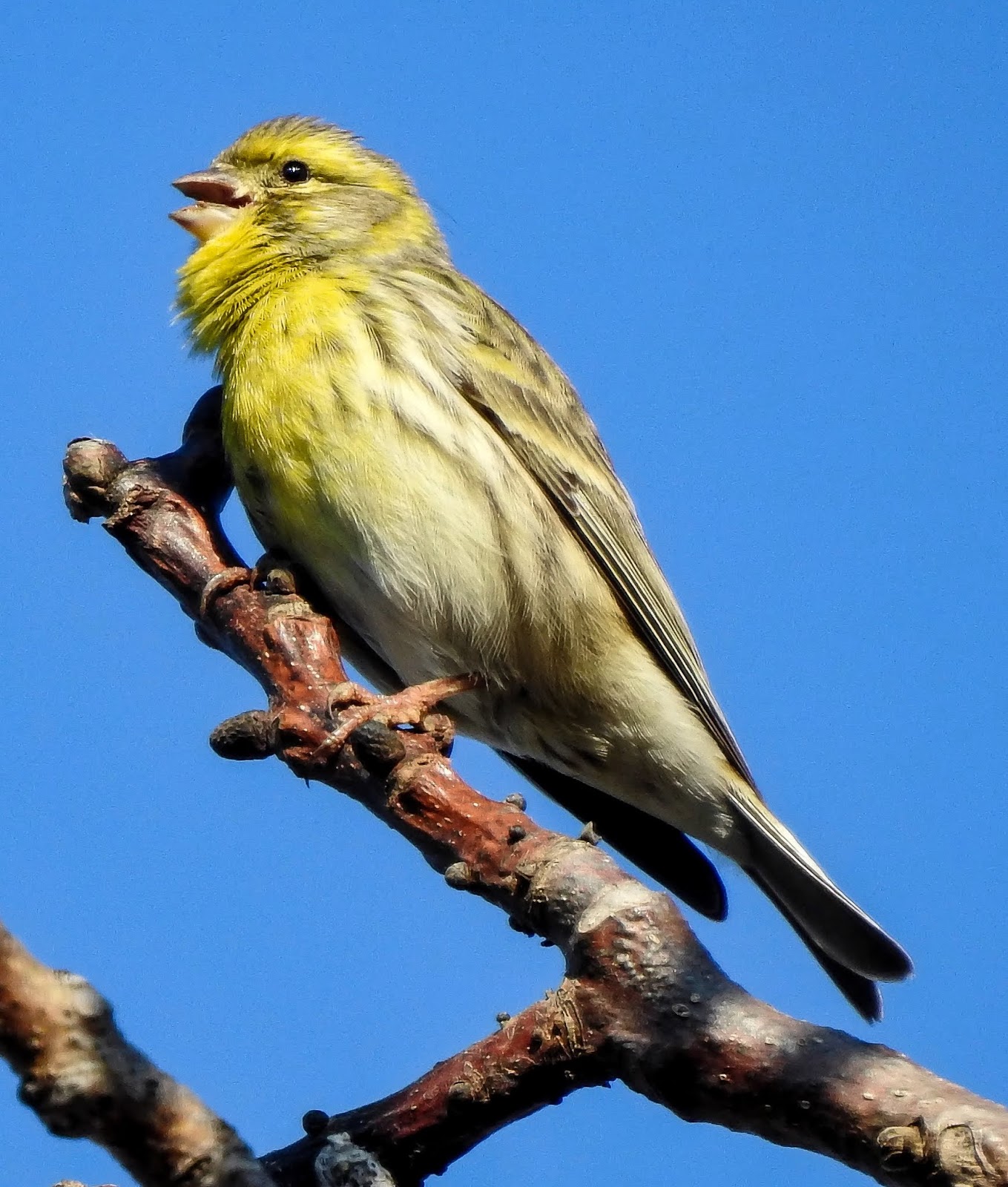
16-2-2020 RAFELCOFER, VALENCIA - EUROPEAN SERIN (MALE) (Serinus serinus)
When attempting to identify the European serin, look for the male's radiant yellow face and breast, which stand out against the greenish backdrop of its feathers. The male also boasts yellow wing bars and yellow tail sides, which can be quite helpful in distinguishing it from similar species. Both sexes share a buzzing trill of a song that resonates through their Mediterranean habitats.
Outside of the breeding season, the European serin is a sociable creature, forming flocks that may sometimes mingle with other finch species. It is an active and often conspicuous bird, its presence easily announced by its distinctive trill.
The European serin weaves its nest within the shelter of a shrub or tree, where it lays a clutch of 3 to 5 eggs. The chosen breeding habitats are often areas of open woodland and cultivation, with a preference for some conifers.
The diet of the European serin is predominantly seeds, but it does not shy away from including insects during the breeding season, providing essential protein for its young.


%2020.jpg)


%2019.jpg)
%2020.jpg)


%2020.jpg)


%2020.jpg)
%2021.jpg)
%2020-topaz-upscale-1.7x.jpg)