TOTAL PAGEVIEWS

TRANSLATE

Sunday, 28 June 2020

28-6-2020 VILLALONGA RESERVOIR, VALENCIA - EURASIAN REED WARBLER (Acrocephalus scirpaceus)


The Common Reed Warbler, Acrocephalus scirpaceus, is a medium-sized warbler measuring approximately 13 cm in length with a wingspan ranging from 17 to 21 cm. It exhibits an unstreaked brown back with buff underparts. Both sexes are identical in appearance, which is typical for warblers. Juveniles can be distinguished by their richer buff underparts. The species is characterized by a flattened forehead and a robust, pointed bill.

When identifying the Common Reed Warbler, look for its brown, unstreaked back and buff underparts. The bird's supercilium is less pronounced than that of the larger Great Reed Warbler. In flight, observe the wing-span and listen for its distinctive song.

This species is almost exclusively found in reed beds, often with interspersed bushes, providing it with the necessary cover and nesting sites.

The Common Reed Warbler breeds across Europe into the temperate western Palaearctic and is migratory, wintering in sub-Saharan Africa. It is also a resident species in large parts of Africa.


Males typically arrive at breeding grounds a few weeks before females. The species is generally monogamous, with pairs raising up to two broods per season. It is known to be brood parasitized by the Common Cuckoo.

The song of the Common Reed Warbler is a distinctive slow, chattering "jit-jit-jit" with acrocephaline whistles and mimicry.

Nests are built by the female over water, often in reeds, and are deep cylindrical cups. Clutches usually contain three to five pale green eggs with olive or grey speckles. Both parents incubate the eggs, which hatch after 9-12 days. Fledglings leave the nest after 10-12 days but are fed by parents for an additional 10-14 days.

The Great Reed Warbler is similar in appearance but is larger and has a more pronounced supercilium.

The Common Reed Warbler is primarily insectivorous but may occasionally consume plant material such as berries.

Saturday, 27 June 2020

27-6-2020 MARXUQUERA, VALENCIA - RED RUMPED SWALLOW (Cecropis daurica)


The Red-rumped Swallow (Cecropis daurica) is a small, graceful passerine bird, a member of the swallow family. It is characterized by its blue upperparts and dusky underparts, with a distinctive pale or reddish rump, face, and neck collar. Unlike the Barn Swallow, it lacks a breast band but features black undertails. Its wings are broad yet pointed, allowing for swift and agile flight.

To identify the Red-rumped Swallow, look for its darker underparts compared to the Barn Swallow, and the absence of a breast band. The rump is pale or reddish, providing a stark contrast to the blue upperparts. The bird's flight is fast, with frequent swoops as it pursues airborne insects.

This species is often found in open hilly country, where it can be seen gracefully hawking for insects over grasslands. It is also known to adapt to human structures, nesting under cliff overhangs, on buildings, and bridges.


The Red-rumped Swallow has a wide distribution, breeding in temperate southern Europe and Asia, from Portugal and Spain to Japan, India, Sri Lanka, and tropical Africa. While the Indian and African populations are resident, European and other Asian birds are migratory, wintering in Africa or India.

These swallows are gregarious outside the breeding season, often seen in large numbers on the plains of India. They do not typically form large breeding colonies but are known to be social. Their flight is characterized by swift, agile movements as they feed on insects in the air.

The Red-rumped Swallow communicates with a series of chirps and trills, a delightful symphony that fills the air especially during the breeding season.

The Red-rumped Swallow constructs quarter-sphere nests with a tunnel entrance, using mud collected in their beaks. They lay 3 to 6 eggs and prefer to nest under cliff overhangs or on human-made structures.

This species is an aerial insectivore, feeding on insects caught in flight. They are adept at catching their prey mid-air, often following cattle or taking advantage of grass fires to find insects.

Friday, 26 June 2020

24-6-2020 RIVER JUCAR, RIOLA, VALENCIA - EUROPEAN MOORHEN (Gallinula chloropus)


The common moorhen (Gallinula chloropus), also known as the waterhen or swamp chicken, is a bird species in the rail family (Rallidae). It is distributed across many parts of the Old World.

The common moorhen lives around well-vegetated marshes, ponds, canals and other wetlands. The species is not found in the polar regions or many tropical rainforests. Elsewhere it is likely the most common rail species, except for the Eurasian coot in some regions.

The closely related common gallinule of the New World has been recognized as a separate species by most authorities, starting with the American Ornithologists' Union and the International Ornithological Committee in 2011.

The moorhen is a distinctive species, with predominantly black and brown plumage, with the exception of a white under-tail, white streaks on the flanks, yellow legs and a red frontal shield. The bill is red with a yellow tip. The young are browner and lack the red shield. The frontal shield of the adult has a rounded top and fairly parallel sides; the tailward margin of the red unfeathered area is a smooth waving line. In the related common gallinule (Gallinula galeata) of the Americas, the frontal shield has a fairly straight top and is less wide towards the bill, giving a marked indentation to the back margin of the red area.


The common moorhen gives a wide range of gargling calls and will emit loud hisses when threatened. A midsized to large rail, it can range from 30 to 38 cm (12 to 15 in) in length and span 50 to 62 cm (20 to 24 in) across the wings. The body mass of this species can range from 192 to 500 g (6.8 to 17.6 oz).

This is a common breeding and resident bird in marsh environments, rivers, well-vegetated lakes and even in city parks. Populations in areas where the waters freeze, such as eastern Europe, will migrate to more temperate climates. In China, common moorhen populations are largely resident south of the Yangtze River, whilst northern populations migrate in the winter, therefore these populations show high genetic diversity.

This species will consume a wide variety of vegetable material and small aquatic creatures. They forage beside or in the water, sometimes walking on lilypads or upending in the water to feed. They are often secretive, but can become tame in some areas. Despite loss of habitat in parts of its range, the common moorhen remains plentiful and widespread.

24-6-2020 RIVER JUCAR, RIOLA, VALENCIA - EUROPEAN MOORHEN (JUVENILE) (Gallinula chloropus)

24-6-2020 ULLAL DE BALDOVI, VALENCIA - PERSIAN SILK TREE (Albizia julibrissin)


Albizia julibrissin, the Persian silk tree, pink silk tree, or mimosa tree, is a species of tree in the Fabaceae family, native to southwestern and eastern Asia.
It was introduced to Europe in the mid-18th century by Italian nobleman Filippo degli Albizzi, and the name of its entire genus Albizzia is given after him. The specific epithet julibrissin is a corruption of the Persian word gul-i abrisham (گل ابریشم), which means "silk flower" (from gul گل "flower" + abrisham ابریشم "silk").

Albizia julibrissin is known by a wide variety of common names, such as Persian silk tree and pink siris. It is also called Lankaran acacia or bastard tamarind, though it is not too closely related to either genus. The species is called Chinese silk tree, silk tree or mimosa in the United States, which is misleading—the former can refer to any species of Albizia which is most common in any one locale; and, although once included in Mimosa, neither is it very close to the Mimoseae. To add to the confusion, several species of Acacia, notably Acacia baileyana and Acacia dealbata, are also known as "mimosa" (especially in floristry), and many Fabaceae trees with highly divided leaves are called thus in horticulture.

24-6-2020 MUNTANYETA DEL SANTS, VALENCIA - BLACK WINGED STILT (Himantopus himantopus)

24-6-2020 ULLAL DE BALDOVI, VALENCIA - AUDOUIN'S GULL (Ichthyaetus audouinii)


The Audouin's gull, Ichthyaetus audouinii, presents itself as a large gull species, predominantly inhabiting the Mediterranean, the western coast of Saharan Africa, and the Iberian Peninsula. Its name pays homage to the French naturalist Jean Victoire Audouin. Resembling a small European herring gull, the adult Audouin's gull is distinguished by its short, stubby red bill and the unique "string of pearls" white wing primary tips. The legs of this bird are a subtle grey-green, and it takes a full four years for the gull to don its adult plumage.

When observing the Audouin's gull, one should note the red bill and the distinctive pattern of white spots along the wingtips, which contrast with the larger "mirrors" seen in other gull species. These features are key to distinguishing it from its relatives.

This gull favors coastal and pelagic environments, strictly adhering to regions where it can pursue its specialized diet.

The Audouin's gull is found in the Mediterranean, along the western Saharan African coast, and on the Iberian Peninsula. It breeds on small islands, either colonially or in solitude.


24-6-2020 ULLAL DE BOLDOVI, VALENCIA - NOMAD DRAGONFLY (MALE & FEMALE) (Sympetrum fonscolombii)


The red-veined darter or nomad (Sympetrum fonscolombii) is a dragonfly of the genus Sympetrum.

Sympetrum fonscolombii was named under the protonym Libellula fonscolombii by the Belgian entomologist Edmond de Sélys Longchamps, in 1840, in honor of the French entomologist Étienne of Fonscolombe (hence the species name). Its name is sometimes spelt fonscolombei instead of fonscolombii but Askew (2004) gives the latter as the correct spelling.

Sympetrum fonscolombii can reach a body length of 38–40 millimetres (1.5–1.6 in). This species is similar to other Sympetrum species but a good view with binoculars should give a positive identification, especially with a male.


Males have a red abdomen, redder than many other Sympetrum species. The frons and the thorax are red-brown. The eyes are brown above and blue/grey below. The wings have red veins and the wing bases of the hind-wings are yellow. The pterostigma is pale yellow with a border of black veins.

Female are similar but the abdomen is ochre yellow, not red, with two black lines along each side. The wings have yellow veins at the costa, leading edge and base, not red veins as found in the males. The legs of both sexes are mostly black with some yellow.

Immature males are like females but often with more red and a single line along each side of the abdomen.

Male S. fonscolombii can be mistaken for Crocothemis erythraea as both are very red dragonflies with yellow bases to the wings, red veins and pale pterostigma. However C. erythraea has no black on the legs, a broader body and no black on the head. Also C. erythraea females do not oviposit in tandem. The gestalt image of these two species is different and with some experience are easy to tell apart.

24-6-2020 ULLAL DE BOLDOVI, VALENCIA - SPECKLED WOOD BUTTERFLY (Pararge aegeria)


The speckled wood (Pararge aegeria) is a butterfly found in and on the borders of woodland areas throughout much of the Palearctic realm. The species is subdivided into multiple subspecies, including Pararge aegeria aegeria, Pararge aegeria tircis, Pararge aegeria oblita, and Pararge aegeria insula. The color of this butterfly varies between subspecies. The existence of these subspecies is due to variation in morphology down a gradient corresponding to a geographic cline. 

The background of the wings ranges from brown to orange, and the spots are either pale yellow, white, cream, or a tawny orange. The speckled wood feeds on a variety of grass species. The males of this species exhibit two types of mate locating behaviors: territorial defense and patrolling. The proportion of males exhibiting these two strategies changes based on ecological conditions. The monandrous female must choose which type of male can help her reproduce successfully. Her decision is heavily influenced by environmental conditions.

Thursday, 25 June 2020

24-6-2020 ULLAL DE BOLDOVI, VALENCIA - LITTLE EGRET (Egretta garzetta)


The Little Egret, Egretta garzetta, is a dainty heron adorned in pure white plumage. It is characterized by a slender black beak, long black legs, and, notably in the western race, yellow feet. This elegant bird is a sight to behold with its graceful neck and poised stance.

Adult Little Egrets measure between 55–65 cm in length with a wingspan of 88–106 cm, and weigh 350–550 g. Their plumage is predominantly white, though some may exhibit bluish-grey coloration. Breeding adults boast ornate nape plumes reaching about 150 mm, along with distinctive feathers on the breast and elongated scapulars. The bill and lores are black, with greenish-grey skin at the base of the lower mandible and around the eye, which houses a yellow iris. Legs are black with contrasting yellow feet, though juveniles may have greenish-black legs and duller feet. The subspecies E. g. nigripes is distinguished by yellow skin between the bill and eye, and blackish feet.


The Little Egret frequents a variety of wetland habitats, from the shores of lakes and rivers to marshes and coastal regions. It is often found in open environments, such as mangroves, swamps, mudflats, and sandy beaches, as well as human-altered landscapes like rice fields.

The species has a broad breeding distribution across warm temperate to tropical regions of Asia, Africa, Australia, and Europe. Northern populations are migratory, wintering in Africa and southern Asia, while others remain as permanent residents in warmer areas.

24-6-2020 ULLAL DE BOLDOVI, VALENCIA - EURASIAN TREE SPARROW (MALE) (Passer montanus)


The Eurasian tree sparrow (Passer montanus) is a charming passerine bird, easily recognized by its rich chestnut crown and nape, and a distinctive black patch on each pure white cheek. Both sexes are similarly adorned, and the juveniles mirror the adults, albeit with slightly duller hues. This species is somewhat smaller than the closely related house sparrow, and its size is approximately 12.5–14 cm in length, with a wingspan of about 21 cm.

To identify the Eurasian tree sparrow, look for the kidney-shaped black ear patch on each white cheek, the black chin and throat, and the light brown upperparts streaked with black. The wings bear two narrow white bars, and the legs are pale brown. The bill is lead-blue in summer, darkening almost to black in winter. Unlike the house sparrow, there is no sexual dimorphism in plumage, making both males and females equally easy to identify.

25-6-2020 PEGO MARJAL, VALENCIA - SQUACCO HERON (Ardeola ralloides)

25-6-2020 PEGO MARJAL, VALENCIA - LARGE PSAMMODROMUS LIZARD (Psammodromus algirus)

25-6-2020 PEGO MARJAL, VALENCIA - RED SWAMP CRAYFISH (Procambarus clarkii)

Wednesday, 24 June 2020

24-6-2020 MUNTANYETA DEL SANS, VALENCIA - GREY HERON (Ardea cinerea)


The Grey Heron (Ardea cinerea) is a statuesque wading bird belonging to the family Ardeidae. It is a familiar sight in both rural and urban settings, often seen standing stoically along the water's edge. An adult Grey Heron is a large bird, reaching up to 100 cm in height, with a wingspan between 155 to 195 cm. It weighs between 1 to 2 kg. The plumage is predominantly ashy-grey above, with a greyish-white underbelly and some black on the flanks. A striking feature is the white head and neck adorned with a broad black stripe that extends from the eye to the black crest. The beak is pinkish-yellow, long, and sharply pointed, while the legs are a brown hue.

When identifying the Grey Heron, look for the white head with the black supercilium and crest, the long grey neck, and the ashy-grey wings and back. The underparts are lighter, and the legs are long and brown. Juveniles can be distinguished by their duller grey neck and smaller crest. The beak is a useful indicator of age, being brighter in breeding adults.


Grey Herons are highly adaptable and can be found in a variety of watery habitats including lakes, rivers, ponds, marshes, and coastal environments. They require shallow waters for foraging or areas with shelving margins where they can wade.

Native to temperate Europe and Asia, as well as parts of Africa, the Grey Heron has a broad range. Northern populations may migrate southwards in autumn, while others remain resident year-round. Vagrant sightings have occurred in the Caribbean, Bermuda, and parts of North America.


The Grey Heron exhibits a slow, deliberate flight with its neck retracted in an S-shape. It is known for its solitary foraging habits, often standing motionless or stalking prey through shallow waters. It is also a communal rooster, often found in trees or cliffs at night.

The primary call of the Grey Heron is a loud croaking "fraaank." At breeding colonies, a variety of guttural and raucous noises can be heard, including greeting calls between mates and alarm calls when predators are nearby.


Breeding takes place in colonies, or heronries, typically in high trees near water. Nests are reused and added to each year. The breeding season sees a clutch of three to five bluish-green eggs laid, which both parents incubate. Chicks fledge at 7-8 weeks old.

The Grey Heron can be confused with the larger North American Great Blue Heron or the South American Cocoi Heron. However, it can be distinguished by its size and the coloration of its flanks and thighs.

Grey Herons are apex predators within their ecosystem, feeding on a variety of aquatic creatures such as fish, amphibians, crustaceans, and insects. They have also been known to consume small mammals and juvenile birds.

The Grey Heron is classified as Least Concern by the IUCN, indicating a stable and widespread population.

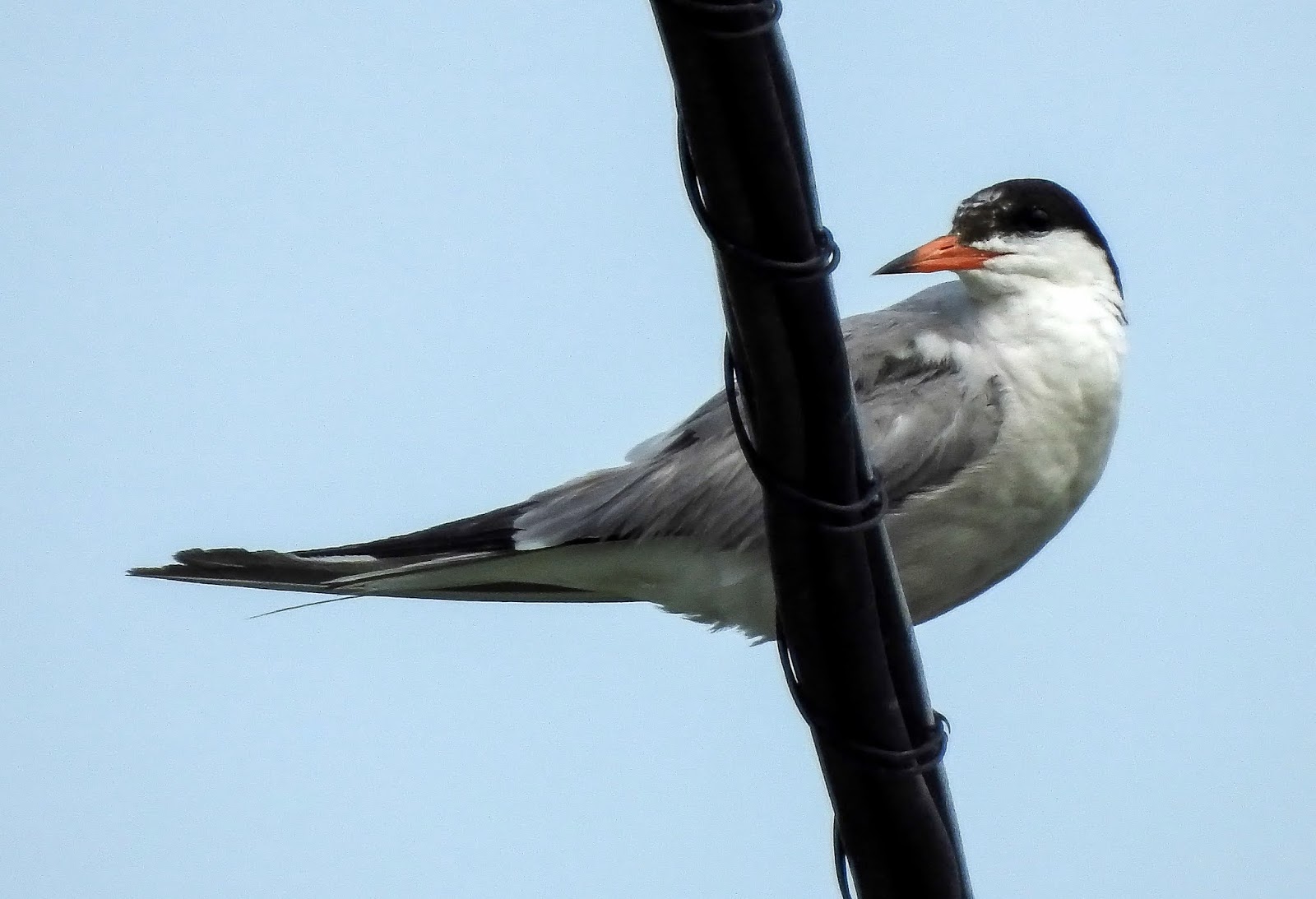
24-6-2020 RIVER JUCAR, RIOLA, VALENCIA - COMMON TERN (Sterna hirundo)

24-6-2020 RIVER JUCAR, RIOLA, VALENCIA - GREAT CRESTED GREBE (Podiceps cristatus)


The great crested grebe, Podiceps cristatus, is a water bird of the grebe family, notable for its striking black and white plumage and elaborate courtship displays. It is the largest grebe species found in the Old World, with some larger species in the Americas.

Adults are unmistakable in summer with ornate head and neck decorations. In winter, they are whiter than most grebes, with a distinctive white above the eye and a pink bill. Juveniles can be identified by their black and white striped heads, which they lose upon reaching adulthood.

This species prefers vegetated areas of freshwater lakes for breeding.

The great crested grebe has three subspecies: P. c. cristatus in Eurasia, P. c. infuscatus in Africa, and P. c. australis in Australia, Tasmania, and the South Island of New Zealand. The European subspecies migrates from colder regions, while the African and Australasian subspecies are mainly sedentary.

The great crested grebe is an excellent swimmer and diver, pursuing fish underwater. Its mating display is particularly elaborate, involving synchronized dances and poses.


The call of the great crested grebe is a loud barking "rah-rah-rah," complemented by a clicking "kek" and deep growls.

Both sexes build the nest at the water's edge, and the average clutch consists of four chalky-white eggs. Incubation is shared, starting with the first egg and lasting 27 to 29 days. The precocial young are capable of swimming and diving almost immediately and are taught by the adults.

Their diet mainly consists of fish, supplemented by small crustaceans, insects, small frogs, and newts.

The great crested grebe is listed as Least Concern by the IUCN. Conservation efforts in places like New Zealand's Lake Wānaka have been ongoing since 2013. The species has also been a beneficiary of early protection efforts by the Royal Society for the Protection of Birds in the United Kingdom.

Tuesday, 23 June 2020

23-6-2020 MONTE CORONA, VALENCIA - MOORISH GECKO (Tarentola mauritanica)


Tarentola mauritanica, known as the common wall gecko, is a species of gecko (Gekkota) native to the western Mediterranean area of North Africa and Europe. It has been introduced to Madeira and Balearic Islands, and the Americas (in Montevideo, Buenos Aires and California). A nocturnal animal with a predominantly insectivorous diet, it is commonly observed on walls in urban environments in warm coastal areas; it can be found further inland, especially in Spain where it has a tradition of cohabitation with humans as an insect hunter. 

A robust species, up to 15 centimetres (5.9 in) long, its tubercules are enlarged and give the species a spiny armoured appearance.
The species was first described by Carl Linnaeus in 1758. It is also known as moorish gecko, crocodile gecko, European common gecko, and, regionally, as osga (in Portuguese), salamanquesa (in Spanish) and dragó (in Catalan).

23-6-2020 MONTE CORONA, VALENCIA - MUSCINA FLY (Genus muscina)


The genus Muscina, commonly known as false stable flies, consists of approximately 27 species of flies within the family Muscidae. These flies are globally distributed and are notable for their significance in forensic science and public health. 

Key Characteristics

Appearance: They typically have a striped thorax and a characteristic pale or reddish tip on the scutellum (the back part of the thorax).

Mouthparts: They possess a retractable proboscis with sponging or sucking mouthparts, similar to the common housefly.

Wing Venation: A distinguishing feature is the "fourth vein" (M vein) on the wing, which is moderately curved but does not meet the third vein at the wing tip.

Size: Most common species, such as M. stabulans and M. levida, are slightly larger than the common housefly, averaging 8 mm in length. 

20-6-2020 MONTE CORONA, VALENCIA - JUNE BEETLE (Anoxia australis)


Melolonthinae is a subfamily of the scarab beetles (family Scarabaeidae). It is a very diverse group; distributed over most of the world, it contains over 11,000 species in over 750 genera. Some authors include the scarab subfamilies Euchirinae and Pachypodinae as tribes in the Melolonthinae.

Unlike some of their relatives, their habitus is usually not bizarre. They resemble the Rutelinae in being fairly plesiomorphic in outward appearance. Like in many Scarabaeidae, males have large fingered antennae, while those of the females are smaller and somewhat knobby. In the Melolonthinae, this sexual dimorphism is particularly pronounced. Many species have striking – though rarely brilliant or iridescent – hues and bold patterns of hairs.

Being often quite sizeable and swarming in numbers at certain times, for example the Amphimallon, Phyllophaga and Polyphylla "June beetles" or the Melolontha cockchafers – all from tribe Melolonthini – feature widely in folklore. Some Melolonthinae are economically significant pests. Other than the Melolonthini, the most diverse tribes are the Ablaberini, Liparetrini, Macrodactylini, Tanyproctini and Sericini.

Monday, 22 June 2020

22-6-2020 MONTE CORONA, VALENCIA - MEDITERRANEAN KATYDID (Phaneroptera nana)

22-6-2020 ALFAUIR, VALENCIA - SPOTTED FLYCATCHER (Muscicapa striata)


The Spotted Flycatcher, Muscicapa striata, is a modestly adorned yet charming small passerine bird belonging to the Old World flycatcher family. It is a migratory species, breeding across Europe and the Palearctic as far as Siberia, and spending the winter months in Africa and southwestern Asia. Despite its widespread presence, there is concern over its decline in certain areas.

Adult Spotted Flycatchers possess grey-brown upperparts and a somewhat pallid underbelly. Their crown and breast are streaked, which is the origin of their common name. They have short, black legs and a black bill shaped to suit their insectivorous diet. Juveniles can be distinguished by their browner plumage and the presence of spots on their upperparts.

These birds favor deciduous woodlands, parks, and gardens, particularly those with open spaces amidst trees.

The Spotted Flycatcher has a broad breeding range, extending from Europe to western Siberia and northwest Africa. During the non-breeding season, they migrate to southern Africa.

22-6-2020 ALFAUIR, VALENCIA - EUROPEAN SERIN (MALE) (Serinus serinus)


The European serin, or simply the serin (Serinus serinus), is a diminutive member of the finch family, Fringillidae. This sprightly bird is the smallest within its family, closely related to the Atlantic canary. It is characterized by its short tail and a length that spans a mere 11 to 12 centimeters. The serin's plumage is a tapestry of nature's palette, with upper parts dappled in dark-streaked greyish green and a conspicuous yellow rump. The underparts are a canvas of yellow breast and white belly, both adorned with heavy streaks.

When attempting to identify the European serin, look for the male's radiant yellow face and breast, which stand out against the greenish backdrop of its feathers. The male also boasts yellow wing bars and yellow tail sides, which can be quite helpful in distinguishing it from similar species. Both sexes share a buzzing trill of a song that resonates through their Mediterranean habitats.

The European serin is partial to open woodland and cultivated areas, often with a sprinkling of conifers. These environments provide the perfect backdrop for breeding and foraging.

This species has a breeding range that extends across southern and central Europe and into North Africa. Populations along the southern and Atlantic coasts tend to be resident, while those in the north are migratory, seeking warmer climates in southern Europe during the winter months.

22-6-2020 ALFAUIR, VALENCIA - MEXICAN PALO VERDE TREE (Parkinsonia aculeata)


Parkinsonia aculeata is a species of perennial flowering tree in the pea family, Fabaceae. Common names include palo verde, Mexican palo verde, Parkinsonia, Jerusalem thorn, jelly bean tree, palo de rayo, and retama.

Parkinsonia aculeata may be a spiny shrub or a small tree. It grows 2 to 8 m (6.6 to 26.2 ft) high, with a maximum height of 10 metres (33 ft). Palo verde may have single or multiple stems and many branches with pendulous leaves. The leaves and stems are hairless. The leaves are alternate and pennate (15 to 20 cm long). The flattened petiole is edged by two rows of 25–30 tiny oval leaflets; the leaflets are soon deciduous in dry weather (and during the winter in some areas) leaving the green petioles and branches to photosynthesize.

The branches grow double or triple sharp spines 7–12 mm (0.28–0.47 in) long at the axils of the leaves. The flowers are yellow- orange and fragrant, 20 mm (0.79 in) in diameter, growing from a long slender stalk in groups of eight to ten. They have five sepals and five petals, four of them clearer and rhomboid ovate, the fifth elongated, with a warmer yellow and purple spots at the base. The flowering period is in the middle months of spring (March–April or September–October). The flowers are pollinated by bees. The fruit is a seedpod, leathery in appearance, light brown when mature.

P. aculeata is a major invasive species in Australia, as it is listed as a Weed of National Significance and is ranked as Australia's worst weed. It is also a major problem in parts of tropical Africa, Hawaii, and other Islands in the Pacific Ocean.

22-6-2020 MONTE CORONA, VALENCIA - SIERRA NEVADA OCELLATED LIZARD (Timon nevadensis)


Timon nevadensis, the Sierra Nevada lizard, is a species of lizard in the family Lacertidae. It is endemic to Spain. It is sometimes considered a subspecies of the ocellated lizard.

Formerly, Timon nevadensis had been regarded as subspecies of Timon lepidus but it has been put into species rank in 2013. Its distribution range is limited to the Sierra Nevada and the Spanish east coast, reaching the Alicante Province in the north.

The Sierra Nevada Ocellated Lizard is an impressive but terribly shy Lacertid. In particular, adult specimens may have flight distances of more than 20 meters. These lizards occur in high altitude mountain areas as well as in coastal dunes and agricultural land.


 Adult specimens differ from Timon lepidus by the grey or brown basic coloration with no or reduced black markings.

Juveniles and subadults of Timon nevadensis frequently show dark edges on the labial scales which lack in juvenile Timon lepidus. However, there seem to exist populations with intermediate characteristics.

Within its distribution range, Timon nevadensis cannot be confused with other lizards, due to its big size of adults and the distinct white spot pattern of the juveniles.

These lizards were a regular visitor to our garden but since the large fire in the area we have not seen them for several years. They are sorely missed.