This Blog contains Wildlife, Plants and Bird Photos from Walks, Safaris, Birding Trips and Vacations. Most of the pictures have been taken with my Nikon P900 and P950X cameras. Just click on any image for a larger picture. On the right column under the Blog Archive are the entries by date. Below that under Animal categories all the diffent species of Animals, Birds, Insects and Plants contained in the website are listed. Clicking on any entry will show all the entries for that species.
TOTAL PAGEVIEWS
TRANSLATE
Thursday, 22 October 2020
21-10-2020 SALADARES DEL GUADALENTIN, MURCIA - EURASIAN COOT (Fulica atra)
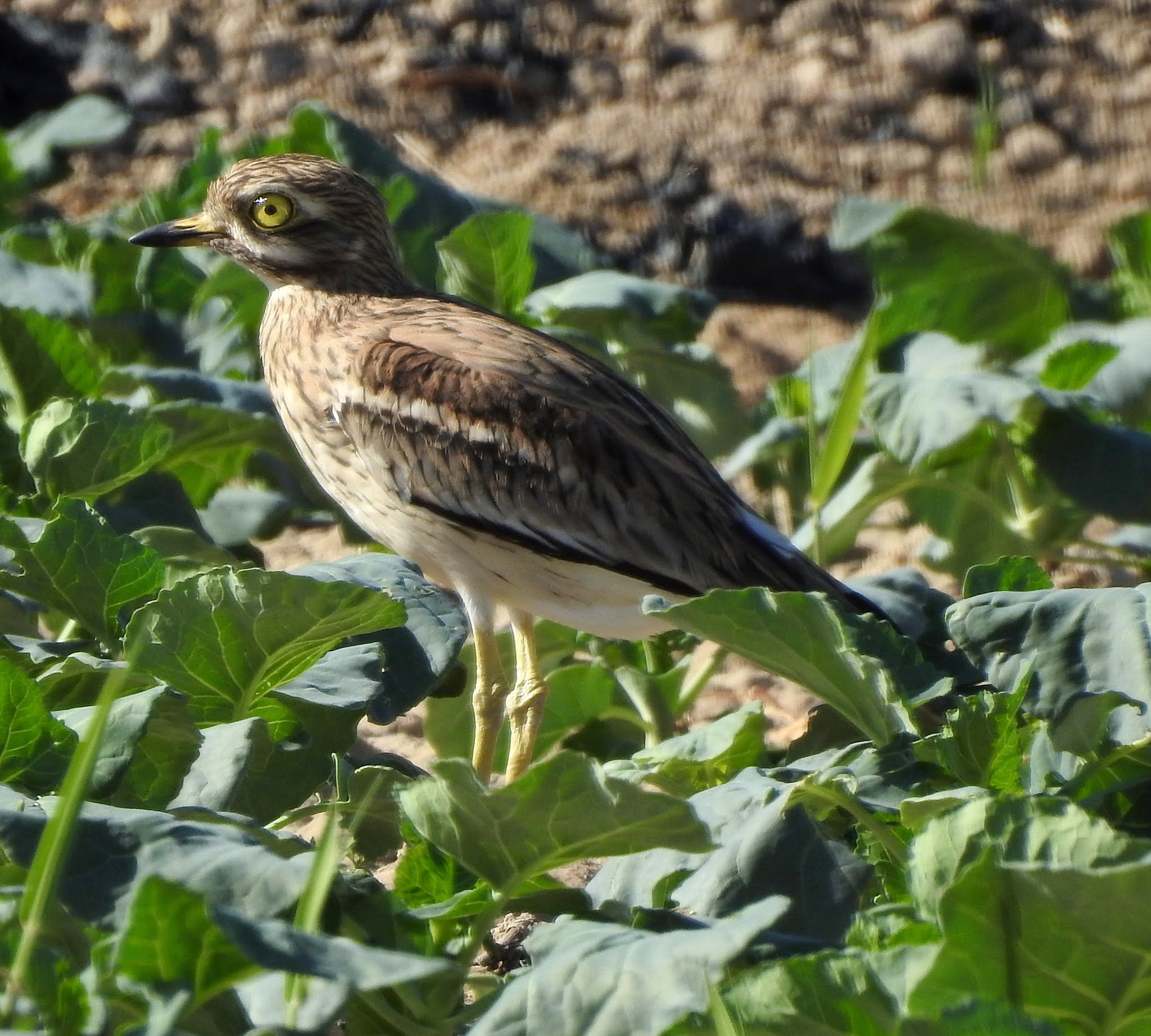
21-10-2020 SALADARES DEL GUADALENTIN, MURCIA - EURASIAN STONE CURLEW (Burhinus oedicnemus)
The Eurasian stone-curlew is a fairly large wader, though mid-sized by the standards of its family. Length ranges from 38 to 46 cm (15 to 18 in), wingspan from 76 to 88 cm (30 to 35 in) and weight from 290 to 535 g (10.2 to 18.9 oz). with a strong yellow and black beak, large yellow eyes (which give it a "reptilian", or "goggle-eyed" appearance), and cryptic plumage. The bird is striking in flight, with black and white wing markings.
The Eurasian stone-curlew is largely nocturnal, particularly when singing its loud wailing songs, which are reminiscent of that of curlews. Food consists of insects and other small invertebrates, and occasionally small reptiles, frogs and rodents.
Eurasian stone-curlews probably first breed when they are three years old. The eggs are laid at two day intervals in a scrape on open ground. The clutch normally consists of 2 eggs which are on average 54 mm × 38 mm (2.1 in × 1.5 in). The eggs are pale buff and are variably spotted, streaked or blotched with brown or purple grey. Both sexes incubate the eggs beginning after the last egg is laid. The eggs hatch after 24–26 days. The precocial young leave the nest soon after hatching and are then cared for by both parents for 36–42 days. Normally only a single brood is raised each year but a replacement clutch is laid after the loss of eggs or the loss of small young.
The maximum recorded age recorded from ring-recovery data within the British Isles is 22 years and 4 months for a bird ringed as a nestling in Suffolk in 1990 and caught again in Suffolk in 2012.
Sunday, 18 October 2020
18-10-2020 MONTAVERNER, VALENCIA - EUROPEAN STONECHAT (Saxicola rubicola)
18-10-2020 MONTAVERNER, VALENCIA - SPOTLESS STARLING (Sturnus unicolor)
18-10-2020 VILLALONGA RESERVOIR, VALENCIA - MOORISH GECKO (Tarentola mauritanica)
18-10-2020 MONTAVERNER, VALENCIA - SPECKLED WOOD BUTTERFLY (Pararge aegeria)
The speckled wood (Pararge aegeria) is a butterfly found in and on the borders of woodland areas throughout much of the Palearctic realm. The species is subdivided into multiple subspecies, including Pararge aegeria aegeria, Pararge aegeria tircis, Pararge aegeria oblita, and Pararge aegeria insula. The color of this butterfly varies between subspecies. The existence of these subspecies is due to variation in morphology down a gradient corresponding to a geographic cline.
The background of the wings ranges from brown to orange, and the spots are either pale yellow, white, cream, or a tawny orange. The speckled wood feeds on a variety of grass species. The males of this species exhibit two types of mate locating behaviors: territorial defense and patrolling. The proportion of males exhibiting these two strategies changes based on ecological conditions. The monandrous female must choose which type of male can help her reproduce successfully. Her decision is heavily influenced by environmental conditions.
18-10-2020 VILLALONGA RESERVOIR, VALENCIA - SPECKLED WOOD BUTTERFLY (Pararge aegeria)
The speckled wood (Pararge aegeria) is a butterfly found in and on the borders of woodland areas throughout much of the Palearctic realm. The species is subdivided into multiple subspecies, including Pararge aegeria aegeria, Pararge aegeria tircis, Pararge aegeria oblita, and Pararge aegeria insula. The color of this butterfly varies between subspecies. The existence of these subspecies is due to variation in morphology down a gradient corresponding to a geographic cline.
Saturday, 17 October 2020
17-10-2020 GANDIA, VALENCIA - CARPET MOTH (Epirrhoe sandosaria)
17-10-2020 GANDIA, VALENCIA - BLACK REDSTART (FEMALE) (Phoenicurus ochruros)
17-10-2020 GANDIA, VALENCIA - EURASIAN HOOPOE (Upupa epops)
17-10-2020 GANDIA, VALENCIA - HOUSE SPARROW (FEMALE) (Passer domesticus)
The house sparrow (Passer domesticus) is a member of the sparrow family Passeridae. This small bird typically measures around 16 cm (6.3 in) in length and weighs between 24–39.5 g (0.85–1.39 oz). The species exhibits sexual dimorphism, with females and young birds displaying pale brown and grey plumage, while males are characterized by more vibrant black, white, and brown markings.
Friday, 16 October 2020
16-10-2020 MONTE CORONA, VALENCIA - SMALL BLOOD VEIN MOTH (Scopula imitaria)
16-10-2020 MONTE CORONA, VALENCIA - PUG MOTH (Eupithecia semigraphata)
16-10-2020 MONTE CORONA, VALENCIA - SATELLITE FLY (Subfamily Miltogramminae)
Sarcophaginae is the largest subfamily of flesh flies (Family: Sarcophagidae), characterized by 0.16–0.9 inch long, grey/black striped, bristled bodies with red eyes and checkerboard abdomens. They are mostly larviparous, giving birth to live larvae on carrion, dung, or organic waste. These flies are crucial in forensics for estimating post-mortem intervals.
Thursday, 15 October 2020
15-10-2020 MONTE CORONA, VALENCIA - PUG MOTH (Eupithecia semigraphata)
Eupithecia semigraphata is a small geometrid moth found across Europe (excluding the far north and northwest), North Africa, and the Canary Islands. It is a nocturnal species, part of the "pug moth" group, often identified through genital dissection due to uniform appearance within the genus. Larvae typically feed on flowers and seeds of specific plants.
Wednesday, 14 October 2020
13-10-2020 MONTE CORONA, VALENCIA - CUTWORM MOTH (Family Noctuidae)
14-10-2020 POU CLAR, ONTINYENT - WHITE WAGTAIL (Motacilla alba)
Tuesday, 13 October 2020
13-10-2020 MONTE CORONA, VALENCIA - PUG MOTH (Eupithecia semigraphata)
12-10-2020 MONTE CORONA, VALENCIA - JASMINE MOTH (Palpita vitrealis)
Palpita vitrealis, common name jasmine moth or white pearl, is a species of moth of the family Crambidae.
This species occurs worldwide, including Africa (Equatorial Guinea, Gambia, Kenya, Sierra Leone, South Africa),Asia, Australia and Europe. In Europe, it is mainly found in southern Europe, but may be found further north.
The wingspan of Palpita vitrealis can reach 27–31 mm. The body and the wings are translucent with a slight sheen. Eyes are large and reddish-brown. On the upper edge of the forewings is present a rather broad orange or brown border. The forewings also show two black spots in the middle. Legs are white and brown ringed.
These moths mainly fly from August till late October, depending on the location. They feed on nectar of various flowers, including ivy and buddleia. This species shows a migratory nature. The larvae are initially yellow, later becoming green. They can grow to a length of about 2 cms. They feed on the leaves of the host plants, mainly jasmine (Jasminum officinale), privet (Ligustrum species), Forsythia, Arbutus unedo and european olive (Olea europaea). In Africa the preferred host plants are Sida rhombifolia, Grewia, Helicteres isora, Schima noronhae and Randia scortechinii. The larvae are considered a pest of olive fields, as they attack the leaves and fruits. The final instar of the larvae spins some leaves together and form a silky cocoon to pupate.
%2020.jpg)


%2020.jpg)
%2021.jpg)
%2022.jpg)
%2020.jpg)


%2020.jpg)


%2020.jpg)
%2021.jpg)


%2020.jpg)


%2020.jpg)


%2021.jpg)
%2022.jpg)