TOTAL PAGEVIEWS

TRANSLATE

Thursday, 4 November 2021

3-11-2021 BIOPARC, VALENCIA - SUPERB STARLING (Lamprotornis superbus)


3-11-2021 BIOPARC, VALENCIA - PYGMY HIPPOPOTAMUS (Choeropsis liberiensis)


31-10-2021 MONTE CORONA, VALENCIA - SPANISH CARPET MOTH (Scotopteryx peribolata)


2-11-2021 MONTE CORONA, VALENCIA - TAWNY COCKROACH (Ectobius pallidus)


Ectobius pallidus, the tawny cockroach, is a species of non-cosmopolitan cockroach in the family Ectobiidae. It occurs in southern England, Belgium, France, the Netherlands, Germany, Switzerland, Italy, Spain and Portugal; in North Africa: Algeria and Tunisia. It is now known to be introduced into North America.

Subspecies include:

Ectobius pallidus chopardi Adelung, 1917

Ectobius pallidus minor Ramme, 1923

Ectobius pallidus pallidus (Turton, 1806) – type

Ectobius pallidus punctulatus (Fieber, 1853)

4-11-2021 MONTE CORONA, VALENCIA - LANG'S SHORT TAILED BLUE BUTTERFLY (Leptotes pirithous)


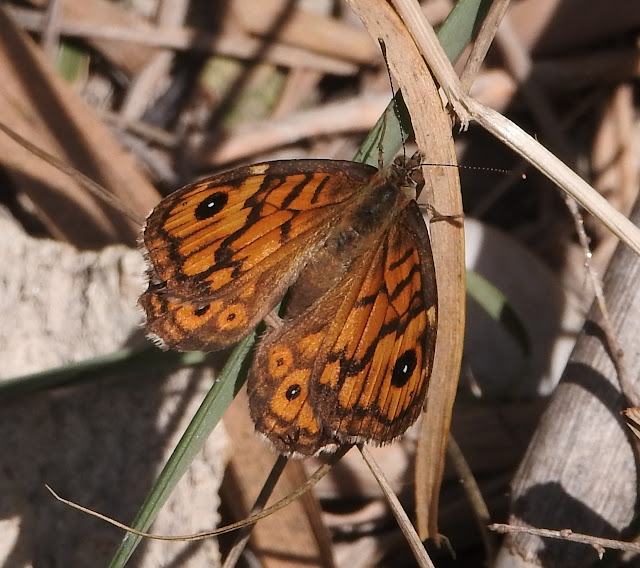
4-11-2021 MONTE CORONA, VALENCIA - WALL BROWN BUTTERFLY (Lasiommata megera)


Wednesday, 3 November 2021

3-11-2021 BIOPARC, VALENCIA - GOLDEN MANTELLA FROG (Mantella aurantiaca)


The golden mantella (Mantella aurantiaca) is a small, terrestrial frog endemic to Madagascar. It has an extremely restricted distribution in three distinct areas centered on the town of Moramanga - Beparasy and Ambohibary Communes, Torotorofotsy Wetland northwest of Andasibe, and in the area of Ambakoana. Mantella aurantiaca is one of Madagascar's most threatened amphibian species due to its limited distribution in an area under tremendous anthropogenic pressure. It may also be threatened by over-collection for the pet trade.

The golden mantella is a uniformly yellow, orange, or red frog measuring 20–26 mm. The inner leg displays red flash marks. The tympanum is visible, but small. Brightly colored skin warns predators that the frog is poisonous. It is thought that the brilliant colors exhibited by the golden mantella are an example of aposematism, warning predators of the poisonous nature of the frog.


The golden mantella is highly seasonal in its behaviour and remains largely inactive during the winter months of May–October. During the summer, the golden mantella is commonly active during the day. They live in groups of typically twice as many males as there are females. When the rains arrive and the temperature warms, frogs emerge from hiding and use small lentic wetlands for breeding. Males often call from concealed positions near a water source. The call is a rather pleasant, repeated click. The frogs do not seem to engage in typical amplexus but rather the male only moves himself over the female's back in virtual amplexus. Eggs are laid on land in moist leaf litter near water and when rains arrive the tadpoles are washed from land into water.

The golden mantella has a diet of small invertebrates. In the wild, this mainly consists of mites, ants, flies, and collembolans. The frogs derive their skin toxins from their diet. These toxins include pumiliotoxin, allopumiliotoxin, homopumiliotoxin alkaloids, pyrrolizidines, indolizidines and quinolizidines. Although poisonous, the snake Thamnosophis lateralis and a skink of the genus Zonosaurus have been observed preying upon this species at Torotorofotsy Wetland.


There are plans to launch a legal regulated collection program for this species.

Showings from a 2017 study found significant difference in captive vs wild golden mantella behavioral response times in captive populations vs wild populations, favoring captive populations.

The golden mantella is occasionally seen in the pet trade and kept in captivity by exotic animal collectors and zoological institutions. They are popular due to their diurnal activity, attractive coloration and relative ease to keep when settled in. Care sheets are easily found for this species. On the downside, however, the golden mantella is critically endangered, and the population is decreasing.

3-11-2021 BIOPARC, VALENCIA - BEARDED BARBET (Lybius dubius)


24-10-2021 ATTICA ZOO ATHENS, GREECE - EURASIAN SPOONBILL (Platalea leucorodia)


Tuesday, 2 November 2021

24-10-2021 ATTICA ZOO ATHENS, GREECE - EMU (Dromaius novaehollandiae)


24-10-2021 ATTICA ZOO ATHENS, GREECE - YELLOW BIBBED LORY (Lorius chlorocercus)


The yellow-bibbed lory (Lorius chlorocercus) is a species of parrot in the family Psittaculidae. It is endemic to the southern Solomon Islands.

The yellow-bibbed lory is 28 cm (11 in) long. It is mostly red with black on top of head and green wings. It has a yellow transverse band on upper chest and a crescent-shaped black patch on each side of neck. It has blue/green thighs and dark-grey legs. It has an orange-red beak, dark-grey eyerings, and orange irises. Under its wings the bird has blue feathers.


The yellow-bibbed lory is endemic to the eastern Solomon Islands. Its natural habitats are subtropical or tropical moist lowland forest and subtropical or tropical moist montane forest.

Yellow-bibbed Lories mimic a wide range of sounds, including the human voice, in other words they are 'talking parrots'. Providing a permit is obtained, it is exempt from export prohibition under the Solomon Islands Wildlife Protection and Management Act (1998).


The Yellow-bibbed Lory (Lorius chlorocercus) is a colorful parrot endemic to the southern Solomon Islands. Highly prized for their vibrant red body, green wings, black cap, and yellow bib, these active 11-inch (28 cm) birds are primarily nectarivores that thrive in both primary rainforests and modified habitats.

Key Facts & Characteristics

Physical Traits: They feature a striking orange-red beak, bright orange irises, a black cap, purple-blue thighs, and a distinct yellow bib underneath a black neck streak.


Diet: In the wild, they consume nectar, pollen, fruit, buds, and small insects. In captivity, they require a specialized wet/dry nectar diet and are known to be enthusiastic chewers of wooden fixtures.

Lifespan: They typically live between 15 and 25 years, though some captive specimens can live up to 30 years.

Behavior: Known to have a soft, relatively quiet voice compared to other parrots, they are playful, highly active, and possess a solid capacity for mimicking human speech.

Conservation Status: Listed as Least Concern, they have stable populations within their limited range.

24-10-2021 ATTICA ZOO ATHENS, GREECE - HOODED PARROT (Psephotus dissimilis)


The hooded parrot (Psephotellus dissimilis) is a species of parrot native to the Northern Territory in Australia. It is found in savannah and open woodland and is one of two extant species in its genus that breed in termite mounds. It has declined from much of its original range.

An Australian endemic, the hooded parrot inhabits to semi-arid areas of northeast Northern Territory, and is separated from the golden-shouldered parrot by the Carpentarian faunal barrier.


Though this species has disappeared from most of its original range, it remains common in protected areas. The hooded parrot is evaluated as Least Concern on IUCN Red List of Threatened Species.

The diet consists mainly of seeds, berries and vegetables.

The hooded parrot digs cavities in termite mounds. It generally chooses conical termite mounds, only successful in flat two dimensional mounds if it digs at the edge rather than on the face of the mound. Excavation takes around three weeks. The tunnel is roughly horizontal and around 50 to 80 cm long.
Breeding takes place once or twice a year between April and August. The female lays four or five white, slightly shiny eggs that are 21 long by 19 mm wide.

The hooded parrot has a close ecological relationship with the moth species Trisyntopa neossophila. The female moth lays eggs in the parrot nesting cavity, so that the eggs hatch at the same time as the baby hooded parrots. The moth larvae live in small tunnels at the base of the cavity and emerge to eat the dark material of parrot feces, leaving the white uric acid deposits. They build a silk layer across the base of the cavity to protect themselves from chicks. They pupate in the cavity walls once the juvenile parrots leave the nest.

24-10-2021 ATTICA ZOO ATHENS, GREECE - YELLOW COLLARED LOVEBIRD


2-11-2021 MONTAVERNER, VALENCIA - HOUSE SPARROW (MALE) (Passer domesticus)


2-11-2021 LLUTXENT, VALENCIA - WINTER SQUASH (Cucurbita maxima)


2-11-2021 LLUTXENT, VALENCIA - MEADOW PIPIT (Anthus pratensis)


2-11-2021 LLUTXENT, VALENCIA - BLACK REDSTART (FEMALE) (Phoenicurus ochruros)


2-11-2021 LLUTXENT, VALENCIA - MARVEL OF PERU (Mirabilis jalapa)

Mirabilis jalapa, the marvel of Peru or four o'clock flower, is the most commonly grown ornamental species of Mirabilis plant, and is available in a range of colors. Mirabilis in Latin means wonderful and Jalapa (or Xalapa) is the state capital of Veracruz in México. Mirabilis jalapa was cultivated by the Aztecs for medicinal and ornamental purposes.

The flowers usually open from late afternoon or at dusk (namely between 4 and 8 o'clock), giving rise to one of its common names. Flowers then produce a strong, sweet-smelling fragrance throughout the night, then close in the morning. New flowers open the following day. It arrived in Europe in 1525. Today, it is common in many tropical regions and is also valued in Europe as a (not hardy) ornamental plant. It is the children's state flower of Connecticut under the name of Michaela Petit's Four O'Clocks.

It is a perennial, herbaceous, bushy plant that reaches stature heights of mostly 1 meter, rarely up to 2 meters, in height. It may also be grown as an annual, especially in the temperate zone. The single-seeded fruits are spherical, wrinkled and black upon maturity, having started out greenish-yellow. The stems are thick, full, quadrangular with many ramifications and rooting at the nodes. The posture is often prostrate.

Monday, 1 November 2021

24-10-2021 ATTICA ZOO ATHENS, GREECE - MARGINATED TORTOISE (Testudo marginata)


31-10-2021 MONTE CORONA, VALENCIA - HAIRY ROSE BEETLE (Tropinota squalida)

Tropinota squalida is a species of beetle belonging to the family Scarabaeidae, subfamily Cetoniinae.

These beetles are mainly found in France, Italy, Greece, Portugal, former Yugoslavia, Spain, in the Near East and in North Africa.

Larvae feed on roots, while the adults can be encountered from May through July feeding on flowers. They are 10–15 millimetres (0.39–0.59 in) long.

Head, scutellum and elytra are dark-brown, with a thick and long tawny hair on elytra and abdomen. Elytra show two series of white spots on the sides of the central hull. Scutellun is rounded and hairy, but glabrous in the posterior. The fifth humeral slot is bifurcated.

1-11-2021 LLUXENT, VALENCIA - EUROPEAN MANTIS (MALE) (Mantis religiosa)

The European mantis (Mantis religiosa) is a large hemimetabolic insect in the family of the Mantidae ('mantids'), which is the largest family of the order Mantodea (mantises). Their common name praying mantis is derived from the distinctive posture of the first pair of legs that can be observed in animals in repose. It resembles a praying attitude. Both males and females have elongated bodies with two pairs of wings. The most striking features that all Mantodea share are a very mobile, triangular head with large compound eyes and their first pair of legs (the 'raptorial legs'), which is highly modified for the efficient capture and restraint of fast-moving or flying prey.

In Germany, M. religiosa is listed as Gefährdet on the German Red List on the basis of an assessment from 1998. It is not supposed to be caught or held as a pet. At a global level, it is assessed by the IUCN as least concern.

The great variation in the coloration of M. religiosa from different shades of yellow, brown, green, and sometimes black has been the cause of numerous hypotheses and studies for over 100 years. However, no generally accepted answer about reason, benefit, or mechanism of the coloration or the change of coloration has been found.

Di Cesnola observed in 1904 that green mantids were found on fresh green grass, whereas brown individuals seemed to prefer brown grass burned by the sun. When forced to change the location as to no longer match their coloration, almost all the ‘not matching’ animals were killed by predators such as birds. This indicates a camouflaging purpose of the coloration.

Przibram also observed in 1907 that a change in temperature can trigger a change in coloration: animals that hatched in a cold environment turned green after moulting when heat and sunlight were provided. Without the change in temperature and only a change in the color of the background, no change in coloration occurred. This finding contradicts with Di Cesnola, who claims to have observed the animals within the same time and location (and therefore the same temperature).

1-11-2021 LLUXENT, VALENCIA - WALL BROWN BUTTERFLY (Lasiommata megera)


1-11-2021 LLUXENT, VALENCIA - OLD WORLD SWALLOWTAIL BUTTERFLY (Papilio machaon)


Papilio machaon, the Old World swallowtail, is a butterfly of the family Papilionidae. The butterfly is also known as the common yellow swallowtail or simply the swallowtail (a common name applied to all members of the family, but this species was the first to be given the name). It is the type species of the genus Papilio. This widespread species is found in much of the Palearctic (it is the only swallowtail in most of Europe) and in North America.

This species is named after Machaon (Ancient Greek: Μαχάων, romanized: Makháōn) a figure in Greek mythology. He was a son of Asclepius.


This butterfly is present throughout the entire Palearctic region, ranging from Russia to China and Japan, (including the Himalayas and Taiwan), and across into Alaska, Canada, and the United States, and thus, is not restricted to the Old World, despite the common name. In Asia, it is reported as far south as Saudi Arabia, Oman, the high mountains of Yemen, Lebanon, Iran and Israel. In southern Asia, it occurs in Pakistan and Kashmir, northern India (Sikkim, to Assam, and Arunachal Pradesh), Nepal, Bhutan, and northern Myanmar.

The butterfly has a strong and fast flight, but frequently pauses to hover over flowering herbs and sip nectar. It frequents alpine meadows and hillsides, and males are fond of 'hilltopping', congregating near summits to compete for passing females. At lower elevations, it can be seen visiting gardens.


This butterfly is widespread in Europe. In the United Kingdom, it is limited to a few areas in the Norfolk Broads of East Anglia. It is the UK's largest resident butterfly. The monarch (Danaus plexippus) is slightly larger, but is only a rare vagrant.

As P. machaon is widespread throughout Eurasia and often common, it is not threatened as a species. It is listed as "vulnerable" in the South Korean and Austrian Red Data Books, and in the Red Data Book of the former Soviet Union. In Armenia the species demonstrates stable population trend and is assessed as Least Concern.

In some countries, P. machaon and its subspecies are protected by law. Papilio machaon machaon is protected by law in six provinces of Austria, Czech Republic, Slovakia, Hungary, Romania, and Moldova. The species is protected in the United Kingdom, and subspecies verityi is protected in India.

1-11-2021 LLUXENT, VALENCIA - EURASIAN SISKIN (Spinus spinus)


The Eurasian siskin (Spinus spinus) is a small passerine bird in the finch family Fringillidae. It is also called the European siskin, common siskin or just siskin. Other (archaic) names include black-headed goldfinch, barley bird and aberdevine. It is very common throughout Europe and Eurosiberia. It is found in forested areas, both coniferous and mixed woodland where it feeds on seeds of all kinds, especially of alder and conifers.

It can be distinguished from other similar finches by the colour of the plumage. The upper parts are greyish green and the under parts grey-streaked white. Its wings are black with a conspicuous yellow wing bar, and the tail is black with yellow sides. The male has a mainly yellow face and breast, with a neat black cap. Female and young birds have a greyish green head and no cap. It is a trusting, sociable and active bird. The song of this bird is a pleasant mix of twitters and trills. For these reasons it is often raised in captivity.

These birds have an unusual migration pattern as every few years in winter they migrate southwards in large numbers. The reasons for this behaviour are not known but may be related to climatic factors and above all the availability of food. In this way overwintering populations can thrive where food is abundant. This small finch is an acrobatic feeder, often hanging upside-down like a tit. It will visit garden bird feeding stations.