This Blog contains Wildlife, Plants and Bird Photos from Walks, Safaris, Birding Trips and Vacations. Most of the pictures have been taken with my Nikon P900 and P950X cameras. Just click on any image for a larger picture. On the right column under the Blog Archive are the entries by date. Below that under Animal categories all the diffent species of Animals, Birds, Insects and Plants contained in the website are listed. Clicking on any entry will show all the entries for that species.
TOTAL PAGEVIEWS
TRANSLATE
Wednesday, 12 July 2023
27-5-2023 TABIN RESERVE, BORNEO - BORNEAN AND PHILIPPINE PALM CIVET (Paradoxurus philippinensis ssp. philippinensis)
27-5-2023 TABIN RESERVE, BORNEO - RHINOCEROS HORNBILL (Buceros rhinoceros)
The rhinoceros hornbill (Buceros rhinoceros) is a large species of forest hornbill (Bucerotidae). In captivity it can live for up to 35 years. It is found in lowland and montane, tropical and subtropical climates and in mountain rain forests up to 1,400 metres in Borneo, Sumatra, Java, the Malay Peninsula, Singapore, and southern Thailand.
The rhinoceros hornbill is the state bird of the Malaysian state of Sarawak and the country's national bird. Some Dayak people, especially the Ibanic groups, believe it to be the chief of worldly birds or the supreme worldly bird, and its statue is used to welcome the god of the augural birds, Sengalang Burong, to the feasts and celebrations of humankind. Contrary to some misunderstandings, the rhinoceros hornbill does not represent their war god, who is represented in this world by the brahminy kite. It is featured on the reverse of the 5 Malaysian ringgit bill.
Majestic and stately inhabitant of mature lowland and foothill forests. Pitch black with a white tail marked by a single dark bar. Enormous bill is bright orange with a prominent casque that is short and rectangular in females, long and upswept in males. Often seen in powerful flight over forests, typically in pairs or small groups. Gives low, resonant calls, usually in series: either a single-syllabled “rohh” or a disyllabic “roh-ow.”
27-5-2023 TABIN RESERVE, BORNEO - CRESTED SERPENT EAGLE (Spilornis cheela)
27-5-2023 TABIN RESERVE, BORNEO - COLONEL BUTTERFLY ( Pandita sinope)
Pandita sinope sinope is the only representative of its genus in Malaysia and Singapore. It is confined to lowland forest and frequents the same localities as the Athyma and Moduza species. The butterfly is relatively active and is a rapid flyer like the Athyma species. It is alert and is not easily captured except when feeding at the blooms of flowering bushes. The caterpillar is believed to feed on Uncaria species.
29-5-2023 TABIN RESERVE, BORNEO - MALAYSIAN BLUE FLYCATCHER (MALE) (Cyornis turcosus)
The Malaysian blue flycatcher (Cyornis turcosus) is a species of bird in the family Muscicapidae. It is found in Brunei, Indonesia, Malaysia, and Thailand.
Its natural habitat is subtropical or tropical moist lowland forests. It is threatened by habitat loss.
Small flycatcher with brilliant blue upperparts, a pale orange throat and chest, and a white belly. Slightly paler female has a whitish throat, while male’s is blue; sexes are otherwise quite similar. Head is fairly uniformly blue, without boldly lighter or darker patches, unlike in many other “blue flycatchers”. Pale and restricted orange also serves as a helpful identifying feature. A lowland species, restricted to secluded riverine forests in Sumatra and the Malay Peninsula, but found in a variety of dry and wet forests on Borneo. Song is a short smooth series of drawn-out piping whistles.
16-5-2023 KOTA KINABULU NAT PRK, BORNEO - BORNEAN LEAFBIRD (Chloropsis kinabaluensis)
16-5-2023 KOTA KINABALU NAT PRK, BORNEO - FRUITHUNTER (Chlamydochaera jefferyi)
The fruithunter or fruit-hunter (Chlamydochaera jefferyi), also known as the black-breasted fruit-hunter, is an enigmatic species of bird currently placed with the typical thrushes in the family Turdidae. It is endemic to forests on the south-east Asian island of Borneo.
It is highly distinct from other thrushes, instead being convergent to Corvoidea such as trillers (Lalage) or true orioles (Oriolus). Thus it is placed in a monotypic genus Chlamydochaera.
29-5-2023 TABIN RESERVE, BORNEO - SOUTHEAST ASIAN PILL MILLIPEDE (Family Zephroniidae)
Zephroniidae (sometimes misspelled "Zephronidae") is a family of giant pill millipedes in the taxonomic order Sphaerotheriida. They occur in southeast Asia from the Himalayas and China south and east to Sulawesi and to Australia, and also inhabit some Philippine islands.
29-5-2023 TABIN RESERVE, BORNEO - FLAT TAILED HOUSE GECKO (Hemidactylus platyurus)
Tuesday, 11 July 2023
29-5-2023 TABIN RESERVE, BORNEO - GREY CHEEKED BULBUL (Alophoixus tephrogenys)
The grey-cheeked bulbul (Alophoixus tephrogenys) is a species of songbird in the bulbul family, Pycnonotidae. It is found from the Malay Peninsula to the Greater Sunda Islands. Its natural habitats are subtropical or tropical moist lowland forests and subtropical or tropical moist montane forests.
28-5-2023 TABIN RESERVE, BORNEO - BORNEAN ORANGUTAN (Pongo pygmaeus)
27-5-2023 TABIN RESERVE, BORNEO - SOUTHERN PIG TAILED MACAQUE (Macaca nemestrina)
28-5-2023 TABIN RESERVE, BORNEO - COMMON GRASS YELLOW BUTTERFLY (Eurema hecabe)
Eurema hecabe, the common grass yellow, is a small pierid butterfly species found in Asia, Africa and Australia. They are found flying close to the ground and are found in open grass and scrub habitats. It is simply known as "the grass yellow" in parts of its range; the general term otherwise refers to the entire genus Eurema.
The common grass yellow exhibits seasonal polyphenism. The lepidopteran has a darker summer morph, triggered by a long day exceeding 13 hours in duration, while the shorter diurnal period of 12 hours or less induces a fairer morph in the post-monsoon period.
29-5-2023 TABIN RESERVE, BORNEO - BLUE MARSH HAWK DRAGONFLY (Orthetrum glaucum)
Orthetrum glaucum is an Asian dragonfly species, common across much of tropical and subtropical Asia. The common name for this species is blue marsh hawk.
Description and habitat
It is a medium sized dragonfly with dark face and greenish blue eyes. The thorax of old males are dark blue due to pruinescence. Its wings are transparent with dark amber-yellow tint in the extreme base. Its abdomen is pruinosed with blue color up to segment 8; last two segments are black. It breeds in marshes associated with forest streams, plantations and canals.
27-5-2023 TABIN RESERVE, BORNEO - BROWN PANSY BUTTERFLY (Junonia hedonia)
Junonia hedonia, the brown pansy, chocolate pansy, brown soldier or chocolate argus, is a butterfly found in Southeast Asia, Indonesia, and Australia.
28-5-2023 TABIN RESERVE, BORNEO - MALAYSIAN BLUE FLYCATCHER (MALE) (Cyornis turcosus)
The Malaysian blue flycatcher (Cyornis turcosus) is a species of bird in the family Muscicapidae. It is found in Brunei, Indonesia, Malaysia, and Thailand.
Its natural habitat is subtropical or tropical moist lowland forests. It is threatened by habitat loss.
28-5-2023 TABIN RESERVE, BORNEO - MALAYAN EGGFLY BUTTERFLY (Hypolimnas anomala)
This species is present as various subspecies in South East Asia (Moluccas, New Guinea, Australia). It especially occurs in lowlands and tropical rainforests, wastelands, hill parks and natural reserves.
Females lay golden in colour globular eggs in a large cluster on the underside of the leaves. They hatch after about 3–4 days. The 6th (and final) instarcaterpillars are black with yellow spots and spines. Also the head is yellow. with long black cephalic horns. They are gregarious and usually occur in large numbers.
28-5-2023 TABIN RESERVE, BORNEO - ORIENTAL PIED HORNBILL (Anthracoceros albirostris)
The oriental pied hornbill (Anthracoceros albirostris) is an Indo-Malayan pied hornbill, a large canopy-dwelling bird belonging to the family Bucerotidae. Two other common names for this species are Sunda pied hornbill (convexus) and Malaysian pied hornbill.
The species is considered to be among the smallest and most common of the Asian hornbills. It has the largest distribution in the genus and is found in the Indian Subcontinent and throughout Southeast Asia. Its natural habitat is subtropical or tropical moist lowland forests. The oriental pied hornbill's diet includes fruit, insects, shellfish, small reptiles and, sometimes, small mammals and birds including their eggs.
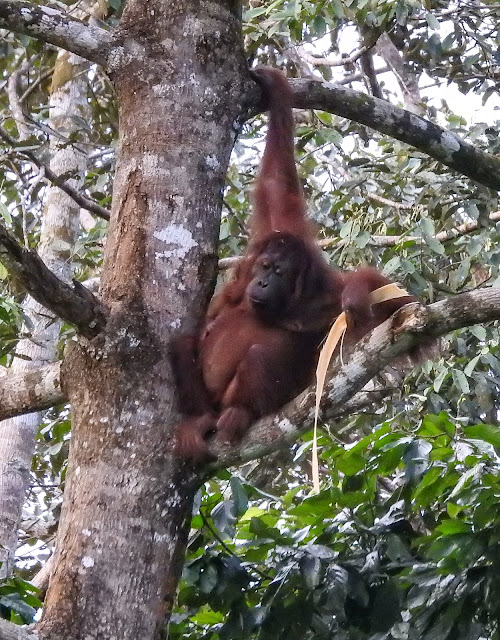
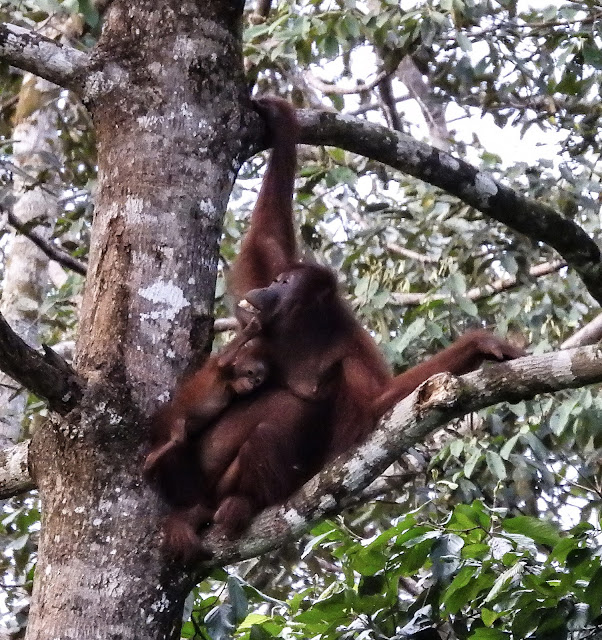
28-5-2023 TABIN RESERVE, BORNEO - BORNEAN ORANGUTAN
The Bornean orangutan (Pongo pygmaeus) is a species of orangutan endemic to the island of Borneo. Together with the Sumatran orangutan (Pongo abelii) and Tapanuli orangutan (Pongo tapanuliensis), it belongs to the only genus of great apes native to Asia. Like the other great apes, orangutans are highly intelligent, displaying tool use and distinct cultural patterns in the wild. Orangutans share approximately 97% of their DNA with humans. Also called mias by the local population, the Bornean orangutan is a critically endangered species, with deforestation, palm oil plantations, and hunting posing a serious threat to its continued existence.
28-5-2023 TABIN RESERVE, BORNEO - SOUTHEAST ASIA WATER MONITOR (JUVENILE) (Varanus salvator ssp. macromaculatus)
The bodies of Asian water monitors are muscular, with long, powerful, laterally compressed tails. Water monitors are often defined by their dark brown or blackish coloration with yellow spots found on their underside - these yellow markings have a tendency to disappear gradually with age. This species is also denoted by the blackish band with yellow edges extending back from each eye. These monitors have very long necks and elongated snouts. They use their powerful jaws, serrated teeth, and sharp claws for both predation and defense.
28-5-2023 TABIN RESERVE, BORNEO - GOULD'S FROGMOUTH (Batrachostomus stellatus)
This species is found solely in Southeast Asia. More precisely, it is found in Brunei, certain regions of Indonesia, Malaysia, Singapore, and in Southern Thailand. However, it is mostly present in Malaysia and Singapore. The habitat of Gould's frogmouths is tropical rainforest. They are mostly found in forest with native tree species that has not been disturbed by humans. This species usually lives in lowland forests, up to 500 metres elevation.


%201.jpg)
%202.jpg)
%201.jpg)


%202.jpg)
%203.jpg)
%204.jpg)


%201.jpg)
%202.jpg)