TOTAL PAGEVIEWS

TRANSLATE

Thursday, 16 May 2024

18-4-2024 PANNA TIGER LODGE, INDIA - RUFOUS TREEPIE (Dendrocitta vagabunda)


The Rufous treepie (Dendrocitta vagabunda) is a bird similar to magpie native to South Asia and adjoining parts of Southeast Asia. It is a member of the crow family and like other corvids, it is very adaptable, omnivorous, and opportunistic in feeding. A local name for the Rufous treepie 'kotri' is derived from its typical call; it is also known locally as Handi Chancha and taka chor meaning "coin thief".

The main colour of the body is cinnamon with a black head and the long graduated tail is bluish grey and is tipped in black. The wing has a white patch. The only confusable species is the Grey treepie which however lacks the bright rufous mantle. The bill is stout with a hooked tip. The underparts and lower back are warm tawny-brown to orange-brown in color with white wing coverts and black primaries. The bill, legs, and feet are black. The male and the female of this species look similar.

Rufous treepies are found in Pakistan, India, Bangladesh, Myanmar, Laos, and Thailand. They live in open forests consisting of scrub, dry forests, wet forests, montane forests, plantations, gardens, and urban parks. In the Garhwal Himalayas, Rufous treepies migrate seasonally between different elevations.

Rufous treepies are arboreal diurnal birds. They are usually seen in pairs or family groups and may gather in flocks in areas with plentiful food sources. Rufous treepies are agile foragers, clinging and clambering through the branches and sometimes joining mixed hunting parties along with species such as drongos and babblers. Like many other corvids, they cache food. Rufous treepies also feed on ectoparasites of sambar which permit them to perch and position themselves to invite the birds to examine specific parts. These birds have a wide repertoire of calls, but a 'bob-o-link' or 'ko-tree' call is most common. They also make various harsh calls, squawks, and musical notes.

18-4-2024 PANNA TIGER LODGE, INDIA - CHITAL (Axis axis) (JUVENILE)


The Axis deer (Axis axis) is a deer species native to the Indian subcontinent. It was first described and given a binomial name by German naturalist Johann Christian Polycarp Erxleben in 1777.

The Axis deer is a beautiful mammal with a spotted body and short tail. Both males and females have markings on their bodies; the markings are white, running in rows along the length of their bodies. The body of Axis deer is bright golden brown in color while the head is a bit lighter shade of the same color. Around their eyes, they have stripes of fur that are paler in color. Males have black spots on their faces and three tines on each of their magnificent antlers. These deer have a dark stripe, running along the length of their back and bordered by a row of spots. The outer parts of their legs are light brown in color while the underparts can be both white and creamy. The Axis deer has a white spot on its throat, which is more noticeable in males. In addition, the tail of the Axis deer has a white underpart. 

Wednesday, 15 May 2024

18-4-2024 PANNA TIGER LODGE, INDIA - ORIENTAL MAGPIE ROBIN (Copsychus saularis)

The Oriental magpie-robin (Copsychus saularis ) is a small passerine bird that was formerly classed as a member of the thrush family Turdidae, but now considered an Old World flycatcher. These birds are particularly well known for their songs and were once popular as cagebirds.

The Oriental magpie-robin is 19 cm (7.5 in) long, including the long tail, which is usually held cocked upright when hopping on the ground. It is similar in shape to the smaller European robin, but is longer-tailed. The male has black upperparts, head, and throat apart from a white shoulder patch. The underparts and the sides of the long tail are white. Females are greyish black above and greyish white. Young birds have scaly brown upperparts and heads.

Oriental magpie-robins are resident breeders in tropical southern Asia from Nepal, Bangladesh, India, Sri Lanka, and eastern Pakistan, eastern Indonesia, Thailand, south China, Malaysia, and Singapore. They inhabit open woodlands, mangroves, and cultivated areas often close to human habitations.


 This magpie-robin is a resident breeder in tropical southern Asia from Nepal, Bangladesh, India, Sri Lanka and eastern Pakistan, eastern Indonesia, Thailand, south China, Malaysia, and Singapore.

The Oriental magpie-robin is found in open woodland and cultivated areas often close to human habitations.

Magpie-robins breed mainly from March to July in India and January to June in south-east Asia. Males sing from high perches during courtship. The display of the male involves puffing up the feathers, raising the bill, fanning the tail and strutting. They nest in tree hollows or niches in walls or building, often adopting nest boxes. They line the cavity with grass. The female is involved in most of the nest building, which happens about a week before the eggs are laid. Four or five eggs are laid at intervals of 24 hours and these are oval and usually pale blue green with brownish speckles that match the color of hay. The eggs are incubated by the female alone for 8 to 14 days. The nests are said to have a characteristic odour.

Females spend more effort on feeding the young than males. Males are quite aggressive in the breeding season and will defend their territory. They respond to the singing of intruders and even their reflections. Males spend more time on nest defense. Studies of the bird song show dialects with neighbours varying in their songs. The calls of many other species may be imitated as part of their song. This may indicate that birds disperse and are not philopatric. Females may sing briefly in the presence of a male. Apart from their song, they use a range of calls including territorial calls, emergence and roosting calls, threat calls, submissive calls, begging calls and distress calls. The typical mobbing calls is a harsh hissing krshhh.

18-4-2024 PANNA TIGER LODGE, INDIA - NORTHERN PLAINS GREY LANGUR (Semnopithecus entellus)

The northern plains gray langur (Semnopithecus entellus ), also known as the sacred langur, Bengal sacred langur and Hanuman langur, is a species of primate in the family Cercopithecidae.

The fur of adults is mostly light colored, with darker fur on the back and limbs, and the face, ears, hands and feet are all black. Infants are brown. Body size excluding tail ranges from 45.1 cm (17.8 in) to 78.4 cm (30.9 in) long, and the tail length is between 80.3 cm (31.6 in) and 111.8 cm (44.0 in). Adult males weigh between 16.9 kg (37 lb) and 19.5 kg (43 lb) while adult females weigh between 9.5 kg (21 lb) and 16.1 kg (35 lb).

The range of the northern plains gray langur covers a large portion of India south of the Himalayas south to the Tapti River and the Krishna River.It is thought to have been introduced to western Bangladesh by Hindu pilgrims on the bank of the Jalangi River.

The northern plains gray langur is diurnal, and is both terrestrial and arboreal. Its natural habitats are subtropical or tropical dry forests and subtropical or tropical dry shrubland. Females groom members of both sexes but males do not groom others.

The northern plains gray langur can live in several different types of groups. It can live in groups of multiple males and females, one male and multiple females or multiple males with no females, and males can also live alone without a group. Single male groups are most common. Group size can exceed 100 monkeys. Upon reaching maturity, males typically emigrate from their natal group while females typically remain. Young adult females are typically dominant over older females. When a new male takes over a group it may engage in infanticide of young fathered by the previous male or males, but this is less common when the takeover occurs slowly over several months.

The northern plains gray langur eats primarily fruits and leaves. It is able to survive on mature leaves, which is a key to its ability to survive throughout the dry season. It also eats seeds, flowers, buds, bark and insects, including caterpillars. It is also fed fruits and vegetables by humans, and some groups get a substantial portion of their diets from food provided by temples and from raiding crops.

Groups that have access to abundant food year-round, for example those that are provisioned by temples or are able to raid crops year-round, also breed throughout the year. Other groups, such as those living in forests, typically give birth between December and May. The gestation period is about 200 days. Females other than the mother alloparent the infant for the first month of its life. Weaning occurs at about 1 year and males reach maturity at about 6 to 7 year old.

The northern plains gray langur often associates with chital deer. Both species respond to each other's alarm calls. The chital seem to benefit from the vigilance of male langurs watching for predators in the trees, while the langurs seem to benefit from the chital's better senses of smell and hearing. It also has been observed engaging in grooming sessions with rhesus macaques.

18-4-2024 PANNA TIGER LODGE, INDIA - YELLOW CROWNED WOODPECKER (MALE) (Leiopicus mahrattensis)

The yellow-crowned woodpecker (Leiopicus mahrattensis ) or Mahratta woodpecker is a species of small pied woodpecker found in the Indian subcontinent. It is the only species placed in the genus Leiopicus.

A medium-small (17.5 cm, 6.9 inches, 28-46 grams, 1–1.6 ounces), pale-headed, pied woodpecker. Upper-parts black, heavily spotted and barred white. Underparts dark, streaked dingy white with red belly patch. Irregular brown cheek and neck patches. Female has yellowish crown and nape. In male nape scarlet and fore-crown yellow.

18-4-2024 PANNA TIGER LODGE, INDIA - RED VENTED BULBUL (Pycnonotus cafer)


The red-vented bulbul (Pycnonotus cafer ) is a member of the bulbul family of passerines. It is a resident breeder across the Indian subcontinent, including Sri Lanka extending east to Burma and parts of Bhutan and Nepal. It has been introduced in many other parts of the world and has established itself in New Zealand, Argentina, Tonga and Fiji, as well as parts of Samoa, Australia, USA and Cook Islands. It is included in the list of the world's 100 worst invasive alien species.

The Red-vented bulbul is a medium-sized songbird that can be found across the Indian subcontinent. It can be easily identified by its short crest giving the head a squarish appearance. The body of this bird is dark brown with a scaly pattern while the head is darker or black. The rump is white while the vent is red. It has a long black tail, tipped in white. The males and the females of this species look similar, but young birds are duller than adults.

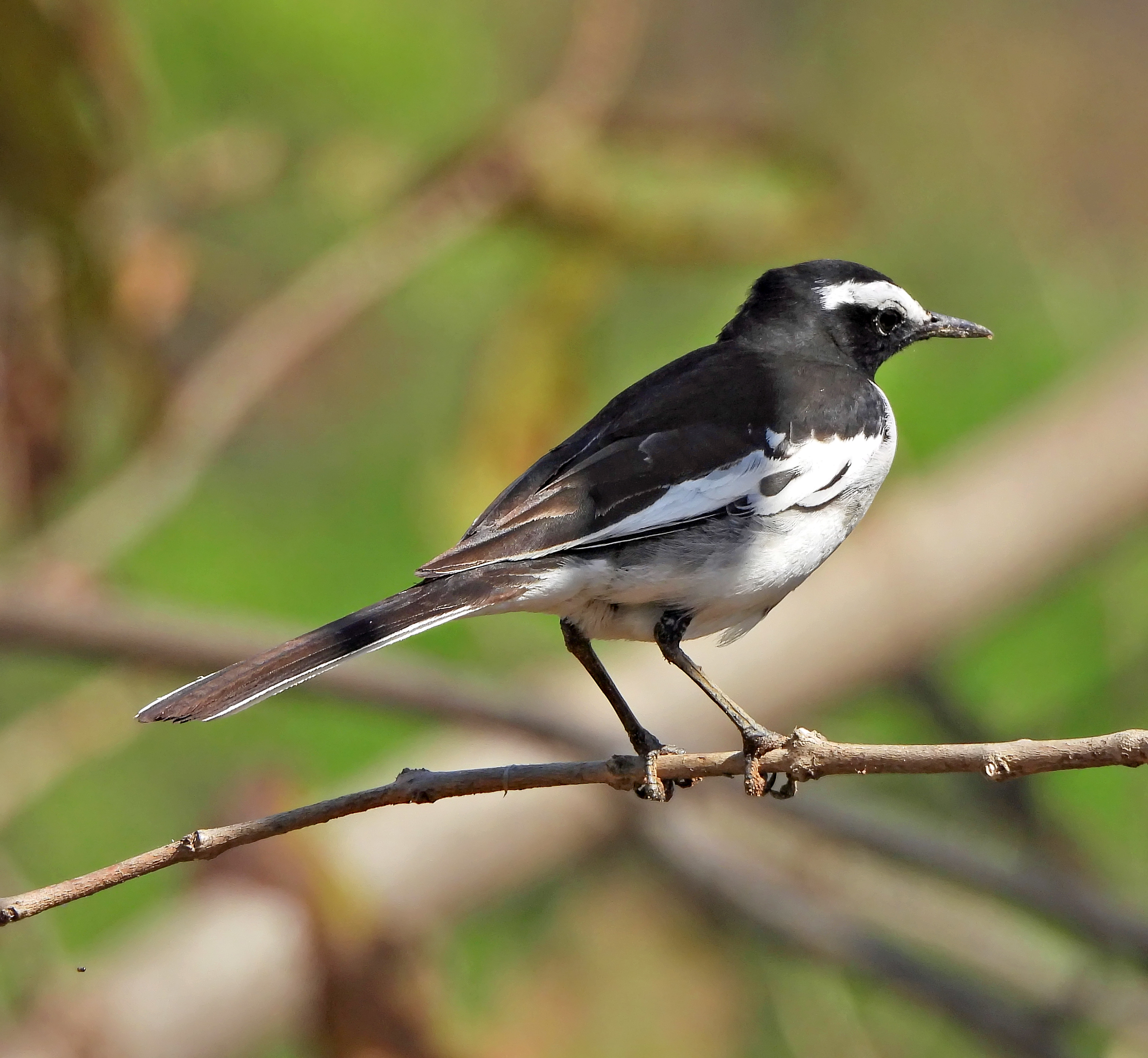
18-4-2024 PANNA TIGER LODGE, INDIA - WHITE BROWED WAGTAIL (Motacilla maderaspatensis)

The white-browed wagtail or large pied wagtail (Motacilla maderaspatensis ) is a medium-sized bird and is the largest member of the wagtail family. They are conspicuously patterned with black above and white below, a prominent white brow, shoulder stripe and outer tail feathers. White-browed wagtails are native to South Asia, common near small water bodies and have adapted to urban environments where they often nest on roof tops. The specific name is derived from the Indian city of Madras (now Chennai).

In older times in India, the species was sometimes kept as a cage-bird and was acclaimed for its singing ability. The native name of khanjan is used in the phrase "khanjan-eyed" to describe someone with beautiful eyes. The Khanjan was held sacred and considered a good omen in India as it supposedly bore an impression of Vishnu's shaligram on its breast. A variety of beliefs on the future predicted by where the bird sat and what it did have been documented by Saratchandra Mitra. Another local name for wagtails in India is dhobin (or washerwoman).

The white-browed wagtail is the largest species of wagtail at 21 cm (8.3 in) length. It is a slender bird, with the characteristic long, constantly wagging tail of its genus. It has black upperparts, head and breast, with a white supercilium and large white wingbar. Unlike white wagtails it never has white on the forehead. The rest of the underparts are white. The female has the black less intense than in the male. Juveniles are like the females brown-grey where the adult is black.

The white-browed wagtail is a resident breeder in India and is endemic to the Indian subcontinent. It is found south of the Himalayas, east of the Indus system and to the west of Bangladesh. It is rare in the higher altitude regions but has been seen in Ladakh on the edge of the Tibetan plateau. In most of India it is found below 1000 m but in southern India it goes up into the hills up to 2200 m. It is very rare in the Indus valley area. It is absent from the Sind region of Pakistan. It is found in open freshwater wetland habitats. It is one of the few Motacilla wagtails that has adapted well to urban habitats and is often found perched on overhead water storages in residential buildings.


 It is a rare winter visitor to Sri Lanka and have possibly extended their range in recent times.

Usually seen in pairs or small groups near open water. They call often especially in the mornings and are active like most other wagtails. They will perch on the ground as well as on wires or on buildings. The song is long and loud with many different notes. The usual call is a wheezy "wheech". They can fly fairly rapidly for long distances and they fly with a bounding (dipping and rising) flight pattern and have been recorded to travel at the speed of about 40 km/h.

Endoparasitic filarial parasites of the species Splendidofilaria singhi have been recorded in individuals of the species.

18-4-2024 PANNA TIGER LODGE, INDIA - STORK BILLED KINGFISHER (Pelargopsis capensis)


It is a very large kingfisher, measuring 35 cm (14 in) in length. The adult has a green back, blue wings and tail, and olive-brown head. Its underparts and neck are buff. The very large bill and legs are bright red. The flight of the stork-billed kingfisher is laboured and flapping, but direct. Sexes are similar. There are 13 races or subspecies, differing mostly in plumage detail, but P. c. gigantea of the Sulu Archipelago in the Philippines has a white head, neck and underparts. The call of this noisy kingfisher is a low and far reaching peer-por-por repeated about every 5 seconds, as well cackling ke-ke-ke-ke-ke-ke.

The stork-billed kingfisher lives in a variety of well-wooded habitats near lakes, rivers, or coasts. It perches quietly whilst seeking food, and is often inconspicuous despite its size. It is territorial and will chase away eagles and other large predators. This species hunts fish, frogs, crabs, rodents and young birds.

Adults dig their nests in river banks, decaying trees, or tree termite nests. A clutch of two to five round white eggs is typical.

Tuesday, 14 May 2024

19-4-2024 BANDHAVGARH, INDIA - RED VENTED BULBUL (Pycnonotus cafer)


The red-vented bulbul (Pycnonotus cafer ) is a member of the bulbul family of passerines. It is a resident breeder across the Indian subcontinent, including Sri Lanka extending east to Burma and parts of Bhutan and Nepal. It has been introduced in many other parts of the world and has established itself in New Zealand, Argentina, Tonga and Fiji, as well as parts of Samoa, Australia, USA and Cook Islands. It is included in the list of the world's 100 worst invasive alien species.

The Red-vented bulbul is a medium-sized songbird that can be found across the Indian subcontinent. It can be easily identified by its short crest giving the head a squarish appearance. The body of this bird is dark brown with a scaly pattern while the head is darker or black. The rump is white while the vent is red. It has a long black tail, tipped in white. The males and the females of this species look similar, but young birds are duller than adults.

12-5-2024 SOLLANA SOUTH, ALBUFERA - GLOSSY IBIS (Plegadis falcinellus)

The glossy ibis (Plegadis falcinellus ) is a water bird in the order Pelecaniformes and the ibis and spoonbill family Threskiornithidae. The scientific name derives from Ancient Greek plegados and Latin, falcis, both meaning "sickle" and referring to the distinctive shape of the bill.

The Glossy ibis is a medium-sized wading bird. They have long, slender, down-curved bill and magnificent plumage with shiny feathers. Breeding adults have reddish-brown bodies and shiny bottle-green wings. Non-breeders and juveniles have duller bodies. These birds have dark facial skin bordered above and below in blue-gray (non-breeding) to cobalt blue (breeding) and red-brown legs.

The Glossy ibis is the most widespread ibis species; it breeds in warm regions of Europe, Asia, Africa, Australia, and the Atlantic and Caribbean regions of the Americas. This species is migratory; most European birds winter in Africa, and in North America birds from north of the Carolinas winter farther south. Though generally suspected to be a migratory species in India, the Glossy ibis is a resident in western India. Birds from other populations may disperse widely outside the breeding season. Glossy ibises inhabit wetlands with tall dense stands of emergent vegetation such as reeds, papyrus or rushes, and low trees or bushes. They show a preference for marshes at the margins of lakes and rivers but can also be found at lagoons, flood-plains, wet meadows, swamps, reservoirs, sewage ponds, paddies, and irrigated farmland. These birds are less commonly found in coastal locations such as estuaries, deltas, salt marshes, and coastal lagoons.

12-5-2024 CREU DE LONGA, ALBUFERA - SQUACCO HERON (Ardeola ralloides)


The squacco heron (Ardeola ralloides ) is a small heron, 44–47 cm (17+1⁄2–18+1⁄2 in) long, of which the body is 20–23 cm (8–9 in), with 80–92 cm (31+1⁄2–36 in) wingspan. It is of Old World origins, breeding in southern Europe and the Greater Middle East.

The English common name squacco comes via Francis Willughby (c. 1672) quoting a local Italian name sguacco. The current spelling comes from John Hill in 1752.

The scientific name comes from Latin ardeola, a small heron (ardea ), and ralloides, Latin rallus, a rail and Greek -oides, "resembling".

The squacco heron is a migrant, wintering in Africa. It is rare north of its breeding range. The species has been recorded in Fernando de Noronha islands, and more rarely in mainland South America, as a vagrant. This is a stocky species with a short neck, short thick bill and buff-brown back. In summer, adults have long neck feathers. Its appearance is transformed in flight, when it looks very white due to the colour of the wings.

The squacco heron's breeding habitat is marshy wetlands in warm countries. The birds nest in small colonies, often with other wading birds, usually on platforms of sticks in trees or shrubs. Three to four eggs are laid. They feed on fish, frogs and insects.

13-5-2024 MONTE CORONA, VALENCIA - ROUGH HAIRED LAGRIA BEETLE (Lagria hirta)


Lagria hirta is a species of beetles in the family Tenebrionidae.

The species name hirta comes from the Latin hirtus meaning rough hair or rough wool, referring to the coarse, fuzzy appearance of the beetle.

This species is present in Europe, in North Africa (Algeria, Morocco), in Russia (Western and Eastern Siberia), in Israel, Turkey, Iran, Iraq, Paraguay, South America, Kazakhstan, Turkmenistan, Uzbekistan and Tajikistan.

It prefers areas with sandy soils. It can be found in open woods, in deciduous forests, in forest clearings, forest edges, in grasslands and wet meadows, but also in dry valleys and wet areas.

Lagria hirta can reach a length of 7–8 millimetres (0.28–0.31 in). These beetles have a soft and elongated body and a head and thorax brown or shiny black. The relatively elongated elytra are yellowish-brown and covered by dense fine light yellowish-brown hairs. The rest of the body is also hairy, but they are less clearly visible. Antennae, underside of body and legs are black. The eyes are remarkably large and round. Antennae are composed with eleven segments.

The elytra of the females are more extended backward than in the males and the female's abdomen looks from above wider than in the males. The male, in addition to its slimmer body, is distinguished from the females by their larger eyes and by the length of the last segment of the antennae, which is nearly twice the corresponding segment in the female. The hind wings are transparent.

The fully formed beetles can be seen from late May to September. The adult beetles feed on nectar and pollen. Females lay the eggs in the soil where they hatch after about eight days. The larvae live in the humus where they feed on decaying vegetables. After having overwintered larvae pupate in early summer of the next year and a new generation of beetles will then develop.

19-4-2024 KEN RIVERSIDE LODGE, INDIA - YELLOW THROATED SPARROW (Gymnoris xanthocollis)

The yellow-throated sparrow or chestnut-shouldered petronia (Gymnoris xanthocollis ) is a species of sparrow found in southern Asia.

It has a finer bill than typical sparrows of the genus Passer and unlike them has no streaks on the plumage. The white double wing bar on the shoulder is diagnostic on the otherwise dull grey-brown sparrow. Males have a chestnut shoulder patch which can sometimes be hard to see. They also have a pale yellow spot on the throat in fresh plumage. Females are duller and lack the chestnut shoulder patch. The yellow spot is much reduced or lacking in females.

This species is tree-loving although sometimes seen on wires and on the ground, where it has a hopping gait. The usual call is a chirrup but the song is distinctive and repetitive chilp chalp cholp. It has a bounding flight and dips deeply before rising up.


 The chestnut-shouldered petronia is found from Turkey into Iran, Afghanistan, Pakistan, India, Bangladesh and as a vagrant in Sri Lanka and possibly parts of Myanmar. It is found in forest, gardens and open scrub habitats.

use of the holes made by primary hole-nesting birds such as barbets and woodpeckers. They may also make use of hollows on buildings. The nest is built mainly by the female, but males may sometimes assist. The female alone incubates the eggs, sometimes leaving the nest during the hotter parts of the day. The eggs hatch after about 12 to 14 days.

They roost communally in low bushes. Some populations are migratory, moving in response to rains.

They feed mainly on grains but also on insects, nectar and berries. An unusual food item is the petals of flowers such as those of Madhuca indica. When they visit flowers such as those of Capparis, Salmalia, Erythrina and Bassia, their foreheads are covered with pollen.

19-4-2024 KEN RIVERSIDE LODGE, INDIA - INDIAN GREY HORNBILL (Dicrurus leucophaeus)

The Indian gray hornbill (Ocyceros birostris) is a tropical bird that can be found on the Indian subcontinent. It is mostly arboreal and is commonly seen in pairs. It is one of the few hornbill species found in urban areas in many cities where they can make use of large trees in avenues.

The Indian grey hornbill is a medium-sized bird with greyish-brown upper parts and a slight trace of a pale supercilium. The ear coverts are darker. The flight feathers of the wing are dark brown with a whitish tip. The tail has a white tip and a dark subterminal band. These birds have a red iris and the eyelids have eyelashes. The casque is short and pointed. 

The male has a larger casque on a dark bill, and the culmen and lower mandible are yellowish. The bare skin around the eye is dark in the male, but sometimes pale reddish in females. The female has a more yellowish bill with black on the basal half and on the casque. The juveniles lack the casque, and the bare skin around the eye is dull orange.

Indian grey hornbills are found from the foothills of the Himalayas southwards, bounded to the west by the Indus system and to the east by the Ganges Delta. They don't migrate but may make local movements in the drier western region. Indian grey hornbills live in dry forests, savannas, rural gardens, and even in cities that have old avenue trees.

19-4-2024 KEN RIVERSIDE LODGE, INDIA - ASIAN GREEN BEE-EATER (Merops orientalis)

The Asian green bee-eater (Merops orientalis) is a brightly-colored bird in the bee-eater family. It performs some seasonal movements and is found widely distributed across Asia. Populations in Africa and the Arabian Peninsula that were formerly assigned to this species (under the name green bee-eater) are now considered distinct species: the African green bee-eater and the Arabian green bee-eater. Asian green bee-eaters are mainly insect eaters and prefer to live quite far from water.

Like other bee-eaters, this species is a richly colored, slender bird. The males and the females are not visually distinguishable. The entire plumage is bright green and tinged with blue, especially on the chin and throat. The crown and upper back are tinged with golden rufous. The flight feathers are rufous washed with green and tipped with blackish. A fine black line runs in front of and behind the eye. The iris is crimson and the bill is black while the legs are dark grey. The feet are weak with the three toes joined at the base. Southeast Asian birds have rufous crown and face, and green underparts. The wings are green and the beak is black. The elongated tail feathers are absent in juveniles.

The Asian green bee-eater’s vast range stretches from Mauritania in West Africa, to sub-Saharan Africa, as well as the Middle East and India as far in the north as Nepal; in Southeast Asia, it is found in central China, Thailand, and Vietnam. This species frequents wooded areas where there are scattered trees and bushes, keeping near streams and shores, but also occurs in arid areas that have acacia and date palms, and in dunes, near cultivated areas and big gardens. It likes bare and sandy soils. Asian green bee-eaters are not known to perform migrations but they make seasonal movements in response to rainfall.

Asian green bee-eaters are fairly gregarious birds, with 30-300 individuals roosting next to each other on a branch, and as many as 20 gathering to dust bathe together, this activity is believed to help remove excess oil from the feathers and dislodge harmful parasites. Flocks sleep together at roosts, high in trees. Except for at nighttime, they perch fairly low. They forage either alone or with a group of 15 to 20 birds. These elegant birds usually hunt low to the ground, making short swoops before returning to their perch. They sometimes perch on the backs of cattle or grazing antelope and make sallies into vegetation close to the ground to catch insects. Before eating their prey, they remove any dirt by striking the insect several times against a hard surface. These birds make soft trilling calls, ‘trree-trree-trree’, or short, sharp alarm calls that sound like ‘ti-ic’ or ‘ti-ti-ti’.


Asian green bee-eaters are thought to be monogamous breeders, which means that a male will mate with only one female and a female will mate with only one male. The breeding season ranges from March to June or sometimes July to August, depending on the range. These birds are solitary nesters in Arabia and Africa, whereas small colonies are found in India, with larger colonies (10 to 30 breeding pairs) in Myanmar and Pakistan. These birds nest in burrows that are dug by both males and females into the flat ground or a gentle slope in Africa, while in Asia it is often on a low shore. The burrow measures one to two meters in length, with the nest chamber of around 15 cm at its end. 4-8 white eggs are laid in the chamber and incubation is 18 to 22 days, mainly carried out by the female. The young stay in the nest for 22 to 31 days while being fed by both their parents. 

Monday, 13 May 2024

19-4-2024 KEN RIVERSIDE LODGE, INDIA - COMMON TAILORBIRD (Orthotomus sutorius)


The Common tailorbird (Orthotomus sutorius ) is a songbird found across tropical Asia. These birds are popular for their nest made of leaves "sewn" together and immortalized by Rudyard Kipling as Darzee in his Jungle Book. Although shy birds that are usually hidden within vegetation, their loud calls are familiar and give away their presence. Tailor birds in Punjab used to lay shiny red eggs but became extinct about 1975 because they lay eggs in fields used to grow fodder crops.

These are brightly colored birds, with bright green upperparts and creamy underparts. They have short rounded wings, a long tail, strong legs, and a sharp bill with a curved tip to the upper mandible. They are wren-like with a long upright tail that is often moved around. The crown is rufous and the upperparts are predominantly olive green. Their underside is creamy white. The sexes are identical, except that the male has long central tail feathers in the breeding season, although the reliability of sexing data accompanying museum specimens used in determining this sexual dimorphism has been questioned. Young birds are duller. When calling, the dark patches on the sides of the neck become visible. These are due to the dark pigmented and bare skin that is present in both sexes and sometimes gives the appearance of a dark gorget.

20-4-2024 BANDHAVGARH, INDIA - GOLDEN JACKAL (Canis aureus)

The Golden jackal (Canis aureus) is a wolf-like canid. Despite its name, the Golden jackal is not closely related to the African Black-backed jackal or Side-striped jackal, which are part of the genus Lupulella, being instead closer to wolves and coyotes. The ancestor of the Golden jackal is believed to be the extinct Arno river dog that lived in southern Europe 1.9 million years ago. It is described as having been a small, jackal-like canine. Genetic studies indicate that the Golden jackal expanded from India around 20,000 years ago, towards the end of the last Last Glacial Maximum. The oldest Golden jackal fossil, found at the Ksar Akil rock shelter near Beirut, Lebanon, is 7,600 years old. The oldest golden jackal fossils in Europe were found in Greece and are 7,000 years old.

The Golden jackal has long, pointed ears and long hair. The coat of the animal is rather coarse and not very long. The tail is fluffy and long. Being the largest species of jackal, this animal, however, has lighter tread, shorter tail, more slender build and a narrower, more pointed muzzle, compared to other jackal species. The coloration of their fur depends on the season of year and region, varying from yellow to pale gold with a brown tip.

20-4-2024 BANDHAVGARH, INDIA - INDIAN ROBIN (Copsychus fulicatus)


The Indian robin (Copsychus fulicatus ) is a species of bird in the family Muscicapidae.It is widespread in the Indian subcontinent and ranges across Bangladesh, Bhutan, India, Nepal, Pakistan and Sri Lanka. The males of the northern subspecies have brown backs whose extent gradually reduces southwards, with the males of the southern subspecies having all-black backs. They are commonly found in open scrub areas and often seen running along the ground or perching on low thorny shrubs and rocks. The long tail is usually held up and the chestnut undertail coverts and dark body make them easily distinguishable from pied bushchats and Oriental magpie-robins.

The Indian robin is sexually dimorphic in plumage, with the male being mainly black with a white shoulder patch or stripe whose visible extent can vary with posture. The northern populations have the upper plumage brownish, while the southern populations are black above. The males have chestnut undertail coverts and these are visible as the bird usually holds the 6–8 cm long tail raised upright. The females are brownish above, have no white shoulder stripe and are greyish below, with the vent a paler shade of chestnut than the males. Birds of the northern populations are larger than those from southern India or Sri Lanka. Juvenile birds are much like females, but the throat is mottled.

20-4-2024 BANDHAVGARH, INDIA - ORANGE HEADED THRUSH (Geokichla citrina)


The orange-headed thrush (Geokichla citrina ) is a bird in the thrush family.

It is common in well-wooded areas of the Indian Subcontinent and Southeast Asia. Most populations are resident. The species shows a preference for shady damp areas, and like many Geokichla and Zoothera thrushes, can be quite secretive.

The orange-headed thrush is omnivorous, eating a wide range of insects, earthworms and fruit. It nests in trees but does not form flocks.

The male of this small thrush has uniform grey upperparts, and an orange head and underparts. The females and young birds have browner upper parts.

The orange-headed thrush is 205–235 milliimetres (8.1–9.25 in) long and weighs 47–60 grammes (1.7–2.1 oz). The adult male of the nominate subspecies of this small thrush has an entirely orange head and underparts, uniformly grey upperparts and wings, and white median and undertail coverts. It has a slate-coloured bill and the legs and feet have brown fronts and pink or yellowish rears.

The female resembles the male but has browner or more olive upperparts and warm brown wings, but some old females are almost identical to the male. The juvenile is dull brown with buff streaks on its back, and a rufous tone to the head and face; it has grey wings. The bill is brownish horn, and the legs and feet are brown.

This species' orange and grey plumage is very distinctive, and it is unlikely to be confused with any other species. Differences between the subspecies, as described above, can be quite striking, as with the strong head pattern on G. c. cyanota, but may be less obvious variations in plumage tone, or whether there is white on the folded wing. As with many other thrushes, all forms of this species shows a distinctive underwing pattern, with a strong white band.

20-4-2024 BANDHAVGARH, INDIA - BLACK DRONGO (Dicrurus macrocercus)


The Black drongo (Dicrurus macrocercus) is a small Asian passerine bird. The species is known for its aggressive behavior towards much larger birds that invade its territory. The Black drongo has been introduced to some Pacific islands, where it has thrived and become abundant to the point of threatening and causing the extinction of native and endemic bird species there.

Parasitic bird lice, Pectinopygus makundi, have been described from little cormorant hosts. Endoparasitic helminths, Hymenolepis childi and Dilepis lepidocolpos have been described from Sri Lankan birds while others like Neocotylotretus udaipurensis and Syncuaria buckleyi have been described from Indian birds.

Black drongos are glossy black birds with a wide fork to the tail. Adults usually have a small white spot at the base of the gape. The iris is dark brown (not crimson as in the similar ashy drongo). The sexes cannot be told apart in the field. Juveniles are brownish and may have some white barring or speckling towards the belly and vent, and can be mistaken for the white-bellied drongo. First-year birds have white tips to the feathers of the belly, while second-years have these white-tipped feathers restricted to the vent. Black drongos fly with strong flaps of the wing and are capable of fast maneuvers that enable them to capture flying insects. With short legs, they sit upright on thorny bushes, bare perches, or electricity wires. They may also perch on grazing animals.

20-4-2024 BANDHAVGARH, INDIA - LITTLE CORMORANT (Microcarbo niger)

The little cormorant (Microcarbo niger ) is a member of the cormorant family of seabirds. Slightly smaller than the Indian cormorant it lacks a peaked head and has a shorter beak. It is widely distributed across the Indian Subcontinent and extends east to Java, where it is sometimes called the Javanese cormorant. It forages singly or sometimes in loose groups in lowland freshwater bodies, including small ponds, large lakes, streams and sometimes coastal estuaries. Like other cormorants, it is often found perched on a waterside rock with its wings spread out after coming out of the water. The entire body is black in the breeding season but the plumage is brownish, and the throat has a small whitish patch in the non-breeding season. These birds breed gregariously in trees, often joining other waterbirds at heronries.

The little cormorant is about 50 centimetres (20 in) long and only slightly smaller than the Indian cormorant (Phalacrocorax fuscicollis ). The Indian cormorant has a narrower and longer bill which ends in a prominent hook tip, blue iris and a more pointed head profile. The breeding adult bird has a glistening all black plumage with some white spots and filoplumes on the face. There is also a short crest on the back of the head. The eyes, gular skin and face are dark. In the non-breeding bird or juvenile, the plumage is brownish and the bill and gular skin can appear more fleshy. The crest becomes inconspicuous and a small and well-marked white patch on the throat is sometimes visible. Towards the west of the Indus River valley, its range can overlap with vagrant pygmy cormorants (Microcarbo pygmaeus ), which can be difficult to differentiate in the field and are sometimes even considered conspecific. The sexes are indistinguishable in the field, but males tend to be larger. Some abnormal silvery-grey plumages have been described.


The species was described by Vieillot in 1817 as Hydrocorax niger. The genus Hydrocorax literally means water crow. It was later included with the other cormorants in the genus Phalacrocorax but some studies place the smaller "microcormorants" under the genus Microcarbo.

The little cormorant is found across India, Sri Lanka, Bangladesh, Pakistan and lowland Nepal. It is also found in parts of Myanmar, Thailand, Laos, Cambodia and Indonesia. It is not found in the Himalayas, but vagrants have been seen in Ladakh. It inhabits wetlands, ranging from small village ponds to large lakes, and sometimes tidal estuaries.

Little cormorants tend to forage mainly in small loose groups and are often seen foraging alone. They swim underwater to capture their prey, mainly fish. A study in northern India found that the little cormorant fished in water which was less than a metre deep and captured fishes of about 2–8 centimetres (0.79–3.15 in) length. They propel themselves underwater using their webbed feet. Captured fishes are often brought up to the surface to swallow them and during this time other birds including other little cormorants, painted storks, gulls and egrets may attempt to steal them. Indian cormorants tend to fish communally in larger groups. Like all other cormorants, they will emerge from water and will hold out their wings and stay immobile for a while. The behaviour has been suggested to be for wing-drying, but this interpretation is debated. A study in Sri Lanka found that the time spent with spread wings was always after they had spent some time underwater, and that the duration was related to time spent underwater and inversely related to the temperature and dryness of air. These observations support the theory that the studied behaviour aids drying of the wings.

The breeding season of the little cormorant is between July to September in Pakistan and northern India and November to February in southern India. In Sri Lanka it is December to May. A study in Bangladesh found them to breed from May to October. Males display at the nest site by fluttering their wings while holding their head back and bill raised. They then lower the bill, and after pairing the male also provides food to the female in courtship feeding. Both parents take part in building the nest, which is a platform of sticks placed on trees and sometimes even on coconut palms. They may nest beside Indian pond herons and little egrets in colonies. The nest is built in about two weeks. The whitish eggs turn muddy with age and incubation begins when the first egg is laid. This leads to asynchronous hatching and the chicks in a nest can vary considerably in age. The clutch size can vary from two to six eggs laid at intervals of about two days. The eggs hatch after 15 to 21 days. The downy chicks have a bare red head. The young birds are able to leave the nest after about a month.

Little cormorants are vocal near their nest and roosts where they produce low roaring sounds. They also produce grunts and groans, a low pitched ah-ah-ah and kok-kok-kok calls. They roost communally often in the company of other waterbirds. 

12-5-2024 SOLLANA SOUTH, ALBUFERA - BLACK HEADED GULL (Chroicocephalus ridibundus)

The Black-headed gull (Chroicocephalus ridibundus) is a small and one of the most abundant gulls in much of Europe and Asia, and also in eastern Canada. It displays a variety of compelling behaviors and adaptations. Some of these include removing eggshells from one's nest after hatching, begging co-ordination between siblings, differences between sexes, conspecific brood parasitism, and extra-pair paternity.

The summer adult has a chocolate-brown head (not black, although does look black from a distance), a pale grey body, black tips to the primary wing feathers, and a red bill and legs. The hood is lost in winter, leaving just two dark spots. Immature birds have a mottled pattern of brown spots over most of the body and a black band on the tail. There is no difference in plumage between the sexes. In flight, the white leading edge to the wing is a good field mark. First-year birds have a black terminal tail band, more dark areas in the wings, and, in summer, a less fully developed dark hood.

Black-headed gulls breed in much of Europe, Asia, and in coastal eastern Canada. Most of their populations are migratory and winter further south, but some birds reside in the milder westernmost areas of Europe. Some Black-headed gulls also spend the winter in northeastern North America. They breed in large reed beds or marshes, or on islands in lakes, rivers, lagoons, deltas, and estuaries. They may also occur in ponds, canals, and flood lands, nesting on the heather moors, sand dunes, or beaches. During the winter these birds are found in estuaries with sandy or muddy beaches, ploughed fields, moist grasslands, reservoirs, urban parks, farmland, and gardens.

Black-headed gulls are highly gregarious birds, both when feeding or in evening roosts; they also breed in colonies. They are rarely seen at sea far from coasts. Black-headed gulls are active during the day and feed mainly by taking prey from the surface while swimming, or by dipping the head under the surface. They also walk along the coasts and probe for aquatic prey or catch flying insects on the wings. Black-headed birds are noisy, especially in colonies, with a familiar "kree-ar" call. When feeding they utter a sharp “kek-kek”.

12-5-2024 FAVARA, CULLERA - LITTLE EGRET (Egretta garzetta)

The Little egret (Egretta garzetta) is small elegant heron in the family Ardeidae. As an aquatic bird, it feeds in shallow water and on land, consuming a variety of small creatures. At one time common in Western Europe, the Little heron was hunted extensively in the 19th century to provide plumes for the decoration of hats and became locally extinct in Northwestern Europe and scarce in the south. Around 1950, conservation laws were introduced in southern Europe to protect the species and their numbers began to increase.

The plumage of the Little egret is normally entirely white, although there are dark forms with largely bluish-grey plumage. In the breeding season, the adult has two long plumes on the nape that form a crest. These plumes are about 150 mm (6 in) and are pointed and very narrow. There are similar feathers on the breast, but the barbs are more widely spread. There are also several elongated scapular feathers that have long loose barbs and may be 200 mm (8 in) long. During the winter the plumage is similar but the scapulars are shorter and more normal in appearance.


The bill is long and slender and it and the lores are black. There is an area of greenish-grey bare skin at the base of the lower mandible and around the eye which has a yellow iris. The legs are black and the feet yellow. Juveniles are similar to non-breeding adults but have greenish-black legs and duller yellow feet, and may have a certain proportion of greyish or brownish feathers. The subspecies nigripes differs in having yellow skin between the bill and eye, and blackish feet. During the height of courtship, the lores turn red and the feet of the yellow-footed races turn red.

20-4-2024 BANDHAVGARH, INDIA - COMMON MYNA (Acridotheres tristis)

The Common myna (Acridotheres tristis) is a tropical bird with a strong territorial instinct, which has adapted extremely well to urban environments. The range of the Common myna is increasing at such a rapid rate that in 2000 the IUCN Species Survival Commission declared it one of the world's most invasive species and one of only three birds listed among "100 of the World's Worst Invasive Species" that pose a threat to biodiversity, agriculture, and human interests.

Common mynas can be recognized by their brown body, black hooded head, and the bare yellow patch behind the eye. Their bill and legs are bright yellow. There is a white patch on the outer primaries and the wing lining on the underside is white. The male and female look similar and are usually seen in pairs.

Common mynas are native to Asia with their home range spanning from Iran, Pakistan, India, Nepal, Bhutan, Bangladesh, and Sri Lanka; as well as Afghanistan, Uzbekistan, Tajikistan, Turkmenistan, Myanmar, to Malaysia, Singapore, peninsular Thailand, Indo-China, Japan (both mainland Japan and the Ryukyu Islands) and China. These birds are typically found in a wide range of habitats with access to water; they inhabit open woodland, mangroves, grasslands, farmlands, orchards, and urban areas.

20-4-2024 BANDHAVGARH, INDIA - INDIAN OAK BLUE BUTTERFLY (Arhopala atrax)

Arhopala atrax, the dark broken-band oakblue or Indian oakblue, is a species of lycaenid or blue butterfly found in the Indomalayan realm (India, Myanmar to Malaya).

The butterfly is locally very common in semi-dried forests at low to moderate elevations (Alt. 350 - 1100m).