%20(Larus%20michahellis)%2020.jpg)
Friday, 23 October 2020
21-10-2020 PUERTO DE MAZARRON, MURCIA - YELLOW LEGGED GULL (JUVENILE) (Larus michahellis)


22-10-2020 EL BERRO, MURCIA - SHORT HORNED GRASSHOPPER (Family Acrididae)

Calliptamus is a genus of short-horned grasshoppers (family Acrididae) widespread across Europe, Africa, and Asia. Famous for their vibrant pink hindwings, high adaptability to arid environments, and localized agricultural impact, they are common throughout Spain and the Mediterranean basin.
Physical Characteristics
Size: Strong sexual dimorphism is present; adult males typically measure \(14\) to \(28 \text{ mm}\), while females are noticeably larger, ranging from \(21\) to \(42 \text{ mm}\).
Coloration: Their bodies vary from pale gray to brownish-red. The hind femora are short and thick, and the hind tibiae are typically a striking ruby-red or pink.
The "Rosy Wings": When in flight, they flash brilliant pink or reddish hindwings, earning them the nickname "rosy-winged locust".

22-10-2020 SALADARES DEL GUADALENTIN, MURCIA - LITTLE OWL (Athene noctua)

The Little Owl, Athene noctua, is a diminutive yet distinctive bird, often associated with the goddess Athena in Greek mythology and Minerva in Roman lore. This bird is characterized by a flat-topped head, a robust, compact body, and a relatively short tail. Its plumage is a mottled greyish-brown, adorned with white spots, streaks, and bars, giving it a cryptic appearance. Both sexes are similar in size, measuring approximately 22 cm in length with a wingspan of 56 cm, and weighing around 180 grams.
The Little Owl possesses a large head, elongated legs, and striking yellow eyes. Its white "eyebrows" lend it a somewhat stern expression. Juvenile birds are somewhat duller than adults and lack the white crown spots. The species is known for its woodpecker-like bounding flight. During the moult, which occurs from July to November, males begin shedding feathers before females.

This owl favors open countryside and thrives in a variety of habitats, including agricultural lands with hedgerows and trees, orchards, woodland edges, parks, gardens, steppes, and semi-deserts. It can also be found in treeless areas such as dunes, and near human-made structures like ruins and quarries.
The Little Owl's range spans much of temperate and warmer parts of Europe, the Palearctic east to Korea, and North Africa. It has been introduced to Britain and the South Island of New Zealand, where it has established populations.

The Little Owl is known for its territorial nature, with males defending their territories from intruders. It is partly diurnal and can often be seen perched in prominent positions during the day. Its diet consists of insects, earthworms, other invertebrates, and small vertebrates. The owl is adept at swooping down on prey from its perch and is known to cache surplus food.
The Little Owl's call is a querulous "kiew, kiew," and it also produces various whistling or trilling sounds. During the breeding season, it may emit more modulated calls, and pairs can engage in duets. Near the nest, the owl may make yelping, chattering, or barking noises.

Breeding season sees increased vocal activity at night in late spring. Nests are located in a variety of places, including tree holes, cliffs, and old buildings. The female lays a clutch of about four eggs, which she incubates. The male provides food during this period, and both parents feed the chicks once hatched. Young owls fledge at about seven weeks of age.
The Little Owl's diet is diverse, including mammals like mice and voles, birds, and a wide range of insects. It hunts both on the ground and in flight, and food caching behavior has been observed.

This owl usually perches in an elevated position ready to swoop down on any small creature it notices. It feeds on prey such as insects and earthworms, as well as small vertebrates including amphibians, reptiles, birds and mammals. It may pursue prey on the ground and it caches surplus food in holes or other hiding places. A study of the pellets of indigestible material that the birds regurgitate found mammals formed 20 to 50% of the diet and insects 24 to 49%. Mammals taken included mice, rats, voles, shrews, moles and rabbits. The birds were mostly taken during the breeding season and were often fledglings, and including the chicks of game birds. The insects included Diptera, Dermaptera, Coleoptera, Lepidoptera and Hymenoptera. Some vegetable matter (up to 5%) was included in the diet and may have been ingested incidentally.

22-10-2020 MONTE CORONA, VALENCIA - STINK BUG (Acrosternum millierei)

Acrosternum millierei (Mulsant & Rey, 1866) is a species of shield bug in the family Pentatomidae, recognized as a significant agricultural pest, particularly for pistachio trees.
Key Facts about Acrosternum millierei:
Agricultural Impact: It is a major pest of pistachios, attacking nuts from early spring to harvest. In Iran, it is known to be a vector for Nematospora coryli, a fungus that causes pistachio nut damage.
Physiological Adaptations: These bugs are freeze-intolerant but highly adapted for overwintering. They survive cold temperatures by accumulating polyols (such as trehalose, myoinositol, sorbitol, and glycerol) and lowering their supercooling point (SCP) from a mean of −11.8 °C in summer to −17.6 °C in winter.
Habitat and Distribution: The species is found in the Mediterranean region, including Spain (Murcia, Balearic Isles, Valencia, Alicante, etc.) and Portugal. It has also been recorded in Iran, where it causes damage to pistachio orchards.
Host Plants: Beyond pistachios, A. millierei has been observed on Leucospermum species.
Description: As a pentatomid, it has a characteristic shield-shaped body and belongs to the tribe Nezarini (green stink bugs and allies).
Classification: It was originally described under the name Nezara millierei.
Defense Mechanism: Like other stink bugs, it can emit a foul-smelling odor when threatened or disturbed.
A. millierei is closely related to other green stink bugs and is a key target for pest management in nut-producing regions.
Thursday, 22 October 2020


21-10-2020 SALADARES DEL GUADALENTIN, MURCIA - EURASIAN COOT (Fulica atra)
%2020.jpg)
The Eurasian coot, Fulica atra, also known as the common coot or Australian coot, is a distinctive waterbird with a slaty-black body, a glossy black head, and a striking white bill topped with a white frontal shield. This bird is a member of the Rallidae family, which includes rails and crakes. Both sexes exhibit similar plumage, making them indistinguishable in the field.
Adult Eurasian coots measure 36–38 cm in length with a wingspan of 70–80 cm. Males are slightly heavier than females, weighing around 890 g compared to the females' 750 g. The species is characterized by its white bill and frontal shield, which contrast sharply with its all-black body. Juveniles are paler with a whitish breast and lack the facial shield, which develops fully by one year of age.


21-10-2020 SALADARES DEL GUADALENTIN, MURCIA - EURASIAN STONE CURLEW (Burhinus oedicnemus)
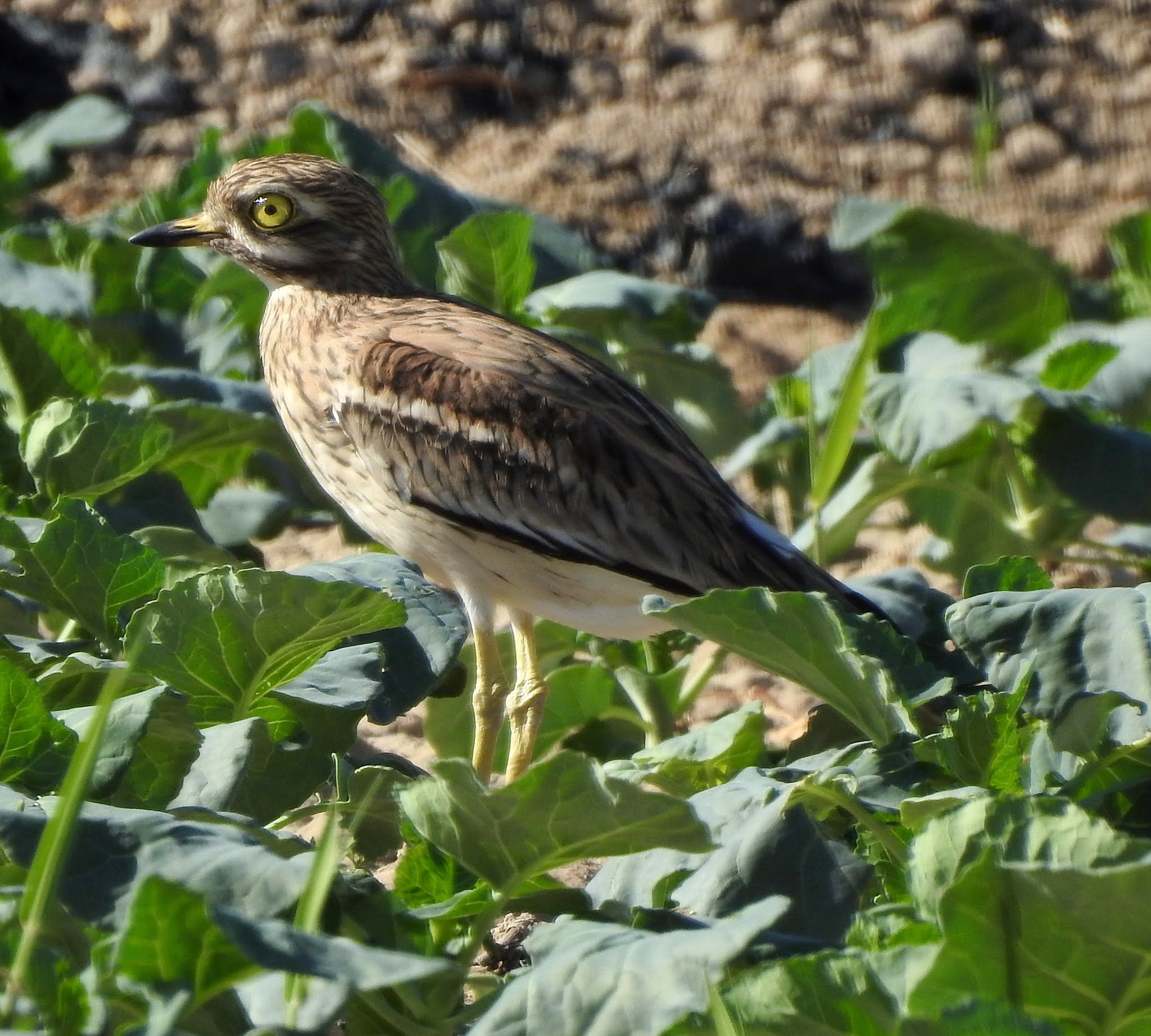
The Eurasian stone-curlew is a fairly large wader, though mid-sized by the standards of its family. Length ranges from 38 to 46 cm (15 to 18 in), wingspan from 76 to 88 cm (30 to 35 in) and weight from 290 to 535 g (10.2 to 18.9 oz). with a strong yellow and black beak, large yellow eyes (which give it a "reptilian", or "goggle-eyed" appearance), and cryptic plumage. The bird is striking in flight, with black and white wing markings.

The Eurasian stone-curlew occurs throughout Europe, north Africa and southwestern Asia. It is a summer migrant in the more temperate European and Asian parts of its range, wintering in Africa. Despite being classed as a wader, this species prefers dry open habitats with some bare ground.
The Eurasian stone-curlew is largely nocturnal, particularly when singing its loud wailing songs, which are reminiscent of that of curlews. Food consists of insects and other small invertebrates, and occasionally small reptiles, frogs and rodents.

Eurasian stone-curlews probably first breed when they are three years old. The eggs are laid at two day intervals in a scrape on open ground. The clutch normally consists of 2 eggs which are on average 54 mm × 38 mm (2.1 in × 1.5 in). The eggs are pale buff and are variably spotted, streaked or blotched with brown or purple grey. Both sexes incubate the eggs beginning after the last egg is laid. The eggs hatch after 24–26 days. The precocial young leave the nest soon after hatching and are then cared for by both parents for 36–42 days. Normally only a single brood is raised each year but a replacement clutch is laid after the loss of eggs or the loss of small young.
The maximum recorded age recorded from ring-recovery data within the British Isles is 22 years and 4 months for a bird ringed as a nestling in Suffolk in 1990 and caught again in Suffolk in 2012.
Sunday, 18 October 2020
18-10-2020 MONTAVERNER, VALENCIA - EUROPEAN STONECHAT (Saxicola rubicola)
%2020.jpg)
The European stonechat (Saxicola rubicola) is a small passerine bird that was formerly classed as a subspecies of the common stonechat. Long considered a member of the thrush family, Turdidae, genetic evidence has placed it and its relatives in the Old World flycatcher family, Muscicapidae.
European stonechats breed in heathland, coastal dunes and rough grassland with scattered small shrubs and bramble, open gorse, tussocks or heather. They are short-distance migrants or non-migratory, with part of the population (particularly from northeastern parts of the range, where winters are colder) moving south to winter further south in Europe and more widely in north Africa.
%2021.jpg)
Perky little bird of open country, especially heathland with gorse, moorland, weedy meadows, scrubby marsh margins, and rough grassland with scattered low bushes. Perches atop bushes and on fences, dropping to the ground to feed, before flying back up to a perch. Male distinctive, with blackish head set off by big white patch on sides of neck, orangey breast. Female brownish overall with paler eyebrow (only behind eye, unlike Whinchat), dull orangey breast; shows paler rump in flight, contrasting with solidly blackish tail. Warbled song is short and buzzy. Calls include dry “tchak” and rising “weet.”
European stonechats breed in heathland, coastal dunes and rough grassland with scattered small shrubs and bramble, open gorse, tussocks or heather. They are short-distance migrants or non-migratory, with part of the population (particularly from northeastern parts of the range, where winters are colder) moving south to winter further south in Europe and more widely in north Africa.
%2022.jpg)
European stonechats first breed when they are one year old. They are monogamous during the breeding season but do not pair for life. The nest is built entirely by the female and is placed in dense vegetation close to the ground. It is a loose unwoven cup of dried grass lined with hair and feathers. The eggs are laid in early morning at daily intervals. The clutch is typically 4–6 eggs, which are pale blue to greenish-blue with red-brown freckles that are more numerous at the larger end. The average size of an egg is 18.7 mm × 14.4 mm (0.74 in × 0.57 in) with a weight of 2.0 g (0.071 oz). They are incubated for 13–14 days by the female beginning after the last egg is laid. Both parents care for and feed the chicks. They are brooded by the female. The nestlings fledge 12–16 days after hatching but continue to be fed by both parents for a further 4–5 days after which the female begins building a new nest for another brood while the male continues to feed the young for another 5–10 days. The parents raise two or three broods in a season.
18-10-2020 MONTAVERNER, VALENCIA - SPOTLESS STARLING (Sturnus unicolor)
%2020.jpg)
The Spotless Starling, known scientifically as Sturnus unicolor, is a member of the starling family, Sturnidae. It bears a striking resemblance to its cousin, the Common Starling, but is distinguished by its slightly larger size, measuring 21-23 cm in length and weighing between 70-100 grams. Its plumage is a glossy, oily black, which may exhibit purple or green iridescence under bright light. Notably, during the spring and summer, its feathers are completely devoid of spots, while in winter, it sports only minuscule pale spots.
To identify the Spotless Starling, look for its longer throat feathers, which are double the length of those on the Common Starling, creating a pronounced "beard" especially visible when the bird vocalizes. Its legs are a vivid pink, and the bill color changes with the seasons: yellow with a bluish or pinkish base in summer, and a duller, often blackish hue in winter. Juveniles present a dull brown plumage, darker than their common counterparts, with a black bill and brown legs.
The Spotless Starling is quite adaptable, inhabiting a variety of open environments from farmlands and olive groves to urban areas. It thrives particularly well in open grazed holm oak woods and in cities like Gibraltar, where it is a common sight.
18-10-2020 VILLALONGA RESERVOIR, VALENCIA - MOORISH GECKO (Tarentola mauritanica)

Tarentola mauritanica, known as the common wall gecko, is a species of gecko (Gekkota) native to the western Mediterranean area of North Africa and Europe. It has been introduced to Madeira and Balearic Islands, and the Americas (in Montevideo, Buenos Aires and California). A nocturnal animal with a predominantly insectivorous diet, it is commonly observed on walls in urban environments in warm coastal areas; it can be found further inland, especially in Spain where it has a tradition of cohabitation with humans as an insect hunter. A robust species, up to 15 centimetres (5.9 in) long, its tubercules are enlarged and give the species a spiny armoured appearance.
The species was first described by Carl Linnaeus in 1758. It is also known as moorish gecko, crocodile gecko, European common gecko, and, regionally, as osga (in Portuguese), salamanquesa (in Spanish) and dragó (in Catalan).

The Common wall gecko is a small lizard native to the western Mediterranean area of North Africa and Europe. It is commonly observed on walls in urban environments, mainly in warm coastal areas. However, the Common wall gecko can be found further inland, especially in Spain where it has a tradition of cohabitation with humans as insect hunter. This little creature is brownish-grey or brown in color with darker or lighter spots. These colors change in intensity according to the light. When geckos are active by day their color is darker than during the night.
Common wall geckos are mainly nocturnal or crepuscular. They may also be active during the day, on sunny days especially at the end of the winter. They like to receive sunlight near their refuge. They prefer to forage and spend their time singly; in the warmer months of the year, geckos can often be seen hunting nocturnal insects near light sources and street lamps.
18-10-2020 MONTAVERNER, VALENCIA - SPECKLED WOOD BUTTERFLY (Pararge aegeria)

The speckled wood (Pararge aegeria) is a butterfly found in and on the borders of woodland areas throughout much of the Palearctic realm. The species is subdivided into multiple subspecies, including Pararge aegeria aegeria, Pararge aegeria tircis, Pararge aegeria oblita, and Pararge aegeria insula. The color of this butterfly varies between subspecies. The existence of these subspecies is due to variation in morphology down a gradient corresponding to a geographic cline.
The background of the wings ranges from brown to orange, and the spots are either pale yellow, white, cream, or a tawny orange. The speckled wood feeds on a variety of grass species. The males of this species exhibit two types of mate locating behaviors: territorial defense and patrolling. The proportion of males exhibiting these two strategies changes based on ecological conditions. The monandrous female must choose which type of male can help her reproduce successfully. Her decision is heavily influenced by environmental conditions.
18-10-2020 VILLALONGA RESERVOIR, VALENCIA - SPECKLED WOOD BUTTERFLY (Pararge aegeria)

The speckled wood (Pararge aegeria) is a butterfly found in and on the borders of woodland areas throughout much of the Palearctic realm. The species is subdivided into multiple subspecies, including Pararge aegeria aegeria, Pararge aegeria tircis, Pararge aegeria oblita, and Pararge aegeria insula. The color of this butterfly varies between subspecies. The existence of these subspecies is due to variation in morphology down a gradient corresponding to a geographic cline.
The background of the wings ranges from brown to orange, and the spots are either pale yellow, white, cream, or a tawny orange. The speckled wood feeds on a variety of grass species. The males of this species exhibit two types of mate locating behaviors: territorial defense and patrolling. The proportion of males exhibiting these two strategies changes based on ecological conditions. The monandrous female must choose which type of male can help her reproduce successfully. Her decision is heavily influenced by environmental conditions.
Saturday, 17 October 2020
17-10-2020 GANDIA, VALENCIA - CARPET MOTH (Epirrhoe sandosaria)
%2020.jpg)
Epirrhoe sandosaria is a species of geometer moth belonging to the subfamily Larentiinae. It is an atlanto-Mediterranean faunistic element primarily distributed across the Iberian Peninsula and neighboring regions, with notable sightings recorded in Spanish provinces like Almería, Murcia, and Alicante.
Taxonomy & Distribution
Family: Geometridae.
Classification: Herrich-Schäffer first described the species in 1852.
Range: It is endemic to the Iberian Peninsula and nearby European regions. You can verify its distribution tracking on Fauna Europaea.
17-10-2020 GANDIA, VALENCIA - BLACK REDSTART (FEMALE) (Phoenicurus ochruros)

The Black redstart (Phoenicurus ochruros) is a small passerine bird in the genus Phoenicurus. Like its relatives, it was formerly classed as a member of the thrush family (Turdidae), but is now known to be an Old World flycatcher (Muscicapidae).
The adult male of this species is overall dark grey to black on the upperparts and with a black breast; the lower rump and tail are orange-red, with the two central tail feathers dark red-brown. The belly and undertail are either blackish-grey (western subspecies) or orange-red (eastern subspecies); the wings are blackish-grey with pale fringes on the secondaries forming a whitish panel (western subspecies) or all blackish (eastern subspecies). The female is grey (western subspecies) to grey-brown (eastern subspecies) overall except for the orange-red lower rump and tail, greyer than the common redstart; at any age, the grey axillaries and underwing coverts are also distinctive. There are two distinct forms in first calendar year males at least in western subspecies, with the first ('carei') being similar to females and the second ('paradoxus') approaching adult males but lacking the whitish wing panel that does only develop during post-breeding molt of wing feathers in the second calendar year. This second form is much rarer than the first.

Black redstarts breed in south and central Europe and Asia and north-west Africa, from Great Britain and Ireland (where local) south to Morocco, east to central China. They are resident in the milder parts of their range, but north-eastern birds migrate to winter in southern and western Europe and Asia, and north Africa. In some areas, birds that breed in mountains move to lower elevations in winter. Black redstarts inhabit stony ground in mountains, particularly cliffs and stony slopes with xerophytic vegetation. They are also found in villages, and urban areas and often occur in large industrial complexes that have bare areas and cliff-like buildings.

Black redstarts are diurnal birds. They spend daytime hours searching for food or perching in trees or bushes. They usually feed on the ground hopping around searching for insects or catching passing insects in flight, and may also use a “sit-and’wait” tactic. During winter Black redstarts are usually solitary but may be seen in pairs or small groups. With the start of the breeding season, they spend time in mated pairs and become territorial. Male Black redstarts have a rattling song and a ‘tick’ call.
17-10-2020 GANDIA, VALENCIA - EURASIAN HOOPOE (Upupa epops)
%2020.jpg)
When identifying the Eurasian hoopoe, look for its unique silhouette, characterized by its long, tapering bill and erectile crest. In flight, its broad and rounded wings display a bold black and white pattern, and its undulating flight is reminiscent of a large butterfly. The hoopoe's size ranges from 25 to 32 cm in length, with a wingspan of 44 to 48 cm, and it weighs between 46 and 89 grams.
%2021.jpg)
The hoopoe is adaptable, favoring habitats with bare or lightly vegetated ground for foraging and vertical surfaces with cavities for nesting. These can include heathlands, wooded steppes, savannas, grasslands, and forest glades.
This species is native to Europe, Asia, and the northern half of Africa. It is migratory in the northern parts of its range, with European and north Asian birds wintering in the tropics. African populations tend to be sedentary throughout the year.
17-10-2020 GANDIA, VALENCIA - HOUSE SPARROW (FEMALE) (Passer domesticus)

The house sparrow (Passer domesticus) is a member of the sparrow family Passeridae. This small bird typically measures around 16 cm (6.3 in) in length and weighs between 24–39.5 g (0.85–1.39 oz). The species exhibits sexual dimorphism, with females and young birds displaying pale brown and grey plumage, while males are characterized by more vibrant black, white, and brown markings.
Males can be identified by their bright black, white, and brown markings, with a distinctive black bib, white cheeks, and a grey crown. Females lack the striking head patterns of males and are predominantly buffish with softer coloration. Juveniles resemble adult females but are generally paler with less defined markings.
The house sparrow is highly adaptable and can thrive in both urban and rural environments. It is commonly found in close association with human habitation and avoids dense forests, grasslands, polar regions, and deserts far from human development.
Native to Europe, the Mediterranean Basin, and much of Asia, the house sparrow has been introduced to various regions worldwide, including parts of Australasia, Africa, and the Americas, making it one of the most widely distributed wild birds.
Friday, 16 October 2020
16-10-2020 MONTE CORONA, VALENCIA - SMALL BLOOD VEIN MOTH (Scopula imitaria)

Scopula imitaria, the small blood-vein, is a moth of the family Geometridae. It was first described by Jacob Hübner in 1799 and it is found throughout Europe and in North Africa.
The wingspan is 12–26 mm. (1st generation); the next generation is typically much smaller and reaches no more than 18 mm. The forewing leading edge (costa) forms an acute angle with the outer edge forming a sharp point. The hindwings also come to a sharp angle in the middle of the outer edge (a "tail"). The pattern and colouring are variable. The wings are reddish, yellowish or orange to light brown. The lines and marginal line are almost always clear, but fine. The median crossline is clearly developed and inclined slightly diagonally to the inner and outer crossline. It is slightly curved and very weakly wavy and often accompanied by a distal facing shadow. The interior and exterior crosslines are slightly wavy (more clearly than the median line). The hindwings have the pattern, however they often lack the inner crossline. The outer cross line shows a pointed bulge outwards, which follows the "tail" of the perimeter. Discal flecks are only sometimes present or weak, They are more pronounced on the hindwing. The discal fleck of the hindwings sits on the outside of the medium line or in the "shadow". On the forewing it is basal to the median line.

The egg is elongate-ovate, strongly flattened at its broader end, with the longitudinal ribbing strong, its colouration is whitish yellow, becoming orange as in the allied species. The larva is extremely long and slender, the skin transversely and very irregularly wrinkled. The head is small and rounded. The body is pale ochreous with a distinct brown dorsal line, often partly broken up into spots anteriorly, but becoming darker and more continuous posteriorly; ventral surface mixed with fuscous. The spiracles are black. Varieties occur in which the ground-colour is more grey, or more tinged with greenish or with red-brown, but it is always of some pale shade. The pupa is golden brown, with ochreous yellow wing-cases.
The species is mostly southern European (from Portugal to the Balkan peninsula and Greece) as well as North African (from Morocco to Libya). It ranges in the east to Asia Minor and Syria. It also occurs in almost the whole of France to the south of the British Isles and Denmark. Also specimens have been caught in southern Germany. There are small, isolated occurrences in western Ukraine. In Germany, there are but so far no secure evidence of an indigenous population. In the Middle East, in southern Turkey, Cyprus, Crete and the Greek islands of the south-east, the nominate S. i. imitaria is replaced by S. i. syriaca Culot, 1918. This form is less clearly has a little less corrugated outer cross line and a less clearly pronounced marginal line. The colour is slightly reddish. The reddish yellow form S. i. syriaca occurs especially on hot, dry areas in the lowlands and hills. It is widespread in the Mediterranean region on sandy or stony soil, the maquis shrubland, evergreen oak forests, olive groves and rocky grassland. In the Alps, S. i. imitaria rises up to 900 m. In Morocco and also in the Mediterranean region it rises up to a height of 1,400 meters. S. i. imitaria is limited to the coastal areas in western France and southern England.
The moth flies in two generations from June to September in western Europe.
The larvae feed on various forms of privet.
16-10-2020 MONTE CORONA, VALENCIA - PUG MOTH (Eupithecia semigraphata)
%2020.jpg)
Eupithecia semigraphata is a moth in the family Geometridae. It is found from most of Europe (except the Netherlands, Ireland, Great Britain, Denmark, Fennoscandia, the Baltic region and Portugal) to the Caucasus and Armenia. It is also present on the Canary Islands and North Africa.
The wingspan is about 18–20 mm. Adults are on wing from late June to August in one generation per year.
The larvae feed on the flowers of Calamintha (including Calamintha nepeta and Calamintha sylvatica), Hypericum, Origanum and Thymus species. The species overwinters in the pupal stage.
16-10-2020 MONTE CORONA, VALENCIA - SATELLITE FLY (Subfamily Miltogramminae)

Sarcophaginae is the largest subfamily of flesh flies (Family: Sarcophagidae), characterized by 0.16–0.9 inch long, grey/black striped, bristled bodies with red eyes and checkerboard abdomens. They are mostly larviparous, giving birth to live larvae on carrion, dung, or organic waste. These flies are crucial in forensics for estimating post-mortem intervals.
Key Facts About Sarcophaginae
Appearance: They possess three black longitudinal stripes on the thorax, a distinct gray-and-black checkered abdomen, red eyes, and a, often red, tail-like abdomen tip.
Reproduction (Larviparity): Unlike many insects, female Sarcophaginae are generally larviparous, producing live, developed maggots directly onto food sources rather than laying eggs.
Larval Diet: Larvae (maggots) are mostly necrophagous, feeding on decaying organic matter, carrion, or feces. Some species are parasitoids of other insects, while others cause intestinal or tissue myiasis.
Habits: Adults are often found near carrion or filth and are among the first insects to arrive at a carcass, making them essential for forensic entomology.
Identification: Most species are difficult to identify by sight; positive identification requires microscopic examination of the male genitalia.
Common Genus: The genus Sarcophaga is widely distributed and common, including species like Sarcophaga carnaria and Sarcophaga crassipalpis.
Thursday, 15 October 2020
15-10-2020 MONTE CORONA, VALENCIA - PUG MOTH (Eupithecia semigraphata)

Eupithecia semigraphata is a small geometrid moth found across Europe (excluding the far north and northwest), North Africa, and the Canary Islands. It is a nocturnal species, part of the "pug moth" group, often identified through genital dissection due to uniform appearance within the genus. Larvae typically feed on flowers and seeds of specific plants.
Key Facts about Eupithecia semigraphata:
Taxonomy: Class Insecta, Order Lepidoptera, Family Geometridae.
Distribution: Primarily found in southern and central Europe, extending to the Caucasus, Armenia, North Africa, and the Canary Islands.
Synonyms: Known by several, including Eupithecia confusata, Eupithecia exquisita, and Tephroclystia semigraphata.
Common Names: Includes the German Dost-Blütenspanner and French Eupithécie des Labiées.
Habits: Generally nocturnal. Like most Eupithecia species, it rests with forewings held at a right angle to the body.
Larval Feeding: Many Eupithecia species larvae are specialized, feeding on flowers and seeds rather than foliage.
Identification: While Eupithecia genus identification is simple, specific
identification of E. semigraphata often requires examination of genitalia.
It is not present in countries like Great Britain, the Netherlands, or Denmark.


Subscribe to:
Posts (Atom)