The White-throated Kingfisher, Halcyon smyrnensis, also known as the White-breasted Kingfisher, is a vibrant tree kingfisher. It boasts a striking blue back, wings, and tail, while its head, shoulders, flanks, and lower belly are a rich chestnut. The throat and breast are a contrasting white, and the large bill and legs are a vivid red. This robust bird measures 27–28 cm in length and exhibits a rapid and direct flight, revealing large white patches on its blue and black wings during flight. Both sexes appear similar, though juveniles present a more subdued version of the adult's plumage.When identifying the White-throated Kingfisher, look for its bright blue upperparts and chestnut head and body. The white throat and breast are distinctive, as is the red bill and legs. In flight, the white wing patches are a key identification feature. Juveniles may be less colorful but retain the same general pattern.
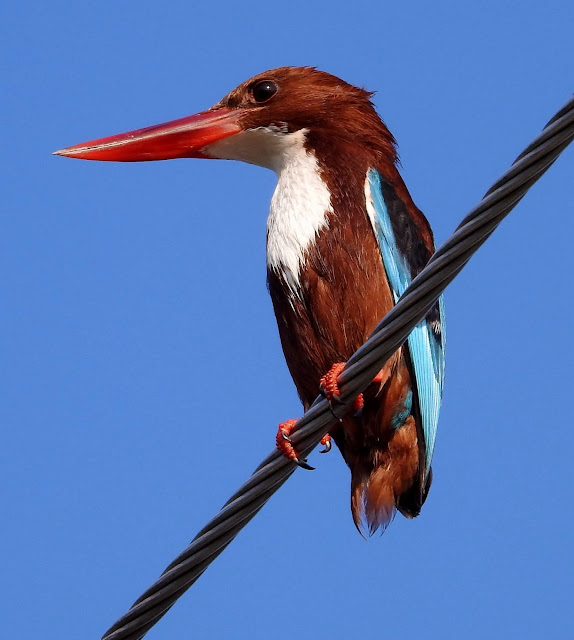
This kingfisher is adaptable and can be found in a variety of open habitats, from plains with trees and wires to urban areas. It is also seen at elevations up to 7500 feet in the Himalayas.
The White-throated Kingfisher has a wide distribution across Asia, from the Sinai in the west, through the Indian subcontinent, to China and Indonesia. It is a resident species over much of its range, with some populations making short-distance movements.
This kingfisher is known for its conspicuous perching on wires or other exposed perches within its territory. It is a common sight in South Asia and is known to be attracted to lights at night during the monsoon season, suggesting partial migratory behavior.
The diet is varied, including large crustaceans, insects, earthworms, rodents, lizards, snakes, fish, frogs, and occasionally small birds. It is noted for rarely drinking water but regularly bathing.
During the breeding season, the White-throated Kingfisher is vocal, with loud calls in the mornings from prominent perches. The male's courtship display includes stiffly flicking open wings to expose the white wing mirrors, while the female invites with a rapid kit-kit-kit call.
Breeding coincides with the onset of the Monsoons. The nest is a tunnel in an earth bank, and a clutch typically consists of 4-7 round white eggs. Incubation takes 20-22 days, and fledging occurs in 19 days.
The White-throated kingfisher (Halcyon smyrnensis) is a tree kingfisher, widely distributed in Asia. This kingfisher is a resident over much of its range and can often be found well away from water where it hunts a wide range of prey.
The adult White-throated kingfisher has a bright blue back, wings, and tail. Its head, shoulders, flanks, and lower belly are chestnut, and the throat and breast are white. The large bill and legs are bright red. The flight of the white-throated kingfisher is rapid and direct, the short rounded wings whirring. In flight, large white patches are visible on the blue and black wings. The male and the female are similar, but juveniles are a duller version of the adult.
White-throated kingfishers are found in Asia from the Sinai east through the Indian subcontinent to China and Indonesia. They are mainly resident over much of their range, although some populations may make short-distance movements. White-throated kingfishers live in a variety of habitats, mostly open country in the plains with trees, wires, or other perches; however, they have also been seen in the Himalayas. These birds also occur in tropical forests, mangrove edges, swamps, ponds, plantations, rice fields, and farmland.


