
Thursday, 18 November 2021
Wednesday, 17 November 2021


Tuesday, 16 November 2021

16-11-2021 MONTE CORONA, VALENCIA - CRAB SPIDER (Genus Bassaniodes)

Scientific Classification
Kingdom: Animalia (Animals)
Phylum: Arthropoda (Arthropods)
Class: Arachnida (Arachnids)
Order: Araneae (Spiders)
Family: Thomisidae (Crab spiders)
Genus: Bassaniodes (Pocock, 1903)
Physical CharacteristicsMembers of the Bassaniodes genus typically exhibit physical traits specialized for ground-dwelling and camouflage:
Appearance: They generally feature dull, textured bodies with combinations of dark brown, black, grey, or dark red-brown tones. Many species have mottled light or yellow spots that allow them to blend into soil, sand, and stones.
Legs: The first two pairs of legs are robust, distinctly long, and heavily armed with frontal spines, optimized for grabbing passing prey.
Sexual Dimorphism: Females are considerably larger than males. For example, a female Bassaniodes bufo can reach 10–12 mm in length, whereas the male usually measures only 4–5 mm.
Habitat & BehaviorUnlike well-known crab spiders that camouflage on colorful flowers, Bassaniodes species are primarily ground-dwellers.
Microhabitat: They are frequently discovered hiding beneath rocks, among stony debris, in leaf litter, or crawling over sand and short grass.
Hunting Strategy: They are ambush predators that do not build webs to catch food. Instead, they sit completely still and rely on their cryptic coloration to remain invisible until a target walks within striking distance.
Distribution & Notable SpeciesThe genus comprises around 39 recognized species widely spread across the Palearctic realm, Europe, North Africa, the Middle East, and parts of Asia.

16-11-2021 MONTE CORONA, VALENCIA - SPECKLED WOOD BUTTERFLY (Pararge aegeria)

The speckled wood (Pararge aegeria) is a butterfly found in and on the borders of woodland areas throughout much of the Palearctic realm. The species is subdivided into multiple subspecies, including Pararge aegeria aegeria, Pararge aegeria tircis, Pararge aegeria oblita, and Pararge aegeria insula. The color of this butterfly varies between subspecies. The existence of these subspecies is due to variation in morphology down a gradient corresponding to a geographic cline.
The background of the wings ranges from brown to orange, and the spots are either pale yellow, white, cream, or a tawny orange. The speckled wood feeds on a variety of grass species. The males of this species exhibit two types of mate locating behaviors: territorial defense and patrolling. The proportion of males exhibiting these two strategies changes based on ecological conditions. The monandrous female must choose which type of male can help her reproduce successfully. Her decision is heavily influenced by environmental conditions.


Monday, 15 November 2021
15-11-2021 MONTE CORONA, VALENCIA - CUTWORM MOTH (Cerastis faceta)
%2020.jpg)
The Cutworm Moth (Cerastis faceta) is a species of noctuid moth belonging to the family Noctuidae, first described by German entomologist Georg Friedrich Treitschke in 1835.
Key Characteristics & Biology
Appearance & Flight: Medium-sized (30–32 mm wingspan) with camouflaged gray-brown forewings. Adults fly early in the season, from February to April.
Larval Behavior: Nocturnal feeders on various low-growing plants that hide underground during the day.
Habitat & DistributionThis Mediterranean species is found across North Africa and Southern Europe, including regions such as Spain, Portugal, Italy, and various islands.


15-11-2021 MONTE CORONA, VALENCIA - SHIELDBACK KATYDID (Thyreonotus corsicus)

Thyreonotus corsicus is a species belonging to the family Tettigoniidae subfamily Tettigoniinae. It is found in the western Mediterranean from the Iberian Peninsula over the south of France to the southwestern Alps. Isolated populations are found in Corsica and Sardinia.
Shieldbacks have a substantial pronotum that looks like a shield.
They look like tiny armored tanks – rounded, plump, sturdy - but they are not as invulnerable as they appear and can be seriously injured if dropped. It might be a good idea to leave them where you find them (should you be fortunate enough to locate one) and simply watch what they do - including catching and eating other insects. I observed a Protean Shieldback about to grab and eat a male Japanese beetle that was in the process of mating!

They live in woodland edges and shrubby meadows, and their shades of brown blend very well with bark, shrub stems, and dry leaves. These katydids are generally nocturnal and are predators on smaller insects. Although I seldom see or hear them, they seem to mature in the beginning of July.
Their song is an electrical buzzing reminiscent of a humming wire. Although non-native, they mature earlier than our native meadow katydids and don’t seem to be a problem. Listen for them in grassy meadows from later June into July.

Habitat:
Thyreonotus corsicus inhabits most often areas with strongly developed vegetation (bushes, dwarf shrubs, grasses) like garigues, scrub, maquis or dry open woodland.
Life cycle:
The adults appear between late June/July and November. The adults often rest in elevated position in bushes such as Buxus or Juniperus.
Remarks:
Thyreonotus corsicus occurs in SW-Europe (Iberian Peninsula, S-France, Corsica and Sardinia).
15-11-2021 MONTE CORONA, VALENCIA - TOAD CRAB SPIDER (Bassaniodes bufo)
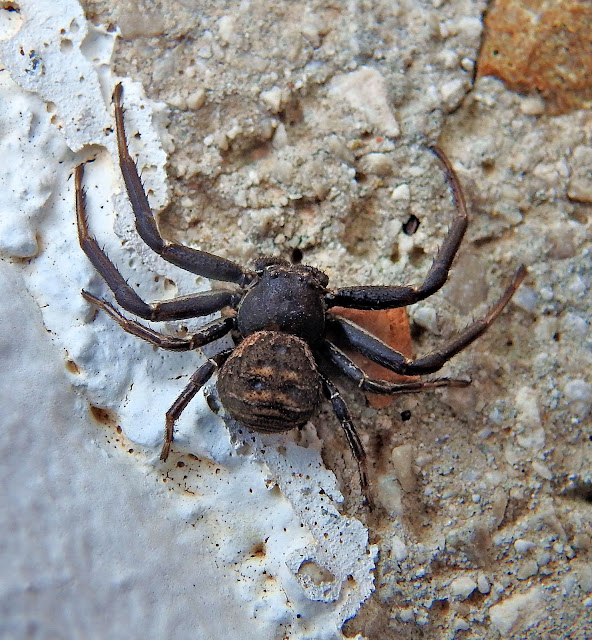
Bassaniodes bufo is a species of crab spider in the genus Bassaniodes , family Thomisidae . It was scientifically described by Dufour in 1820.
This species is found in the Mediterranean.
The toad crab, Hyas coarctatus, is a 'true crab' and therby has a heavily calcified, flattened carapace with a short abdomen folded up beneath it. The first appendages form large claws. It is a member of the spider crab family and has long, thin legs, and claws of the same length as the legs. Its stalked eyes are visible from above.
Hyas coarctatus can reach up to 61 mm in carapace length and is reddish-brown above and white underneath. It has longer claws than the giant spider crab, Hyas araneus, and the two forward-projecting horns on its head are slightly longer and further apart than those of the giant spider crab.

Found throught the British Isles but absent from the west coasts of Ireland.
The toad crab is a benthic species found on both hard and sandy bottoms from the intertidal region down to a depth of up to 50 m.
Spider crab is up to 61 mm in carapace length.
Cornea of the retracted eye is visible from above and not concealed under the orbit.
Post-orbital spine is flattened and expanded laterally.
Basal antenna segment is less than twice as long as it is wide.
Abdominal region is dilated laterally and, with the post-orbital region, forms a harp-shaped shelf.
Sunday, 14 November 2021


14-11-2021 LA FONT EN CARROS, VALENCIA - BLACK REDSTART (FEMALE) (Phoenicurus ochruros)
%20(Phoenicurus%20ochruros)%2020.jpg)
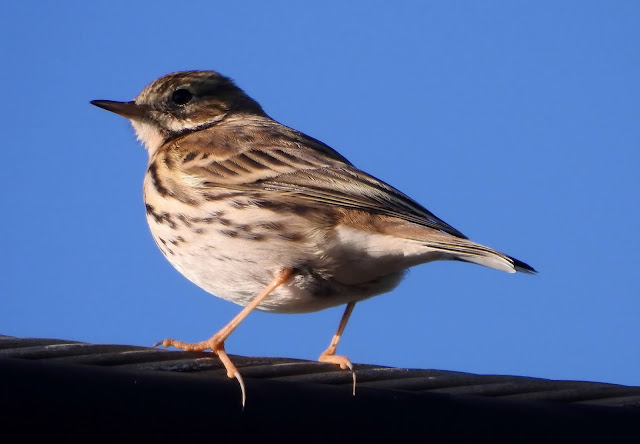
The Black Redstart (Phoenicurus ochruros) is a small, charismatic passerine bird, exhibiting a blend of dark and vibrant plumage. Males are distinguished by their dark grey to black upperparts and breast, with a striking orange-red rump and tail. Females and juveniles are more subdued in color, with grey to grey-brown feathers and the same vivid tail coloration that is the hallmark of the species.
Adult males are easily identified by their dark upperparts and black breast, contrasting with the orange-red lower rump and tail. The belly and undertail may vary from blackish-grey to orange-red, depending on the subspecies. Females and juveniles are less conspicuous, with overall greyer tones and a distinctive orange-red rump and tail. The presence of pale fringes on the secondaries forms a whitish wing panel in some subspecies.
The Black Redstart has adapted remarkably to urban environments, often found nesting in crevices or holes within buildings. Originally a dweller of stony mountainous regions, it now thrives in industrial areas with similar structural features.
This species is widely distributed across south and central Europe, Asia, and north-west Africa. It is a resident in milder regions, while populations in the northeast migrate to warmer areas during winter.
%20(Phoenicurus%20ochruros)%2021.jpg)
The Black Redstart is known for its robin-like movements, including quick ducks of the head and body, and frequent tail flicking. Males possess a rattling song and a tick call, adding to their distinctive presence.
The Black Redstart's vocal repertoire includes a variety of calls, which differ among subspecies. The male's song is a rattling melody, while its call is a sharp 'tick', often heard during its active foraging.
Typically monogamous, the Black Redstart begins breeding in mid-April. Nests are built by females in sheltered nooks, lined with soft materials. Clutches consist of 4 to 6 eggs, incubated primarily by the female. Both parents tend to the fledglings, which leave the nest after 12 to 19 days.
The Common Redstart shares some similarities but can be distinguished by its different behavior, ecological requirements, and less dark plumage.
The Black Redstart's diet includes insects, which it often catches mid-flight. It is also known to forage in coastal areas for tiny crustaceans and flies.
The IUCN Red List classifies the Black Redstart as Least Concern, indicating a stable population across its extensive range.
14-11-2021 GANDIA, VALENCIA - EURASIAN COLLARED DOVE (Streptopelia decaocto)

The Eurasian collared dove, also known as the collared dove or Turkish dove (Streptopelia decaocto), is a bird of modest size, presenting a grey-buff to pinkish-grey plumage that is slightly darker above than below. It is recognized by its distinctive black half-collar edged with white on its nape, from which it derives its name. The species exhibits a blue-grey underwing patch and a tail that is grey-buff above, with dark grey and white-tipped feathers below. The sexes appear similar, with juveniles displaying a less developed collar and a brown iris.
To identify the Eurasian collared dove, look for its medium size, slimmer and longer-tailed body compared to a rock pigeon, and a shorter stature than the wood pigeon. The red legs, black bill, and red iris surrounded by a small area of bare skin, which may appear white or yellow, are key features. The bird's song, a three-part cooing "goo-GOO-goo," and a harsh screeching call are also distinctive identifiers.

This species is often found in proximity to human habitation, particularly where food is plentiful and trees are available for nesting. It is not uncommon to see these doves frequenting bird tables and farms.
Originally from warm temperate and subtropical Asia, the Eurasian collared dove has expanded its range dramatically, colonizing colder countries and becoming a permanent resident in many. Its range now includes Europe, North America, and the Caribbean.


Saturday, 13 November 2021
13-11-2021 MONTE CORONA, VALENCIA - CUTWORM MOTH (Cerastis faceta)
%2020.jpg)
The Cutworm Moth (Cerastis faceta) is a species of noctuid moth belonging to the family Noctuidae, first described by German entomologist Georg Friedrich Treitschke in 1835.
Key Characteristics & Biology
Appearance & Flight: Medium-sized (30–32 mm wingspan) with camouflaged gray-brown forewings. Adults fly early in the season, from February to April.
Larval Behavior: Nocturnal feeders on various low-growing plants that hide underground during the day.
Habitat & DistributionThis Mediterranean species is found across North Africa and Southern Europe, including regions such as Spain, Portugal, Italy, and various islands.
Subscribe to:
Posts (Atom)